

How this page has changed
July 26, 2026
Sources, internal links and safety or product context reviewed.
In this guide
- 01Quick decision
- 02Current yoga strap specifications
- 03Choose length by usable loop, not height alone
- 04D-rings, sliding buckles and fixed loops
- 05Cotton, hemp and synthetic webbing
- 06Width and edge construction
- 07What quality looks like before use
- 08Practice strap versus mat carrier
- 09Yoga strap versus resistance band
- 10Care without guessing
- 11When an alternative is enough
- 12Buying checklist
- 13How this guide was researched
A yoga strap is a non-elastic length of woven webbing used as a practice prop. The buying decision is mostly mechanical: choose enough usable length, a closure you can operate and inspect, a comfortable width, webbing that does not behave like an elastic resistance band, and care instructions you can realistically follow.
For most first purchases, an 8-foot cotton strap with metal D-rings or a sliding-bar buckle is the least restrictive format. Six feet packs smaller but leaves less tail after you form a loop. Ten feet is useful only when the intended setup needs a large circumference or additional reach. A multi-loop strap is easier to grab at repeatable intervals but is not continuously adjustable in the same way.
This is a source-checked equipment guide, not hands-on testing, pose instruction or medical advice. We compare published construction and care information from current products; we do not infer comfort, strength or safety from marketing language.
Quick decision
| If this describes the purchase | Start with | Check before buying |
|---|---|---|
| One versatile home or studio strap | 8 ft cotton, D-ring or sliding buckle | Finished width, care label, reinforced hardware stitching |
| Compact prop for simple reach work | 6 ft non-elastic strap | Whether enough tail remains after your largest intended loop |
| Large loop or extra reach | 10 ft strap | Excess webbing management and storage |
| You dislike threading a buckle | Multi-loop strap | Loop spacing, total length and reinforced seams |
| You need rapid opening | Purpose-built quick-release strap | Buckle condition and maker instructions |
| You only need to carry a rolled mat | Dedicated two-loop carrier | Read the mat-strap setup guide instead |
Do not choose from color or the headline length alone. A buckle consumes part of the stated length, and a loop uses circumference before any tail reaches your hands. The useful question is not “am I tall?” but “how much webbing remains in the exact configuration I plan to use?”
Current yoga strap specifications
These examples show how products sold under the same name differ. They are not a performance ranking.
| Current product | Published length | Width | Webbing | Closure | Published care |
|---|---|---|---|---|---|
| Hugger Mugger D-Ring Cotton | 6, 8 or 10 ft | 1.5 in | Cotton | Metal D-rings | Hand wash; hang dry |
| Manduka AligN | 6, 8 or 10 ft | 1.75 in on published 8/10 ft specs | Unbleached cotton | Zinc-alloy interlock buckle | Hand wash; hang dry |
| Yogamatters Organic Cotton Wide Belt | 250 cm | 4.2 cm in details | Organic cotton | Metal sliding-bar buckle | Soft brush; lukewarm soapy water |
| JadeYoga Yoga Strap | 8 ft | Not published | Cotton | Nickel-finished D-ring | Not published on current page |
| Gaiam Yoga Strap | 6 ft | 1.5 in | 70% polyester, 30% cotton | Two metal D-rings | Machine wash cold; dry flat |
| Lotuscrafts Organic Cotton Strap | 250 cm | 3.8 cm | Organic cotton | Metal D-rings | Product-specific instructions apply |
Published values are manufacturer claims, not our measurements. Specifications can vary by color, length and market, so check the exact variant rather than assuming every strap under a product name is identical.
Choose length by usable loop, not height alone
Six, eight and ten feet are common US sizes. European listings often use 2.5 metres, about 8.2 feet. Manufacturer guides frequently map lengths to practitioner height, but height is only a proxy. Limb proportions, the intended loop circumference, buckle design and required free tail all change the result.
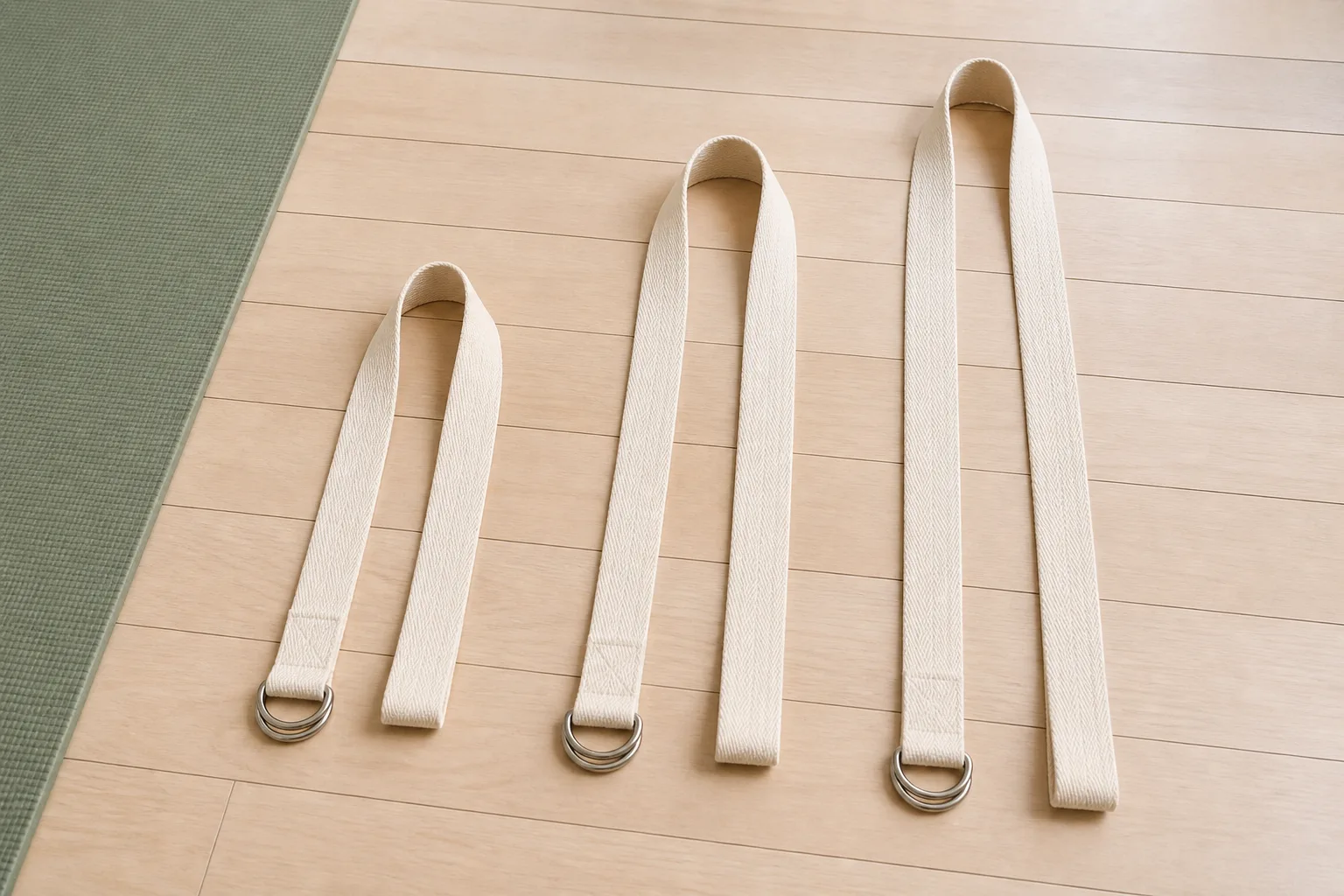
Six feet
A 6-foot strap is compact and creates less loose tail. Current examples include the 6-foot Gaiam and the shortest variants from Manduka and Hugger Mugger. It can be entirely sufficient for a simple connection between hands or between a hand and foot.
The limitation appears when the strap must form a large loop. Once webbing circles a broad shape, the remaining ends can become too short to hold without reaching. Buying a short strap because it is called “standard” is therefore less reliable than measuring the intended path.
Eight feet
Eight feet is the practical default because the extra two feet preserve options. It covers modest loops without immediately running out of tail, yet it still rolls into a small bundle. Manduka, Hugger Mugger and JadeYoga all publish an 8-foot option or format.
Longer does not automatically mean better. Loose webbing can trail, twist or become awkward to gather. If every planned use is simple and you already know six feet works, the extra length has no inherent performance benefit.
Ten feet
Ten feet is a specialist choice for genuinely large loops, unusually long reach requirements or a specific class setup. Manduka and Hugger Mugger both offer this length. It should be chosen because a measured configuration needs it, not as an automatic premium upgrade.
More length adds a little mass and more tail to control. Hugger Mugger publishes weights of 0.32 lb, 0.41 lb and 0.47 lb for its 6-, 8- and 10-foot cotton D-ring variants. Those differences are small in a gear cupboard but more noticeable when packing multiple props.
A simple sizing check
Use a soft tape measure or non-stretch cord to trace the largest loop or connection path you expect to use. Add enough free length for the buckle path and two relaxed handholds. Do not pull the tape tight around the body. If the result sits near one size limit, move to the next length rather than relying on a short tail.
This is a purchase check, not a prescription for any pose. A teacher or the class instructions should define the actual setup.
D-rings, sliding buckles and fixed loops
The closure determines how a strap forms a loop, how continuously its size can change and which parts require inspection. No design is universally safest; a closure works only when it is intact, correctly threaded and used within its maker’s instructions.
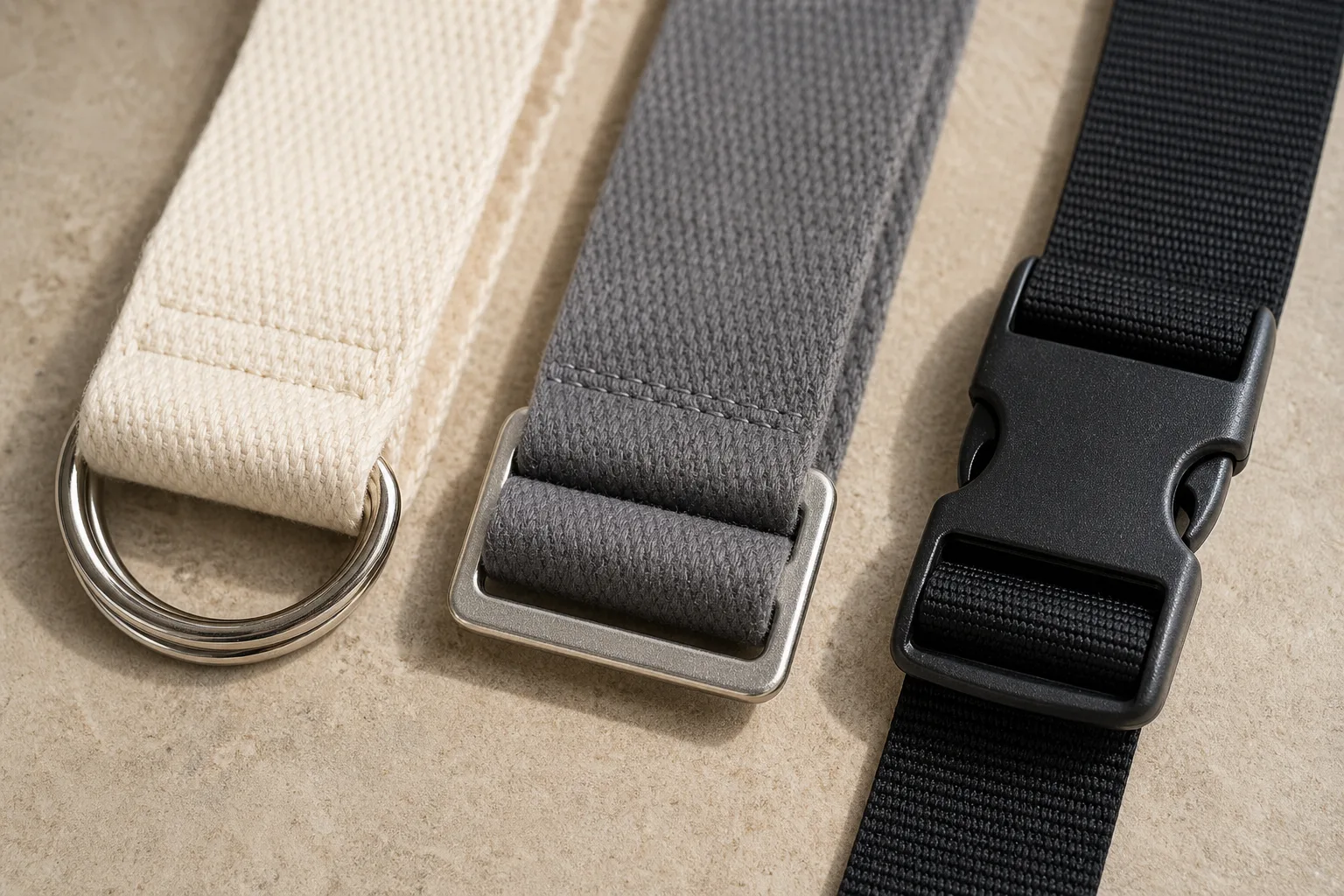
D-ring strap
Two metal rings are sewn to one end. The free end passes through both rings, reverses direction and returns through one ring. Tension pinches the webbing between them. The loop is continuously adjustable, the mechanism has no moving hinge, and the load-bearing seam remains visible.
The trade-off is threading. Passing the tail straight through both rings does not create the same lock. The rings can also contact the body or floor if positioned poorly. Check that both rings are smooth, closed and firmly captured by reinforced stitching.
Sliding-bar or interlock buckle
A rectangular metal buckle routes the webbing around one or more bars. Yogamatters describes an Iyengar-style metal sliding-bar buckle; Manduka publishes a zinc-alloy interlock design with a middle bar. These are related formats, not necessarily identical threading paths.
The buckle can sit flatter than paired rings and may hold with a shorter hardware stack. Its exact route is product-specific. Follow the diagram supplied with the strap rather than copying the path from a different brand.
Quick-release buckle
A molded or metal release mechanism prioritizes fast opening. That can be convenient when a long loop must be removed without feeding the entire tail through hardware. It also adds moving or flexing parts that need inspection for cracks, deformation and positive engagement.
Do not treat a familiar backpack-style buckle as proof of suitability. The complete strap must be sold for the intended practice use, and its buckle must close fully without webbing trapped in the mechanism.
Multi-loop strap
Repeated sewn loops give the hands fixed locations without threading hardware. This can make grip positions easy to repeat and removes loose metal from one end. The compromise is discrete adjustment: available hand positions depend on loop spacing, and every divider is another load-bearing seam.
Inspect all loop stitching, not just the ends. A multi-loop stretch strap may also contain elastic, so confirm that it is intended as a yoga strap when a class expects non-elastic webbing.
Cotton, hemp and synthetic webbing
Material affects texture, water response, care and edge feel. It does not by itself establish load capacity or quality. Construction, weave density, seam design and hardware attachment matter at least as much.
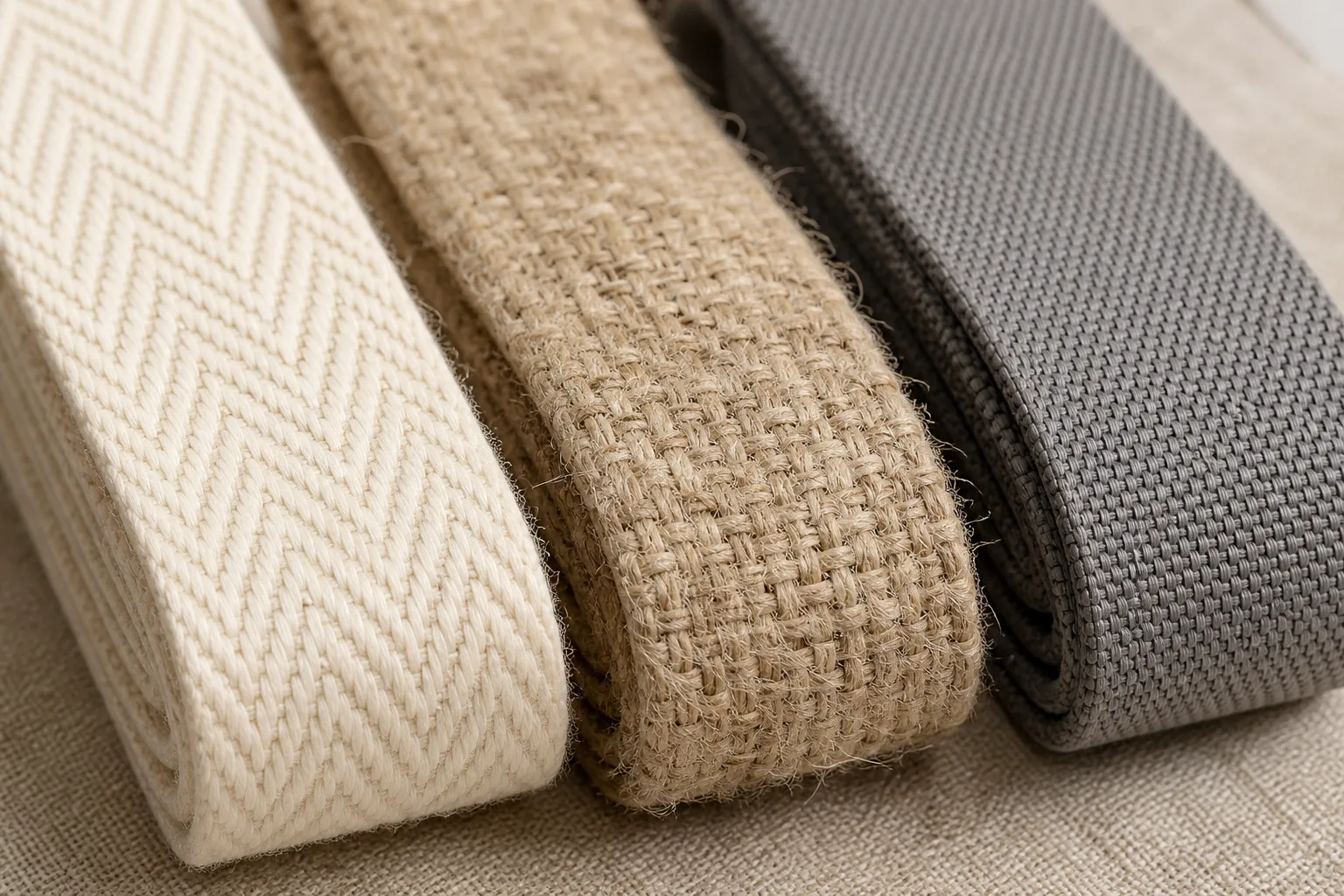
Cotton
Cotton dominates current traditional straps. Hugger Mugger, Manduka, Yogamatters, JadeYoga and Lotuscrafts publish cotton constructions. It creates a familiar woven hand feel and accepts metal hardware well. Organic-cotton claims should be attached to the exact product, not extended to every cotton strap from a brand.
Cotton absorbs moisture and its care varies. One maker says hand wash and hang dry; another recommends surface cleaning. Read the label before soaking hardware or putting a strap in a machine.
Blended or synthetic webbing
Gaiam’s current 6-foot page specifies 70% polyester and 30% cotton, while allowing a cold machine wash and flat drying. That illustrates why appearance is not a reliable fiber test: woven webbing can look cotton-like while being mostly polyester.
Synthetic fibers can create dense, abrasion-resistant webbing and lower water uptake, but “synthetic” does not guarantee machine washability. Heat, detergent and the attached closure remain limiting factors.
Hemp and other plant fibers
Hemp straps appear in the market, usually with a textured natural-fiber story. Treat “hemp,” “natural” and “eco-friendly” as separate claims. Ask for actual fiber percentage, certification where relevant, country of manufacture and care instruction. A natural fiber does not automatically prove lower lifecycle impact or better durability.
Width and edge construction
Current examples cluster around 1.5 to 1.75 inches wide: Gaiam and Hugger Mugger publish 1.5 inches, Lotuscrafts 3.8 cm, Yogamatters 4.2 cm in its details, and Manduka 1.75 inches for published variants. A wider strap spreads contact across more area, while a narrow strap packs smaller and can pass through tighter spaces.
Width must be read with thickness and stiffness. A broad, thin tape can still fold into a narrow edge under tension; a dense weave may remain flatter. Look for a smooth finished edge, even weave, straight stitching and no hard melted ridge where the hands hold.
If hand comfort drives the purchase, do not assume padding is the answer. Padding can bulk up a loop and obscure wear. A wide, supple, non-elastic webbing with clean edges is the simpler starting point.
What quality looks like before use
A product page may publish a tensile-strength claim, but that number does not certify the complete system in every practice configuration. Hugger Mugger currently states that its cotton webbing is rated to 400 lb tensile strength. That is a webbing specification from the maker—not our independent load test, not a working-load limit, and not permission to suspend body weight.
Inspect the parts you can verify:
- webbing lies flat without cuts, pulled yarns, glazing or severe abrasion;
- both edges are evenly finished along the full length;
- hardware has no sharp burr, crack, open gap or deformation;
- the attachment uses intact, dense stitching with no loose thread path;
- the free end cannot accidentally disappear into the buckle;
- a correctly threaded loop stays the same size during a gentle, stationary hand check;
- the care label and maker instructions are available for the exact model.
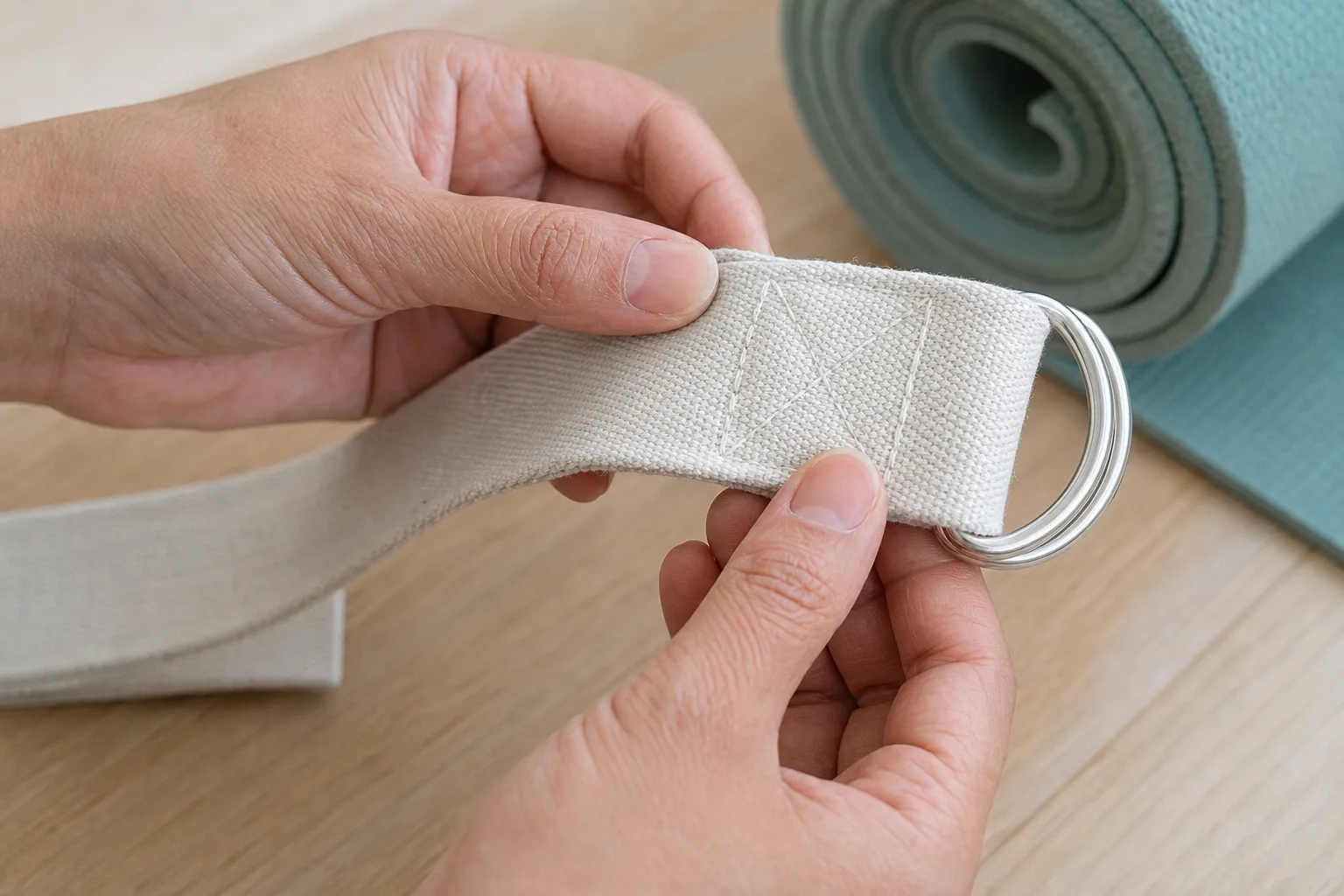
Retire the strap when damage changes that load path. Do not repair a torn hardware seam with a household knot and assume the original performance remains. A strap is inexpensive relative to the uncertainty created by a hidden or improvised repair.
Practice strap versus mat carrier
Search results often mix two products:
| Practice strap | Mat carrier strap |
|---|---|
| Creates or preserves distance during practice | Secures a rolled mat for transport |
| Usually one long strip with one closure or repeated loops | Usually two adjustable end loops plus a shoulder section |
| Selected by usable length, width and closure | Selected by roll diameter, mat weight and loop security |
| Normally non-elastic | May use cinch loops or a cradle construction |
| Not automatically approved to carry a mat | Not automatically approved as a practice prop |
Some designs are convertible, but that capability must come from their construction and instructions. Do not infer it because both products contain webbing. If transport is the goal, our guide to using a yoga mat strap covers the carrier setups without competing with this buying intent.
Yoga strap versus resistance band
A conventional yoga strap is deliberately non-elastic. It sets a distance. A resistance band deliberately elongates and produces increasing force. A looped stretching strap can sit between those categories depending on material.
Read the product name and composition carefully. “Stretch strap” can describe either a non-elastic mobility aid or an elastic training band. If a class asks for a yoga belt, bring non-elastic webbing unless the teacher specifies otherwise. Never substitute an elastic product in a setup designed around a fixed length.
The same discipline applies elsewhere in a prop kit. A yoga block changes height, a bolster distributes support across a broad area, and a strap preserves distance. Similar marketing language does not make the tools interchangeable.
If the strap is packaged with a matching block pair, use the yoga block and strap set checklist to verify quantity, block dimensions, strap length, buckle construction and genuine bundle value.
Care without guessing
There is no universal washing method. Current official instructions conflict because constructions differ:
- Hugger Mugger: hand wash and hang dry its cotton D-ring strap.
- Manduka: hand wash only and hang dry the AligN.
- Gaiam: machine wash cold and dry flat for its 6-foot polyester-cotton D-ring model.
- Yogamatters: use a soft brush and lukewarm soapy water on its organic cotton wide belt.
Follow the sewn label when it differs from an online summary. Close or contain hardware only if machine washing is explicitly allowed; metal parts can strike a drum, and quick-release components can catch. Avoid bleach, dryers and high heat unless the maker permits them.
After cleaning, open the strap fully and let every layer dry before rolling it. Inspect the buckle seam, webbing edges and closure again. Store it loose and dry, away from direct heat and prolonged sunlight. Do not leave a damp cotton strap cinched around other equipment.
When an alternative is enough
You may not need to buy a strap immediately. A non-elastic household belt can demonstrate whether extra reach is useful, provided it is intact, wide enough to hold comfortably and has no sharp buckle in the contact area. A towel is softer but tends to bunch and provides no adjustable lock. Neither substitute inherits the claims or instructions of a purpose-built product.
Do not use bungee cord, thin rope, luggage elastic, a damaged dog lead or an unknown resistance band. The issue is unpredictable stretch, narrow pressure, unsuitable hardware or an unknown load path.
If a class repeatedly uses a strap, a basic purpose-built cotton model is easier to inspect, size and clean than an improvised object. Pair it with only the props the class calls for. Our beginner yoga guide starts with function rather than a shopping list.
Buying checklist
Before ordering, confirm:
- Category: non-elastic practice strap, not only a mat carrier or resistance band.
- Usable length: enough for the largest intended loop plus buckle path and handholds.
- Closure: D-rings, sliding bar, quick release or fixed loops you understand.
- Width: broad enough to hold without folding into a hard edge.
- Webbing: actual fiber composition, dense weave and finished edges.
- Seams: reinforced, visible and straight at every load-bearing junction.
- Hardware: smooth, closed and free from burrs or cracks.
- Care: specific instructions for that model and variant.
- Claims: no reliance on an unexplained tensile number or therapeutic promise.
- Return terms: enough time to inspect length and construction before use.
Our practical default is an 8-foot cotton strap with inspectable metal hardware. Choose six feet because you measured a simple use and value compactness; choose ten feet because the intended loop actually needs it. Color, trend language and oversized strength claims are secondary to usable length and a clear load path.
Check price on AmazonHow this guide was researched
We compared current official product pages from Manduka, Hugger Mugger, Yogamatters, Gaiam, JadeYoga and Lotuscrafts. We recorded only published length, width, fiber, closure, weight and care data, and kept variant-specific omissions visible. We did not personally test grip, comfort, tensile strength or longevity, and we do not convert manufacturer marketing into firsthand conclusions.
The page owns practice-strap selection. It deliberately excludes pose sequences, flexibility programs and mat-carry instructions. That boundary keeps the topic useful without unsupported instructional or therapeutic claims—and keeps it distinct from the existing mat-carrier URL.
Frequently asked questions
What length yoga strap should I buy?
An 8-foot strap is the most forgiving general-purpose starting point because it leaves more usable tail after a loop is formed. A 6-foot strap is more compact but may limit large loops, while a 10-foot strap suits setups that genuinely need more circumference. Test the intended loop with a tape measure instead of choosing from height alone.
Is a yoga strap supposed to stretch?
A conventional yoga practice strap is non-elastic woven webbing. Its job is to preserve a chosen distance and provide a stable extension of reach. Resistance bands and elastic stretching straps are different tools and should not be substituted when instructions specify a non-elastic yoga strap.
Are D-rings or a buckle better on a yoga strap?
D-rings are simple, continuously adjustable and easy to inspect. A sliding-bar buckle can create a compact, flat lock, while a quick-release buckle opens faster but adds a molded component. The better choice is the closure you can thread correctly and that stays fixed during a low-load check.
Is a yoga strap the same as a yoga mat strap?
No. A practice strap is a non-elastic prop used to create or preserve distance. A mat carrier is designed to secure a rolled mat, commonly with two end loops. Some long practice straps can be converted for carrying, but only when the manufacturer permits it and the setup forms two secure loops.
Can I wash a yoga strap?
Only according to its own care label. Current official instructions differ: Hugger Mugger and Manduka specify hand washing and hang drying, Gaiam specifies cold machine washing and flat drying for one blend, and Yogamatters recommends a soft brush with lukewarm soapy water.