

How this page has changed
July 26, 2026
Sources, internal links and safety or product context reviewed.
In this guide
- 01Yoga block and strap sets at a glance
- 02First, verify exactly what “set” means
- 03Compare the two blocks as a matched pair
- 04Audit the strap as its own product
- 05Does every component belong together?
- 06Calculate genuine bundle value
- 07Delivery-day inspection checklist
- 08Care for a mixed-material set
- 09Plan storage before choosing the bundle
- 10Red flags in yoga prop bundle listings
- 11A practical buying sequence
A yoga block and strap set is only a bargain when all of its parts are the right specification. The most useful starter format contains two matching blocks and one adjustable strap. Yet “set” is not a standardized quantity: a product title, hero photo and package-details field can each suggest something different.
Start with the written contents. Then compare every block by length × width × thickness, identify its material, and read the strap’s usable length, width, fiber and buckle type. Treat the bundle as three products sharing one checkout button—not as a single generic accessory.
This guide owns that bundle decision: item count, component compatibility, specifications, delivery inspection, storage and value. Our best yoga blocks guide owns block materials and individual picks; the yoga block size guide goes deeper on block geometry; and the yoga strap guide compares standalone strap formats. This page does not teach poses or prescribe how a prop should be used on a body.
Yoga block and strap sets at a glance
| Decision | Strong listing | Weak listing | Why it matters |
|---|---|---|---|
| Contents | States “2 blocks + 1 strap” in written specifications | Says “set” and relies on a photo | Images may show props that are not included |
| Block size | Gives three dimensions for each block | Uses only small, standard or large | Thickness and face area cannot be inferred reliably |
| Block material | Names EVA foam, cork, wood or another exact material | Says eco, premium or high density only | Material affects weight, texture, care and durability |
| Strap specification | Gives usable length, width, fiber and closure | Says adjustable strap | Adjustment range and hardware remain unknown |
| Pair consistency | Confirms matched blocks | Lists a block quantity without tolerances | Uneven blocks can signal a picking or manufacturing issue |
| Value | Makes like-for-like comparison possible | Promotes a discount without component detail | A lower-spec bundle can cost less for the wrong reason |
First, verify exactly what “set” means
The minimum useful check is not the product name. It is a written inventory:
- number of blocks;
- number of straps;
- whether a bag, mat or other pictured item is included;
- whether color or material selection changes the contents; and
- whether the specifications describe one component or the packed carton.
Current listings illustrate the problem. Ananday describes a two-block-and-strap bundle. Warrior Addict likewise specifies two cork blocks and a D-ring strap. Academy’s Freely listing states two recycled-EVA blocks plus a cotton-and-steel strap. Elsewhere in search results, visually similar listings use one block and one strap or add a mat. The noun “set” does not resolve the count.
Check the order summary after selecting a variant. A thumbnail can remain unchanged while a selector switches quantity, material or color. Save the listing or confirmation email until the products arrive. When the title says “blocks” but the specifications say “one piece,” ask the retailer before paying rather than choosing the interpretation you prefer.
Product dimensions are not package dimensions
Marketplaces often place shipping-box measurements close to product measurements. A long carton number may belong to the package, not the strap; a thick carton measurement may represent two stacked blocks, not one block. Look for labels such as “item dimensions,” “each block,” “strap length” and “package dimensions.”
If the page publishes only package measurements, the component fit is still unknown. Request the missing specifications. Do not divide a carton dimension by two and assume the result is the thickness of each block: packaging, orientation and protective material invalidate that shortcut.
Compare the two blocks as a matched pair
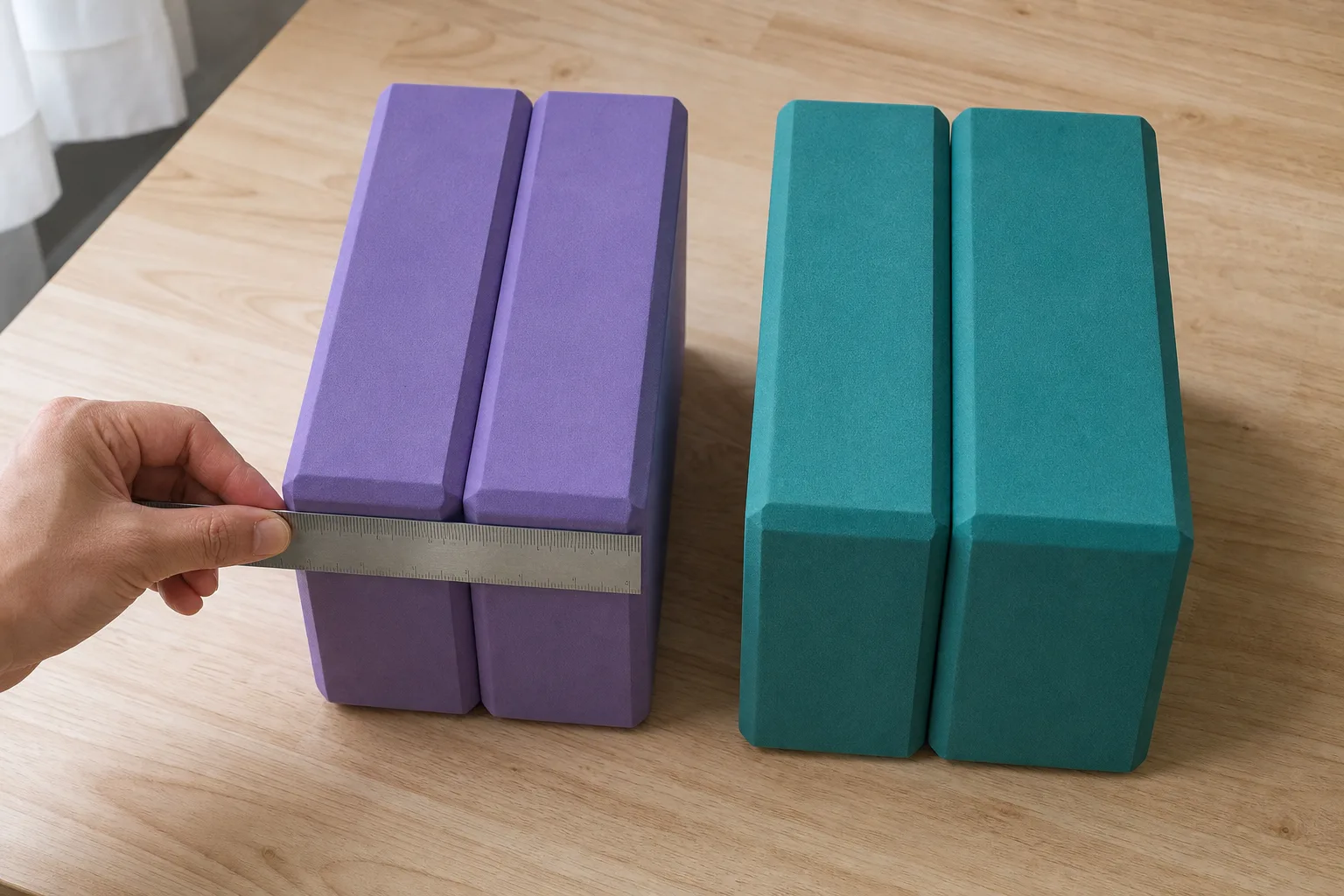
Two blocks are not automatically a matched pair because their colors agree. They should share the same nominal dimensions, material, surface finish, edge profile and firmness. Manufacturers may sell mixed-color pairs, but the functional specifications should still match unless the listing clearly describes a mixed-format kit.
Record all three block dimensions
A conventional rectangular block is described as length × width × thickness. Current bundles commonly use blocks around 9 × 6 × 3 inches or 9 × 6 × 4 inches, but dimensions vary. Everyday Yoga’s current kit description, for example, identifies a 4-inch foam block and an 8-foot strap. That is a useful specification, not a universal standard.
| Block format | What changes in the bundle | What to verify |
|---|---|---|
| 3-inch thickness | Narrower cross-section and lower stored volume | Exact face dimensions; both blocks identical |
| 4-inch thickness | Broader face and more storage volume | Whether “4-inch” is actual thickness or category wording |
| Compact or mini | Shorter and/or narrower than conventional formats | All three measurements; do not infer from photography |
| Oversized | One or more dimensions exceed common formats | Pair weight, shelf fit and return cost |
Our separate block size guide includes metric conversions and a fuller format comparison. For a set, the extra concern is consistency: measure both blocks on receipt using the same ruler and orientation.
Read material literally
Foam and cork dominate current set results. Academy specifies recycled EVA for its blocks; Everyday Yoga describes foam; Warrior Addict sells a cork pair. These are material categories, not automatic quality grades.
For foam, look for a named polymer where available, published density or weight, surface texture and edge construction. “High density” without a number is a maker’s relative claim. For cork, check whether the block is solid agglomerated cork or another construction, and inspect for crumbling, large voids or lifting surface layers. A wood-look color or printed grain is not wooden construction.
Avoid treating broad environmental words as composition. “Natural,” “eco,” “sustainable” and “recycled” require separate evidence. A recycled-content claim should state what component contains recycled material and, ideally, the proportion or certification behind it.
Weight reveals hidden trade-offs
The listing may publish weight per block, combined product weight or shipping weight. Those numbers are not interchangeable. Multiply a clearly stated per-block weight by two, add the strap weight, and compare the result with any total product weight. A large discrepancy deserves clarification.
Weight matters for carrying and storage, but it can also help catch a specification error. A pair described as cork that weighs dramatically less than otherwise comparable cork blocks may use different dimensions or construction. It is a reason to investigate, not proof that the listing is wrong.
Audit the strap as its own product
The strap should not be the anonymous free item in the bundle. Confirm four fields: usable length, width, webbing material and closure. Six-foot and eight-foot straps both appear in current bundles. Longer is not automatically better; it creates more tail to store and manage.
| Strap field | Useful specification | Ambiguity to avoid |
|---|---|---|
| Length | Finished or usable length in feet/inches or centimeters | “Long” with no measurement |
| Width | Actual webbing width | “Wide” or “comfortable” only |
| Fiber | Cotton, polyester or stated blend | “Fabric” or “premium material” |
| Closure | Two D-rings, cinch buckle, quick release or another named system | “Adjustable buckle” |
| Hardware material | Steel, zinc alloy or another disclosed material | “Metal” with no further detail |
| End construction | Hemmed or finished tail and reinforced hardware loop | Cropped photos hiding both ends |
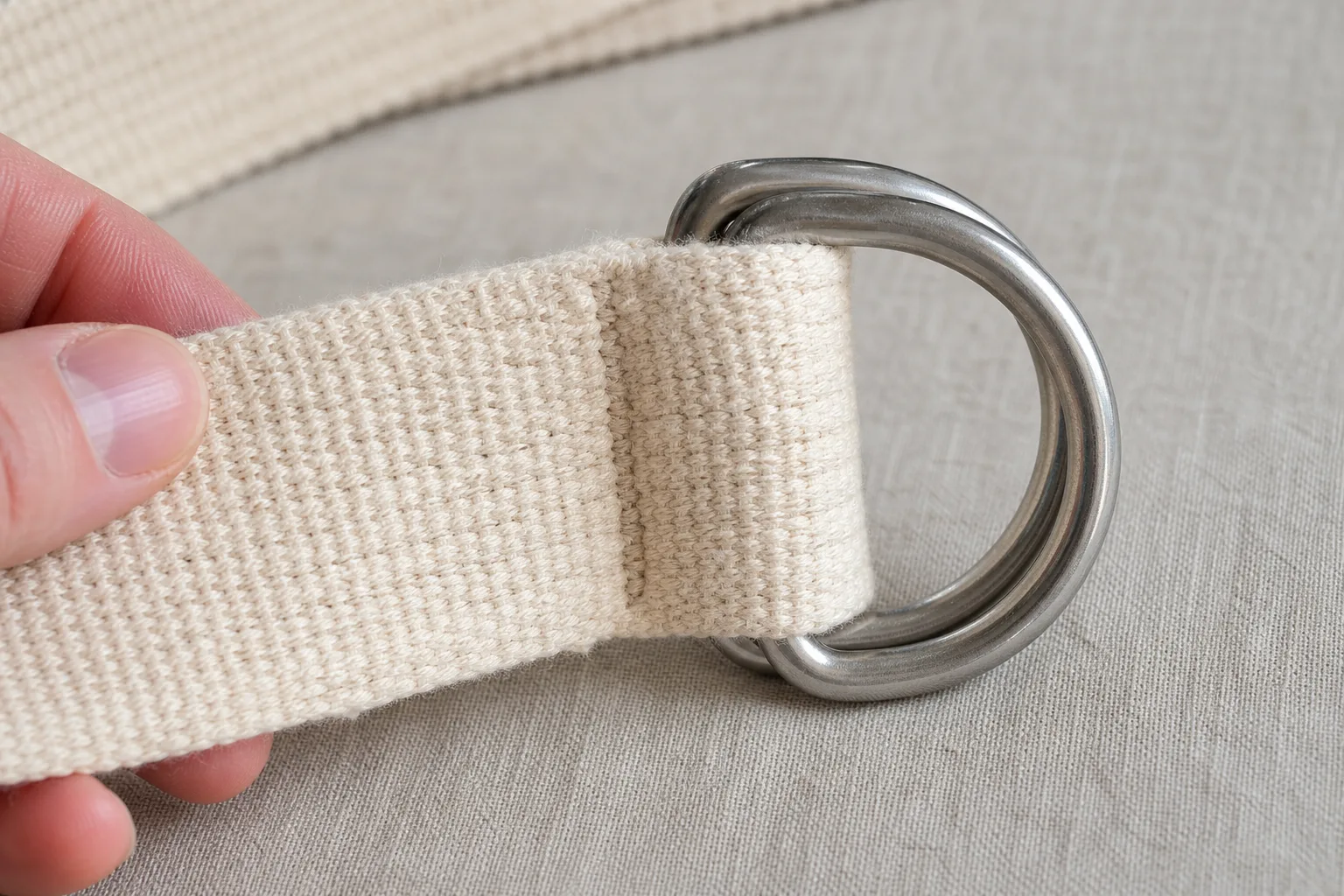
D-ring hardware needs two separate rings
A D-ring closure normally uses two rings held in a reinforced loop. Product photography should show separate rings, smooth edges and secure stitching. Check that the webbing passes between the rings without sharp hardware edges abrading it. Surface scratches can be cosmetic; burrs, cracks, open seams or distorted rings are more consequential defects.
The Academy listing identifies cotton and steel in its bundled strap, while Warrior Addict identifies a D-ring format. Those facts are more decision-useful than color. Even so, they do not replace an actual length and width. A listing must provide both material and geometry to be complete.
Webbing and stitching inspection
Unroll the entire strap in good light. Look for cuts, pulled yarns, abrupt width changes, stains and twisted stitching. At the hardware end, the folded webbing should lie flat and the reinforcement should remain inside the strap edges. At the free end, check that the cut edge is finished rather than actively unraveling.
Thread and unthread the buckle over a table without loading it. The tail should move through the hardware without snagging. This is a product-function check, not an instruction for applying the strap to the body.
Does every component belong together?
A coordinated bundle should make sense beyond color. Use a simple compatibility sheet before buying:
| Component | Listing claim | Your measured requirement | Confirmed? |
|---|---|---|---|
| Block 1 and 2 | Quantity and L × W × T | Storage shelf and preferred hand fit | Yes / no |
| Block material | Exact foam, cork or wood construction | Weight, texture and care preference | Yes / no |
| Strap | Length × width | Storage and handling preference | Yes / no |
| Closure | Hardware type and material | Adjustment and maintenance preference | Yes / no |
| Whole set | Combined or component weights | Bag, shelf and transport limit | Yes / no |
Color matching is optional. Dimensional matching is not. If a retailer permits mixed colors, verify that both selected variants keep the same dimensions and material. Product families sometimes reuse a color name across a compact block and a conventional block.
Calculate genuine bundle value
Ignore the crossed-out reference price until you can reproduce it. Use this comparison:
separate total = two matching blocks + one equivalent strap + separate-order shipping
Then compare that live total with the bundle’s live checkout total, including taxes where applicable. Use the same material, dimensions, strap length, buckle and return terms. Comparing a two-cork-block kit with two compact foam blocks purchased separately proves nothing.
A bundle can still be the better purchase without a nominal discount. One shipment may reduce handling, a coordinated return may be simpler, and the exact matching pair may be unavailable separately. Conversely, a discount is poor value when the included strap is too short, when the bundle has only one block, or when a weak return policy makes defects expensive.
Score specifications before style
Assign one point for each field the listing states clearly:
- exact component quantity;
- three dimensions per block;
- exact block material;
- weight per block or clearly labeled pair weight;
- strap usable length and width;
- strap fiber and buckle type;
- care instructions for both materials;
- return window and defect process.
This is not a universal product rating. It is a disclosure check. A high score says the purchase can be evaluated; it does not guarantee manufacturing quality. A low score tells you how many assumptions are hiding behind the bundle photo.
Delivery-day inspection checklist
Inspect before removing tags or discarding packaging.
- Count everything. Confirm two blocks and one strap, or the exact alternate inventory promised.
- Match the order. Compare color, material, dimensions and closure with the confirmation.
- Measure both blocks. Use the same faces and light pressure; note any meaningful mismatch.
- Compare surfaces. Look for gouges, tears, crumbling, delamination, strong discoloration or contamination.
- Check stability on a flat table. Each block should rest without obvious rocking caused by a warped face.
- Unroll the strap. Inspect the full webbing length, both ends, reinforcement stitching and hardware.
- Document discrepancies. Photograph the shipping label, packaging, complete contents and close defects.
- Use the stated return route. Keep the set clean and unmodified while the retailer assesses it.
Minor foam molding lines and natural cork color variation can be normal. The relevant question is whether the delivered object matches the listing and is intact. Do not try to repair separated foam, cracked hardware or failing structural stitching before contacting the seller; alteration can complicate a return.
Care for a mixed-material set
Never apply one cleaning method indiscriminately to foam, cork, cotton and metal.
For blocks, follow the maker’s material-specific instructions. Use minimal moisture unless immersion is explicitly permitted, avoid prolonged direct sun or high heat, and let surfaces dry fully before stacking. Cork is porous; foam formulas vary; wood requires an intact finish and its own care routine.
For a textile strap, first check whether machine washing is permitted and whether hardware requires protection. Close or contain metal rings so they do not strike a washer drum. Avoid bleach or high heat unless the label allows it. Dry completely before rolling, because a tight roll slows evaporation.
Clean products separately when dye transfer is possible. A dark new strap pressed against a damp pale block can stain it. Product-care directions override generic advice because fibers, dyes, adhesives and finishes differ.
Plan storage before choosing the bundle
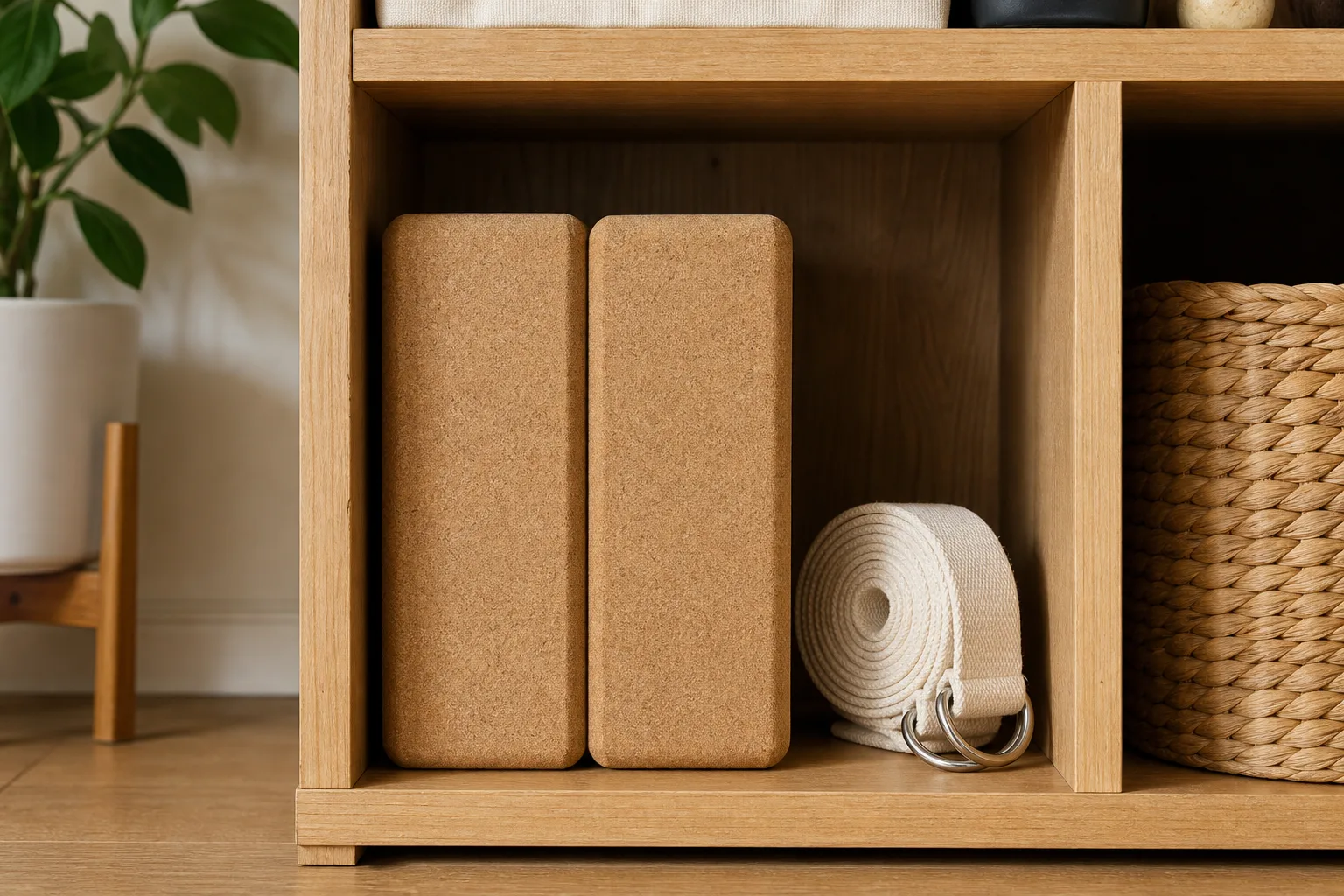
Two blocks consume approximately twice the block volume of one. Use the published dimensions to test the real shelf, drawer or bag rather than judging by a styled photo. Remember to leave hand clearance around a tight cubby.
Roll the fully dry strap loosely, keep the rings accessible, and avoid trapping the webbing beneath heavy items. Store foam and cork away from heaters, wet floors, direct prolonged sunlight and sharp edges. Do not cinch the strap tightly around soft blocks for long storage; concentrated pressure can leave marks or deformation.
For a larger equipment system, our yoga props guide helps decide which categories deserve space. It keeps category priorities separate from this page’s bundle-specification decision.
Red flags in yoga prop bundle listings
- “Complete set” without an itemized contents list.
- A plural product title but a singular block quantity in specifications.
- Dimensions that are actually the shipping carton.
- Lifestyle photos showing a mat or bag not named in the contents.
- “Standard size” with no three-axis block measurements.
- “Long strap” with no usable length.
- “Metal buckle” without a clear hardware photograph.
- Environmental claims without material scope or supporting detail.
- Reviews referring to a previous version with different contents.
- A discount comparison that cannot be reconstructed from equivalent components.
Reviews can reveal recurring ambiguity, but they do not replace the current product page. Sort by recent when possible, match the review’s color or model to the active variant, and prioritize photographs that show the received item. Product configurations change.
A practical buying sequence
Use this order to keep the decision factual:
- Write down the exact desired item count.
- Choose a block format using three measurements, not a size label.
- Select a disclosed block material and acceptable pair weight.
- Choose strap length, width, fiber and buckle.
- Confirm that the chosen variant keeps those specifications.
- Measure the storage space and, if relevant, the carrying bag.
- Compare the live bundle total with equivalent separate components.
- Save the listing and inspect every component on arrival.
The best yoga block and strap set is not the one with the most accessories or the loudest discount. It is the one whose three core products are fully specified, mutually consistent, easy to inspect and worth buying together.
Need a mat and carrying system in the same package too? The separate yoga starter kit guide owns broader multi-category kits and their piece-count, replaceability and packed-capacity checks.
Frequently asked questions
What should a yoga block and strap set include?
A useful basic set normally contains two matching yoga blocks and one yoga strap. Do not rely on the staged photo or the word “set”: confirm the written quantity for each component, because some listings include one block while others include two.
Is a 3-inch or 4-inch yoga block better in a set?
Neither thickness is universally better. A typical 3-inch block is narrower to grip and takes less storage space, while a 4-inch block offers a broader face and more volume. Compare the published length, width and thickness—not a size label alone—and make sure both included blocks match.
How long should the strap in a block set be?
Six-foot and eight-foot straps are both common in current bundles. Length should be treated as a product-fit and handling choice: verify usable length, width, buckle style and whether the tail can be threaded and adjusted smoothly. Taller users or buyers wanting more excess webbing may prefer the longer option.
Are two blocks and a strap cheaper as a bundle?
Sometimes. Compare the live set price with the current total for the same two blocks and same strap bought separately, including shipping and returns. A bundle is not good value when it substitutes smaller blocks, a shorter strap or a lower-spec buckle.
What should I inspect when a yoga prop set arrives?
Count the pieces, compare both block dimensions and firmness, inspect block edges and surfaces, unroll the entire strap, and check the webbing, stitching and buckle. Photograph defects before use and follow the seller’s return process if the delivered contents differ from the listing.