

How this page has changed
July 27, 2026
Sources, internal links and safety or product context reviewed.
In this guide
- 01Yoga starter kits at a glance
- 02Reconstruct the advertised piece count
- 03The mat cannot be the anonymous base item
- 04One block or a matched pair?
- 05Audit the strap instead of accepting the free extra
- 06Treat bags and slings as capacity claims
- 07Extra pieces: useful component or count inflation?
- 08Component replaceability is long-term value
- 09Calculate like-for-like bundle value
- 10Delivery-day inspection checklist
- 11Store mixed materials separately when necessary
- 12Red flags in starter-kit listings
- 13A practical starter-kit buying sequence
A yoga starter kit is a retail bundle, not a curriculum. The common core is one mat, one or two blocks and one strap. Current listings stretch that definition from compact three-piece sets to seven-piece packages with towels, a knee pad and carrying accessories.
The useful question is not “Does this look complete?” It is “Can I identify and evaluate every item?” A bundle deserves consideration only when the mat, blocks, strap and bag are specified as real products rather than anonymous extras added to inflate the piece count.
This page owns the starter-bundle purchase decision: exact inventory, component specifications, replaceability, storage, transport and like-for-like value. Our yoga props guide owns the category-level decision about which prop types matter. Individual mat, block and strap guides own their deeper product comparisons. This page contains no pose setup, technique or therapeutic advice.
Yoga starter kits at a glance
| Advertised format | Likely count logic | Inventory to confirm | Main hidden trade-off |
|---|---|---|---|
| 3-piece | One mat + one block + one strap | Whether strap also carries the mat | A single block may be unexpected |
| 4-piece | One mat + two blocks + one strap | Mat dimensions and matched block pair | No dedicated bag may be included |
| 5-piece | Core kit + bag or second accessory | What counts as the fifth object | Thin sleeve may not fit all components |
| 7-piece | Mat + two blocks + strap + mat towel + hand towel + pad | Each textile size and exact block quantity | Count looks impressive while core specs stay vague |
| “Complete” kit | Varies without a standard | Written itemization | Marketing adjective supplies no quantity |
Menkind currently describes a mat, one block and one strap and publishes approximate dimensions for all three. Iron Body Fitness describes a four-piece set: a 4 mm mat, two blocks and a strap. Asivana’s current starter bundle uses a mat, two cork blocks and a strap. Those are all legitimate kits, but they are not equivalent purchases.
Reconstruct the advertised piece count
Start by assigning one line to every physical object:
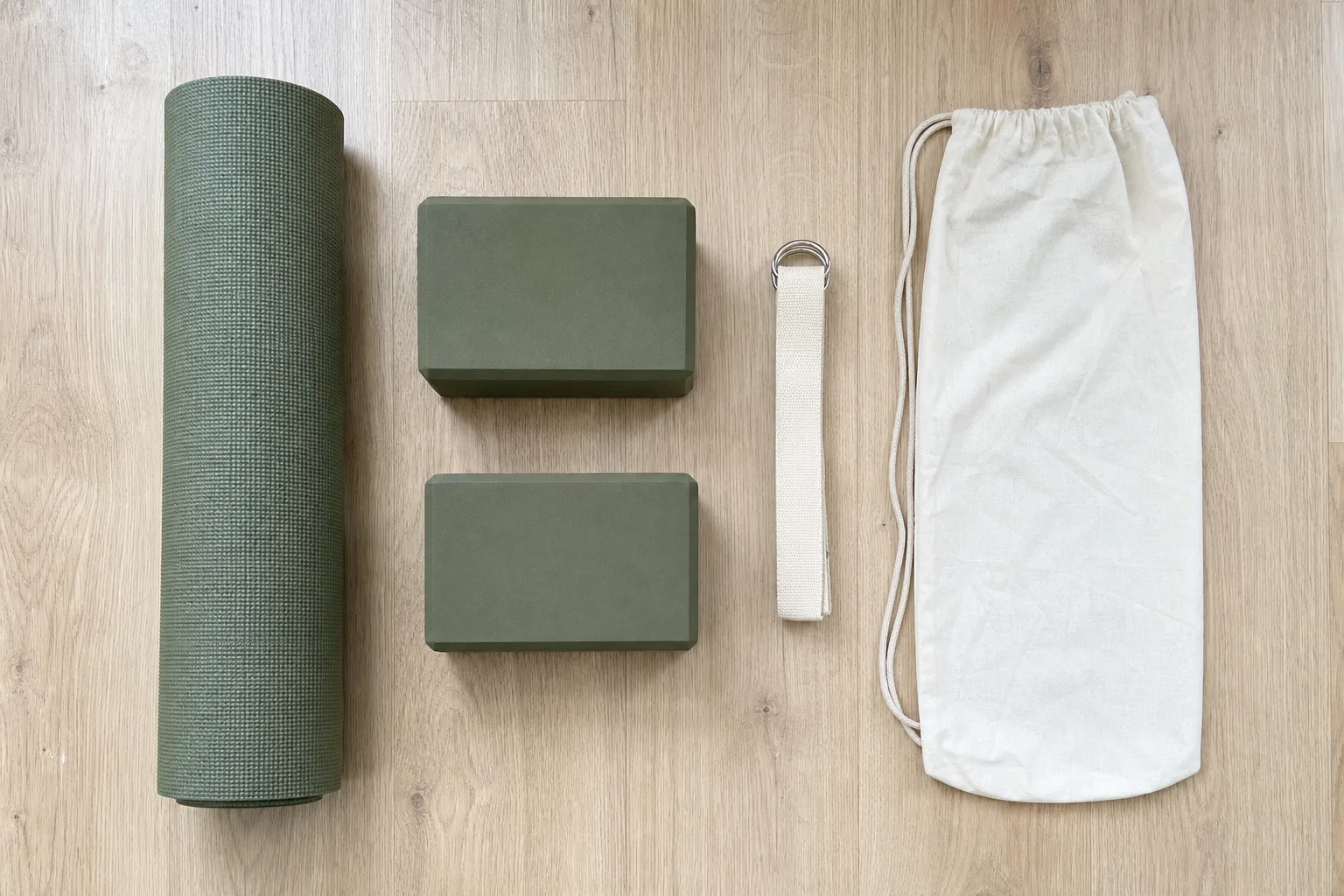
| Line item | Quantity | Exact specification found? | Included or pictured only? |
|---|---|---|---|
| Yoga mat | ___ | L × W × T, material, weight | ___ |
| Yoga blocks | ___ | Each block’s L × W × T and material | ___ |
| Yoga strap | ___ | Length, width, fiber, closure | ___ |
| Carry bag or sling | ___ | Internal size and carrying method | ___ |
| Mat towel | ___ | L × W, fiber, underside | ___ |
| Hand towel | ___ | L × W and fiber | ___ |
| Pad or other accessory | ___ | Dimensions, material, purpose | ___ |
Retailers often count two blocks as two pieces, even when sold as one pair. A carrying strap can also be a separate piece, while another listing describes the same strap as a mat carrier but counts only the main equipment. Neither convention is inherently wrong; ambiguity is the problem.
Do not count a printed pose chart, downloadable video, packaging sleeve or warranty card unless the seller’s advertised total explicitly includes it. If “seven pieces” becomes six when reconstructed, ask the retailer what the missing item is.
Written contents override staged photography
Gallery images may show a bottle, towel, blanket or second block for context. Treat anything absent from the written inventory as not included. Conversely, a bag packed behind the mat can be easy to miss in a hero image but valid when named in specifications.
Save the active variant and order summary. Kit contents can change by color, material tier or region while reviews and photos remain pooled across versions.
The mat cannot be the anonymous base item
Record at least seven mat fields:
- finished length;
- finished width;
- thickness in millimeters or inches;
- top and base materials;
- product weight;
- rolled dimensions if published; and
- cleaning and storage instructions.
Menkind’s current kit specifies an approximately 173 × 61 cm mat at 4 mm thick. Iron Body Fitness also identifies a 4 mm mat but must still be evaluated on its other dimensions and construction. “Starter mat” is not a material or size.
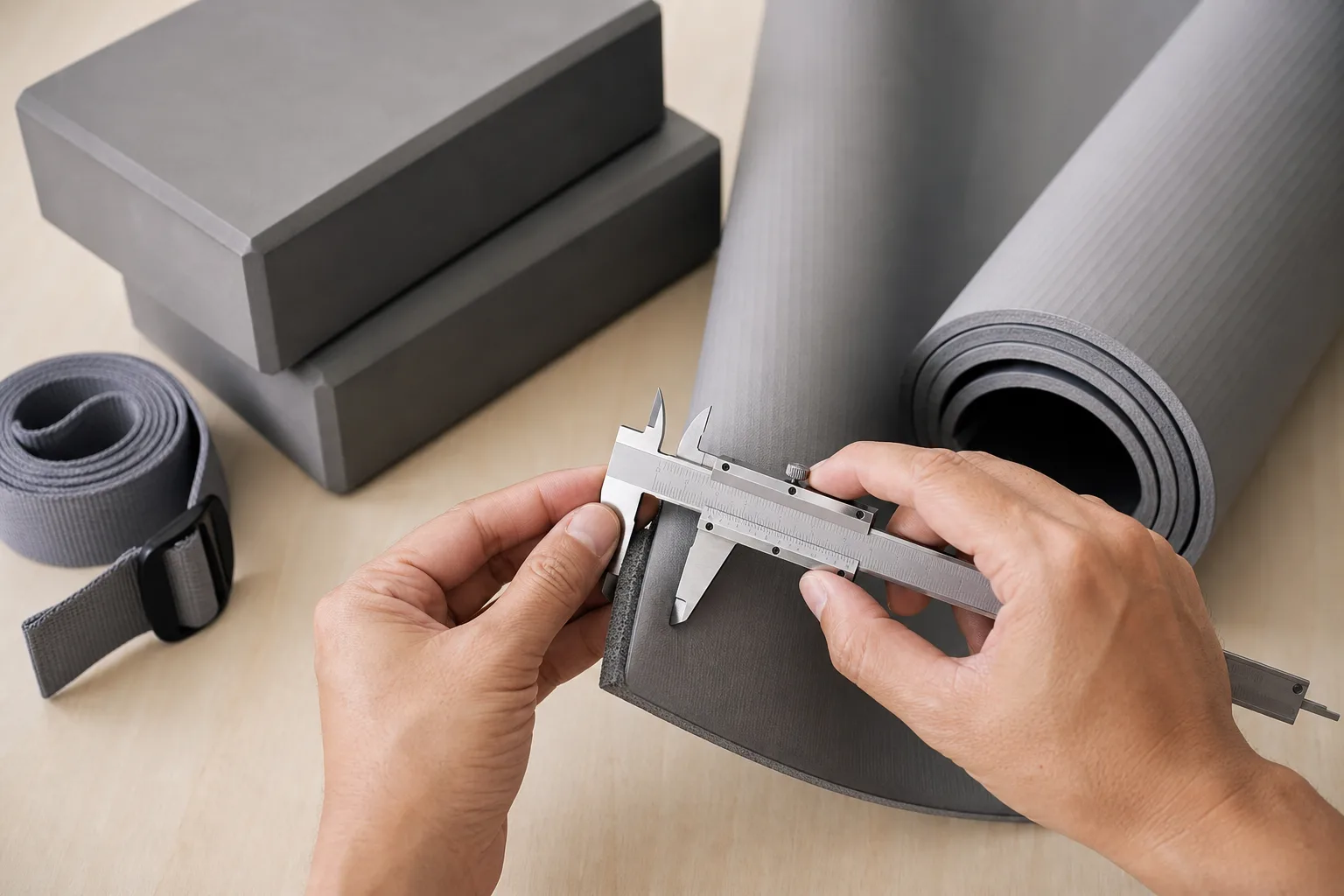
Our how to choose a yoga mat guide owns the complete individual-mat framework. For kit evaluation, the extra question is whether the mat can be replaced without making the remaining bundle redundant.
Avoid quality conclusions from thickness alone
A thicker mat is not automatically higher quality. It occupies more storage volume, increases rolled diameter and may change whether the included sling or bag fits. Density and construction influence mass and compression but are rarely disclosed consistently in low-cost kits.
If the page uses “non-slip,” “supportive” or “high density,” look for measurable construction behind the words. Do not convert marketing claims into safety guarantees.
One block or a matched pair?
Kit listings commonly include one or two blocks. The count should be explicit in text and reproducible from the advertised total. Two blocks should match in:
- length, width and thickness;
- material and nominal density;
- edge profile;
- surface texture;
- weight within reasonable production tolerance; and
- color, unless a mixed-color pair is intentional.
Menkind publishes an approximately 23 × 15 × 8 cm single block. Iron Body Fitness describes two foam blocks. Asivana describes two cork blocks. Those configurations differ in quantity, material, weight and storage even before brand or color enters the decision.
Use the yoga block size guide for precise format comparisons and the best yoga blocks guide for foam-versus-cork trade-offs. Here, the priority is verifying that the starter-kit listing discloses the component instead of hiding it behind “essential prop.”
Audit the strap instead of accepting the free extra
A useful strap specification includes finished length, width, webbing fiber, closure type, hardware material and end construction. Current kits use D-rings, rectangular cinch buckles or simple carrier loops. These are not interchangeable just because all can be called straps.
| Strap field | Complete listing | Incomplete listing |
|---|---|---|
| Length | Measurement in feet/inches or centimeters | Long or adjustable |
| Width | Actual webbing width | Comfortable width |
| Fiber | Cotton, polyester or disclosed blend | Fabric |
| Closure | Two D-rings or named buckle system | Metal buckle |
| Function | Stretch strap, mat carrier or convertible design | Multipurpose |
A strap that doubles as a mat carrier needs enough adjustment range for the bundled mat’s rolled diameter. Confirm whether it secures the mat at two points or forms only a shoulder loop. Our yoga strap guide covers standalone closures and webbing in more depth.
Treat bags and slings as capacity claims
A bag is useful only if its opening and internal geometry fit the intended contents. Many starter-kit sleeves carry the rolled mat but not the blocks. A larger tote may hold blocks and strap while the mat attaches outside. Product photos should make that architecture clear.
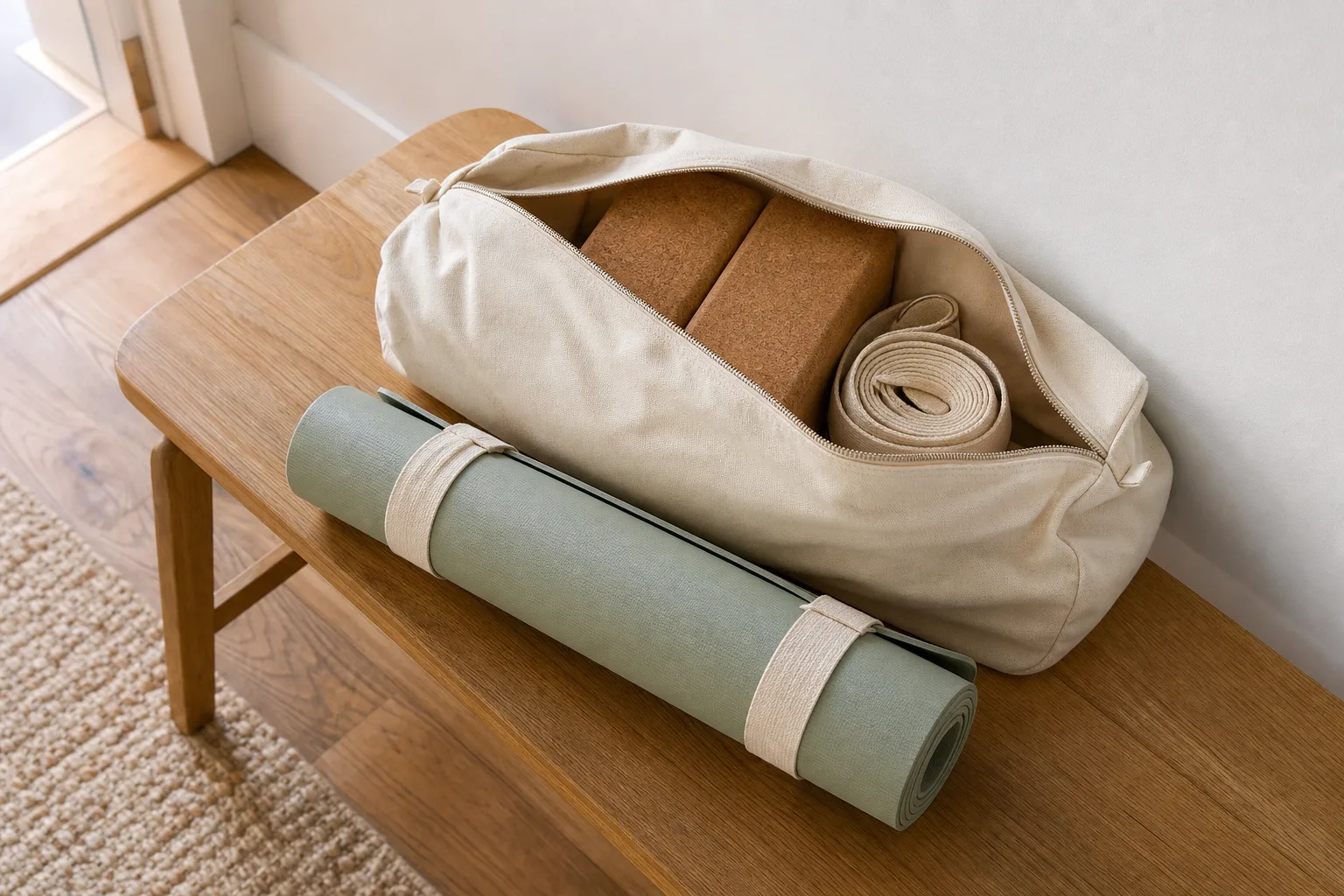
Record:
- opening width and closure type;
- internal length, width and depth;
- exterior mat-holder dimensions;
- strap length and attachment points;
- empty bag weight;
- ventilation; and
- whether the full dry kit fits without force.
Do not infer bag capacity from package dimensions. A folded fabric bag can ship in a small carton. For gym-first carrying systems, the gym bag with yoga mat holder guide compares loaded geometry and compartment design.
Extra pieces: useful component or count inflation?
Extended kits may add a full-length mat towel, hand towel, knee pad, resistance band, bottle or printed chart. Judge each addition with the same questions:
- Is it explicitly included?
- Are its dimensions and material published?
- Does it fit or interact with the core kit?
- Does it have a practical care method?
- Would you choose it separately?
- Can it be replaced without repurchasing the kit?
A seven-piece bundle with unnamed textiles is not necessarily more complete than a four-piece bundle whose mat, two blocks and strap are fully specified. More pieces also create more separate care routines and packed volume.
The GoFit kit currently listed by Target includes a mat, foam block, strap, pose chart and carrying bag. That is a distinct configuration with a single block and an informational extra. It should not be compared directly with a mat–two-block–strap set by piece count alone.
Component replaceability is long-term value
Ask whether every item uses ordinary dimensions and can be replaced individually. A proprietary bag that fits only a very narrow mat, an unusually small block or a strap permanently sewn into a carrier can lock the kit together.
| Replacement question | Better evidence | Risk signal |
|---|---|---|
| Can the mat be replaced? | Bag or sling gives a size range | “Fits included mat” only |
| Can one damaged block be matched? | Exact size, material and model identified | Generic block with no dimensions |
| Can the strap be replaced? | Ordinary standalone strap specification | Sewn permanently into bag |
| Can textiles be replaced? | Separate dimensions and fiber listed | Custom shape with no spare available |
| Can accessories be cleaned alone? | Component-level care labels | One vague care sentence for all materials |
Replaceability matters even when the initial bundle is inexpensive. Mat surfaces, foam blocks, textile straps and bags age differently. Requiring a full-kit repurchase because one anonymous component failed creates waste and can erase the original saving.
Calculate like-for-like bundle value
Use live totals rather than a permanent price quoted in an article:
separate total = same mat + same number and type of blocks + equivalent strap + equivalent bag/extras + shipping
Compare that with the kit’s live checkout total and return terms. Match the specifications closely. A one-block kit cannot be priced against a two-block separate basket without correcting the quantity; a compact foam block is not equivalent to a conventional cork block.
Value can come from one shipment, confirmed color matching and a coordinated return. A bundle does not need the largest discount to be sensible. But a crossed-out list price is not evidence until you can reproduce it using equivalent separately available components.
Use a disclosure score, not a fake quality score
Give the listing one point for each field it publishes:
- exact item inventory;
- full mat dimensions and material;
- block quantity, dimensions and material;
- strap length, width, fiber and closure;
- bag geometry or stated component capacity;
- individual weights or an unambiguous combined weight;
- component-level care; and
- return and defect process.
This measures how confidently the kit can be assessed. It does not prove durability or performance. A well-documented product can still arrive defective, which is why delivery inspection remains necessary.
Delivery-day inspection checklist
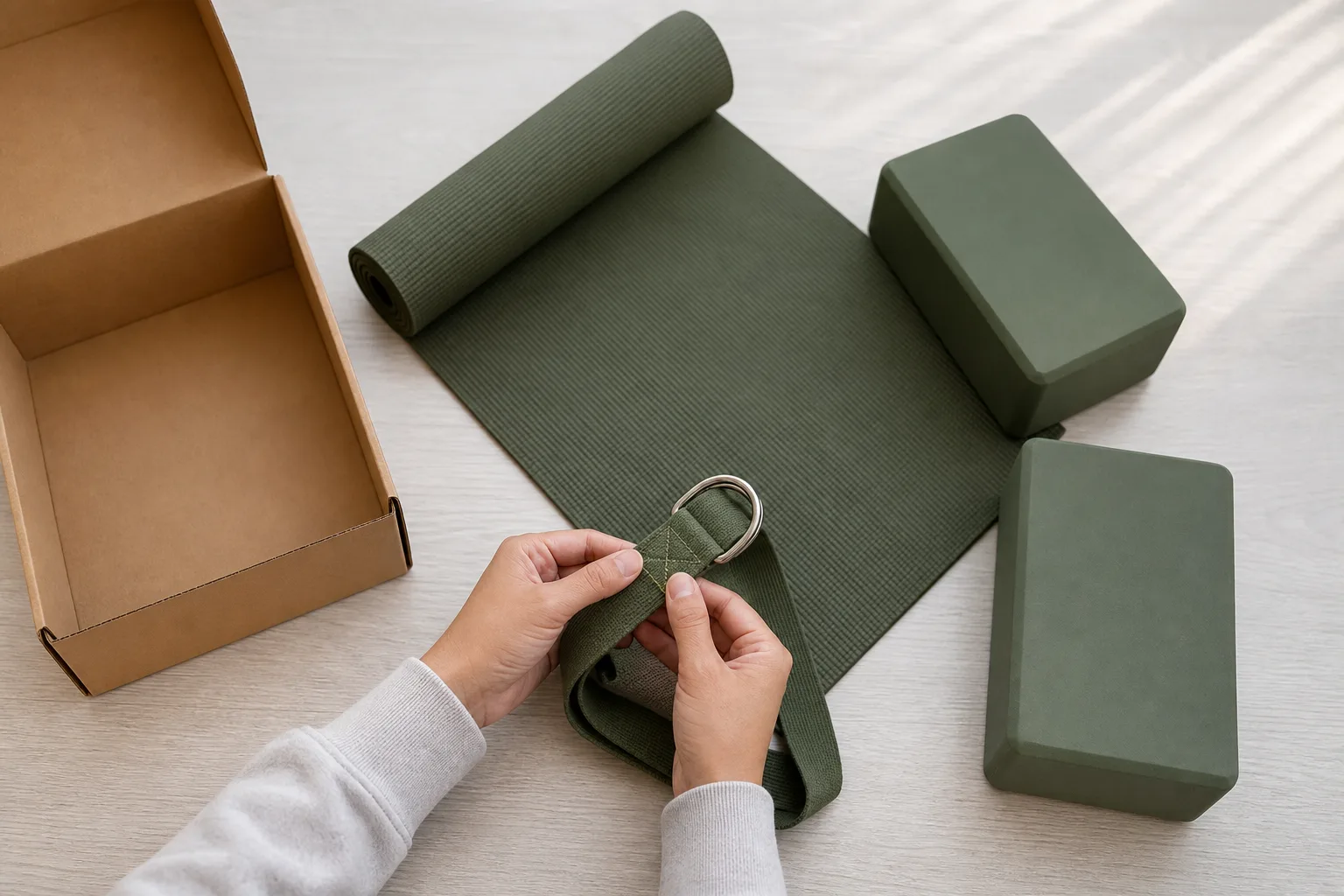
- Count the pieces. Reconstruct the advertised total physically.
- Match the variant. Confirm color, material and configuration against the order.
- Unroll the mat. Check dimensions, faces, edges, odor guidance and obvious damage.
- Compare blocks. Measure both, check surfaces and confirm they form the promised pair.
- Unroll the strap. Inspect full webbing length, ends, stitching and hardware.
- Test dry packing. Put the intended items in or on the bag without forcing closures.
- Find care labels. Save component-specific instructions.
- Document defects. Photograph the carton, complete inventory and close problem areas.
Keep the equipment clean and unmodified while a return is evaluated. Do not trim loose stitching, glue a lifting surface or wash a questionable textile first; alteration can complicate the defect process.
Store mixed materials separately when necessary
Mat, foam, cork, cotton, metal and bag fabric do not share one universal care routine. Follow each maker’s directions. Let every component dry before packing, keep metal hardware from pressing into soft foam, and avoid cinching a strap tightly around blocks for long storage.
Measure the shelf using the mat’s rolled size plus the two-block footprint. Store a bag open enough to ventilate after use. If a kit includes towels, keep damp textiles away from the mat and other porous components until laundered and completely dry.
Red flags in starter-kit listings
- “Complete” with no itemized inventory.
- An advertised piece count that cannot be reconstructed.
- Mat thickness without length, width or material.
- Blocks shown as a pair but written as a singular item.
- A strap called adjustable with no length or closure type.
- A bag pictured with the full kit but sized only for the mat.
- One care sentence applied to foam, textile and metal together.
- Environmental claims without a named component or evidence.
- Reviews pooled across materially different kit variants.
- A large discount based on non-equivalent separate products.
A practical starter-kit buying sequence
- Define the core inventory you actually want.
- Reconstruct the listing’s advertised piece count.
- Evaluate the mat as an individual product.
- Confirm one block or a matched pair and record dimensions.
- Audit strap length, width, fiber, closure and function.
- Check which components the bag truly carries.
- Remove unwanted extras from the value calculation.
- Compare equivalent separate products at live checkout.
- Save the listing and inspect the complete delivery.
The best yoga starter kit is not the box with the largest number on it. It is the bundle whose core equipment is fully specified, individually replaceable, practical to carry and genuinely worth purchasing together.
Frequently asked questions
What should a yoga starter kit include?
A common core kit contains one yoga mat, one or two blocks and one adjustable strap. Some sets add a bag, towel, knee pad or printed chart. There is no standardized contents list, so count each written component and verify its specifications rather than relying on the word “complete.”
Is one yoga block enough in a starter kit?
One block is a valid product configuration, but two matching blocks offer a symmetric pair and are common in four-piece kits. This guide does not prescribe pose use; it recommends checking whether the listing contains one or two and whether both blocks share the same dimensions and material.
How many pieces are in a four-piece yoga set?
Retailers usually count individual objects, so one mat, two blocks and one strap equals four pieces. A carry bag or strap may be counted separately in another listing. Reconstruct the advertised number from an itemized inventory before ordering.
Is a yoga starter kit cheaper than buying separately?
Sometimes. Compare the live kit total with the same mat, same block quantity and an equivalent strap bought separately, including any bag, shipping and return terms. A larger piece count is not better value when accessories are underspecified or difficult to replace.
What should I inspect when a yoga kit arrives?
Count every item, confirm materials and dimensions, unroll the mat, compare matching blocks, inspect strap webbing and hardware, and test the empty bag against the dry equipment. Photograph shortages or defects before use and retain packaging until the order is accepted.