

How this page has changed
July 26, 2026
Sources, internal links and safety or product context reviewed.
In this guide
- 01Quick decision
- 02Current formats compared
- 03Four holder architectures
- 04Measure the rolled mat, not mat thickness
- 05Compartment layout
- 06Loaded dimensions and carry balance
- 07Materials, weather and cleaning
- 08Construction and inspection
- 09Packing sequence
- 10Claims to question
- 11Buying checklist
- 12How this guide was researched
- 13Further reading
A gym bag with a yoga mat holder combines two jobs: it carries ordinary workout gear in a duffel, tote or backpack, and secures a rolled mat outside or in a dedicated compartment. That is different from a narrow yoga mat tube with one small pocket.
Choose by holder architecture, actual rolled-mat diameter, retention spacing, bag dimensions, compartment layout, loaded balance, materials and care. A product photo showing a slim mat is not proof that your 6 mm rubber mat will fit—or that the holder remains secure when the bag is full.
This is an independent product-selection guide, not a hands-on ranking.
Quick decision
| You usually carry | Best starting format | Critical check |
|---|---|---|
| Mat, shoes, clothing and bottle | Gym duffel with two adjustable external loops | Loop range at your actual roll diameter |
| Mat plus blocks and a towel | Large tote with front mat sleeve | Sleeve opening, closure and loaded tote shape |
| Mat protected from weather | Long internal mat duffel | Internal length, diameter and lost cargo volume |
| Commute gear and laptop | Structured backpack with separate mat straps | Mat position, laptop protection and total loaded balance |
| Damp towel or swimwear | Duffel with separate lined wet pocket | Seam/zip construction and cleaning instructions |
| Thick or extra-wide mat | Open adjustable loops | Maximum circumference, mat width and end retention |
Eliminate any bag that publishes neither a mat-diameter limit nor enough holder dimensions to assess fit. “Holds one yoga mat” only states quantity. It does not state which mat.
Current formats compared
| Current product | Mat arrangement | Published bag size | Other disclosed organization | Important limit |
|---|---|---|---|---|
| Blogilates Ultimate Gym Bag | External yoga-mat straps | 17 W × 13.8 H × 9.4 D in; 1.2 lb | Shoe compartment, bottle storage, multiple pockets | Target lists one-mat capacity but no roll diameter |
| Gonex Yoga Mat Bag XL | Zipped external front compartment | 26 × 17 × 7 in | Two side pockets and internal zip pocket | Maker states maximum rolled diameter of 9 in |
| Warrior2 Yoga Duffle | External mat strap system | Exact overall dimensions not found on current page | Eight-pocket claim, wet pocket, padded handle and shoulder strap | “Even thicker” mat language is not a numeric fit limit |
| Kindfolk Patterned Duffel | Mat inside long main compartment | 26 × 8 × 8 in; 1.2 lb | One exterior valuables pocket | Mat width up to 26 in; no external holder |
| Halfmoon Mat Duffle | Mat inside cylindrical duffel | 29 × 7 × 7 in | Double horizontal zips and phone/key pockets | Seven-inch cross-section constrains roll and cargo together |
These are manufacturer or retailer disclosures, not our measurements. They demonstrate four different interpretations of “mat holder”: external straps, a front sleeve, a shared internal compartment and a mat-sized duffel. Compare architecture before comparing color or price.
Four holder architectures
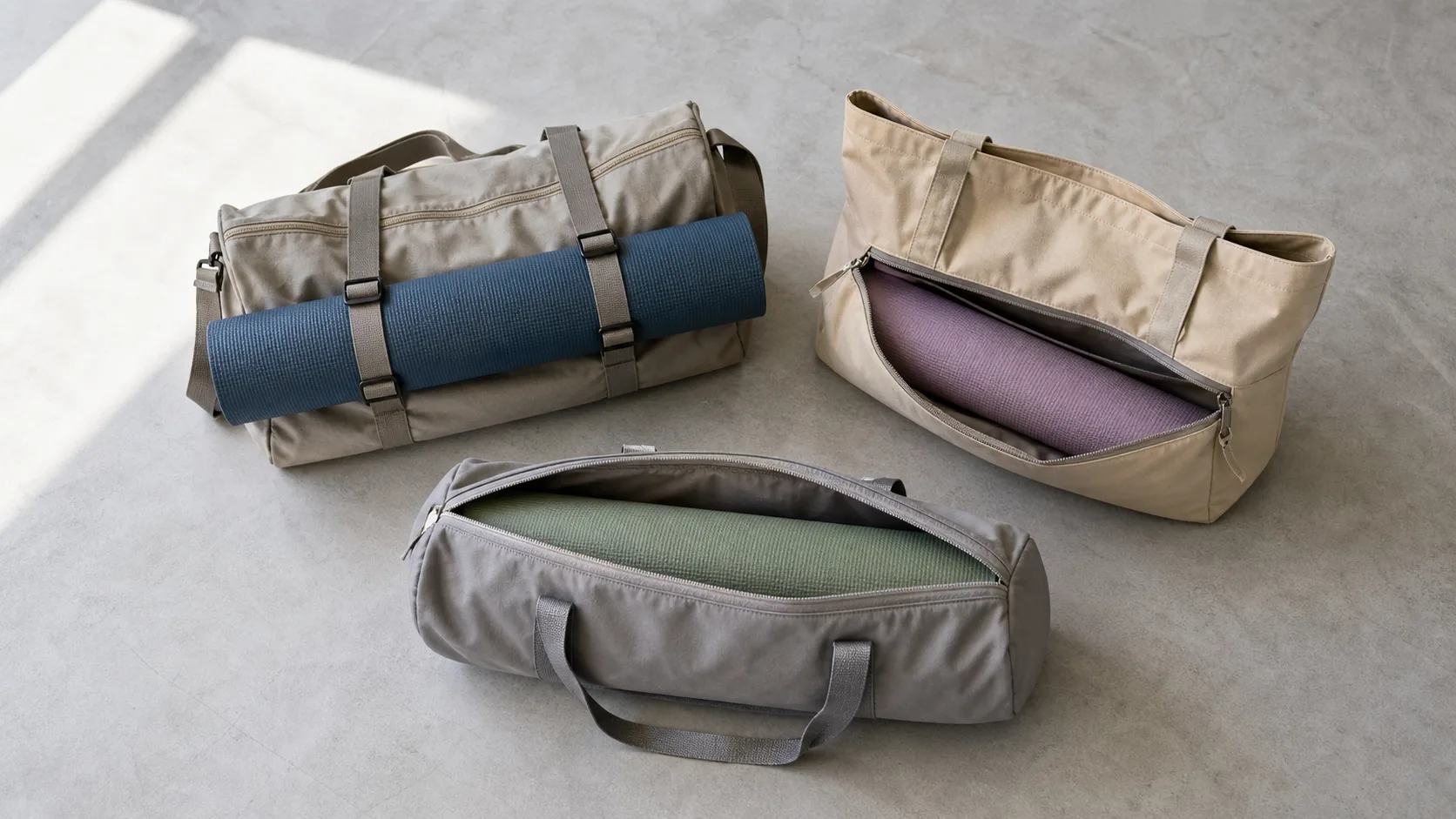
Two external loops
Two webbing loops wrap around the mat and attach to the top, front or bottom of the bag. Their main advantage is independence: the mat does not consume the clothing compartment. Adjustable loops can also accept more roll diameters than a fixed tube.
Check that each loop adjusts independently and closes mechanically with a buckle, cam or hook-and-loop area sized for the load. Elastic alone can relax over time. The loops should be far enough apart to control yaw—the roll rotating left or right—but not so close to its ends that a tapered or loosely rolled mat can slip through.
Look at what supports the loop anchors. A strap stitched only into a thin pocket panel can distort it. Reinforcement into a seam, backing patch or structural webbing path is a more informative construction detail, though only a stated load limit or test supports a load claim.
Zipped front sleeve
Gonex uses a large front zip compartment for the rolled mat and says it can hold a roll up to 9 inches in diameter. The sleeve keeps the mat against the bag while leaving the main interior available. When no mat is carried, the same compartment can hold a towel, blocks or footwear according to the maker.
Inspect the opening, not only the compartment body. A roll can theoretically fit the sleeve but fail to pass through a short zipper. The zipper path should not force the mat against sharp teeth, and the closed slider should not sit where a shifting roll can push it open.
A partially enclosed sleeve offers more lateral retention than two loops, but it can trap more moisture and grit. Check whether the lining can be wiped and whether the bottom has drainage or only a marketing “wet/dry” claim.
Internal mat compartment
Kindfolk’s 26 × 8 × 8-inch patterned duffel places the mat, blocks, towel and other gear in one main compartment and states compatibility with mats up to 26 inches wide. Halfmoon publishes a longer 29 × 7 × 7-inch mat duffel with double horizontal zips.
An internal design protects the mat from direct contact with seats, walls and light rain. It also makes roll diameter a hard constraint and lets a dirty mat touch other contents unless the bag has a true divider. The eight-inch external dimension is not necessarily eight inches of usable internal clearance; lining, seam allowances, padding and zipper geometry consume space.
This format belongs nearer the conventional yoga mat bag end of the spectrum. Choose it when mat coverage matters more than a dedicated shoe zone.
Backpack-mounted holder
Backpacks may place two straps at the base, front or top. They keep both hands free and can combine a laptop sleeve with gym storage, but the mat becomes a wide crossbar behind the wearer.
Measure your body-and-mat clearance for doors, transit aisles and other people. A 26-inch-wide mat extends beyond most backpacks. Bottom mounting keeps the main zipper clear but places the roll nearer wet floors and bench edges. Confirm that the straps cannot interfere with shoulder-strap adjustment or cover a ventilation panel.
Measure the rolled mat, not mat thickness
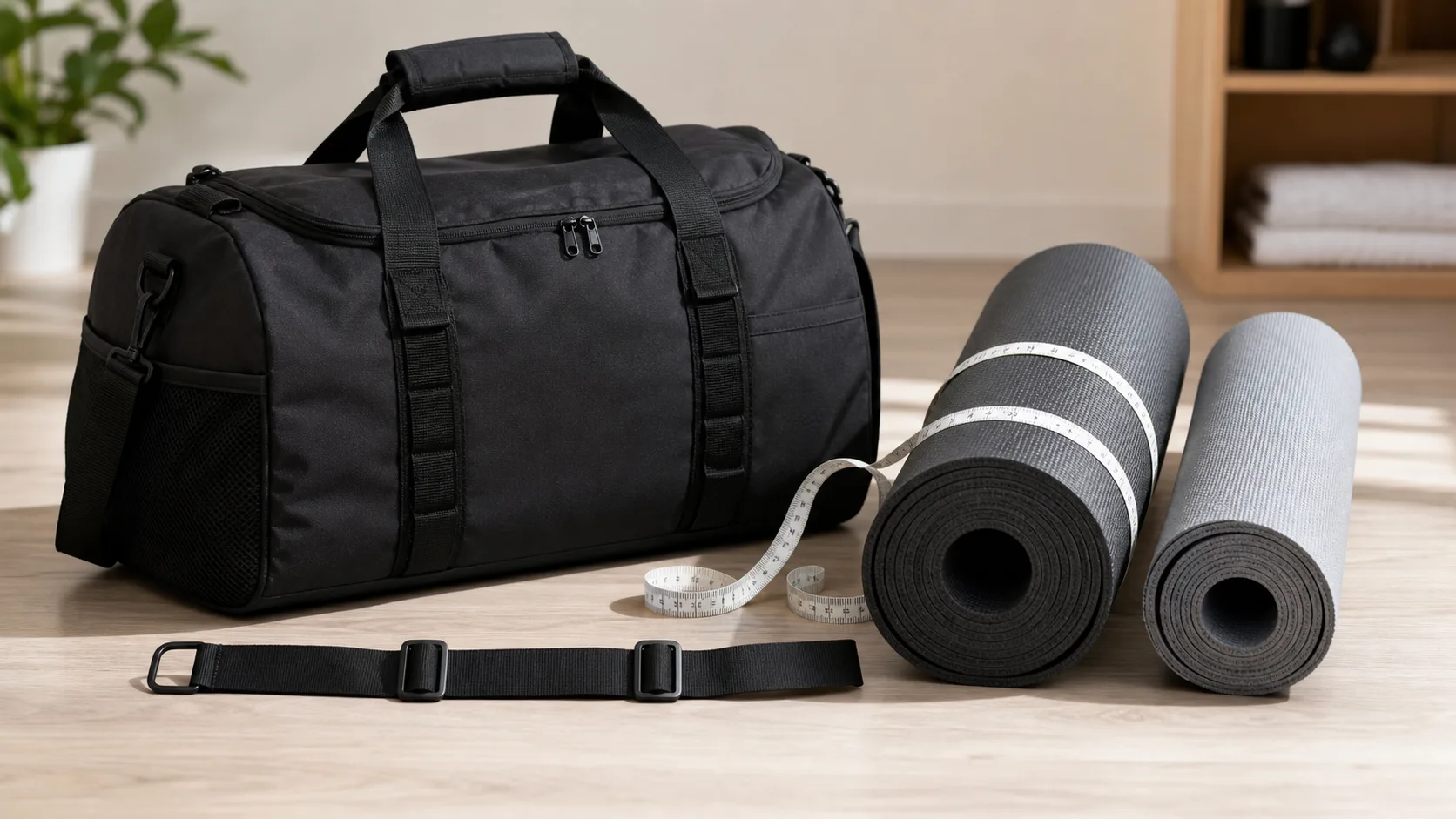
Roll diameter depends on mat thickness, length, stiffness, surface texture and how tightly it is rolled. A long dense 5 mm rubber mat can form a larger cylinder than a shorter soft 6 mm foam mat.
Measure the mat after normal use and full drying:
- Roll it as you genuinely transport it, without forcing abnormal compression.
- Measure outside diameter at the widest point.
- Measure circumference around that same point if the bag publishes loop length.
- Measure roll width from end to end.
- Record the mat’s dry weight.
- Note whether the roll expands when an ordinary strap is removed.
For two loops, usable loop circumference must include room for the webbing to route through the buckle and close with adequate engagement. A strap’s total cut length is not the usable loop limit. For a sleeve, compare the maker’s internal diameter or stated maximum roll diameter. For an internal bag, compare roll width and diameter with the narrowest opening and internal dimensions.
Gonex is unusually specific in stating a 9-inch maximum roll diameter. Blogilates/Target states a capacity of one mat but publishes no diameter. Warrior2 says its design accommodates even thicker mats but gives no numeric boundary in the current product copy checked. In the latter two cases, request the maximum rolled circumference before buying a thick mat.
Width and end clearance
A standard mat is often around 24 inches wide, but current mats also come in 26-, 28- and 30-inch widths. Kindfolk explicitly states a 26-inch mat-width limit for its internal duffel. An external holder may accept a wider mat, yet the overhang can strike doorframes or make the bag awkward on transit.
The loops should land on consistent cylindrical sections, not loose flared edges. Leave enough mat beyond each loop to prevent pull-through, but keep both loops well away from the ends where the roll can taper.
Compartment layout
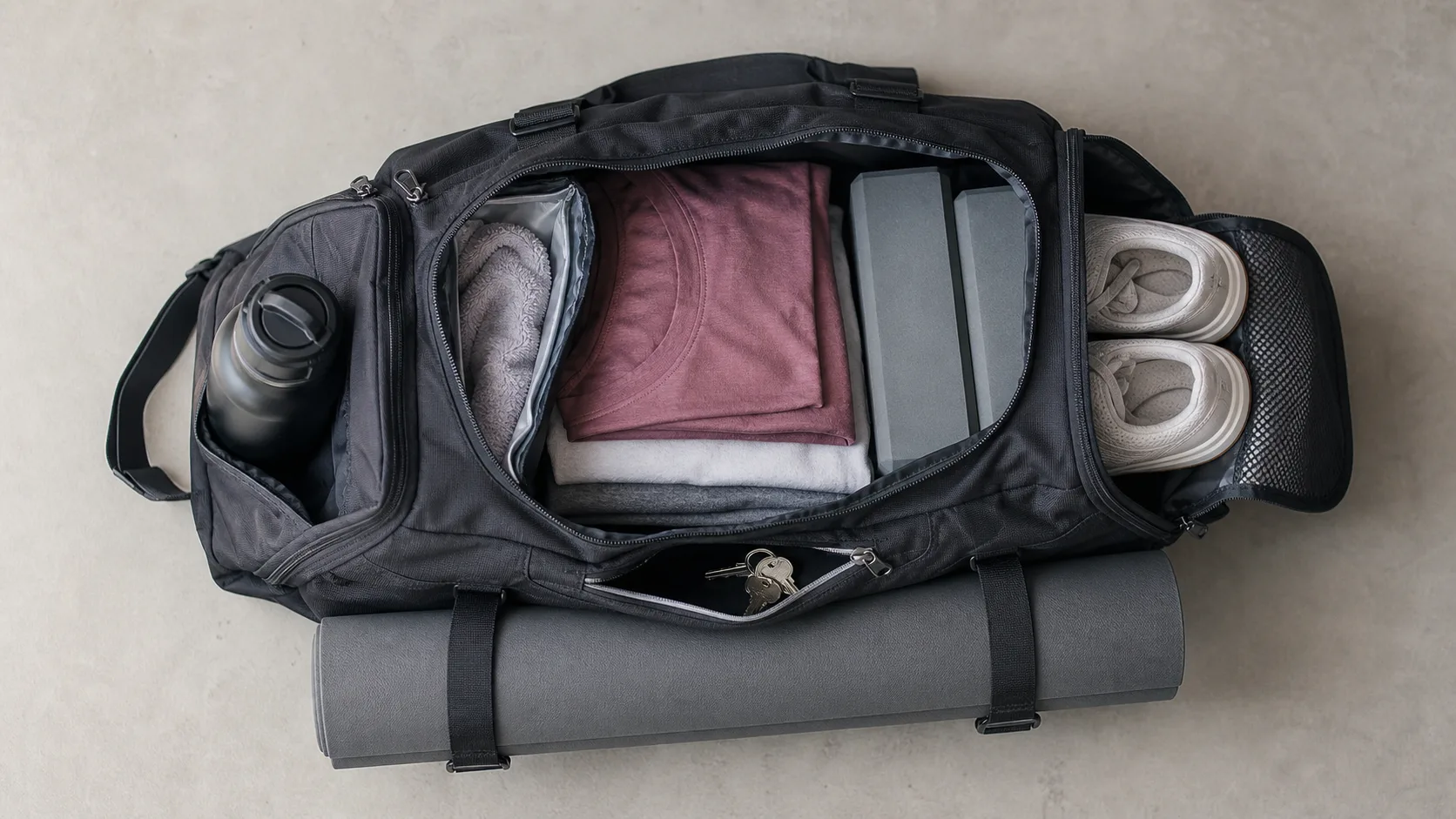
The holder solves only the mat. A true gym bag still needs to organize everything else without turning into one deep cavity.
Shoe compartment
A shoe tunnel or end pocket keeps soles away from clean clothing, but it usually pushes into the main compartment when occupied. Assess the bag with shoes inside, not from the empty exterior dimensions. Look for a wide opening, wipeable lining and ventilation disclosure without assuming mesh makes the compartment odor-proof.
Blogilates describes a separate shoe compartment. If you carry large training shoes, ask for the pocket’s internal length and height. A generic “fits shoes” statement does not specify size or whether a pair fits when the main bay is full.
Wet pocket
Warrior2 advertises a dedicated wet pocket. Determine whether that means a water-resistant lining, a truly sealed compartment or simply a separate zipper area. Unless the maker explicitly claims waterproof seams and closure, treat it as splash management rather than containment.
Do not leave a wet towel sealed for long periods. Remove and dry contents promptly, wipe the pocket under its care instructions and keep damp textiles away from electronics.
Bottle pocket
An external upright bottle pocket protects clothing from minor condensation and keeps the bottle accessible. Compare pocket circumference and height with your actual bottle. A shallow elastic mesh pocket can eject a tall, heavy bottle when the bag tilts.
Check whether an external mat covers the bottle opening. Some top-mounted systems block the main zipper or side pocket when a large roll is installed.
Small valuables and electronics
A zipped pocket for keys and phone prevents them from abrading the mat or disappearing below clothing. A laptop sleeve needs padding, a raised bottom and separation from wet gear; a plain divider is not equivalent protection.
Kindfolk publishes one external pocket for small valuables. Halfmoon lists zippered phone and key pockets. Gonex lists an internal zip pocket. The location matters as much as the count: quick-access storage should remain reachable with the mat attached.
Loaded dimensions and carry balance
A bag’s published height, width and depth usually describe the empty textile shell. The attached mat can be wider than the bag and may add its full diameter to height or depth.
Calculate the loaded envelope:
- loaded width: greater of bag width and mat roll width;
- loaded height: bag height plus the portion of top-mounted roll above it;
- loaded depth: bag depth plus a front-mounted roll’s projection;
- total weight: bag, mat, shoes, blocks, bottle and contents together.
Target publishes the Blogilates bag at 17 × 13.8 × 9.4 inches and 1.2 pounds. With a standard-width mat attached, the loaded package is likely wider than 17 inches; that is an inference from geometry, not a tested dimension. Measure your mat to determine the actual result.
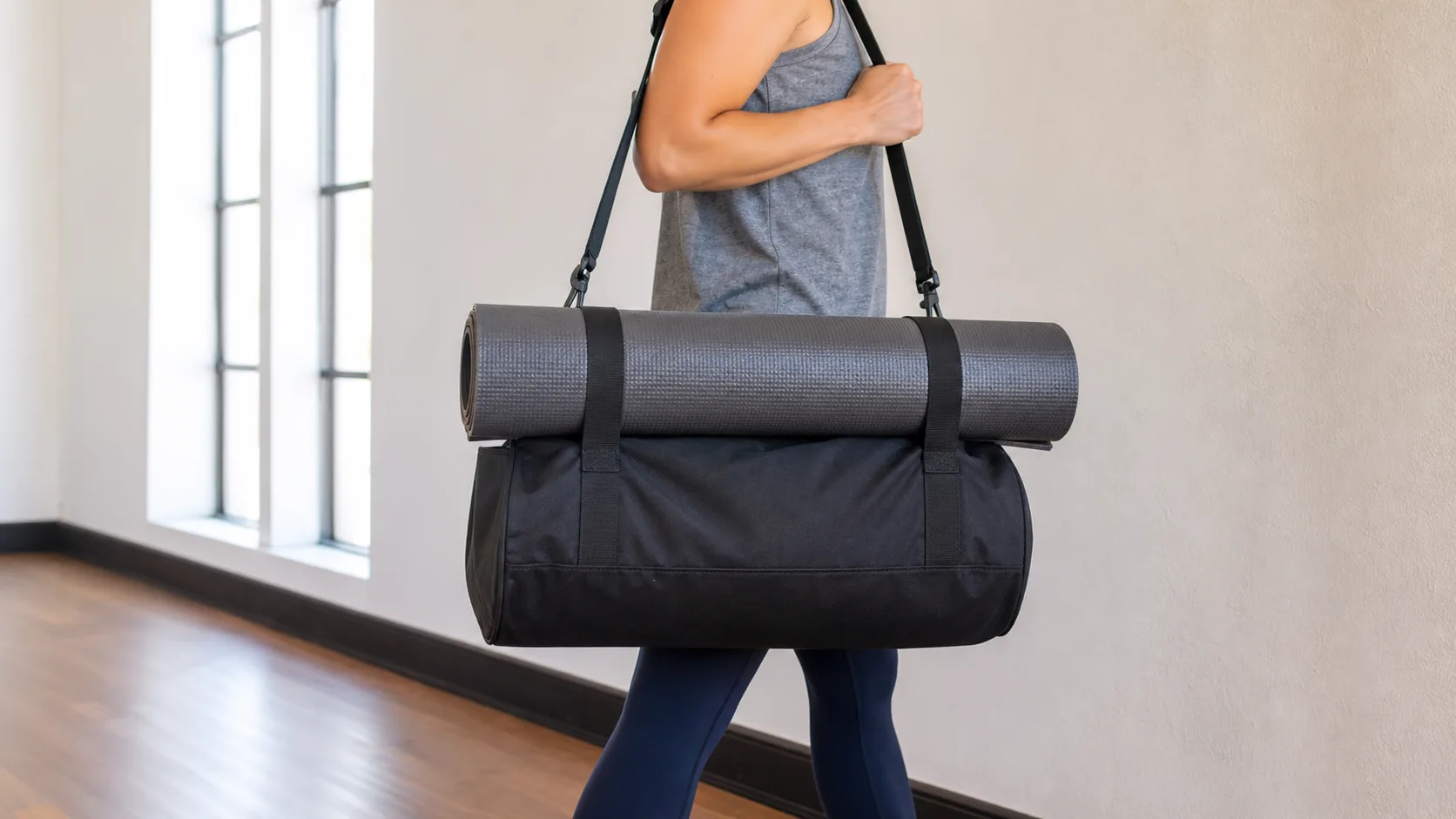
Top-mounted mat
Top mounting keeps the mat visible and away from the ground. It can block the main zipper and raise the center of mass. Check whether you can open the bag without removing the mat and whether the carry handles still meet comfortably above the roll.
Front-mounted mat
Front straps or a sleeve leave the handles clear but increase projection away from the body. The roll can make the bag rotate on a shoulder strap. A broad base and correctly positioned strap anchors help, but only a real loaded check reveals balance.
Bottom-mounted mat
Bottom loops keep the top opening accessible and work well on some backpacks. They expose the mat to floors, splashes and impacts when the bag is set down. Confirm that buckles do not become feet that scratch benches or dig into the mat.
Shoulder strap and handles
Warrior2 describes a padded handle plus adjustable padded shoulder strap. Padding spreads pressure, but it does not establish a safe or comfortable load. Check strap width, adjustment range, swivel hooks, anchor reinforcement and whether the shoulder pad stays under load rather than sliding to one side.
Do not clip extra weight to decorative rings. Use only attachment points the maker identifies for carrying.
Materials, weather and cleaning
Current examples span nylon/polyester, cotton canvas, polyester lining and polyurethane trim. Each has different trade-offs.
Synthetic woven shells can be light and easy to wipe, but “water-resistant” needs a test method or at least clear construction details. Zippers, seams and mat openings remain common entry points.
Cotton canvas is structured and repairable but can absorb water and take longer to dry. Gonex describes heavy-duty water-repellent cotton canvas with polyester lining; “water-repellent” is not waterproof. Kindfolk uses canvas and faux-leather trim. Halfmoon specifies a 100% cotton body and polyurethane straps.
Lining matters around shoes and wet gear. Ask whether it can be pulled out for wiping and whether coatings require special care. Flaking, bubbling or persistent odor are inspection signals.
Follow the exact care label. Halfmoon specifies spot cleaning with a damp cloth. Do not machine-wash a structured bag merely because the outer fabric is cotton; padding, coatings, hardware and adhesives may not tolerate it.
After a damp commute, empty every compartment, open zippers and dry the bag and mat separately. External holder loops improve exposure but can still trap moisture where webbing crosses the roll. Never use the bag as long-term storage for a damp mat; see the mat storage guide for drying and environment decisions.
Construction and inspection
Inspect the actual load path from mat to bag:
- loop webbing without cuts, glazing or pulled fibers;
- buckles without cracks, whitening or deformation;
- full stitching at loop anchors, not only decorative topstitching;
- no zipper teeth separating around a loaded sleeve;
- shoulder-strap hooks that close fully and rotate without binding;
- handles attached into reinforced panels;
- base fabric without abrasion holes;
- wet-pocket lining without delamination;
- no sharp hardware touching the mat surface.
Before each commute, pull on both mat restraints and try to slide the roll lengthwise by hand. Re-center and retension it after accessing the main bag. Stop using a holder when a buckle opens unexpectedly, stitching pulls away, a sleeve zipper separates or the mat can pass through either loop.
Do not knot damaged webbing or add an unapproved carabiner as a permanent repair. A bag maker or qualified repair service can determine whether the structural attachment can be restored.
Packing sequence
A repeatable sequence improves balance and prevents forgotten wet gear:
- Dry and roll the mat consistently, then measure if this is the first use.
- Put shoes into their separate compartment before filling the main bay.
- Place dense items low and close to the carry side.
- Keep rigid blocks away from phone, glasses and bottle.
- Put towel or damp clothing only in the intended lined pocket.
- Close every cargo zipper before mounting the mat.
- Center the mat and tighten both holder points evenly.
- Lift the bag a few inches and check tilt, roll movement and zipper access.
- Recheck the holder after the first minute of walking.
Do not pack beyond a published load limit. When none is provided, that absence is a reason to ask the manufacturer rather than estimate capacity from bag volume.
Claims to question
Pause when a listing:
- says “fits all yoga mats” without diameter, circumference or width limits;
- shows only one unusually slim mat in every photograph;
- counts pockets without showing their internal dimensions;
- uses waterproof and water-resistant interchangeably;
- claims a wet pocket is leakproof without seam and zipper details;
- says heavy-duty without fabric weight, construction or test information;
- lists external dimensions as though they were internal capacity;
- promises ergonomic or pain-free carrying without a tested load and method;
- calls synthetic trim “vegan” and then implies that proves low environmental impact;
- combines manufacturer claims and customer comments without identifying which is which.
“Best” requires controlled comparison. We have not loaded and abrasion-tested these current bags, so this guide compares disclosed construction rather than awarding a winner from product copy.
Buying checklist
Before checkout, answer these twelve questions:
- Is this a gym-first duffel/tote or a mat-first tube?
- Does the holder use loops, a sleeve, internal space or backpack straps?
- What is your mat’s actual dry roll diameter, circumference, width and weight?
- What holder range or maximum diameter does the maker publish?
- Are there two independent retention points?
- Can the mat slide out lengthwise?
- Does the mounted mat block the main zipper, handles or bottle pocket?
- What usable space remains after shoes and wet gear occupy their compartments?
- What are the loaded external dimensions with the mat attached?
- Are strap anchors and high-wear panels visibly reinforced?
- Are weather resistance and care instructions specific?
- Is the return policy practical if your measured mat still fails to fit?
Reject the bag when fit depends on guessing from styled photography. The integrated holder earns its value only when it securely carries your exact roll while the rest of the bag still functions as a gym bag.
How this guide was researched
Specifications are attributed disclosures, not our measurements. Products were selected to explain holder architectures, not to create an affiliate ranking.
The query has a distinct reader job. This URL owns gym-first bags with integrated mat retention, compartment planning and loaded carry geometry. Our existing best yoga mat bag guide owns mat-first tubes, slings and simple carriers. The yoga mat rack guide owns fixed wall storage, while the yoga strap guide owns practice straps rather than luggage.
Further reading
- Compare simple mat-first formats in the yoga mat bag and carrier guide.
- Check roll width with the yoga mat size guide.
- Estimate the combined carry load using the yoga mat weight guide.
- Dry and store the mat correctly with the yoga mat storage guide.
- Read our affiliate disclosure for how commercial content is handled.
Have a current bag manual or holder dimension we should verify? Email hello@theyogasensei.com. Corrections are recorded in the review date.
Frequently asked questions
What is the best type of gym bag with a yoga mat holder?
For most mixed gym-and-yoga trips, a duffel with two adjustable external loops keeps the main compartment available for clothes and shoes. A front sleeve gives faster access, while an internal mat compartment offers more coverage but consumes packing volume. The best type depends on your rolled-mat diameter and the other gear you carry.
Will a thick yoga mat fit in a gym bag holder?
Only when the holder’s usable circumference or published maximum roll diameter covers the actual rolled mat. Mat thickness alone does not predict roll diameter. Measure the dry mat in its normal roll and compare it with the holder’s documented limit.
Is a yoga mat gym bag different from a yoga mat bag?
Yes. A gym bag with a mat holder is primarily a duffel, tote or backpack for clothing, shoes and gym items, with the mat attached separately. A conventional yoga mat bag is primarily a tube or sleeve built around the rolled mat, with limited accessory storage.
Should a yoga mat attach to the top, front or bottom of a gym bag?
Top or front mounting is usually easier to inspect and keeps the mat away from the floor. Bottom straps can keep the top opening clear but expose the mat to impact and dirt. In every position, use two spaced retention points and check that the roll cannot slide out.
Can I put a damp mat in the holder?
Dry the mat fully according to its maker before prolonged transport or storage. External loops provide more airflow than an enclosed compartment, but contact areas can still trap moisture. A wet pocket is for compatible damp clothing or towels, not proof that the mat can be packed wet.