

How this page has changed
July 26, 2026
Sources, internal links and safety or product context reviewed.
In this guide
- 01Yoga block sizes at a glance
- 02What “standard” actually means
- 033-inch versus 4-inch yoga blocks
- 04Yoga block dimensions in inches and centimeters
- 05How to verify a block’s real size
- 06Size and material are separate decisions
- 07Mini, lean, half and oversized blocks
- 08Storage and travel calculations
- 09A no-guesswork buying checklist
- 10Bottom line
- 11Frequently asked questions
The most common yoga block size is approximately 9 × 6 × 4 inches (23 × 15 × 10 cm). That is a useful reference, not an industry guarantee. Full-length blocks also come in a slimmer 3-inch format, while lean, mini, half and oversized products use very different proportions.
The right comparison starts with four numbers: length, width, thickness and weight. Material matters because two blocks with the same outer dimensions can feel like entirely different objects to carry and store. Shape matters because rounded edges reduce the usable flat area even when the maximum measurements match.
This guide owns the measurement and format decision. It does not prescribe pose setup or physical alignment. For product rankings and the foam-versus-cork buying decision, use our best yoga blocks guide. For the wider equipment system, see yoga props.
Yoga block sizes at a glance
| Retail format | Typical outer dimensions | Approximate metric equivalent | What changes |
|---|---|---|---|
| Full-size, 4-inch | 9 × 6 × 4 in | 23 × 15 × 10 cm | Broadest common low face; three nominal heights of 4, 6 and 9 in |
| Full-size, 3-inch | 9 × 6 × 3 in | 23 × 15 × 7.6 cm | One inch slimmer; nominal heights of 3, 6 and 9 in |
| Lean or narrow | Varies; examples near 8.7 × 4.3 × 2.8 in | About 22 × 11 × 7 cm | Less volume and narrower faces; specifications vary substantially |
| Mini or half | Varies; examples near 6 × 4.5 × 4 in | About 15 × 11.5 × 10 cm | Shorter length; not equivalent to a slim full-length block |
| Oversized | Examples near 12 × 6 × 5 in | About 30.5 × 15 × 12.7 cm | Larger storage envelope and higher mass |
| Contoured or curved | Often near full-size maximums | Maker-specific | Flat contact area differs from the outer envelope |
“Typical” is deliberate. Manduka currently lists full-size cork and foam blocks at 23 × 15 × 10 cm, but its Lean Cork Block at 22 × 7 × 10 or 11 cm depending on the regional listing, and its Mini Recycled Foam Block at 10 × 11.5 × 15 cm. Hugger Mugger lists a full-size foam block at 4 × 9 × 6 inches, a cork block at 3.5 × 9 × 5.5 inches and an oversized foam block at 5 × 12 × 6 inches. Those live catalogs show why a format name cannot replace the measurements.
What “standard” actually means
“Standard yoga block” usually means the familiar rectangular block whose longest edge is about 9 inches and whose broad face is about 9 × 6 inches. Gaiam publishes 9 × 6 × 4 inches for its current Yoga Essentials Block. Manduka publishes the same imperial dimensions for its Cork Yoga Block, alongside 23 × 15 × 10 cm.
Those figures are not exact mathematical conversions. Four inches is 10.16 cm, six inches is 15.24 cm and nine inches is 22.86 cm. A maker may design in imperial units and round the metric listing, design in metric units and round the imperial listing, or use nominal measurements for packaging. A few millimeters of difference do not automatically indicate a defective product.
The word standard also does not establish material, density, edge radius or weight. Manduka lists its 4 × 6 × 9-inch cork block at 2.2 pounds (1 kg), while Gaiam lists its same-size EVA foam block at 4.6 ounces. The outer envelope matches; the published mass differs by almost eight times.
3-inch versus 4-inch yoga blocks
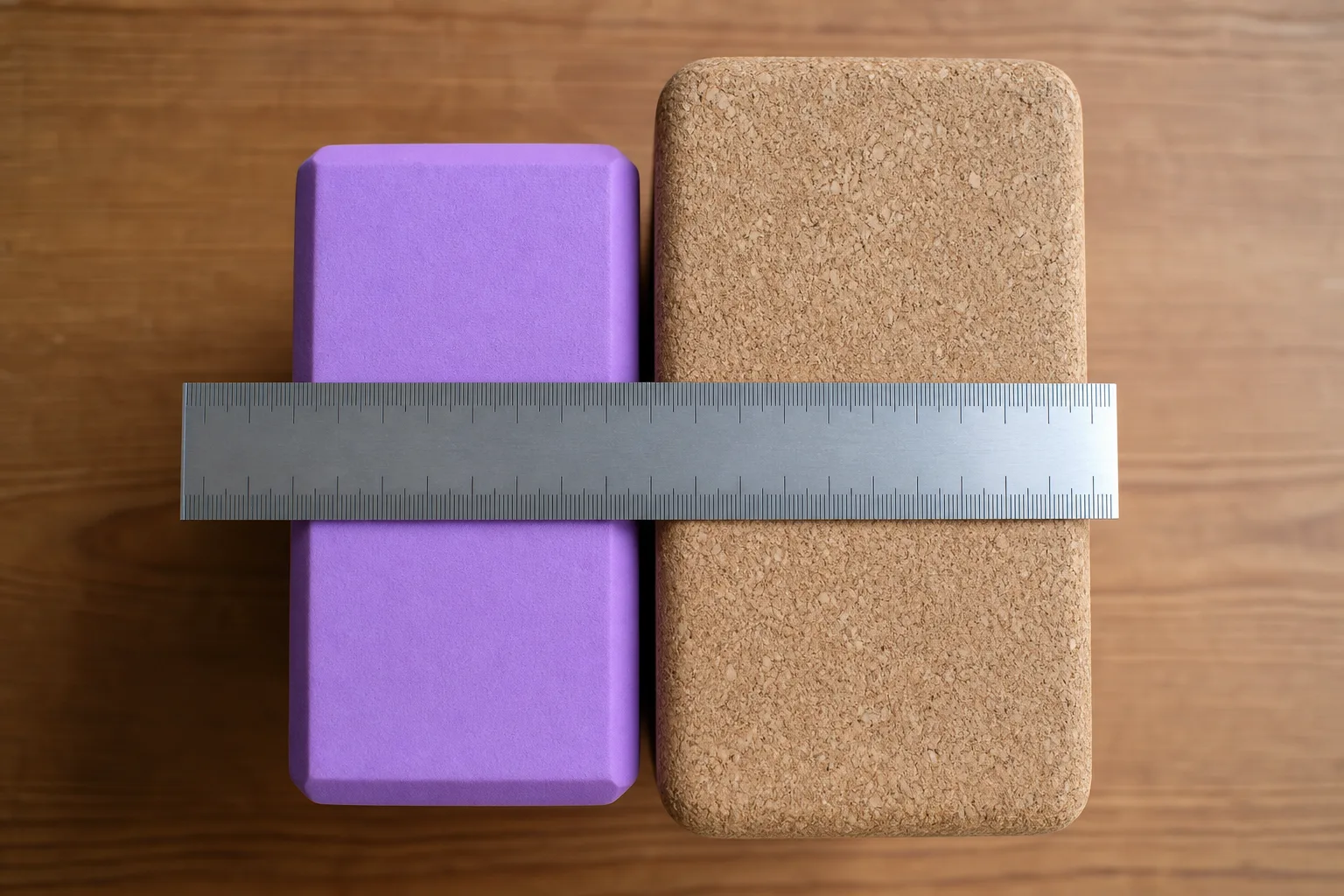
The 3-inch and 4-inch labels normally describe the shortest dimension of a full-length block. Both may retain a length near 9 inches and a width near 6 inches. Turned onto their broadest face, they therefore provide nominal heights of three or four inches. Turned to the other faces, both may provide six or nine inches.
That simple difference affects the object in several practical ways:
| Comparison | 3-inch full-length block | 4-inch full-length block |
|---|---|---|
| Low-face height | About 3 in / 7.6 cm | About 4 in / 10.2 cm |
| Broad low face | About 9 × 6 in | About 9 × 6 in |
| Narrow side face | About 9 × 3 in | About 9 × 4 in |
| End face | About 6 × 3 in | About 6 × 4 in |
| Nominal volume | 162 cubic in | 216 cubic in |
| Pair storage volume | About 324 cubic in | About 432 cubic in |
The 4-inch version has roughly one-third more geometric volume when the other dimensions are identical. That does not mean it weighs one-third more: foam density, cork granulation, hollow wood construction and moisture all change mass. It does mean the pair occupies more shelf or bag space.
A 3-inch block is not necessarily a “small” block. If it remains 9 × 6 inches, its broad face has the same footprint as the 4-inch version. It is more accurate to call it slim. Conversely, a mini block can be four inches thick but only six inches long, making it a different object from both full-length options.
Choose by complete geometry, not body type labels
Retail advice sometimes assigns a block size to a person’s height, hand size or flexibility. Those shortcuts are too vague to settle a purchase. Hand span does not tell you the required block height, and body height does not establish which orientations a class or teacher will request.
Use observable product criteria instead:
- Check the exact dimensions stated by the maker.
- Compare the narrowest face you may need to grip.
- Compare the flat contact area after rounded edges.
- Check whether your class, studio or existing pair uses a specific format.
- Measure the shelf, bag or travel space allocated to the pair.
If an individual physical setup matters, ask the qualified teacher or clinician responsible for that guidance. A shopping page can compare objects; it cannot determine an appropriate movement setup for a particular body.
Yoga block dimensions in inches and centimeters
Use exact conversion for comparison, then respect the maker’s listed dimensions when ordering.
| Inches | Exact centimeters | Common retail rounding |
|---|---|---|
| 3 in | 7.62 cm | 7.5 or 8 cm |
| 3.5 in | 8.89 cm | 9 cm |
| 4 in | 10.16 cm | 10 cm |
| 4.5 in | 11.43 cm | 11 or 11.5 cm |
| 5 in | 12.70 cm | 12.5 or 13 cm |
| 5.5 in | 13.97 cm | 14 cm |
| 6 in | 15.24 cm | 15 cm |
| 9 in | 22.86 cm | 23 cm |
| 12 in | 30.48 cm | 30 or 30.5 cm |
Do not combine rounded figures from two listings as if they describe different products. A block advertised as 9 × 6 × 4 inches and 23 × 15 × 10 cm can be internally consistent. The listing is simply using conventional rounded units.
Do investigate when the proportions change. A published 22 × 7 × 11 cm lean block is not a metric restatement of 9 × 6 × 4 inches. Its middle dimension is less than half as wide. That changes the footprint and storage profile materially.
How to verify a block’s real size
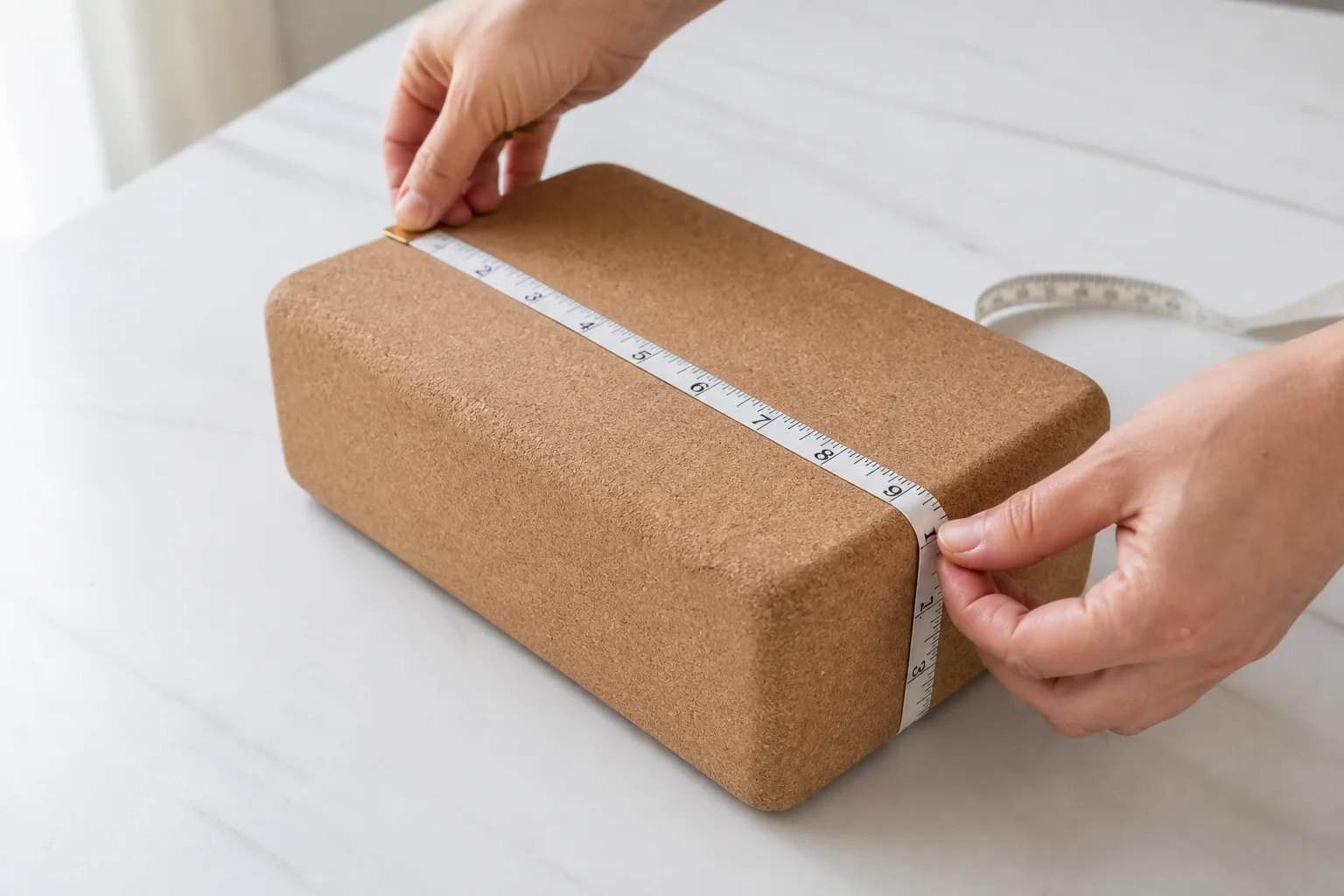
For an existing block, place it on a flat surface and measure the maximum distance along each axis:
- Length: the longest edge.
- Width: the longer of the two remaining edges.
- Thickness: the shortest edge.
Record the result as length × width × thickness, even if the retailer orders the numbers differently. A listing that says 4D × 6H × 9W describes the same rectangular envelope as 9 × 6 × 4 inches.
Use a rigid ruler or caliper for thickness when precision matters. A fabric tape can bow around the edge and overstate a straight dimension. Measure at the center and near both ends if the block appears tapered, compressed or warped. Do not compress foam while measuring.
Nominal size, actual size and tolerance
Nominal size is the convenient category name. Actual size is what the object measures. Manufacturing tolerance is the permitted difference between the target and delivered object. Consumer yoga-block listings rarely publish a tolerance, so do not invent one.
Small differences can arise from cutting, molding, sanding, edge rounding and unit conversion. Foam may also show localized compression after long storage under load. Cork can shed tiny particles at an edge without changing the useful size. Wood constructions may be solid or hollow, but the outside measurement alone will not reveal that.
If you need a visually matched pair, buy the pair together or verify the exact product code. Two “standard” blocks from different makers can differ in thickness, corner radius and surface profile. If you need stack-compatible studio inventory, sample and measure the current product before placing a large order.
Measure the flat contact area separately
Outer length and width are not always the same as the uninterrupted flat face. A large corner radius, chamfer or curved surface can reduce the area that sits flush against another block or shelf.
To compare flat faces, lay a straightedge across the surface and identify where the rounding begins. Record the uninterrupted length and width without treating the curved transition as flat. This extra measurement is useful for stacking, shelving and product photography; it is not commonly supplied by retailers.
Size and material are separate decisions
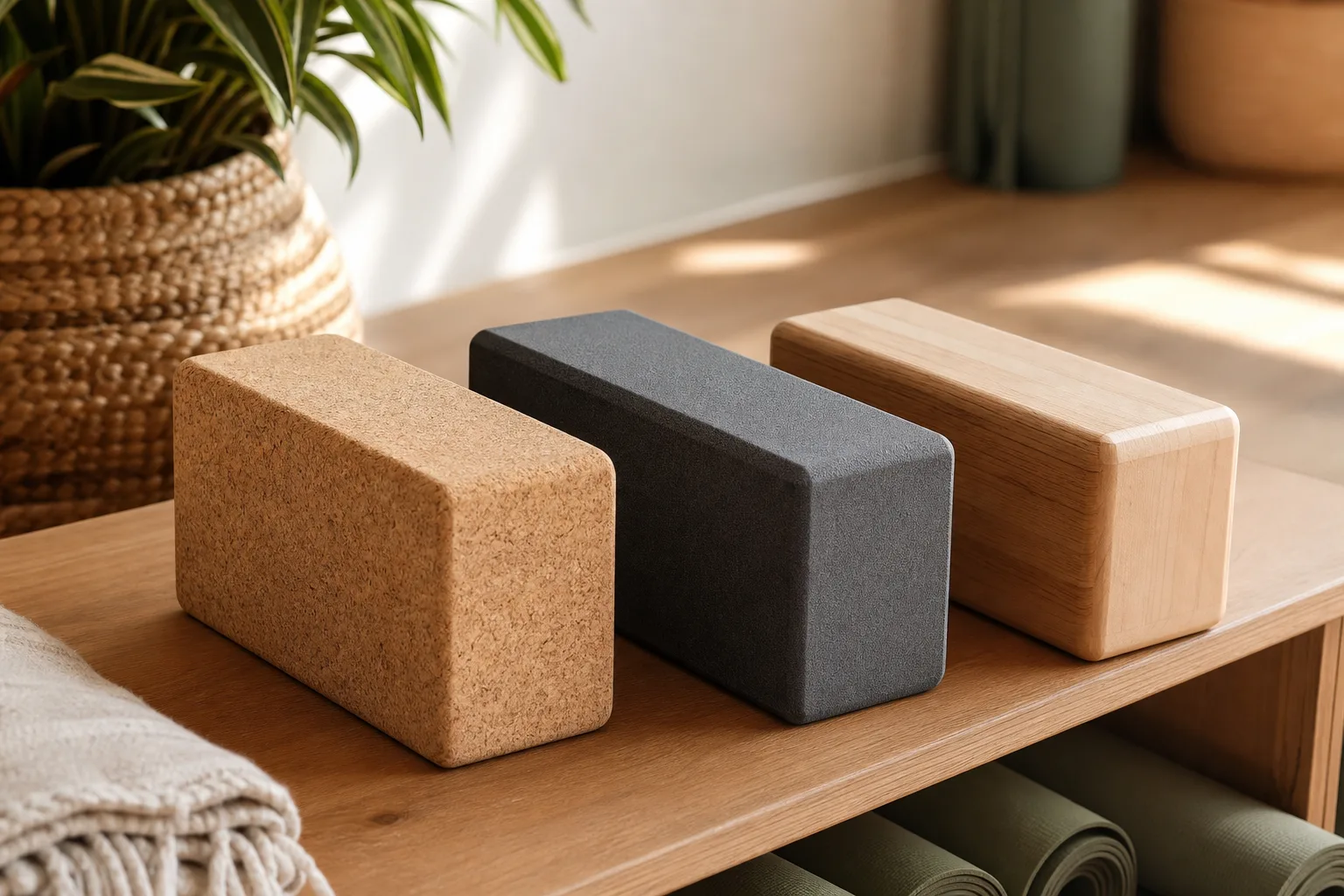
A dimension guide cannot tell you whether cork, foam or wood is the best material, but it can prevent a common comparison error: treating mass as a consequence of size alone.
For wood specifically, the wooden yoga block guide explains solid versus hollow construction, bamboo lamination, joinery, finishes and delivery inspection.
Current manufacturer examples make the distinction clear:
| Published example | Material | Published dimensions | Published weight |
|---|---|---|---|
| Manduka Cork Yoga Block | Fine-grain cork | 4 × 6 × 9 in | 2.2 lb / 1 kg |
| Gaiam Yoga Essentials Block | EVA foam | 9 × 6 × 4 in | 4.6 oz / 130 g |
| Hugger Mugger 4-inch Foam Block | Foam | 4 × 9 × 6 in | 0.8 lb / 363 g |
| Hugger Mugger Cork Block | Cork | 3.5 × 9 × 5.5 in | 1.65 lb / 748 g |
| Hugger Mugger Bamboo Block | Bamboo construction | 4 × 9 × 6 in | 2.25 lb / 1.02 kg |
These are specification examples, not product-performance test results. Designs, stock and listings can change. Follow the cited maker page for the current product before buying.
The table also shows why generic weight estimates are unreliable. Gaiam and Hugger Mugger both publish full-size foam blocks, yet the listed weights differ substantially. Density and construction matter. The practical rule is simple: record dimensions and weight as separate fields.
For a fuller material comparison and current buying shortlist, use Best Yoga Blocks: Foam vs Cork. That page owns product selection; this one owns geometry and measurement.
Mini, lean, half and oversized blocks
Alternative format names are not standardized. Read the numbers before the label.
Lean blocks
A lean block typically retains much of the standard length while reducing one or both cross-section dimensions. Manduka’s current EU collection provides a useful example: its Lean Cork and Lean Recycled Foam formats are listed at 22 × 7 × 11 cm, compared with 23 × 15 × 10 cm for its conventional full-size block.
The lean format is therefore not just one inch thinner. One face is dramatically narrower, while the other short dimension can be slightly larger. A listing photo viewed alone may hide that difference.
Mini or half blocks
Mini often means reduced length as well as width. Manduka lists its Mini Recycled Foam Yoga Block at 10 × 11.5 × 15 cm. Its 15 cm longest edge is roughly the width of a conventional full-size block. That makes it a compact format, not merely a thin version of the same footprint.
“Half block” can mean half-length, half-height or a specialty shape. Require all three dimensions. If a retailer supplies only one measurement, the format is not adequately specified for comparison.
Oversized blocks
Hugger Mugger lists a Big Foam Yoga Block at 5 × 12 × 6 inches. Compared with a 4 × 9 × 6-inch block, the longest edge gains three inches and the shortest gains one. Its nominal outer volume is 360 cubic inches versus 216 cubic inches—about two-thirds more space.
That difference affects cupboards and bags immediately. Oversized is a meaningful category only when the added dimensions solve a known equipment requirement. It should not be inferred from product photography.
Curved and contoured blocks
A contoured block can share the 9 × 6 × 4-inch maximum envelope while having fewer rectangular faces. The maximum dimensions remain useful for storage, but they do not describe every usable surface. Photograph the profile or inspect a dimensioned drawing when shelf fit, nesting or pairing matters.
Storage and travel calculations
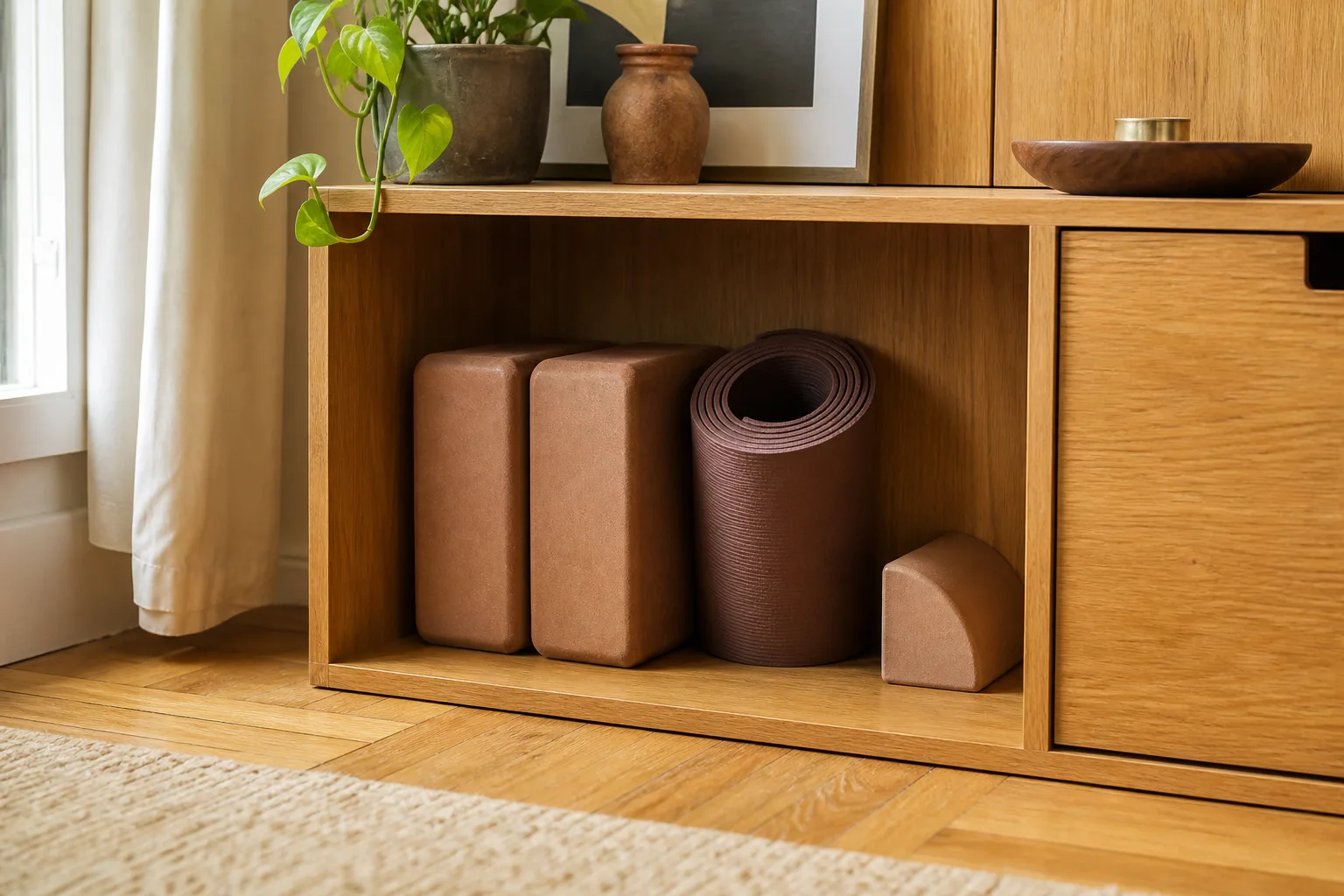
Measure storage with the pair, not one block. Two 9 × 6 × 4-inch blocks can be arranged several ways:
| Pair arrangement | Minimum rectangular envelope before clearance |
|---|---|
| Side by side on broad faces | 12 × 9 × 4 in |
| Side by side on narrow faces | 8 × 9 × 6 in |
| Stacked on broad faces | 9 × 6 × 8 in |
| End to end | 18 × 6 × 4 in |
Add clearance for rounded corners, doors, shelf lips and your fingers. A 12-inch internal opening is not comfortably usable for an exactly 12-inch pair. Fabric bags also taper around zippers and seams, so published exterior dimensions do not prove interior fit.
For travel, multiply the published weight as well as checking size. A pair of the cited Manduka cork blocks would be about 4.4 pounds before the bag, while a pair of Gaiam’s cited foam blocks would be about 9.2 ounces. That is a product-specific comparison, not a universal cork-versus-foam ratio.
If blocks share a bag with a mat, measure the bag’s usable interior cross-section. A “yoga mat bag with block pocket” may fit one slim block rather than two full-size blocks. Our best yoga mat bag guide covers bag construction; verify any pocket against the exact block pair.
A no-guesswork buying checklist
Before ordering, copy the following fields from the manufacturer rather than a marketplace title:
- Exact length × width × thickness
- Unit used by the maker
- Product weight per block
- Material and construction
- Quantity: single block or pair
- Flat, beveled, rounded or contoured faces
- Care and storage instructions
- Product code or variant name
- Return terms if fit cannot be checked locally
Convert units only for comparison. Keep the original maker values in your notes so rounding does not create a false mismatch. If a marketplace description conflicts with the manufacturer, ask the seller to identify the exact model rather than averaging the figures.
Do not infer size from color names or photographs. Product imagery may combine variants, use perspective that enlarges the foreground object or show an older version. A ruler in a generated editorial image—including those on this page—is visual context, not the source of a product specification. The cited maker data and your own measurement are authoritative for an actual purchase.
Bottom line
Use 9 × 6 × 4 inches (23 × 15 × 10 cm) as the common full-size reference. Choose a 3-inch version when the same full-length footprint with less thickness is the required format. Treat lean, mini, half, oversized and contoured as separate geometries whose names alone are insufficient.
The best record is a short one: three actual dimensions, one weight, one material and one product code. That is enough to compare storage, portability and compatibility without turning a familiar rectangle into a body-specific promise.
Frequently asked questions
What is the standard yoga block size?
The most common full-size retail block is approximately 9 × 6 × 4 inches, or 23 × 15 × 10 centimeters. A slimmer full-length format is usually about 9 × 6 × 3 inches. Exact dimensions vary by maker, so treat “standard” as a category and check the published measurements.
Is a 3-inch or 4-inch yoga block better?
Neither thickness is universally better. A 4-inch block creates a broader low face and one extra inch of height; a 3-inch block is slimmer to grip and pack. Compare the complete length, width, thickness, material and weight rather than choosing from the thickness label alone.
Are all yoga blocks 9 × 6 inches?
No. Many full-size blocks are close to 9 × 6 inches, but lean, mini, oversized and shaped blocks can be much narrower, shorter or longer. Even cork blocks sold as full size may measure 9 × 5.5 × 3.5 inches. Always verify the maker’s actual specification.
How do I measure a yoga block?
Measure the longest edge, the next-longest edge and the shortest edge at the widest points. Record the actual dimensions in one unit, note whether rounded edges affect the flat contact area, and weigh the block separately if portability matters.
Do yoga block dimensions include rounded edges?
Published dimensions normally describe the maximum outer envelope. Rounded or beveled edges can make the usable flat face slightly smaller. Product listings rarely publish that contact area, so inspect clear side photographs or measure the physical block when exact stacking compatibility matters.
Frequently asked questions
What is the standard yoga block size?
The most common full-size retail block is approximately 9 × 6 × 4 inches, or 23 × 15 × 10 centimeters. A slimmer full-length format is usually about 9 × 6 × 3 inches. Exact dimensions vary by maker, so treat “standard” as a category and check the published measurements.
Is a 3-inch or 4-inch yoga block better?
Neither thickness is universally better. A 4-inch block creates a broader low face and one extra inch of height; a 3-inch block is slimmer to grip and pack. Compare the complete length, width, thickness, material and weight rather than choosing from the thickness label alone.
Are all yoga blocks 9 × 6 inches?
No. Many full-size blocks are close to 9 × 6 inches, but lean, mini, oversized and shaped blocks can be much narrower, shorter or longer. Even cork blocks sold as full size may measure 9 × 5.5 × 3.5 inches. Always verify the maker’s actual specification.
How do I measure a yoga block?
Measure the longest edge, the next-longest edge and the shortest edge at the widest points. Record the actual dimensions in one unit, note whether rounded edges affect the flat contact area, and weigh the block separately if portability matters.
Do yoga block dimensions include rounded edges?
Published dimensions normally describe the maximum outer envelope. Rounded or beveled edges can make the usable flat face slightly smaller. Product listings rarely publish that contact area, so inspect clear side photographs or measure the physical block when exact stacking compatibility matters.