

How this page has changed
July 26, 2026
Sources, internal links and safety or product context reviewed.
In this guide
- 01Wooden yoga blocks at a glance
- 02Solid versus hollow wooden yoga blocks
- 03Bamboo versus timber
- 04Dimensions and weight: compare the actual products
- 05Finish, edges and joinery
- 06A practical pre-purchase specification
- 07Cleaning and care
- 08Delivery-day inspection checklist
- 09Wooden blocks versus cork and foam
- 10Bottom line
- 11Frequently asked questions
A wooden yoga block is a rigid prop made from solid timber, laminated timber panels or a hollow plant-based shell such as laminated bamboo. The category looks simple, but two blocks with similar photographs can differ sharply in weight, dimensions, joinery, edge radius, surface finish and repairability.
The most important buying question is not “wood or bamboo?” It is what exactly is the construction? A solid paulownia block behaves as one piece of lightweight timber. A hollow bamboo block depends on panels, corners and adhesive joints. A heavy bamboo model may be sturdier or simply larger; a light model may be hollow rather than low quality.
This guide compares the physical product. It does not prescribe pose setup, alignment or therapeutic use. Our yoga block size guide owns 3-inch versus 4-inch geometry and metric conversion. Best yoga blocks owns the general foam-versus-cork shortlist.
Wooden yoga blocks at a glance
| Construction | What it is | Useful evidence to request | Main inspection point |
|---|---|---|---|
| Solid single-piece timber | One shaped piece of wood | Species, dimensions, weight, finish | Checks, warping, end grain and splinters |
| Solid laminated timber | Glued strips or boards forming a solid block | Species, adhesive/finish disclosure, weight | Open glue lines, delamination and surface flatness |
| Hollow bamboo shell | Bamboo-faced panels joined around an internal void | Wall construction, dimensions, weight, warranty | Panel flex, corner seams, rattles and impact damage |
| Hollow wood shell | Timber or veneered panels around a void | Panel and frame construction, finish, weight | Loose panels, seams and crushed corners |
| Unspecified “wood” | Listing omits species and build method | Ask seller before buying | Treat every important property as unknown |
A product being rigid does not prove it is solid. Hugger Mugger explicitly describes its current bamboo block as hollow, at 4 × 9 × 6 inches. Barefoot Yoga also describes its 9 × 5.5 × 3.5-inch bamboo block as hollow. By contrast, iPaulownia identifies its 22.5 × 10.5 × 7.5 cm block as solid paulownia.
Those are three different constructions and sizes. “Natural wood block” is therefore not a sufficient specification.
Solid versus hollow wooden yoga blocks
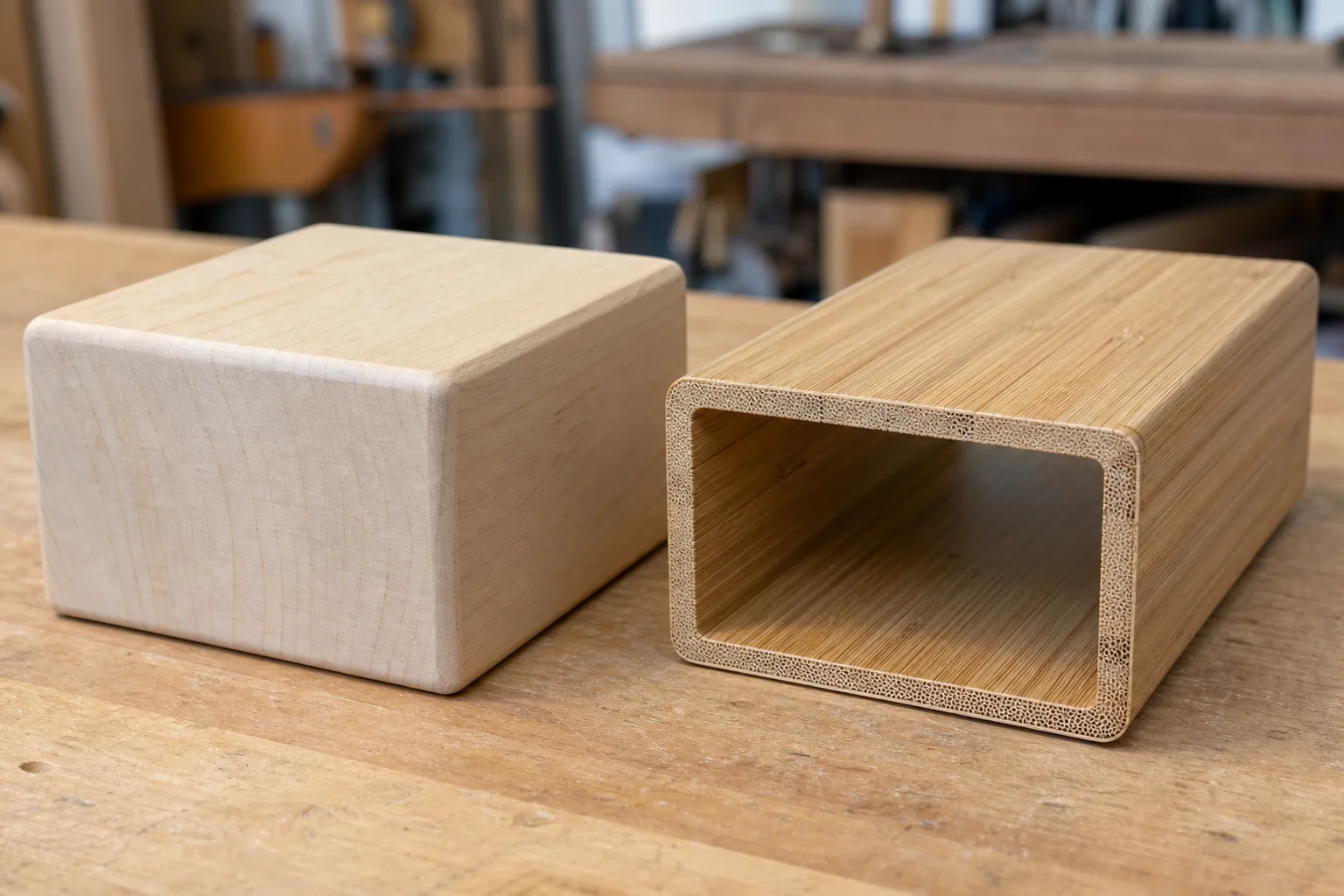
Solid construction
A true solid block contains wood throughout its outer volume. It may be one piece, or it may be laminated from multiple pieces. Those are not the same build, and “solid wood” should not be assumed to mean single-piece.
Single-piece timber exposes continuous grain on each face, with end grain on the cut ends. Laminated construction shows repeated strips or glue lines. Lamination is not automatically a defect; engineered panels and laminated bamboo rely on adhesive by design. The relevant questions are whether the construction is disclosed, the seams are closed and the finished object remains flat and intact.
Species strongly affects mass. Paulownia is marketed specifically for low weight, while dense hardwoods can make a block inconveniently heavy. Pine products vary with species and moisture. A seller that identifies only “natural wood” leaves density, origin and finish uncertain.
Hollow construction
A hollow block uses less material in its center. Panels form the outer faces and connect at edges, corners or an internal frame. This can reduce mass substantially, but performance depends on the full assembly rather than the face material alone.
Look for:
- A stated hollow construction rather than inference from weight
- Closed, even corner seams
- No panel bowing or soft spots
- No loose object rattling inside
- Consistent edge rounding
- A finish that covers faces and transitions evenly
- Warranty terms that address separation or manufacturing defects
Do not assume every hollow model is lighter than every solid one. The Hugger Mugger bamboo block is described as hollow but listed at 2.25 pounds in the brand’s current prop guide. Barefoot Yoga lists its smaller hollow bamboo block at 1.5 pounds. Dimensions and panel construction differ.
Which construction should you buy?
Choose from verifiable requirements rather than a universal winner. Solid construction reduces reliance on a thin shell, while hollow construction can reduce material and travel weight. Either can be poorly made; either can be durable when properly designed.
For home storage, compare actual weight and footprint. For frequent transport, check the pair’s total weight. For shared studio inventory, prioritize repeatable dimensions, finish consistency, replaceability and warranty support. If a class or qualified teacher requires a particular prop, match that specification rather than substituting based on appearance.
Bamboo versus timber
Bamboo is a grass, not a tree, but retailers commonly place bamboo blocks within the wooden-block category because the finished product is hard, grain-visible and rigid. That retail grouping should not obscure the actual build.
Most bamboo products are engineered. Strips are laminated into boards or shells, so adhesive and finish are part of the object. “Bamboo” does not mean an unprocessed block cut directly from a single bamboo stem. A rectangular block with broad flat faces must be manufactured from smaller elements.
Timber blocks may use paulownia, pine, maple or another named species. They can be single-piece, laminated or hollow. A named species improves traceability but does not prove sourcing, low emissions or durability.
| Claim on listing | What it establishes | What it does not establish |
|---|---|---|
| “Bamboo” | Primary visible plant material | Adhesive, coating, wall thickness, sourcing or lifecycle impact |
| “Solid wood” | No intentional central void if accurate | Single-piece build, species, moisture or finish |
| “Natural” | No consistent technical meaning by itself | Chemical-free, certified, untreated or sustainable |
| “Eco-friendly” | Marketing position | Verified environmental benefit without scope and evidence |
| “Sustainably sourced” | A claim requiring substantiation | Certification, chain of custody or exact source unless supplied |
| “Non-slip” | Intended surface behavior | Performance on every mat, floor, moisture level or orientation |
Treat environmental language with the same discipline as dimensions. Ask which certification applies, which component it covers and whether the claim refers to feedstock, factory energy, packaging or finished-product durability. A fast-growing plant is not a complete lifecycle assessment.
Dimensions and weight: compare the actual products
The yoga block size guide explains nominal 3-inch and 4-inch formats in detail. Wooden blocks add another variable: many current examples are slimmer than the common 9 × 6 × 4-inch foam block.
| Current published example | Construction/material | Dimensions | Published weight |
|---|---|---|---|
| Hugger Mugger Bamboo Yoga Block | Hollow bamboo | 4 × 9 × 6 in | 2.25 lb in brand prop guide |
| Barefoot Yoga Bamboo Block | Hollow bamboo | 9 × 5.5 × 3.5 in | 1.5 lb |
| iPaulownia Wood Yoga Block | Solid paulownia | 22.5 × 10.5 × 7.5 cm | Not stated on cited page |
The absence of a weight is itself useful buying information. Do not fill it with a generic estimate. Ask the seller or weigh a sample.
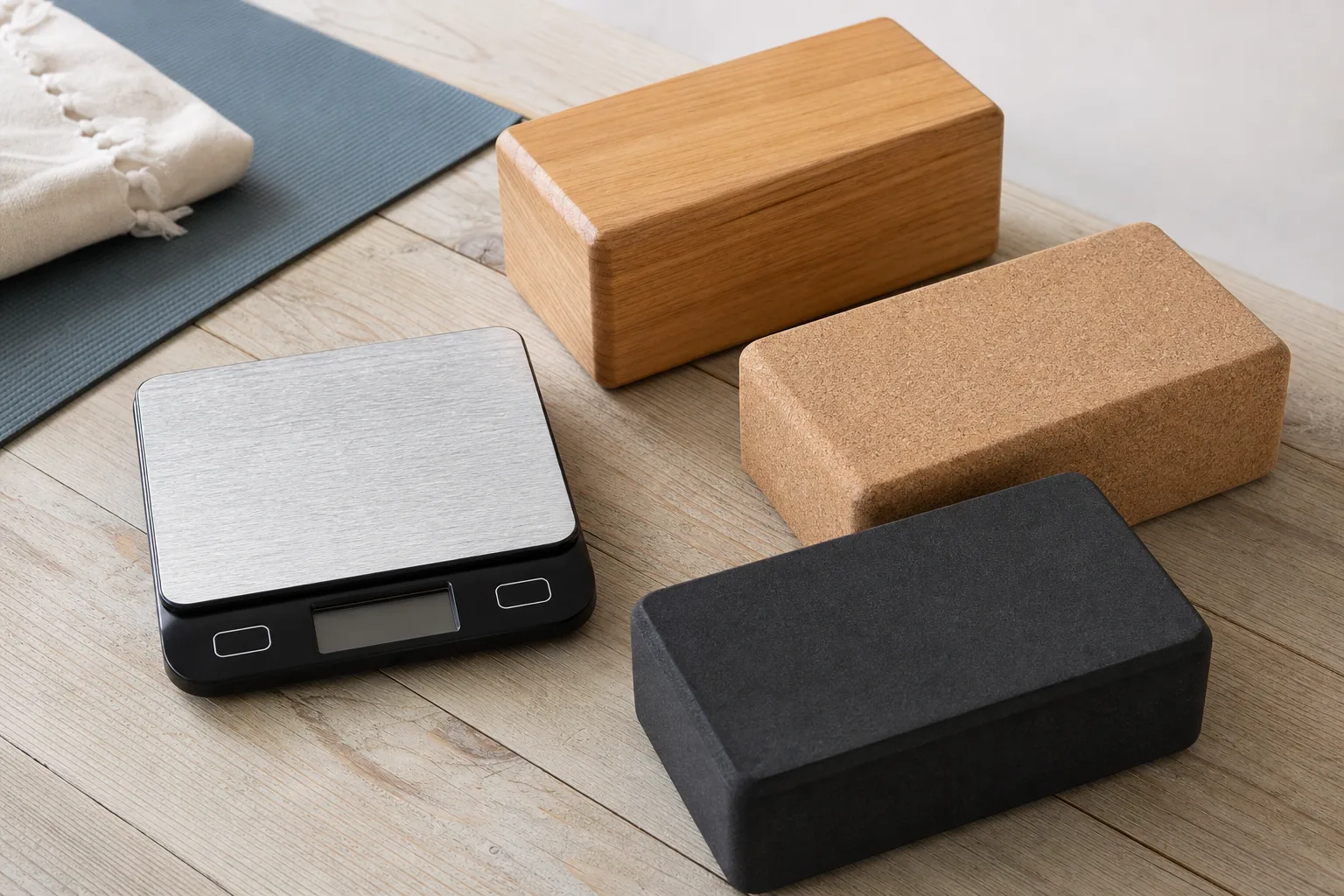
Pair weight matters
Blocks are often sold or used as a pair, while product pages may state weight per item. Confirm the unit and quantity. A 2.25-pound block creates a 4.5-pound pair before adding a bag. A 1.5-pound block creates a 3-pound pair.
Shipping weight may include packaging, and marketplace fields sometimes combine package and item data. Prefer the manufacturer’s explicit “product weight” or ask for net item weight. If portability matters materially, weigh the delivered product during the return window.
Volume is not density
You cannot compare density unless you know both true material volume and mass. A hollow block’s outer volume includes air. Dividing its weight by the outer box volume produces an apparent density for the complete object, not the density of bamboo or wood.
For consumers, there is no need to calculate material density. Compare actual product weight, outer dimensions and stated construction. Those fields answer carrying and storage questions without pretending to reverse-engineer the shell.
Finish, edges and joinery
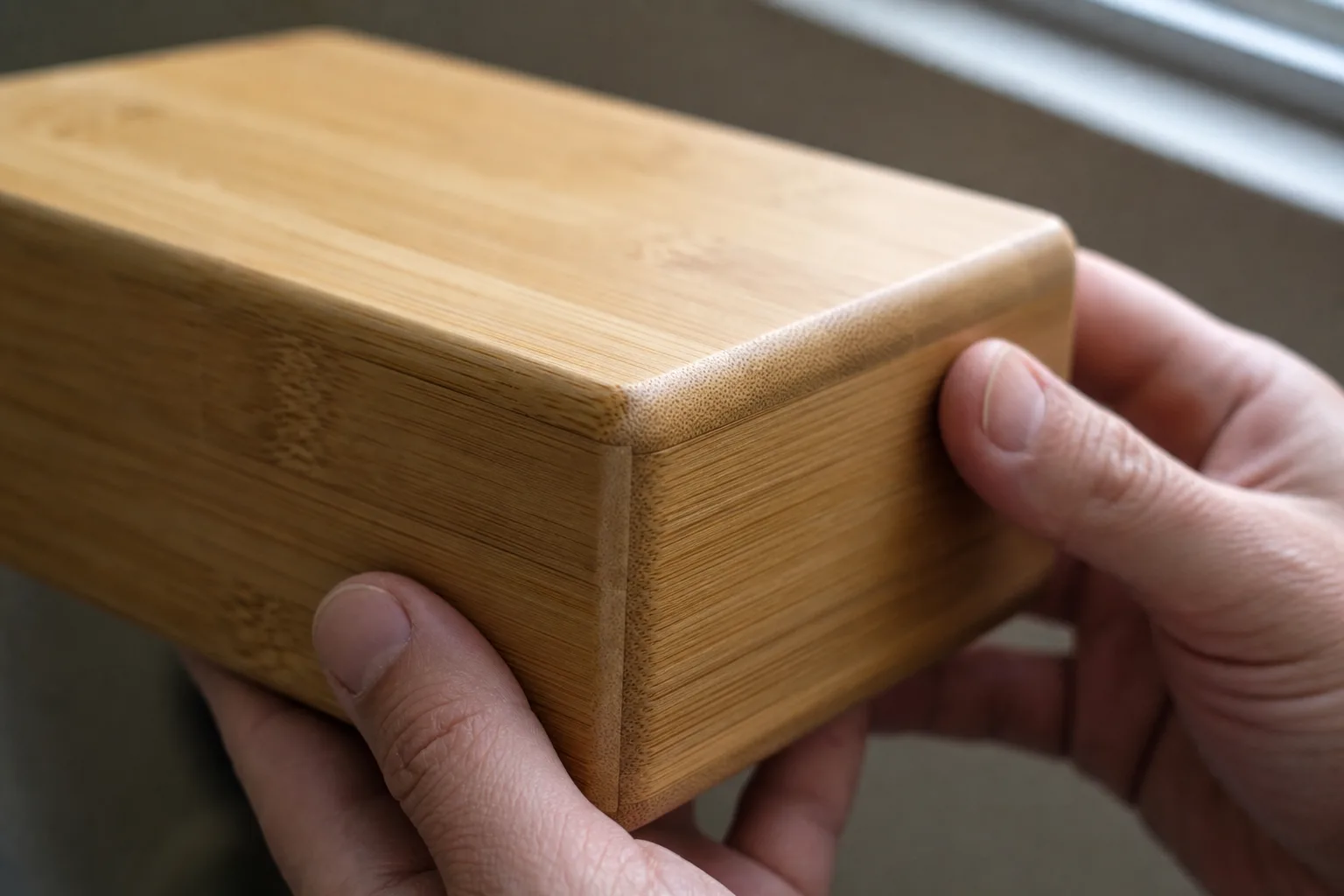
A wooden block is a contact object. Its faces, edges and corners deserve the same attention as its material.
Edge radius
Rounded edges remove a sharp 90-degree corner. Listings may describe them as rounded, radiused, beveled or contoured without giving a dimension. Compare clear close-up images from multiple angles. A generous radius reduces the uninterrupted flat face; a tiny bevel changes the corner feel while preserving more flat area.
Do not infer comfort or suitability for a person from the phrase “rounded edge.” That is an individual and setup-specific decision. The objective product fact is the geometry.
Surface finish
Common descriptions include satin, lacquered, oiled, sealed, smooth and unfinished. Each implies different care, but marketing language can be incomplete. Request the exact finish when allergies, indoor-emissions preferences, refinishing or cleaner compatibility matter.
iPaulownia states that its current solid block receives an organic vegetable-oil finish. Hugger Mugger describes a satiny finish on its bamboo model. These are product-specific statements, not care instructions for all wood blocks.
An apparently unfinished surface may still have a clear coating. Conversely, an oil-finished product may require no routine re-oiling. Never add furniture polish, mineral oil, essential oils or finish-restoration products without manufacturer guidance. They can change grip, transfer to a mat or interfere with an existing coating.
Joinery and seams
On laminated and hollow products, examine the seams under raking light:
- A dark line can be grain or a glue line; look for actual separation.
- Press gently near panel centers and seams for unexpected movement.
- Set the block on each broad face and check for rocking on a known-flat surface.
- Look for squeeze-out, gaps, lifted veneer and crushed corners.
- Compare the two blocks in a pair for height and flatness.
Do not conduct destructive tests or pry at joints. If a new product arrives with an open seam, photograph it and use the return or warranty process.
A practical pre-purchase specification
Copy these fields before choosing a wooden yoga block:
| Field | Adequate answer | Weak answer |
|---|---|---|
| Construction | Solid single-piece, solid laminated or hollow shell | “Premium wood” |
| Material | Named timber species or bamboo construction | “Natural material” |
| Dimensions | Three measurements with units | “Standard size” |
| Weight | Net weight per block | Shipping weight without quantity |
| Finish | Named coating/oil or explicitly unfinished | “Smooth eco finish” |
| Edge profile | Clear multi-angle photos or stated radius/bevel | One front rendering |
| Quantity | One block or pair | Ambiguous plural title |
| Care | Maker-specific written method | Generic marketplace advice |
| Warranty | Term and defect process | No manufacturer identity |
This is a category where product photos can be especially misleading. A laminated bamboo surface may resemble solid timber. A hollow block can look solid from every closed face. Image generation can illustrate concepts—as on this page—but cannot document a specific commercial product. Use the cited manufacturer specifications and the delivered item for purchase decisions.
Avoid unsupported load claims
Many listings say “strong,” “sturdy” or “supports body weight” without publishing a test method, load orientation, safety factor or standard. Do not convert those adjectives into a numeric capacity.
If a product will be used in a way that makes structural capacity safety-critical, require explicit manufacturer guidance and qualified instruction. This page does not validate load-bearing performance. Visible damage, looseness or unexpected flex is a reason to stop and consult the maker.
Cleaning and care
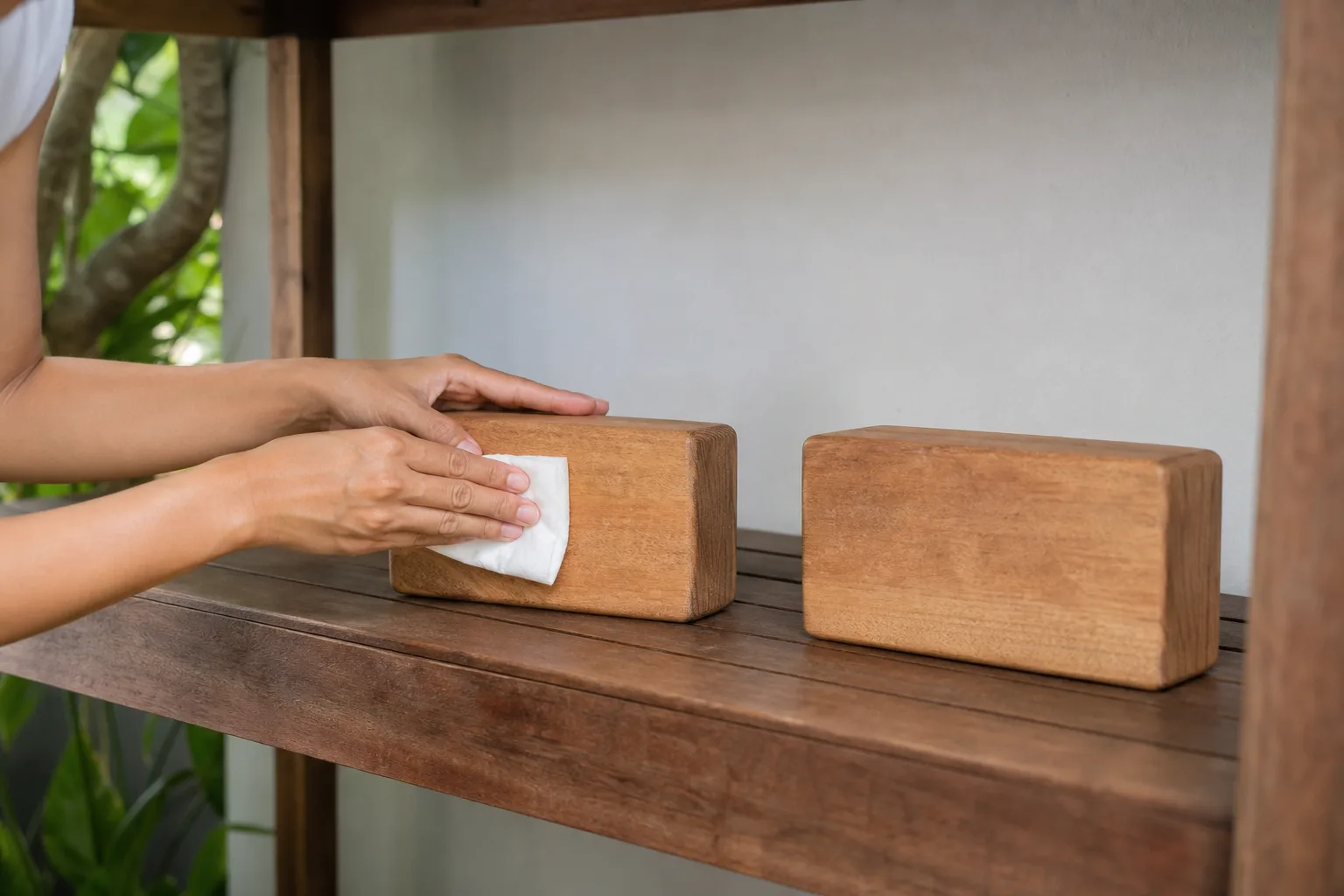
Wood, bamboo lamination, adhesive and coating react differently to moisture and chemicals. Manufacturer instructions override generic advice.
When no specific method is available, the low-intervention approach is:
- Remove loose dust with a dry soft cloth.
- Wipe with a barely damp lint-free cloth rather than saturating the surface.
- Dry the complete surface promptly.
- Leave air around the block away from prolonged direct sun, radiators and damp floors.
- Store only when dry.
This is conservative surface care, not disinfection guidance. If shared-facility hygiene requires a specific disinfectant, confirm coating and adhesive compatibility with the manufacturer. A cleaner safe for sealed furniture is not automatically validated for every laminated bamboo block.
Avoid soaking and dishwashers
Immersion allows water to reach seams, end grain and any damage in the finish. Dishwashers add heat, extended moisture and detergent. Unless the maker explicitly authorizes those methods, do not use them.
Do not sand a finished block casually
Sanding changes dimensions, edge geometry and coating continuity. It can expose adhesive or veneer, and the dust may require controls based on the material and finish. A splintering or damaged purchased block should be handled through the manufacturer rather than improvised repair when it remains under warranty.
Storage
Store blocks dry with airflow and without a heavy object pressing on a hollow panel. Avoid a location where they can fall onto feet or hard flooring. For a matched pair, keep both in the same humidity and light conditions so appearance and dimensions age together.
Our yoga props guide covers category-level storage planning. For exact pair envelopes, use the block size guide.
Delivery-day inspection checklist
Inspect a new block before removing tags or discarding packaging:
- Confirm the model, quantity, material and published dimensions.
- Weigh each block if weight influenced the purchase.
- Compare pair height on a flat surface.
- Check every face for cracks, dents, lifting veneer and finish defects.
- Run a cloth—not bare skin—lightly along edges to detect snagging.
- Check seams for gaps or movement.
- Gently rotate a hollow block and listen for loose material.
- Photograph damage and packaging before contacting the seller.
Natural color and grain variation are not automatically defects. Open joints, sharp splinters, rocking, loose panels and unexpected structural movement are different. Use the seller’s published tolerances and warranty terms to resolve borderline cases.
Wooden blocks versus cork and foam
This page does not reopen the full product ranking, but the material boundary should be clear.
| Property | Wooden or bamboo construction | Cork block | Foam block |
|---|---|---|---|
| Rigidity | Usually very high | High, with limited surface give | Varies with density |
| Construction | Solid, laminated or hollow | Molded/agglomerated cork or other stated construction | Molded foam |
| Weight | Highly variable by species and build | Often moderate to heavy | Usually light, but varies |
| Seams | Possible on laminated/hollow products | Usually no panel seams | Usually no panel seams |
| Finish | May be oil, lacquer, sealant or unfinished | Typically exposed cork surface | Molded skin/texture |
| Impact behavior | Hard surface and edges | Firm granular surface | More forgiving surface |
| Primary inspection | Cracks, seams, splinters, coating | Crumbling, cracks, odor, flatness | Cuts, compression, deformation |
There is no honest universal winner. The better product is the one whose verified construction, dimensions, mass, finish and care match the actual requirement. For broader buying choices, return to best yoga blocks.
Bottom line
Buy a wooden yoga block from its specification, not its grain photograph. Identify whether it is solid, laminated or hollow; record the exact material, dimensions and per-block weight; inspect edge rounding, seams and finish; and follow the maker’s care instructions.
Bamboo belongs in this comparison because it is sold as a rigid wood-like block, but the word alone reveals little about the shell or adhesive system. Likewise, “solid wood” is incomplete without species, mass and finish.
The strongest listing is pleasantly boring: it names the build, gives all three dimensions, states net weight, shows every face, identifies the coating and explains warranty and care.
Frequently asked questions
Are wooden yoga blocks solid or hollow?
They can be either. Solid blocks may be cut from one timber piece or laminated from multiple pieces. Bamboo blocks are commonly hollow shell constructions to reduce weight, but bamboo can also be laminated into solid components. A product page should state the construction explicitly.
Is bamboo a wood yoga block?
Retailers commonly group bamboo blocks with wooden blocks because both are rigid plant-based constructions. Botanically, bamboo is a grass rather than timber. For buying purposes, construction, wall thickness, seams, finish, dimensions and weight are more informative than the category label.
How heavy is a wooden yoga block?
Weight varies widely with species, moisture, dimensions and hollow or solid construction. Current published examples range from about 1.5 pounds for a hollow 9 × 5.5 × 3.5-inch bamboo block to about 2.25 pounds for a 4 × 9 × 6-inch hollow bamboo block. Check the exact product rather than applying one generic weight.
How should I clean a wooden yoga block?
Follow the maker’s care instructions and finish specification. As a conservative default, wipe the surface with a barely damp soft cloth, avoid soaking and dry it promptly with airflow away from prolonged heat or direct sun. Do not apply oil, cleaner or disinfectant unless the manufacturer confirms compatibility.
What should I inspect on a wooden yoga block?
Inspect every face and edge for splinters, sharp corners, open seams, cracks, rocking, swelling, finish wear and loose panels. For a hollow block, listen for movement inside and press each panel gently for unexpected flex. Stop using a damaged product and follow the seller’s warranty process.
Frequently asked questions
Are wooden yoga blocks solid or hollow?
They can be either. Solid blocks may be cut from one timber piece or laminated from multiple pieces. Bamboo blocks are commonly hollow shell constructions to reduce weight, but bamboo can also be laminated into solid components. A product page should state the construction explicitly.
Is bamboo a wood yoga block?
Retailers commonly group bamboo blocks with wooden blocks because both are rigid plant-based constructions. Botanically, bamboo is a grass rather than timber. For buying purposes, construction, wall thickness, seams, finish, dimensions and weight are more informative than the category label.
How heavy is a wooden yoga block?
Weight varies widely with species, moisture, dimensions and hollow or solid construction. Current published examples range from about 1.5 pounds for a hollow 9 × 5.5 × 3.5-inch bamboo block to about 2.25 pounds for a 4 × 9 × 6-inch hollow bamboo block. Check the exact product rather than applying one generic weight.
How should I clean a wooden yoga block?
Follow the maker’s care instructions and finish specification. As a conservative default, wipe the surface with a barely damp soft cloth, avoid soaking and dry it promptly with airflow away from prolonged heat or direct sun. Do not apply oil, cleaner or disinfectant unless the manufacturer confirms compatibility.
What should I inspect on a wooden yoga block?
Inspect every face and edge for splinters, sharp corners, open seams, cracks, rocking, swelling, finish wear and loose panels. For a hollow block, listen for movement inside and press each panel gently for unexpected flex. Stop using a damaged product and follow the seller’s warranty process.