

How this page has changed
July 26, 2026
Sources, internal links and safety or product context reviewed.
In this guide
- 01Yoga sandbags at a glance
- 02The three-part system
- 03Filled versus empty
- 04Rectangular versus square
- 05How much weight?
- 06How to fill an empty yoga sandbag
- 07Handles, seams and closures
- 08Cleaning and inspection
- 09Sandbag versus bolster, blanket and exercise weight
- 10Claims to reject
- 11Buying checklist
- 12The verdict
- 13Frequently asked questions
A yoga sandbag is a compact weighted prop, not a strength-training sandbag. The strongest buying choice for most homes is an adjustable 10-pound-capacity rectangular model with a removable washable outer cover, separate coated inner liner, secure closure and reinforced handle. Buy filled when convenience matters; buy empty when shipping cost and adjustable load matter more.
This guide compares current manufacturer specifications and does not claim hands-on testing. It deliberately does not teach body placement or promise relaxation, pain relief, deeper stretching or therapeutic outcomes. A weighted object can create significant localized load; use it only in the way a qualified instructor or appropriate clinician has approved for you.
Yoga sandbags at a glance
| Format | Source-checked example | Published specification | Filled? | Main trade-off |
|---|---|---|---|---|
| Adjustable rectangular | b, halfmoon 10lb Cover | 15 × 10 in; 10 lb capacity | No; cover only | Liner and fill setup must be confirmed |
| Ready-to-use rectangular | Hugger Mugger 10 lb | 15 × 7 × 3 in; 10 lb | Yes; silica sand | Higher shipping burden |
| Washable nylon filled | Bean Products 10 lb | 10 lb; dual handles | Yes; dust-free sand | Nylon feel; dimensions not clearly published |
| Large empty system | iYogaprops 5kg | 42 × 20 cm; 5 kg capacity | No; liner included | User must source clean dry sand |
| Square heavy format | Sun and Moon Square | 12 × 12 in; 14 lb | Filled option | Heavier and broader than common 10 lb bags |
These are construction examples, not rankings based on physical trials. Availability and specifications can change; verify the exact option in the seller’s selector before ordering.
The three-part system
The best-designed adjustable models separate the surface you touch from the component that contains abrasive granular fill.
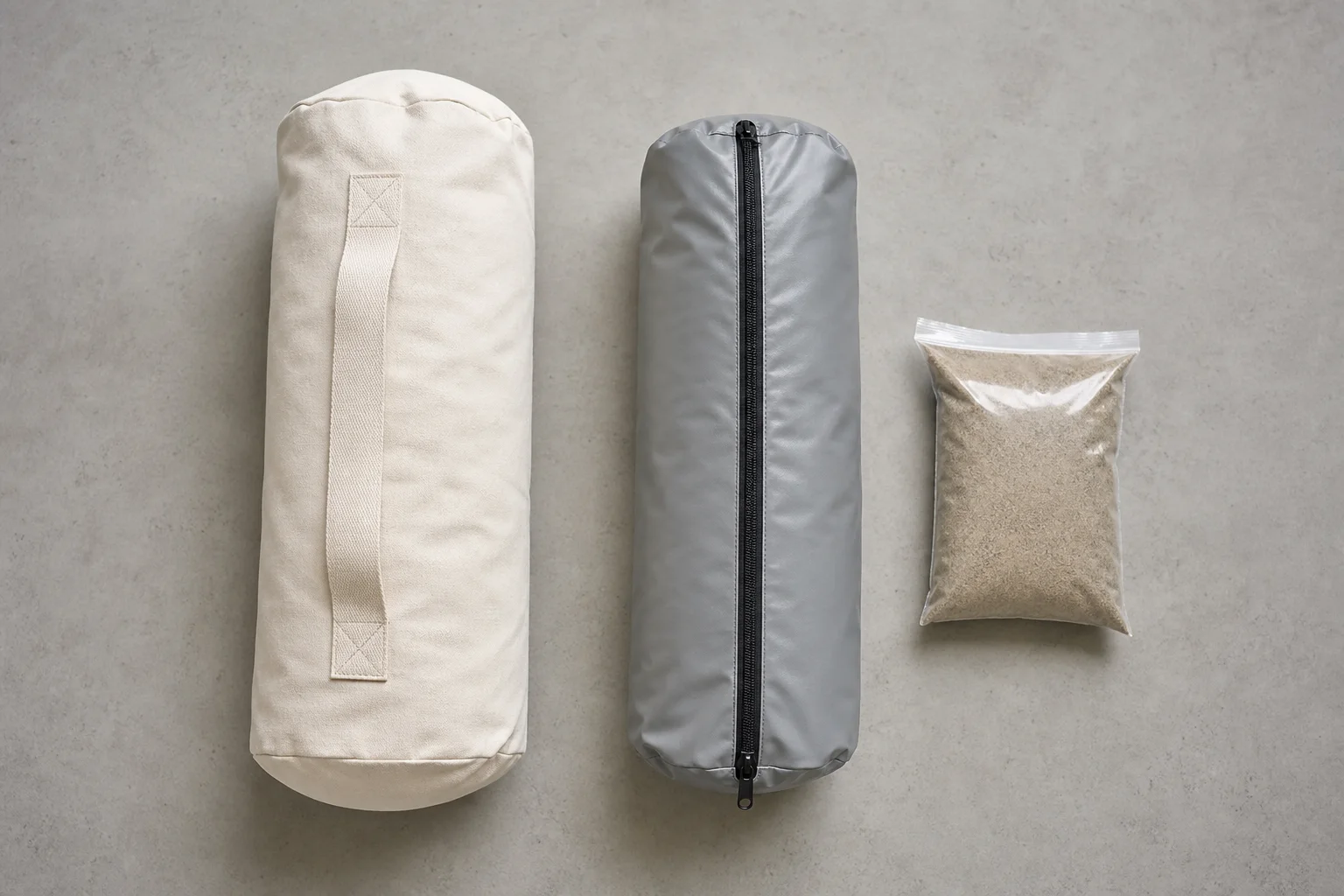
Outer cover
The outer cover manages abrasion, handling and routine cleaning. Dense cotton twill feels different from nylon pack cloth, but fiber name alone does not prove strength. Inspect seam allowance, stitching density, zipper protection and whether the handle is anchored into a structural seam.
b, halfmoon specifies 65% polyester and 35% cotton for its outer cover. Bean Products uses nylon pack cloth. Hugger Mugger’s listing describes a removable cover around silica fill. Those are meaningfully different constructions even when every product is marketed as a 10-pound sandbag.
Inner liner
The liner’s job is containment. A coated nylon or synthetic liner reduces the chance that fine grains migrate through the decorative textile. It should have its own closure and enough empty volume for sand to redistribute without forcing the zipper or seams.
iYogaprops publishes an inner bag with a filling spout and cord tie. b, halfmoon publishes a 100% nylon liner with PU coating, although its listing calls the item a cover-only product; confirm exactly what ships in the selected market. Sun and Moon describes a lined, plastic-sealed system with a zippered self-fill liner.
Fill
Fill is not interchangeable by assumption. Hugger Mugger uses silica sand; Yogistar publishes quartz sand; iYogaprops recommends clean, dry sandpit sand. Grain size, moisture and density influence dust, flow and final mass.
Use only the maker-approved material. Never use damp beach sand: moisture can introduce odor, staining and microbial growth, while collection may be illegal. Avoid gravel, sharp aggregate and food such as rice or beans unless the manufacturer explicitly permits them; food can attract pests and changes with humidity.
Filled versus empty
An empty sandbag is cheaper to ship and lets you choose a lower starting mass. A filled model eliminates the mess and uncertainty of sourcing, weighing and sealing material.
| Question | Filled model | Empty model |
|---|---|---|
| Ready immediately? | Yes | No |
| Shipping weight | High | Low |
| Load adjustable before use | Sometimes, if liner opens | Yes |
| Fill provenance known | Only if disclosed | You select it |
| Filling equipment needed | No | Funnel, scale and containment tray |
| Spill risk during setup | Low | Higher |
Do not confuse capacity with delivered weight. The b, halfmoon item is titled for 10 lb but arrives empty and requires sand. iYogaprops holds 5 kg—about 11 lb—and also arrives empty. Sun and Moon offers both filled and unfilled rectangular variants, plus a filled square version.
An unusually low price often means you are buying only the outer shell. Check the variant name, package weight and “sand not included” language before comparing prices.
Rectangular versus square
Most yoga sandbags are rectangular because the long footprint distributes granules across a wider area and packs neatly on a shelf. Square models concentrate the same or greater mass in a shorter footprint.
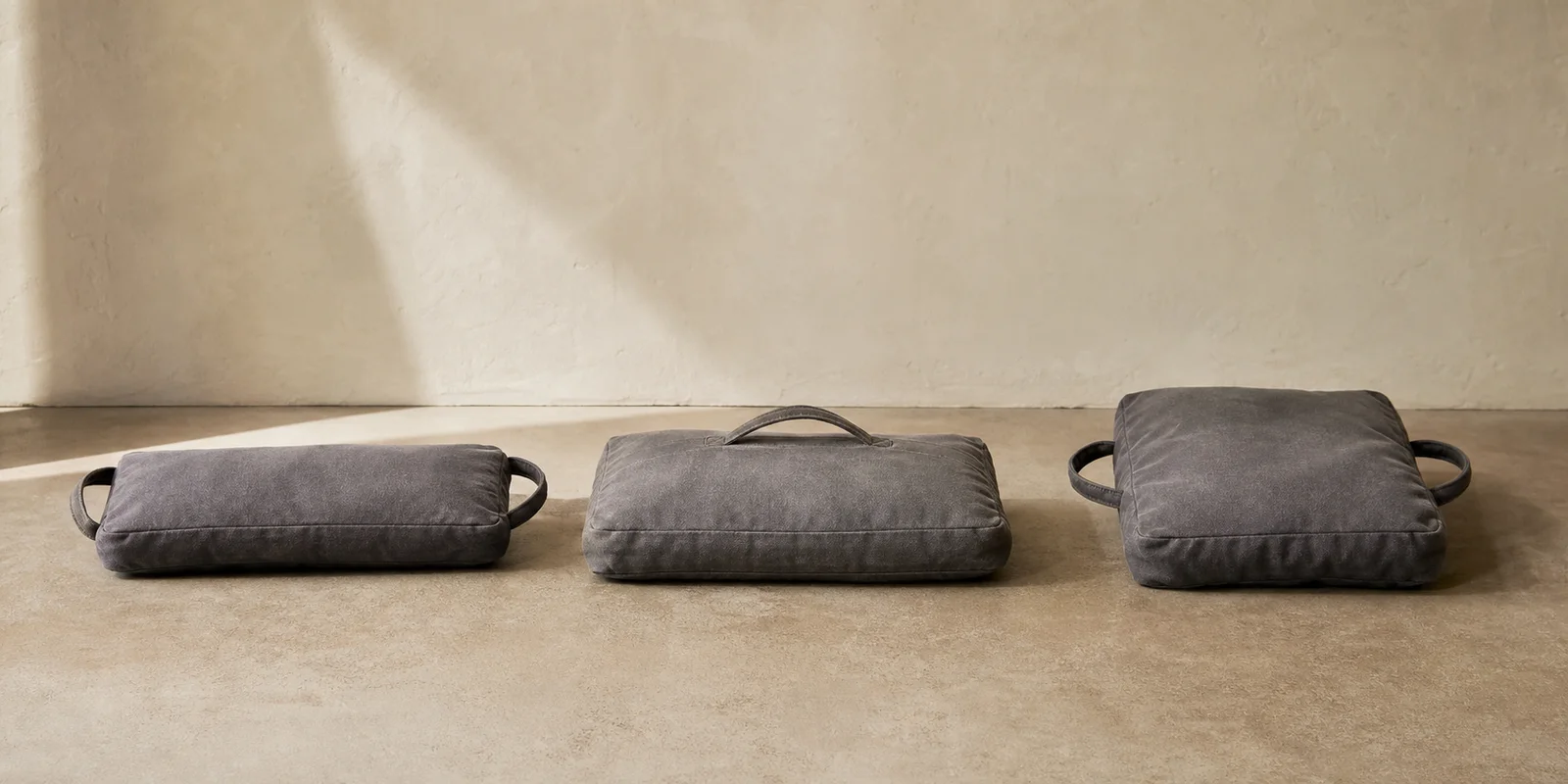
Hugger Mugger’s filled 10-pound model measures 15 × 7 × 3 inches. b, halfmoon publishes 15 × 10 inches for its 10-pound-capacity cover. iYogaprops measures 42 × 20 centimeters, approximately 16.5 × 7.9 inches, for a 5 kg capacity.
Sun and Moon provides the clearest shape contrast:
- rectangular: about 16 × 6.5 inches, 10 pounds, two handles at one end;
- square: 12 × 12 inches, 14 pounds, one handle at each end.
The square format carries 40% more filled mass and has a substantially broader footprint. Do not select it merely because “more weight” sounds better. A heavier product is harder to position, remove and store, and it raises the consequence of a handle or seam failure.
How much weight?
There is no universal correct yoga-sandbag weight. Current commercial formats cluster around 4–5 kg or 9–11 lb, but that reflects product convention rather than a safe dose for every body or setup.
Choose from the outside inward:
- Follow the maximum and placement specified by qualified instruction.
- Confirm that you can lift and move the product safely with both hands.
- Prefer an adjustable liner if you need to trial less than full capacity.
- Weigh the complete closed system, not loose fill alone.
- Mark the final weight on a removable external tag rather than writing on the liner.
Never drop a filled sandbag onto a person or place it where breathing, circulation, nerves, healing tissue or rapid removal could be compromised. Children and pets should not handle or climb on it. If you cannot remove the bag independently, the setup needs direct competent supervision.
These boundaries are more important than marketing language about “grounding,” “release” or deeper range.
How to fill an empty yoga sandbag
Filling is product assembly, not a yoga technique. Follow the manufacturer’s capacity, material and closure directions.
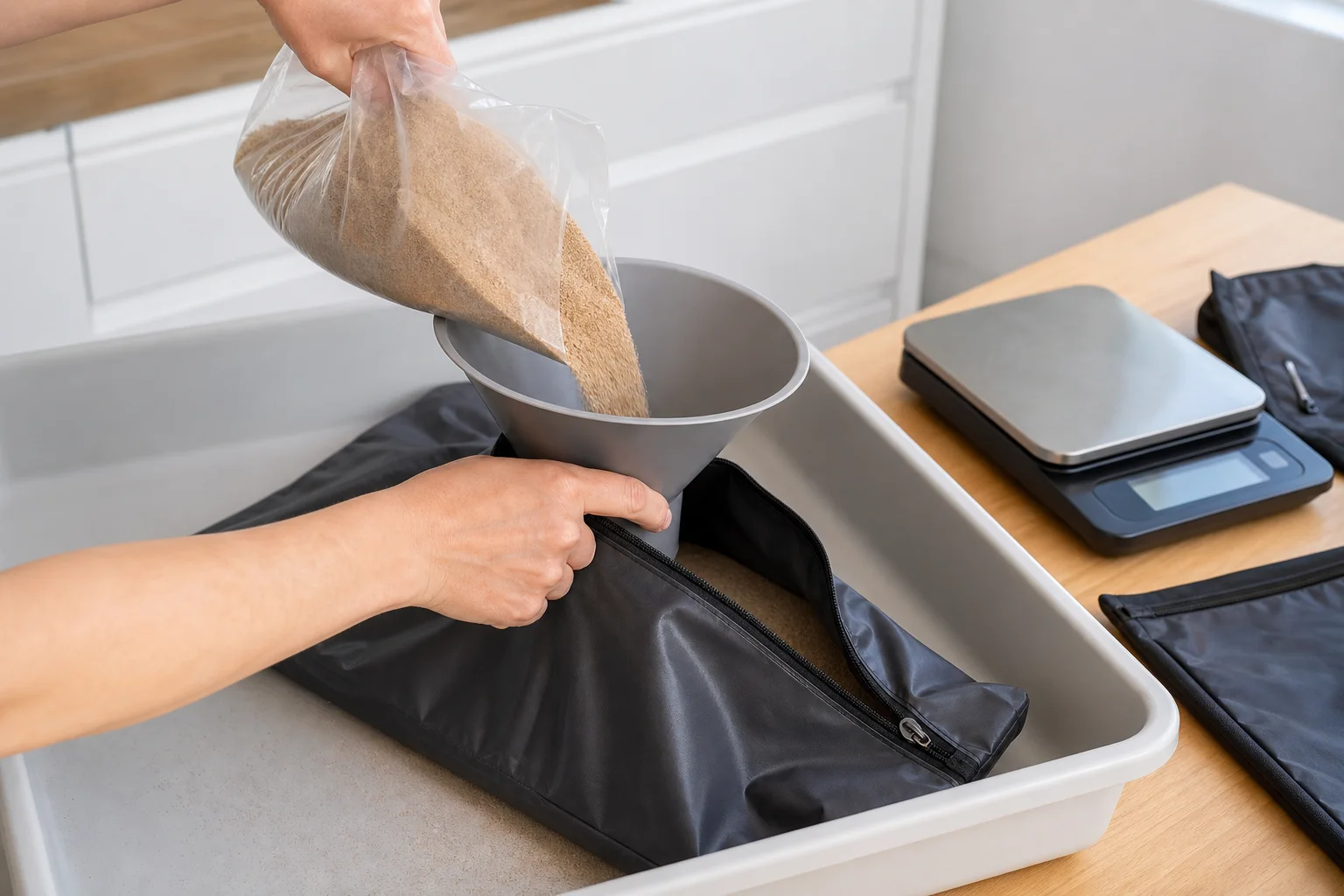
Use this controlled process when the maker permits self-filling:
- Inspect the empty liner, zipper or tie and all seams under bright light.
- Place the liner inside a large dry tray or tub.
- Use only approved, clean and fully dry fill.
- Add small amounts through a stable wide funnel.
- Weigh the liner repeatedly; include outer-cover mass in the final total.
- Stop below the rated capacity if the liner cannot close without compression.
- Clean grains from the closure track and seal it completely.
- Put the liner in the outer cover, close that zipper and lift-test over the tray.
- Record the date, fill type and finished weight.
Do not fill directly over carpet, a yoga mat or outdoors where escaped grains cannot be recovered. Do not inhale dust; stop if the material produces airborne particles and follow its safety information. A punctured, wet or poorly closing liner should be replaced, not hidden inside the cover.
Handles, seams and closures
A ten-pound bag puts repeated load into a small number of stitched junctions. A decorative handle sewn only to the surface panel is less reassuring than webbing anchored with box-and-X stitching or into a surrounding structural seam.
Look for:
- handle webbing wide enough to grip without twisting;
- reinforced attachment at every end;
- an outer zipper that cannot open under normal sag;
- a separate liner closure;
- rounded or protected internal zipper edges;
- no fill trapped in teeth or hook-and-loop tape;
- enough slack for granules to redistribute.
Dual handles can help with two-handed transport, but they do not make a 14-pound bag light. Never swing or toss a sandbag by one handle. Support the base when carrying it over feet, furniture or another person.
Cleaning and inspection
Manufacturers consistently separate fill from cover care. Hugger Mugger instructs owners to remove silica sand, hand wash the cover and hang it to dry. b, halfmoon permits cold machine washing and hang drying of its empty cover, with no bleach or softener. Bean Products describes its nylon pack cloth as washable, but follow its current model-specific instructions rather than assuming the complete filled bag goes into a machine.
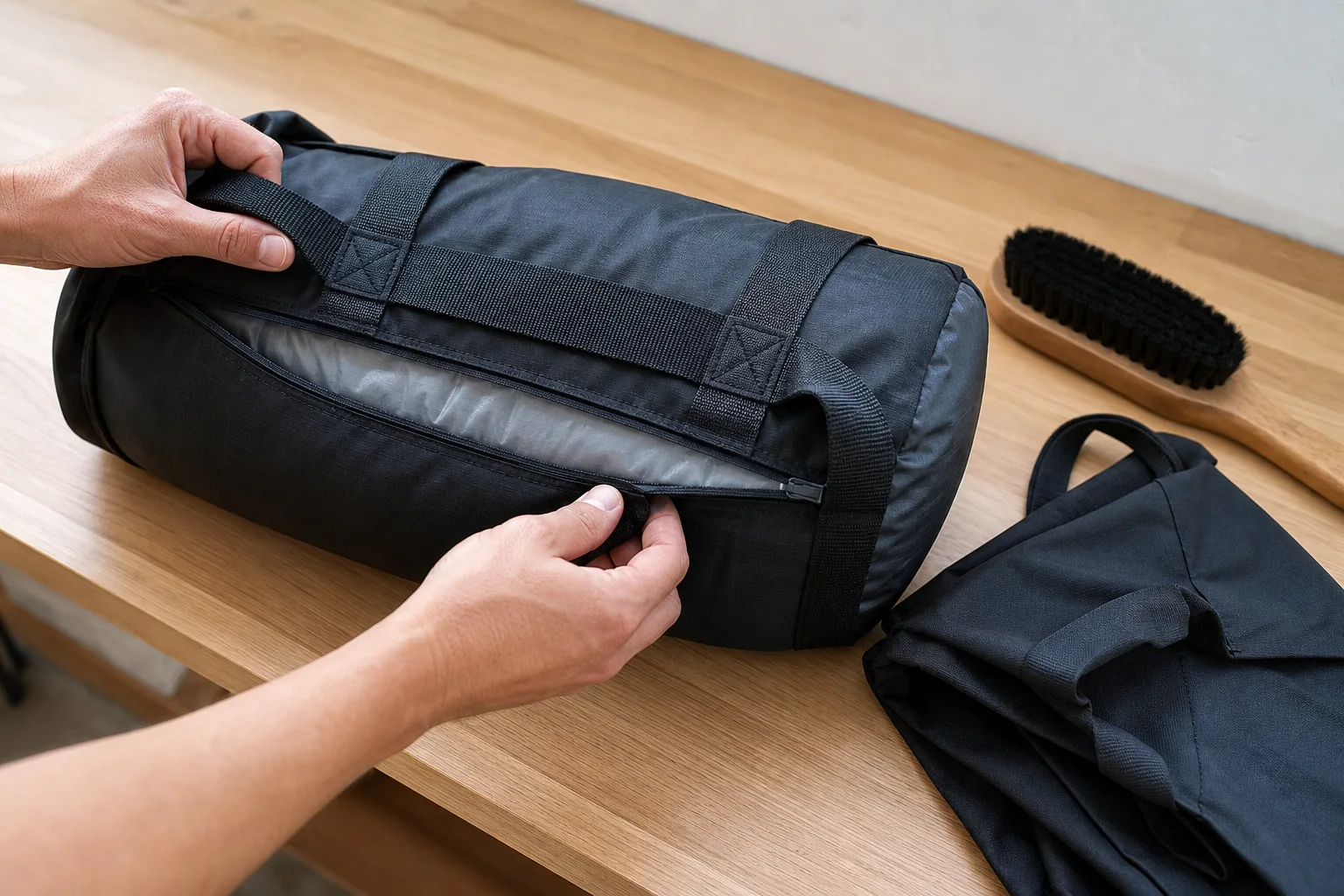
Before each use:
- scan the floor and cover for escaped grains;
- flex the bag gently over a tray and listen for liner movement;
- inspect handle attachment and seam puckering;
- operate the outer zipper without forcing it;
- check for dampness, odor, abrasion or sharp internal points;
- confirm the recorded weight if fill may have been changed.
To wash a removable cover, first take out the closed liner. Wash only by the stated method and let every seam dry fully before reassembly. Keep the liner dry. Store the assembled bag flat, low and away from heat, moisture, children and pets—not on a high shelf where ten pounds can fall.
Retire the product when the liner leaks, a handle stitch breaks, coating becomes brittle, the closure will not stay shut or moisture has reached the fill. Surface patching the outer cover does not repair a failed inner liner.
Sandbag versus bolster, blanket and exercise weight
A yoga bolster is a fixed-volume support cushion, not concentrated loose weight. A yoga blanket creates adjustable textile layers but carries far less mass. A meditation cushion supports sitting geometry. None is interchangeable solely because it can be placed on a mat.
Exercise sandbags are designed to be lifted dynamically and often use handles, compartments and shifting load for training. A compact yoga sandbag may not be rated for swings, drops or loaded carries. Conversely, a rough fitness bag is not automatically suitable as a passive yoga prop.
Use every item only within its documented design. A dumbbell, kettlebell, ankle weight or improvised loose bag has different edges, failure modes and load distribution.
Claims to reject
Product pages frequently say a sandbag relieves tension, improves circulation, treats anxiety, deepens stretches or corrects alignment. Those claims need evidence and individualized context. A sandbag provides mass and pressure; it cannot guarantee a therapeutic result.
Also reject:
- “dust-free” without a sealed liner or test basis;
- “waterproof” when only the inner coating is described;
- “washable” without saying which component;
- “10 lb” when it actually means capacity and ships empty;
- “universal” weight or placement advice;
- “safe” without load, closure and inspection information.
The trustworthy listing is specific and somewhat boring: dimensions, filled or empty state, rated capacity, fill type, liner material, closure, handle construction and exact care.
Buying checklist
Before ordering, confirm:
- Is this cover-only, an empty cover-and-liner system or fully filled?
- What is the delivered weight and maximum capacity?
- What are the filled dimensions and shape?
- Which fill is supplied or permitted?
- Is there a separate coated inner liner?
- How does the liner close?
- Can the outer cover be removed without emptying the liner?
- How many handles are there and how are they reinforced?
- Which part may be washed, at what temperature and how is it dried?
- Are replacement liners and covers available?
- Can you store the finished weight safely at floor level?
If a seller cannot distinguish cover, liner and fill, the product is not comparison-ready.
The verdict
For most buyers, an empty adjustable rectangular system rated around 10 pounds is the most flexible choice—provided it includes or clearly specifies a coated liner and approved fill. The b, halfmoon cover has strong published textile and care detail, but confirm package contents. iYogaprops explicitly includes a spouted liner and accepts up to 5 kg. For a ready-filled option, Hugger Mugger publishes a compact 15 × 7 × 3-inch silica-sand model with an empty-and-hand-wash care route.
Choose a 14-pound square only when qualified instruction calls for that broader heavier format and you can handle it safely. The best yoga sandbag is not the heaviest one; it is the system whose load, containment, handle, cleaning and storage are fully understood.
Frequently asked questions
What is a yoga sandbag?
It is a compact weighted prop, usually an outer fabric cover around a sand-containing liner. It is not automatically rated for strength-training movements.
What weight should I buy?
Current products commonly hold about 9–10 pounds, with some square models at 14 pounds. There is no universal correct load; follow qualified instruction and favor adjustability when uncertain.
Do yoga sandbags come filled?
Some do. Others are cover-only or include an empty liner. Confirm package contents and delivered weight before comparing price.
What should I use as fill?
Only clean, dry fill allowed by the manufacturer, such as the specified silica, quartz or sandpit sand. Do not improvise with damp, sharp or edible material.
Can a yoga sandbag be washed?
Usually only the empty outer cover. Remove the closed liner and follow the exact hand- or machine-wash and drying instructions.
Frequently asked questions
What is a yoga sandbag?
A yoga sandbag is a compact weighted prop, usually a fabric outer cover around a sand-containing liner. It is distinct from a shifting exercise sandbag and should be selected by filled weight, dimensions, containment system, handle and care instructions.
What weight yoga sandbag should I buy?
Current purpose-built examples commonly hold about 9 to 10 pounds, while some square models reach 14 pounds. There is no universal correct weight. Follow qualified instruction for placement and favor an adjustable empty model when you need to trial lower loads.
Do yoga sandbags come filled?
Some arrive filled and ready to use; others are cover-only or include an empty liner. Read the listing carefully because an inexpensive cover may still require sand, a funnel and a scale, while filled products cost more to ship.
What should I fill a yoga sandbag with?
Use only a clean, dry fill explicitly permitted by the manufacturer. Current makers specify silica, quartz or clean sandpit sand for different models. Do not improvise with damp beach sand, food or sharp aggregate.
Can a yoga sandbag be washed?
Usually only the empty outer cover can be washed. Depending on the model, that may mean cold machine washing or hand washing followed by hang drying. Remove all fill and the liner first, and follow the exact care label.