

How this page has changed
July 26, 2026
Sources, internal links and safety or product context reviewed.
In this guide
- 01Meditation benches at a glance
- 02Four construction decisions matter most
- 03Best current constructions
- 04Measure front height, rear height and seat width
- 05Folding hardware: what to inspect
- 06Seat padding and floor padding solve different problems
- 07Bench versus cushion, chair and bolster
- 08Cleaning and storage
- 09Buying checklist
- 10Bottom line
A meditation bench is a low rigid seat made for a kneeling arrangement, often called a seiza bench. The best buying approach is to compare front and rear height, usable seat width, leg geometry and connection hardware before considering wood species or appearance. There is no universal “standard” height: current products span multiple sizes, slopes and support systems.
If the product has an upholstered backrest or an office-style raised base, use the meditation chair guide. It compares fixed and adjustable floor chairs with cross-legged office formats. This page retains ownership of compact backless meditation benches.
Our most complete conventional specification is the MeditationBench.com Folding Bench, available with two heights and either angled or rounded legs. Bluecony IKUKO Original provides three explicit heights and removable legs. Lotuscrafts Dharma is the upholstered beech option, while B. Folden is the standout travel construction at a published 720 grams and 3 cm folded thickness.
This is a source-checked construction guide, not a hands-on ranking. Manufacturer posture, pain and therapeutic claims are not used as evidence. A bench requires sustained kneeling and floor transfers; if that raises a health or mobility concern, get individual advice from an appropriate qualified professional rather than selecting from an online chart.
Meditation benches at a glance
| Model | Construction | Published size | Published weight | Main reason to shortlist |
|---|---|---|---|---|
| MeditationBench.com Folding | Padded top; folding angled or rounded legs | Top approx. 18.5 × 7.5 × 2 in; regular and tall legs | 4 lb | Most explicit choice of height and leg geometry |
| Bluecony IKUKO Original | Curved solid-birch seat; removable legs | 42 × 20 cm; 16, 18 or 20 cm high | 2 kg | Three heights and no permanent hinge |
| Lotuscrafts Dharma | Beech; padded organic-cotton cover; folding legs | Seat 46 × 19.5 cm; standard or large | 2.2 kg | Integrated upholstery and two leg lengths |
| The Monastery Store Folding Alder | Alder top; folding angled or rounded legs | Top 17.75 × 7 in; published regular leg dimensions | 4 lb | Traditional simple folding format |
| B. Folden | Multiplex wood; flat-folding mechanism | Folded approx. 30 × 20 × 3 cm | 720 g | Lowest documented travel mass and volume |
These are specification-led selections, not performance awards. Availability changes: several source pages were sold out when checked. Verify the exact size, leg option, included cushion and current return terms before ordering.
Four construction decisions matter most
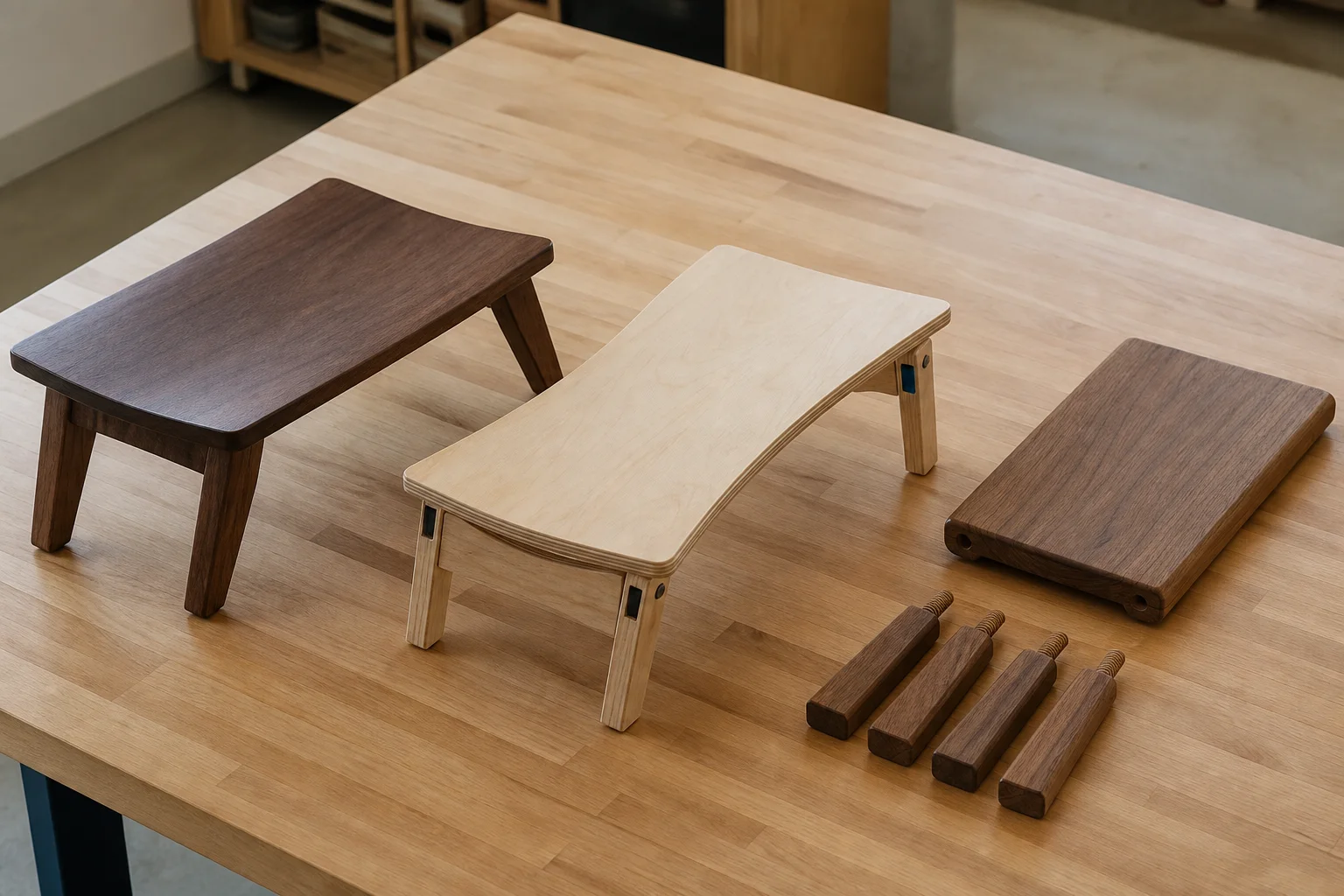
A bench looks like a small stool, but its low height and sloped seat make the connections unusually important. The four decisions below determine whether the product is predictable to size, move and maintain.
1. Fixed, folding or removable legs
Fixed legs have no moving hardware. A properly joined fixed frame is simple to inspect, quiet and immediately ready, but occupies its full volume in storage and luggage. Look for broad glue joints, mechanical fasteners or traditional joinery—not legs attached only by an unexplained thin plate.
Folding legs make a full-width bench pack flatter. They introduce hinges, screws and often a stay or lock. The Monastery Store’s tall maple model explicitly describes a locking mechanism on each hinge; that is stronger evidence than “foldable” alone. A hinge that merely reaches an open position without positive bracing may fold if unloaded or moved incorrectly.
Removable legs separate portability from hinges. Bluecony’s IKUKO uses legs intended to be removed and supplies a cotton bag. Confirm whether assembly is tool-free, how the legs are retained and whether repeated removal is covered by the warranty. Threads should engage cleanly without wobble or cross-threading.
2. Flat, sloped or curved seat
Many benches place the rear edge higher than the front, producing a fixed forward slope. MeditationBench.com publishes angled-leg heights separately: regular is 5 inches front and 6¼ inches rear, while tall is 6 inches front and 7¼ inches rear. Those two numbers tell you more than a single “height” field.
Rounded or rocking feet allow the user to vary the seat angle within the product’s designed range. That adjustability also means the contact point shifts and the bench must sit on a stable surface. Bluecony takes another route with a curved and arched seat rather than a simple flat plank.
Do not infer that more slope is better. Geometry changes load distribution and clearance, and individual tolerance cannot be diagnosed from height. If a seller provides only one ambiguous dimension, ask whether it is measured at the front, rear, center or top of padding.
3. Bare wood or padded top
Bare wood is easy to wipe and lets you inspect the full seat, but its hard surface is unforgiving. Integrated or removable padding changes contact feel and adds textile care, seam and compression questions.
Lotuscrafts specifies a foam cushion with a 100% organic-cotton cover. MeditationBench.com includes padding in its approximate 7.5 × 18.5 × 2-inch top measurement. Bean Products sells a separate 15 × 6 × 1.25-inch bench cushion, illustrating why “fits most benches” still requires a width check.
A loose household cushion can change seat height, slope and stability. Use only an accessory the bench maker identifies as compatible, and distinguish a thin seat pad from a larger floor mat placed beneath the knees and lower legs.
4. Solid wood, laminated wood or bamboo
Wood names are not quality grades. Bluecony publishes local solid birch; Lotuscrafts publishes European beech; The Monastery Store uses alder or maple depending on model; B. Folden uses multiplex plywood; Bean Products describes bamboo.
Solid wood can move slightly with humidity and show natural grain variation. Laminated plywood can offer efficient strength and thin folded geometry, but exposed plies and edge finishing need inspection. Bamboo panels are engineered from bonded strips, so adhesive quality, lamination and hinge anchoring matter as much as the plant source.
Environmental claims need evidence beyond “natural” or “eco.” Look for species, origin, finish composition, repairability, packaging and verified certification. A product’s long useful life can matter more than a vague material adjective.
Best current constructions
MeditationBench.com Folding Bench — best configurable conventional bench
This model has the most useful geometry disclosure. Its padded top is approximately 18.5 inches wide, 7.5 inches deep and 2 inches thick. It weighs 4 pounds. Angled legs come in regular (5 inches front, 6¼ inches rear) and tall (6 inches front, 7¼ inches rear). Rounded legs are 5⅝ inches at the tallest point in regular and 6½ inches in tall.
That gives buyers two independent decisions: height and a fixed versus user-variable tilt behavior. The company says angled legs provide a set support angle, whereas rounded legs allow tilt choice. Treat that as design description, not proof one style is ergonomically superior.
The trade-offs are bulk and moving hardware. Four pounds is portable but not ultralight, and the padded top remains roughly 18.5 inches long after the legs fold. Confirm whether the selected configuration locks, what warranty covers its hinges and whether replacement legs remain available.
Bluecony IKUKO Original — best removable-leg height range
The IKUKO Original publishes 42 cm width, 20 cm depth and 2 kg weight, with low 16 cm, standard 18 cm and high 20 cm versions. The seat is curved and arched, made from solid local birch in Québec, and the removable legs pack in a cotton bag.
Three actual heights are better buying data than a universal size claim. Bluecony associates them with stature bands, but height alone cannot establish fit; proportions, mobility, floor padding and the exact seat curve also matter. Use the chart as a starting point within a returnable trial, not a diagnosis.
There is no integrated cushion, according to the maker. That keeps the wood visible and eliminates upholstery care, but buyers should not assume a third-party pad can be added without altering geometry. The published one-year manufacturing guarantee is worth reading for removable connection wear.
Lotuscrafts Dharma — best integrated upholstered design
Lotuscrafts publishes a 46 × 19.5 cm seating area and 2.2 kg product weight. The standard leg dimensions are 13.5 cm front and 16.5 cm rear; the large version is 14 cm front and 18 cm rear. Its beech structure has folding legs and an upholstered foam top with a 100% organic-cotton cover.
This is the cleanest shortlist choice for someone who already knows they want an attached padded surface. The two heights preserve the forward slope while changing clearance. The maker associates standard with users up to 180 cm and large with taller users, but again that is a manufacturer selection rule, not an individualized fit guarantee.
Ask whether the fabric layer is removable and washable on the exact SKU, because the listing specifies the cover material but does not present a clear care method in the details captured. An attached cushion that cannot be removed requires more cautious spot cleaning and complete drying.
The Monastery Store Folding Alder — best simple traditional format
The Folding Alder bench publishes a 17.75 × 7-inch top and 4-pound weight. Its regular angled legs measure 5.5 inches front and 7.25 inches rear; the regular rounded-leg version is 5⅝ inches at the tallest point. A compatible foam cushion is separate.
This product is useful as a bare-seat benchmark because the dimensions and leg alternatives are explicit. Compare its steep difference between front and rear height with other products rather than assuming all “angled” benches share one slope.
The official page was sold out when checked. That does not invalidate its construction as a comparison, but it means it should not be presented as immediately buyable. Availability, finish and locking details should be rechecked if it returns.
B. Folden — best ultralight travel construction
B. Folden publishes a folded form approximately A4-sized (30 × 20 cm), 3 cm thick, and a weight of 720 grams. It uses multiplex wood and an integrated quick-fold mechanism, with a carrying case.
That is a materially smaller travel specification than a full top with simply folded legs. It makes sense for retreats or frequent transport when packed mass and thickness dominate. Compactness does not prove fit, strength or durability; the product page needs clearer open height, seat dimensions and load guidance for a complete comparison.
Before purchase, request those missing figures and details of the folding lock. A product can be exquisitely made yet remain unsuitable when a critical dimension is absent.
Measure front height, rear height and seat width
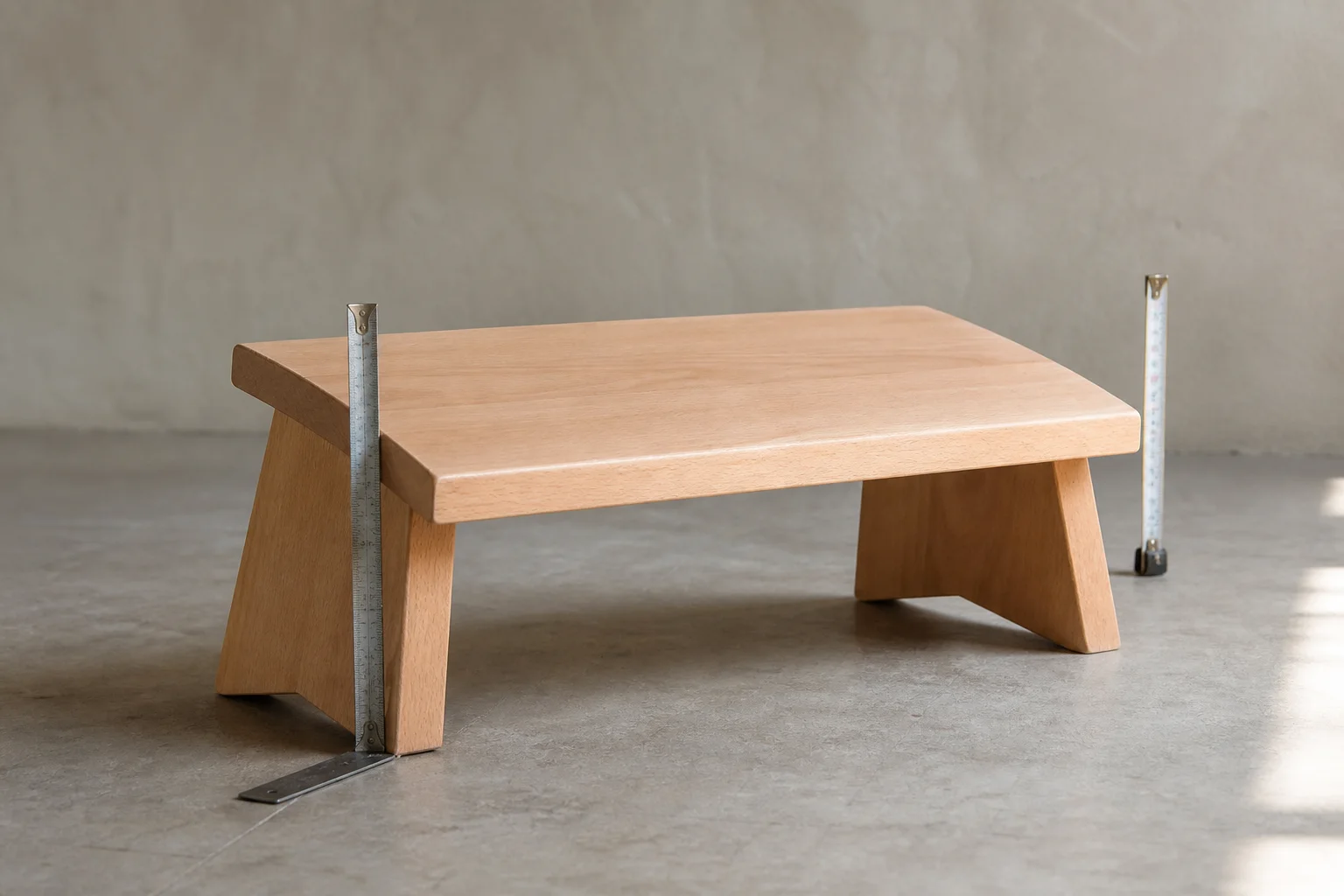
One height number can hide the most important geometry. Record these dimensions in the same units:
- front seat height: floor to top at the low edge;
- rear seat height: floor to top at the high edge;
- usable width: clear seating distance between rounded side edges;
- depth: front-to-rear seat surface;
- under-seat clearance: space between the legs and underside;
- packed dimensions: including detached pieces or bag;
- pad thickness: compressed and uncompressed if the maker provides both.
Compare measurements taken to the same reference point. One seller may report leg length while another reports finished seat height including upholstery. A 2-inch padded top cannot be compared directly with a bare plank using only leg length.
The sensible way to resolve uncertainty is not an online body-height formula. Use a seller with a realistic return window, retain packaging and trial the product only within the maker’s safe instructions. Do not persist through numbness, joint pain, instability or difficulty getting up.
Folding hardware: what to inspect
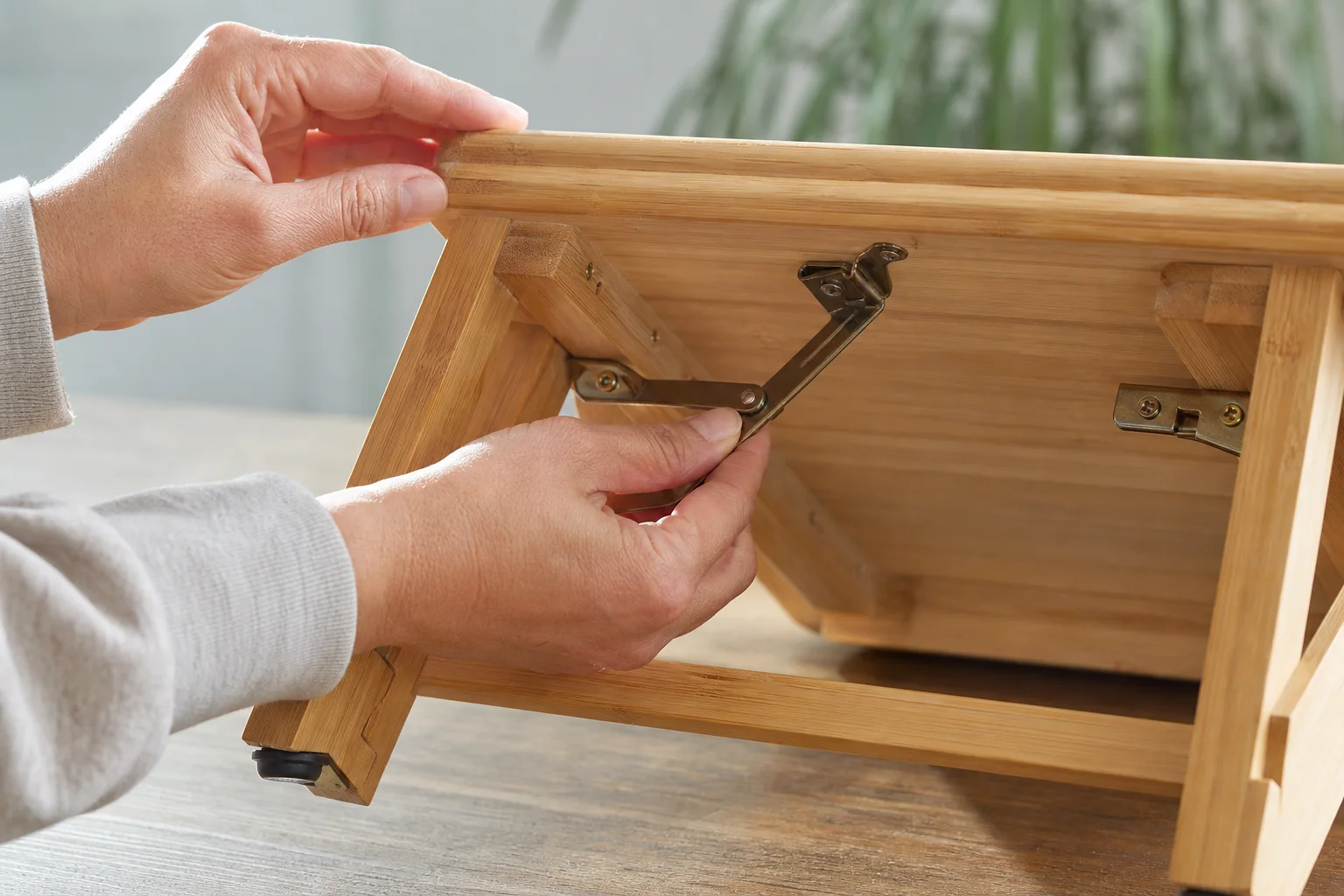
Inspect a folding bench on arrival and before each use. Turn it over on a protected surface and compare the left and right assemblies. Hinges should be aligned, screws seated and wood around fasteners free from spreading splits. Open both legs fully and confirm any stays or locks reach their intended end position.
Reject or retire a bench when you find:
- a bent hinge, brace or pin;
- a loose or missing screw that will not remain correctly tightened;
- an enlarging crack around a fastener;
- asymmetric leg angles;
- a lock that does not engage positively;
- a detached foot or damaged anti-slip contact;
- unexpected wobble on a verified flat floor;
- delaminating plywood or bamboo strips.
Do not improvise a structural repair with a longer screw, household glue or an added bracket. That can split the wood, interfere with folding or conceal damage. Ask the manufacturer for an approved part or replacement assessment.
Fixed benches need inspection too. Check joints for movement, finish for sharp chips and feet for uneven wear. A natural wood product can show color and grain variation without being defective; a joint line that opens under light hand pressure is different.
Seat padding and floor padding solve different problems
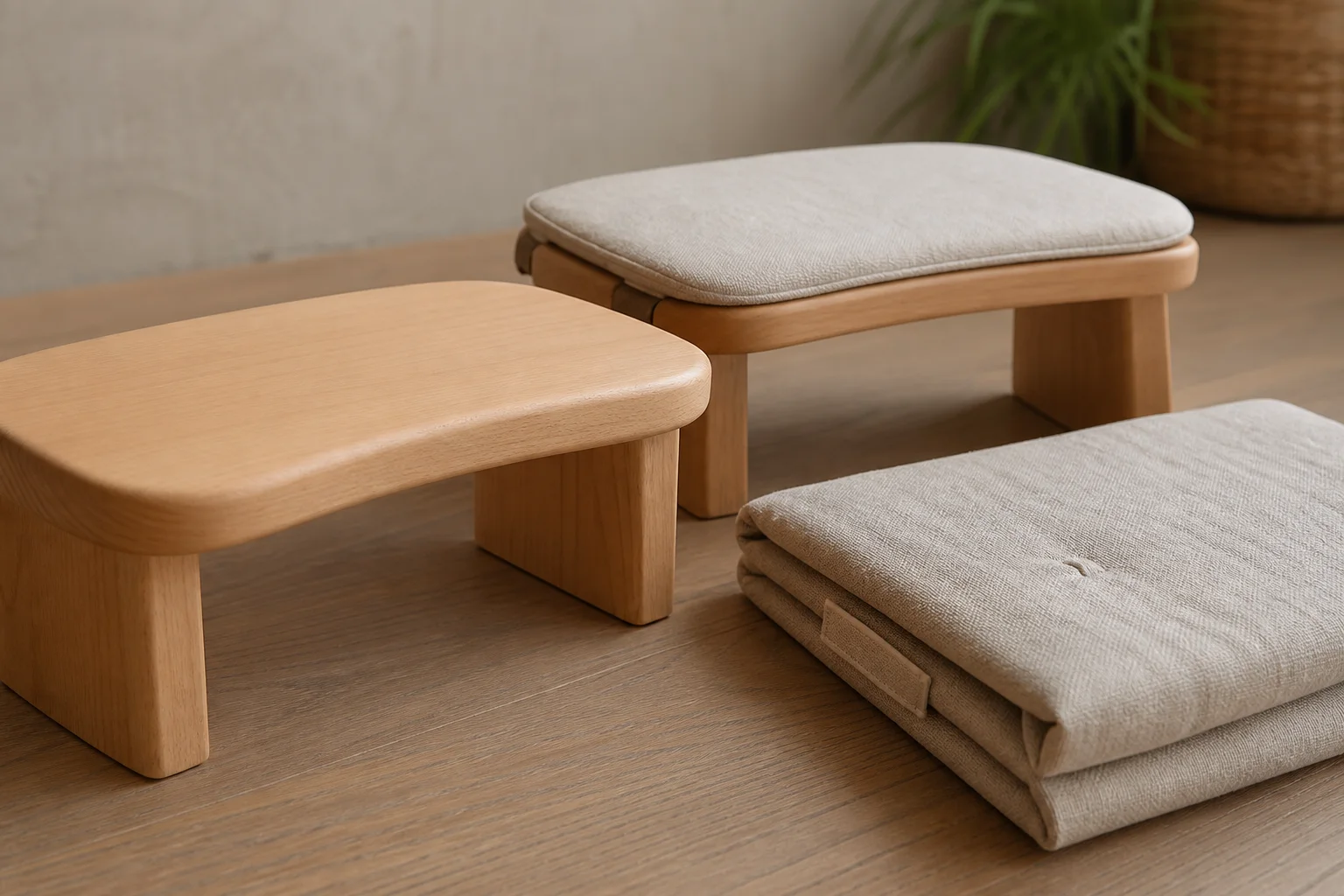
An integrated pad belongs to the bench geometry. Its foam density, edge shape and attachment influence how the top feels and how easy it is to clean. Look for an even surface with no migrating foam, open seams or slippery cover.
A zabuton or folded meditation mat sits on the floor beneath the setup. It should be broad enough for the intended arrangement while leaving the bench’s feet supported evenly. Very soft or uneven piles can let narrow legs sink or rock. Confirm the bench maker’s surface recommendations rather than layering props by guesswork.
Our meditation cushion guide explains zafu, crescent, rectangular and support-set constructions. Those cushions compress and redistribute fill; a rigid bench does not. The two pages therefore answer different purchase questions despite sharing a meditation cluster.
Bench versus cushion, chair and bolster
| Seat | Structure | Storage | Main buying question |
|---|---|---|---|
| Meditation bench | Rigid low platform for kneeling | Fixed, folded or disassembled | Are height, slope and connections appropriate? |
| Meditation cushion | Compressible textile shell with fill | Bulky but light-to-moderate | Are shape, fill and adjustable loft suitable? |
| Chair | Raised seat, usually with back and four legs | Largest footprint | Are seat height, access and stability appropriate? |
| Yoga bolster | Long compressible support | Bulky and non-rigid | Does a qualified setup call for broad soft support? |
A bench is not automatically a progression from a cushion, nor is kneeling inherently more authentic. Traditions and bodies use many arrangements. Select equipment that supports the practice you have been taught and that you can enter and leave safely.
If floor transfer is difficult or contraindicated, a conventional stable chair may be the more appropriate equipment. That decision belongs with someone who can assess the individual situation, not a product roundup.
Cleaning and storage
Follow the finish and upholstery instructions for the exact model. For bare sealed wood, use a soft dry or lightly damp cloth only if the maker permits it, then dry promptly. Do not saturate end grain, laminate edges, hinge recesses or threaded holes.
Avoid alcohol, essential oils, abrasive pads and furniture polish unless explicitly approved. They can attack a finish, leave a slick film or transfer to fabric. For upholstered tops, identify whether the cover removes before applying moisture. Foam trapped beneath a damp cover needs complete air circulation.
Store folding benches dry, with the mechanism protected from impacts. Keep detached legs and hardware together in the supplied bag. Do not place heavy objects on a folded bench or use it as a general step stool, side table or exercise platform unless the manufacturer explicitly designs it for that purpose.
Buying checklist
Before checkout, save the exact SKU and confirm:
- front and rear finished seat height;
- usable seat width and depth;
- fixed, folding, rocking or removable leg behavior;
- positive-locking or bracing mechanism;
- material and finish disclosure;
- product weight and packed dimensions;
- stated user/load limit, if published;
- included versus optional seat pad and bag;
- cleaning instructions;
- replacement hardware and warranty;
- trial and return conditions after opening.
On arrival, compare the product with the listing before sitting on it. Confirm symmetrical legs, smooth edges, intact joints and full hardware engagement. A high-quality listing should make this verification easy.
Bottom line
The best meditation bench is the one whose geometry and connections you can verify—not the one making the strongest posture promise. MeditationBench.com provides the clearest conventional height and leg choices. Bluecony IKUKO offers three heights with removable legs. Lotuscrafts Dharma integrates a documented padded top, The Monastery Store supplies a simple traditional folding reference, and B. Folden owns the ultralight packed-size niche.
Buy with a returnable fit trial, inspect every moving connection and keep seat padding separate from floor-padding decisions. For broader beginner context, continue with yoga for beginners and choose qualified instruction before specialized equipment.
Frequently asked questions
What is the best meditation bench for most people?
There is no universal best height. A well-documented bench with a broad seat, rounded edges, stable feet and either fixed joints or positive-locking folding hardware is the safest shortlist. Choose height and angle through a returnable trial or qualified in-person guidance.
How tall should a meditation bench be?
Current full-size products span roughly 5 inches at the low front edge to 8 inches or more for tall variants. Manufacturer height recommendations differ and body height alone cannot predict fit. Compare front and rear height separately and use a return policy rather than assuming one standard size.
Is a folding meditation bench stable?
A folding bench adds hinges and fasteners that require inspection. Look for a positive locking or bracing mechanism, fully opened legs, seated screws and non-damaged feet. Fixed legs remove moving hardware but are less packable.
Is a meditation bench better than a cushion?
They are different formats. A bench provides a rigid elevated seat intended for kneeling arrangements; a cushion compresses and can support several floor-seated arrangements. Neither is inherently better for every body or practice.
Do I need a cushion under a meditation bench?
A thin seat pad changes surface pressure, while a separate floor mat cushions contact with the floor. Some benches include upholstery and others are bare wood. Follow the bench maker’s setup instructions and do not use loose padding that makes the feet unstable.