

How this page has changed
July 27, 2026
Sources, internal links and safety or product context reviewed.
In this guide
- 01Meditation chair formats at a glance
- 02Fixed floor chairs
- 03Adjustable and folding floor chairs
- 04Cross-legged office chairs
- 05Chairs, benches and cushions are not substitutes by name
- 06Frame and load path
- 07Measure the usable seat
- 08Backrest: fixed, ratcheting or adjustable
- 09Padding and upholstery
- 10Floor interface and room fit
- 11Portability and storage
- 12Delivery and assembly inspection
- 13Adjustment test
- 14Cleaning and maintenance
- 15Accessibility and practical handling
- 16Compare current value
- 17Red flags
- 18A practical selection sequence
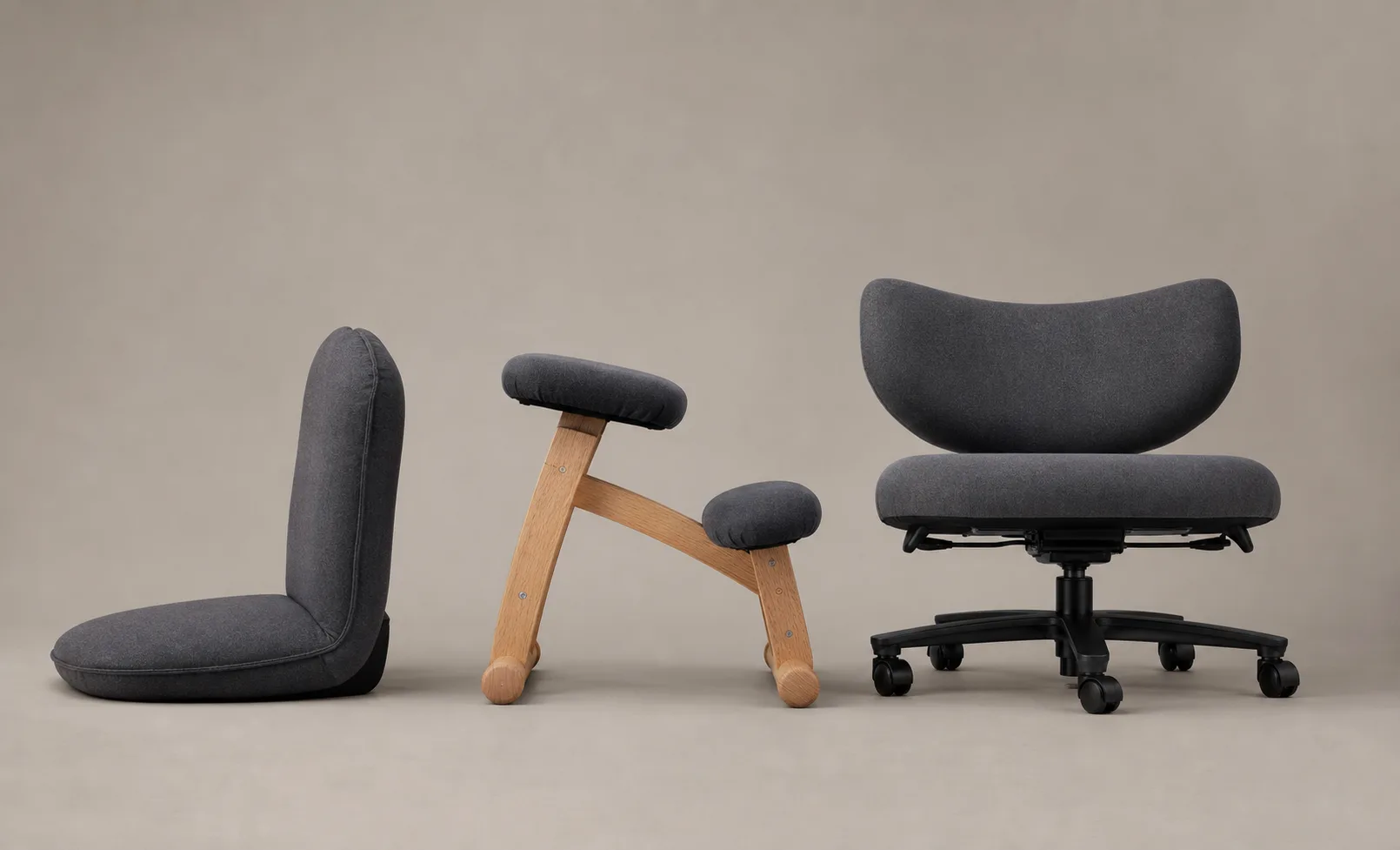
A meditation chair is not one standardized object. Current results use the name for at least three furniture classes: a backrest that sits directly on the floor, a hinged floor chair with several back angles, and a raised office-style chair with a wide secondary platform for different seated positions. They have different dimensions, loads, storage needs and failure points.
Choose the class before comparing upholstery or price. A floor chair does not create desk height. A rolling cross-legged chair does not pack like a floor pad. A small wooden meditation bench is another product again.
This page is a product-specification and inspection guide. It does not prescribe a meditation posture, claim that back support treats pain or tell a reader to maintain a position. If sitting causes pain, numbness, weakness, dizziness or another concerning symptom, stop and seek appropriate qualified advice rather than buying furniture on the strength of a marketing claim.
Meditation chair formats at a glance
| Format | Floor relationship | Moving parts | Primary dimensions | Main verification |
|---|---|---|---|---|
| Fixed floor chair | Seat rests on floor | Few or none | Seat width/depth, back height, footprint | Frame and floor contact |
| Adjustable floor chair | Seat rests on floor | Ratchet or hinge at seat/back | Dimensions at upright and flat settings | Lock positions and hinge guarding |
| Fold-flat floor chair | Seat rests on floor | Folding back or frame | Open and folded envelope | Lock, carry method and exposed hardware |
| Cross-legged office chair | Raised caster or fixed base | Gas lift, swivel, platform adjustments | Seat height, platform size, base diameter | Mechanism, caster base and desk clearance |
| Meditation bench | Raised on legs, usually no back | Sometimes folding legs | Seat height, width, leg spread | Joint, feet and load rating |
| Cushion or mat | Soft item on floor | None | Diameter/width, height and fill | Cover, fill and care |
Fixed floor chairs
A fixed floor chair places its seat cushion directly on or very near the floor and supports an upholstered back with a metal, wood or composite frame. Mukha Yoga’s current OM Sutra listing describes a zinc-steel frame and cotton-canvas cover. That construction is more informative than “ergonomic”: it tells the buyer to inspect welded or fastened frame points, upholstery attachment and floor contact.
The useful measurements are:
- clear seat width between piping or frame edges;
- usable seat depth from front edge to the back cushion;
- backrest height above the compressed seat;
- backrest width at its narrowest useful section;
- total floor footprint, including rear frame projection;
- chair mass; and
- published maximum load.
A floor backrest can extend behind the visible cushion. Measure the entire product so it does not strike a wall, radiator or low shelf. Check whether rubber feet or a continuous fabric base separate metal structure from the floor.
Fixed does not necessarily mean rigid. Foam compresses, upholstery stretches and a cantilevered frame can flex. Product photographs cannot establish how a chair behaves under a particular user, so prioritize a clear return policy and inspect the delivered structure.
Adjustable and folding floor chairs
Adjustable floor chairs commonly use a ratcheting hinge between the seat and back. The current SVOPES listing describes six adjustment levels, a 330-pound published capacity, 6.4-pound product mass and separate dimensions at 90 and 180 degrees. KOMFOTT likewise publishes both upright product size and lay-flat dimensions for a larger model.
Those two states matter because “foldable” can mean several things:
- the back folds forward for storage;
- the back reclines flat but the product remains full length;
- the hinge clicks through multiple use angles;
- a steel frame itself collapses; or
- only a removable cushion folds.
Confirm the actual sequence in the manual. Some ratchets must move fully forward before they release back to flat. Never force a hinge that has not reached the reset position.
Hinge questions
| Field | What to verify |
|---|---|
| Adjustment count | Exact usable positions, including flat and storage states |
| Lock feedback | Audible/tactile engagement described by the maker |
| Reset method | How to return from the final notch |
| Pinch exposure | Whether fingers or fabric can enter the mechanism |
| Service | Replacement hinge or support availability |
| Load condition | Whether the rating applies at every approved angle |
| Folding envelope | Full length, width and thickness when stored |
Do not adjust a loaded chair unless the instructions expressly describe that operation. Keep hands, loose clothing and nearby textiles away from the hinge path.
Cross-legged office chairs
This newer category uses an office-chair base, swivel seat and a broad secondary platform or footrest. Listings often add “meditation,” “yoga,” “ADHD” and “ergonomic,” but those are marketing categories—not proof of a health outcome or suitability for every position.
KERDOM’s current Best Buy listing publishes a 17.3-to-21.3-inch seat-height range, retractable platform dimensions, 360-degree movement and a 250-pound rating. Giantex publishes overall dimensions of 34.5 × 25 × 31–35.5 inches for a cross-legged office format. Bestier publishes a 300-pound rating and a wide padded platform.
Compare these chairs as adjustable furniture:
- minimum and maximum seat height;
- clear main-seat width and depth;
- lower-platform width, depth and height relationship;
- backrest width, height and adjustment;
- base diameter and caster count;
- total product mass and published capacity;
- gas-lift certification or documentation;
- swivel and platform lock behavior;
- desk, drawer and keyboard clearance; and
- assembly instructions and replacement parts.
A larger platform increases the space available for different sitting configurations, but it also increases the chair’s envelope. Check whether it collides with desk legs when rotating and whether the base remains wider than the upper load envelope.
Chairs, benches and cushions are not substitutes by name
Our meditation cushion guide covers zafu, crescent and rectangular filled formats. The meditation cushion-set guide owns zafu-plus-zabuton bundles. Neither has a hinged frame or backrest.
A meditation bench is normally a compact raised seat without a back. Its meaningful variables are seat height, tilt, leg geometry and joint construction. A floor chair adds a backrest while keeping the seat close to the floor. An office-format chair raises the whole system on a base. Retailers may place all three under “meditation seating,” but the specification tables should remain separate.
Frame and load path
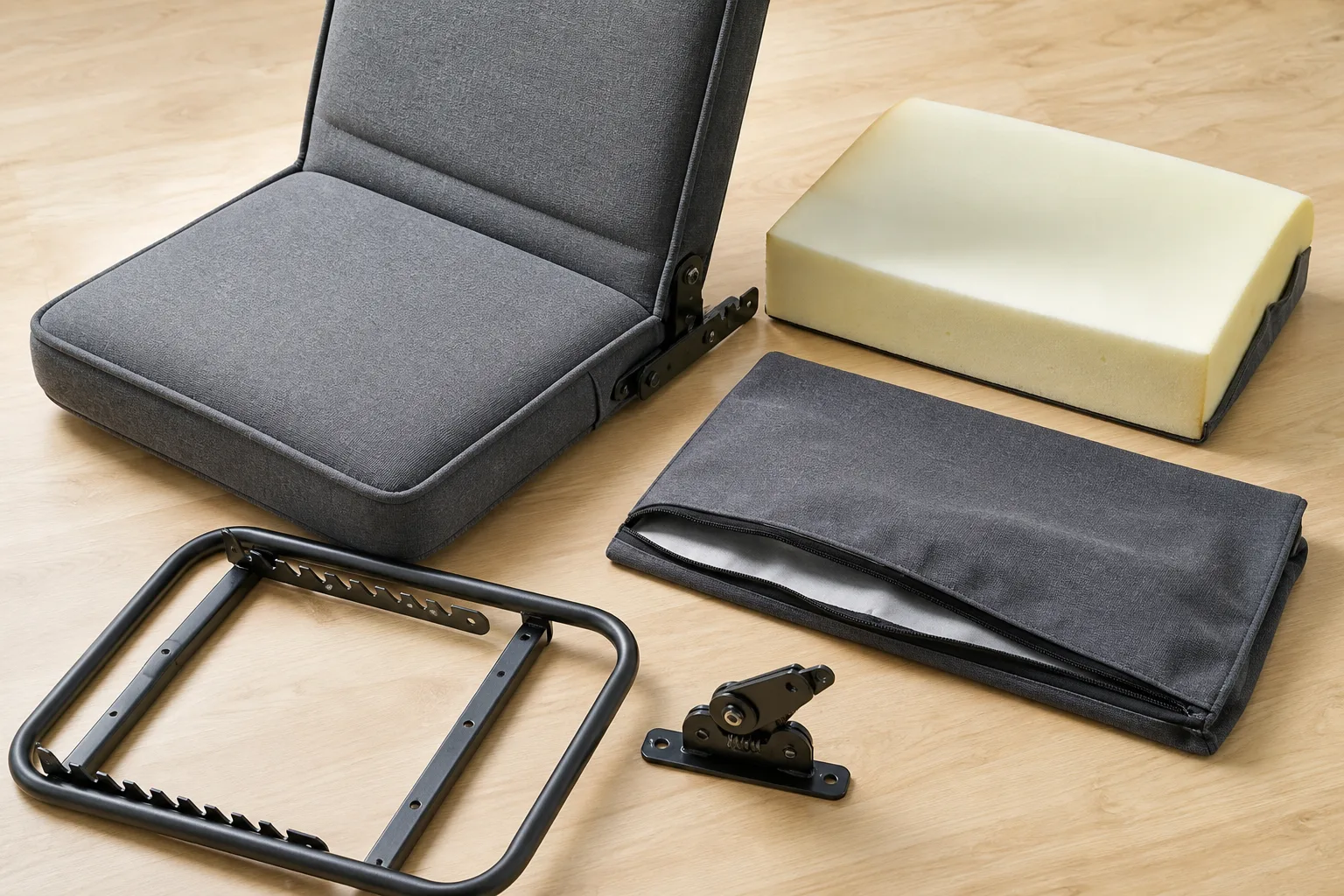
The frame carries the load; foam and fabric conceal it. Current floor products cite steel or zinc-steel frames, while office formats combine steel, wood, plastics, casters and a gas lift. Ask what supports the seat and back rather than accepting “sturdy construction.”
Inspect:
- tubing diameter and visible wall condition;
- welds, brackets, rivets and bolts;
- whether the back is braced on both sides;
- how loads transfer into floor feet or the caster base;
- whether fasteners are accessible for the instructed checks;
- corrosion or bent components on delivery; and
- the exact published load limit for that model.
Do not use a chair above its stated capacity or assume a high static rating covers rocking, dropping into the seat or leaning outside the approved envelope. Avoid attaching accessories to the back unless the manufacturer provides attachment points.
Measure the usable seat
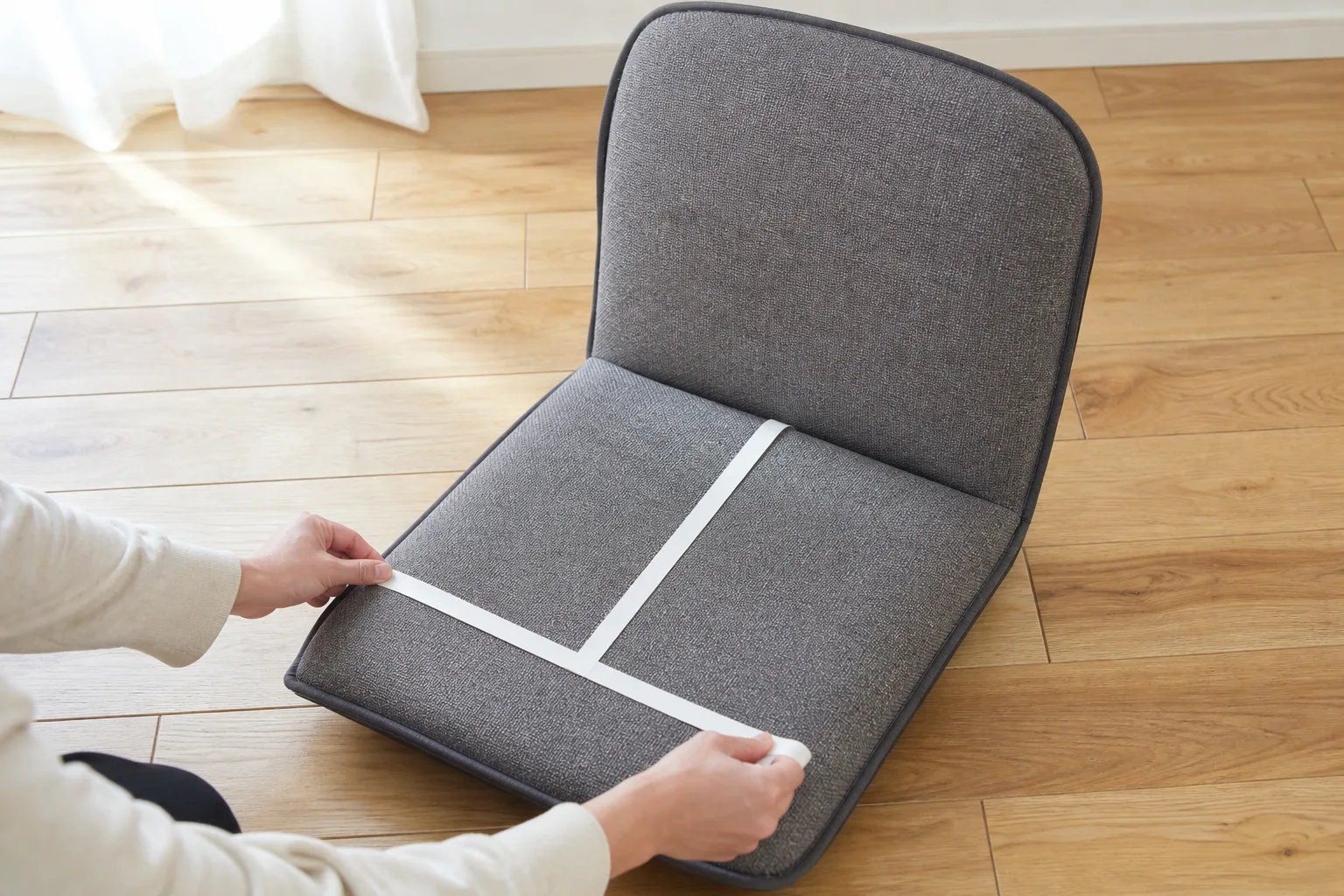
Overall width can include frame, hinges and upholstery wings. Measure the clear surface available between them. For a floor chair, record seat width and depth with the back in its normal upright state. For a two-level office chair, measure the main seat and lower platform separately.
Measurement worksheet
| Measurement | Start and end points | Why it matters |
|---|---|---|
| Clear seat width | Between seams, wings or brackets | Usable lateral space |
| Clear seat depth | Front edge to compressed back cushion | Usable front-to-back surface |
| Back height | Compressed seat to top edge | Backrest coverage and storage height |
| Rear projection | Back of seat to furthest rear structure | Wall clearance |
| Floor footprint | Furthest contact points | Rug and room fit |
| Folded envelope | Maximum folded L × W × H | Closet, shelf and transport fit |
| Chair mass | Published net weight | Carrying and relocation |
Use manufacturer measurements for initial screening and verify the delivered chair before the return period closes. Upholstery thickness and measurement conventions can create differences.
Backrest: fixed, ratcheting or adjustable
A backrest can be fixed to a floor frame, adjusted by a hinge or mounted on an office mechanism. “Back support” only states that a back exists; it does not describe height, width, angle, stiffness or whether the back is intended to bear load in every setting.
Check the approved adjustment range and whether the product locks positively. Look for a gap where the back meets the seat: an exposed bar or hard hinge can be felt through thin upholstery and can trap small objects or fingers during folding.
Do not add an unapproved thick cushion behind the back to change the angle. It can move the user forward, shift the load and reduce usable seat depth. If the supplied back does not fit the intended setup, return or replace the chair rather than rebuilding its geometry with loose props.
Padding and upholstery
Foam thickness is not the same as firmness or long-term resilience. A thick low-density cushion can compress more than a thinner dense one. Listings rarely publish density, so inspect recovery, seam tension and whether the frame can be felt through normal hand pressure before accepting the product.
Common covers include cotton canvas, polyester fabric, velvet-like textiles and polyurethane-coated upholstery. Compare:
- removable versus fixed cover;
- zipper placement and pull protection;
- complete fiber or material disclosure;
- spot-clean versus machine-wash instructions;
- abrasion at hinge and floor edges;
- colorfastness warnings; and
- replacement-cover availability.
“Easy clean” does not mean washable. A fixed upholstered frame may permit only spot cleaning. Never saturate internal foam or metal hardware unless the manufacturer specifically allows it.
Floor interface and room fit
Low chairs can have exposed tubes, small rubber feet or a broad fabric underside. Confirm every contact point is intact and suitable for the floor. Sand or grit trapped under a chair can scratch hard flooring even when the feet are soft.
On a rug, check that the chair sits fully on one level surface. A caster chair requires a floor and caster combination permitted by the maker; a soft rug can impede movement and a hard caster can mark some floors. Do not place a floor chair partly on a yoga mat and partly on the floor, which creates an uneven base.
Measure the removal path through doors and around furniture. A chair that folds flat may become longer, not smaller in every direction. Cross-legged office chairs can have wide platforms that prevent them from tucking beneath a desk.
Portability and storage
Portability depends on mass, folded envelope and a safe grip point. A 6.4-pound floor chair may be light, yet its 36.7-inch flat length remains awkward in a crowded vehicle or closet. A product without a handle may require two hands despite low mass.
Verify:
- whether the chair locks closed;
- whether the hinge is exposed when carried;
- an approved handle or frame grip;
- whether cushions detach in transit;
- storage orientation permitted by the maker;
- stacking limit; and
- protection from moisture and crushing.
Never carry an office-format chair by its adjustable platform, backrest or gas-lift lever. Follow assembly instructions for moving or disassembly.
Delivery and assembly inspection
Before the first use:
- compare the model, color and components with the order;
- read the manual and locate the published load limit;
- inspect packaging for impact or water damage;
- check frame tubes, welds, brackets and hinge alignment;
- verify all fasteners, feet, caps or casters;
- inspect upholstery seams, zippers and padding;
- assemble only in the documented sequence;
- operate each adjustment while the chair is unloaded; and
- retain the manual, hardware list and proof of purchase.
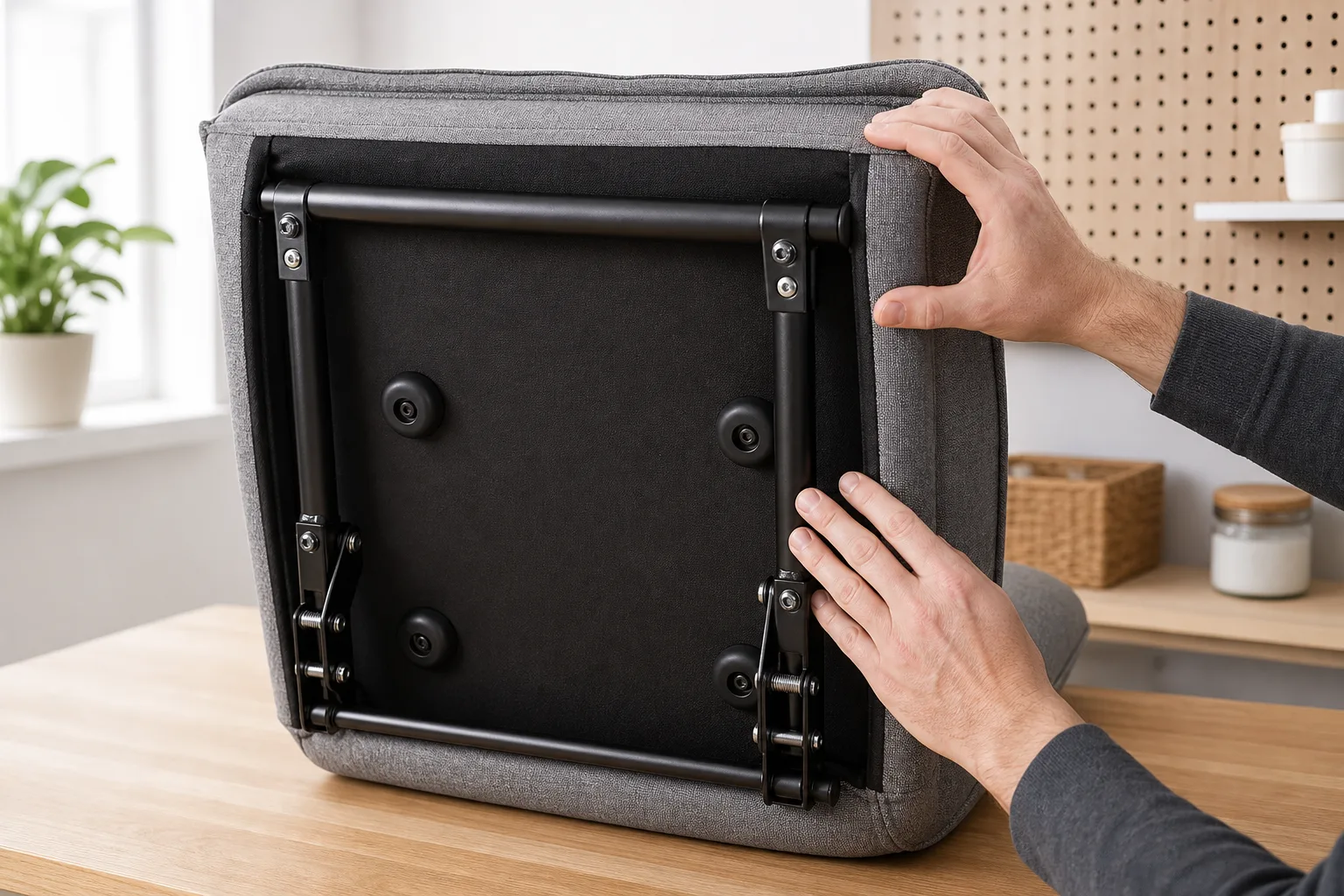
Do not substitute longer bolts, add holes or remove structural pieces to make assembly easier. If holes do not align without force, stop and contact the seller or manufacturer.
Adjustment test
Test mechanisms without a person on the chair:
- move through every documented position;
- listen and feel for consistent engagement;
- confirm both sides align where the design uses paired hinges;
- check that release and reset follow the manual;
- inspect cable, lever or ratchet clearance; and
- verify that the final state does not drift under light hand pressure.
For caster chairs, test height, swivel, platform movement and wheel retention on the intended floor. Do not improvise a dynamic stress test or exceed the instructions.
Cleaning and maintenance
Follow the product label. A practical routine is to vacuum loose debris with an appropriate upholstery tool, wipe hard frame areas using the approved method and spot-clean fabric only as directed. Let every component dry fully before folding or storage.
Periodically inspect:
- loose or missing fasteners;
- hinge play, noise or skipped positions;
- cracked tubing, welds or plastic;
- compressed padding that exposes structure;
- separating seams or zippers;
- worn floor feet or loose casters;
- gas-lift drift; and
- corrosion or persistent odor.
Stop using the chair if a load-bearing component changes. Do not oil a hinge unless the manual specifies a lubricant and application point; oil can damage fabric, attract grit or alter a ratchet.
Accessibility and practical handling
A floor chair requires getting to and from floor level. That is a material access requirement, not a lifestyle detail. A raised chair reduces the vertical distance but may introduce casters, adjustment controls and a wider base. The appropriate setup depends on the individual and environment.
Check whether controls can be reached, whether instructions are legible, whether the chair can be moved without lifting beyond the user’s ability and whether a stable external support is needed. Seek an occupational therapist or other appropriate professional for individualized accessibility recommendations; a retail “ergonomic” label is not an assessment.
Compare current value
Do not copy a static price. Use live delivered cost and normalize within the same class:
Delivered ownership cost = item price + delivery + required accessories + expected replacement parts
Compare a floor chair with other floor chairs, not a simple cushion or full office chair. Include whether the cover is replaceable, whether hinges or casters are supported, return-shipping terms and the published warranty. A low purchase price can be poor value when the chair cannot be returned after assembly or has no replacement feet.
Red flags
- “Ergonomic” with no usable dimensions or adjustment range.
- “Back support” without backrest height, width or angle.
- A load claim that differs between retailer and manual.
- Folding photographs without the folded dimensions.
- No explanation of ratchet reset behavior.
- A wide upper platform over a visibly narrow or incomplete base.
- Health, circulation, pain or neurodiversity claims presented without appropriate evidence.
- Upholstery claims without material or care instructions.
- Product photos that conceal underside structure.
- Casters, fasteners or tools missing from the parts list.
- A floor chair marketed as portable with no mass or carry method.
- A meditation bench, cushion and floor chair ranked as if they were interchangeable.
A practical selection sequence
- Choose floor chair, adjustable floor chair or raised office format.
- Measure the room, floor surface, storage envelope and access path.
- Compare clear seat and platform dimensions—not external width alone.
- Verify backrest geometry, frame material and published load.
- Audit hinges, gas lift, swivel, casters and locks relevant to the class.
- Check upholstery composition, cover architecture and cleaning method.
- Review folded size, mass and a safe carrying method.
- Read assembly and return terms before discarding packaging.
- Inspect and operate every mechanism unloaded.
- Stop using the product when a structural or locking component changes.
The best meditation chair is not the product making the broadest comfort promise. It is the correct furniture class with documented dimensions, a clear load path, inspectable mechanisms, suitable floor contact and a realistic route for storage, cleaning and replacement.
Frequently asked questions
What type of meditation chair should I buy?
First choose the furniture class. A floor chair adds a backrest at floor level, an adjustable floor chair folds through several back angles, and a raised cross-legged chair uses an office-style base with a wide secondary platform. Compare clear seat dimensions, frame, load rating, floor contact and storage within that class.
Is a meditation chair the same as a meditation bench?
No. A meditation bench is a compact raised seat supported by legs or a folding base and normally has no backrest. A floor meditation chair rests directly on the floor and typically includes an upholstered back. Cross-legged office chairs are higher rolling furniture. The categories should not share one size comparison.
How do I measure a meditation chair?
Record clear seat width and depth between seams or side structures, backrest height and width, total floor footprint, folded dimensions and chair mass. For an office-style model also record seat-height range, lower-platform dimensions, base diameter and desk clearance.
Are folding meditation chairs portable?
Some are, but “folding” only proves that the back can collapse or adjust. Check folded length, width, thickness, product mass, locking method, carry handle and whether the hinge remains exposed. A folding floor chair can still be too large for routine transport.
What should I inspect on a meditation chair?
Before use, inspect frame joints, hinges, adjustment locks, fasteners, upholstery seams, padding, floor feet or casters and the label or manual. Confirm the delivered model and published load limit, assemble it exactly as instructed and stop using it if the frame moves, the hinge skips or upholstery exposes structure.