

How this page has changed
July 27, 2026
Sources, internal links and safety or product context reviewed.
In this guide
- 01Yoga sock formats at a glance
- 02Conventional full-toe socks
- 03Five-toe full-toe socks
- 04Half-toe and toeless socks
- 05Open-vamp and ballet-style socks
- 06Read the grip map, not “non-slip”
- 07Match the sock to the mat surface
- 08Size by foot length, then check volume
- 09Materials: read the percentages literally
- 10Seams, bands and straps
- 11Delivery inspection
- 12Washing and drying
- 13When grip socks are worn out
- 14Compare value without stale prices
- 15Red flags
- 16A practical selection sequence
Yoga socks are close-fitting socks with grip material printed or bonded to the sole. The category includes ordinary closed-toe shapes, individual five-toe pockets, half-toe designs and open-vamp ballet shapes. Those formats do not feel or fit alike, even when their product titles all say “non-slip.”
Start with construction, not color. Decide how much toe and upper-foot coverage you want, measure your foot against the current brand chart, and inspect where the grip actually sits. A dense pattern that rotates away from the sole because the knit is too large is less useful than a modest pattern that stays under the foot.
This page owns the yoga-mat product decision. Our Pilates grip-socks guide covers reformer equipment, studio rules and product picks. This is an equipment guide—not pose instruction, footwear advice for a medical condition or a guarantee against slipping.
Yoga sock formats at a glance
| Format | Coverage | Main fit variable | Check before buying |
|---|---|---|---|
| Conventional full-toe | Toes enclosed together | Toe-box length and width | Fabric does not fold under the forefoot |
| Five-toe full-toe | Each toe enclosed separately | Individual pocket length | No empty tips or webbing pressure |
| Half-toe or toeless | Toe ends exposed, often individually separated | Position of each opening | Openings sit behind the toe pads without tight edges |
| Open-vamp or ballet | Toes enclosed; much of upper foot exposed | Heel pocket and crossed straps | Straps lie flat and heel stays seated |
| Low-rise closed | Full foot with low ankle line | Top opening and heel depth | Edge does not roll or pull down |
Names are inconsistent. One retailer may call exposed toe tips “half-toe,” another “toeless,” and a third may use “open toe.” Read the construction description and inspect product photographs rather than ordering by title alone.
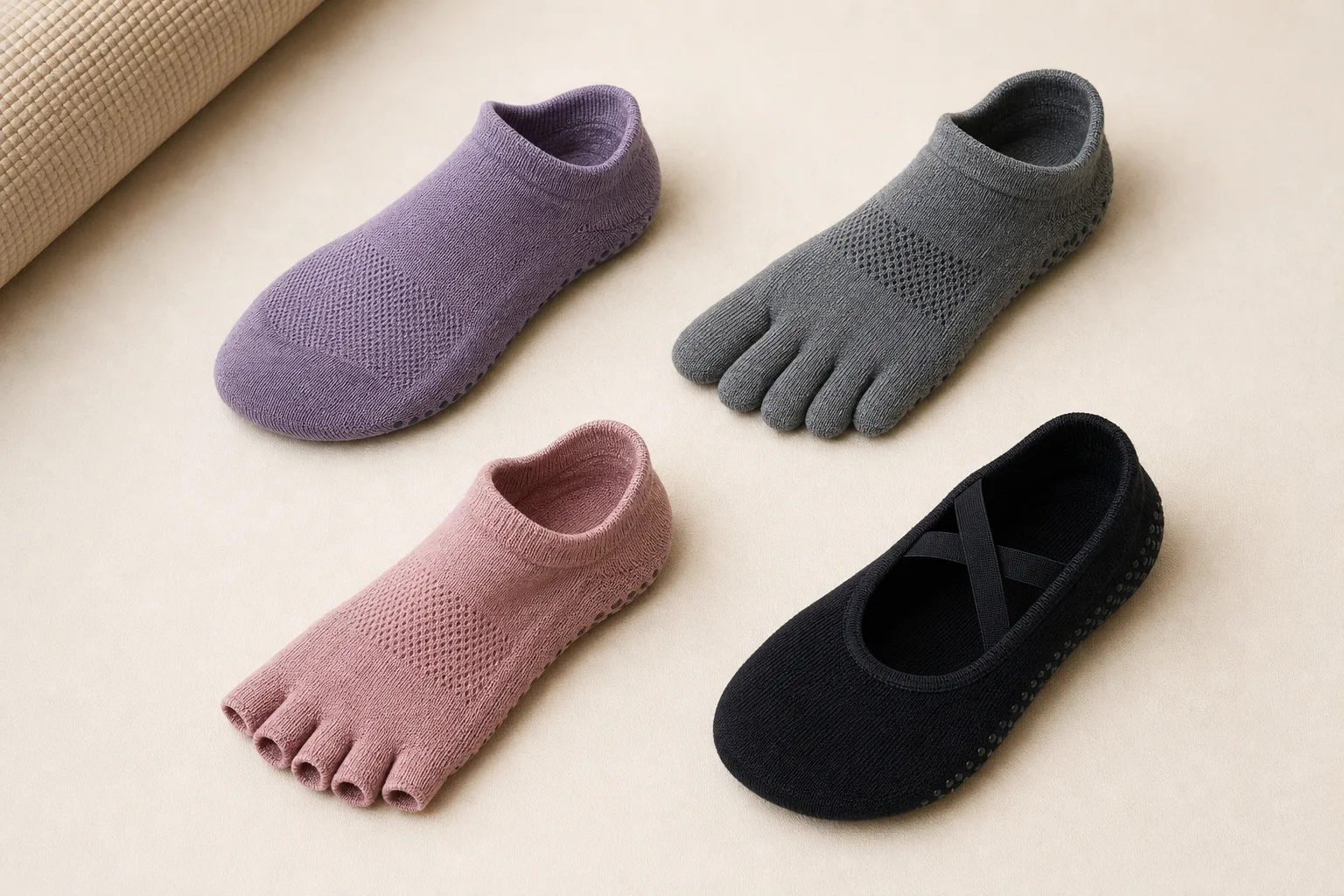
Conventional full-toe socks
A conventional sock encloses all toes in one knitted toe box. It is the most familiar format and usually the quickest to put on. Its critical dimension is not just overall length: the toe box needs enough width and depth to avoid pulling the heel forward or leaving a fold beneath the forefoot.
Check whether the grip continues far enough toward the toe edge. Some generic lounge socks concentrate dots in the middle of the sole and leave the heel or forefoot relatively bare. That construction may be sold beside yoga-specific products, but a familiar sock shape does not make the grip map equivalent.
Closed coverage can be useful when warmth or a complete fabric barrier is the reason for wearing socks. It also means more fabric can retain moisture. Fiber blend, knit density and ventilation panels matter more than a vague “breathable” label.
Five-toe full-toe socks
Five-toe socks enclose each toe separately. Current ToeSox and Manduka listings show this as a distinct full-toe construction rather than a cosmetic variation. The format adds several fit points: each pocket can be too long, short, narrow or loose, and the seams should not bunch between toes.
Do not assume separated pockets create a performance benefit. The verifiable buying advantage is construction choice: they prevent one broad toe box from folding across the forefoot and let each enclosed toe occupy its own section. Whether that feels better is personal.
When trying a pair, seat the heel first and then place each toe without pulling aggressively on the pocket ends. Inspect the underside afterward. If the sole twists while the upper looks straight, either the size or shape is wrong for that foot.
Half-toe and toeless socks
Half-toe designs cover the base of each toe while leaving the tips and pads exposed. ToeSox’s current Ivy, Luna and Bellarina pages illustrate this family and also note an elastic arch band. The design preserves more direct contact at the toe tips while keeping knit and grip beneath much of the foot.
The open edges add their own checks:
- each opening should sit in a consistent position;
- the edge should recover after stretching;
- no tube should rotate across an adjacent toe;
- exposed toe pads should not land partly on a thick seam; and
- the heel must remain fully seated when the toes move.
“One size” deserves caution here. Foot length alone does not predict toe proportions. A graded size range is easier to compare, although it still cannot describe every toe shape.
Open-vamp and ballet-style socks
An open-vamp design exposes much of the top of the foot and may use one or more crossing straps. Gaiam’s current Grippy Barre product, for example, combines a full-toe foot shape, silicone sole grip and crossed straps. MAD Group’s catalogue also separates full-foot and open-toe constructions.
The strap arrangement should be judged as hardware. Look for flat attachment points, symmetrical tension and reinforced stitching. A strap can look secure in a product shot yet pull the heel pocket downward when stretched over a high instep. If a maker publishes an instep warning or fit note, treat it as material information rather than fine print.
Read the grip map, not “non-slip”
Grip is commonly printed as silicone dots, bars or a branded pattern. The useful questions are visible and testable:
- Does coverage extend from the heel through the ball of the foot?
- Does it reach the toe area relevant to that construction?
- Are there large unprinted gaps at likely contact zones?
- Is the print bonded evenly without lifted edges?
- Does the sock stay oriented so the print remains underneath?
“Non-slip” is a category description, not a promise that a sock cannot move. There are two interfaces: grip material against the mat and knit against the foot. A secure outer pattern cannot stop a loose sock from sliding or rotating internally.
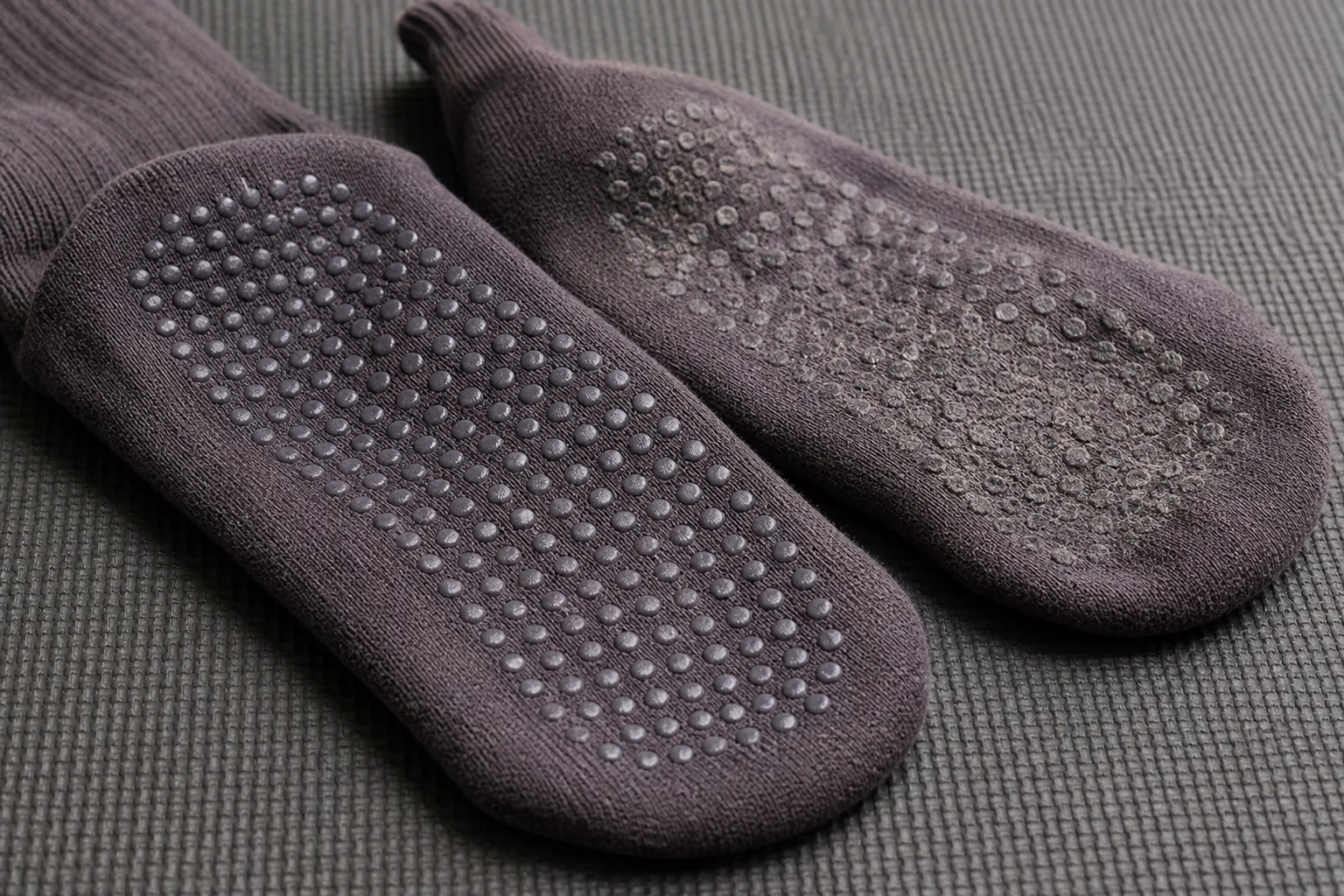
Grip coverage checklist
| Zone | What to inspect | Common problem |
|---|---|---|
| Heel | Print under the full heel contact area | Sparse center-only dots |
| Midfoot | Continuous transition or intentional spacing | Large bare strip that encourages rotation |
| Forefoot | Coverage across the ball of the foot | Pattern stops too far back |
| Toes | Dots on enclosed toes or coverage near open edges | Print misses the active end of the sock |
| Edges | Clean bonding with no curled print | Silicone lifting after wear or washing |
Product images often show only one sole. Check both socks on delivery because print registration and bonding can vary within a pair.
Match the sock to the mat surface
Yoga mats range from smooth polyurethane tops to textured rubber, PVC, TPE, cork and fabric-faced surfaces. A grip pattern can feel different across them because dot shape, spacing and surface texture interact. Product descriptions rarely identify every compatible mat material.
Use a reversible, low-stakes check before relying on a new combination: place the clean sock flat on the clean, dry mat, press with a hand and look for obvious rotation, folding or grip transfer. Then follow the class or teacher’s footwear policy. Do not treat this simple product inspection as proof of stability during movement.
If the underlying mat itself moves on the floor, changing socks does not address that interface. Our non-slip yoga mat guide covers mat construction. If both hands and feet need a clothing barrier, compare the separate fit and seam questions in our yoga gloves guide.
Avoid using a generated product photograph as compatibility evidence. The images on this page explain construction; they are not laboratory tests or endorsements of a depicted pattern.
Size by foot length, then check volume
Use the maker’s live size chart because letter sizes are not standardized. Manduka’s current ToeSox listings publish XS through XL ranges in centimeters; other products use broad shoe-size bands or a single range. Convert units carefully and do not assume a medium from one brand equals another.
Measure both feet on the same day:
- place paper on a hard, level floor;
- mark the back of the heel and longest toe while standing normally;
- measure the straight distance between those points;
- repeat for the other foot; and
- compare the longer measurement with the current brand chart.
This is a purchasing measurement, not a clinical assessment. If the brand only publishes shoe sizes, use the size system and region stated by that brand.
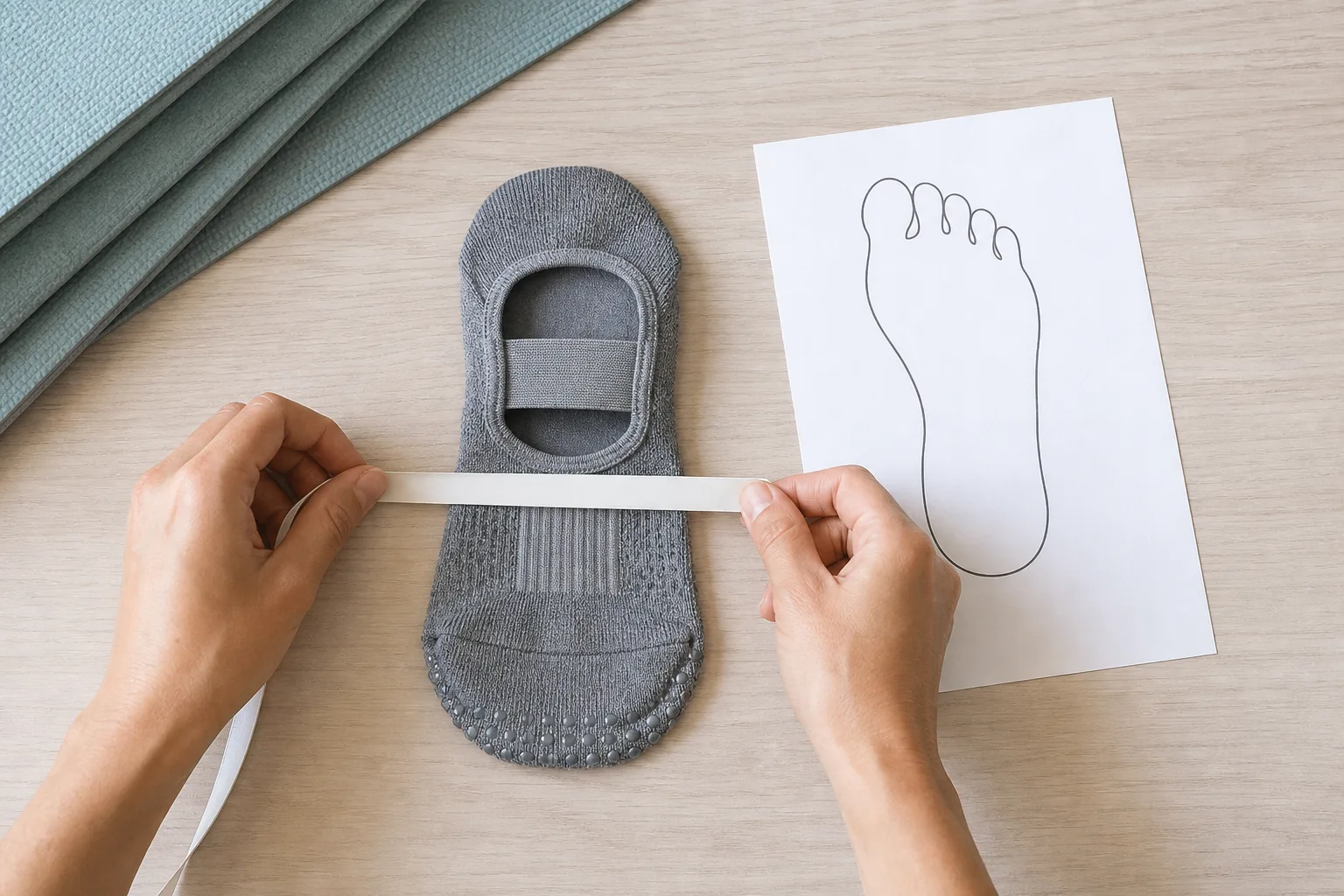
Width, instep and heel depth
Foot length cannot capture volume. An arch band that comfortably stabilizes one foot can feel restrictive on a high instep. ToeSox currently includes a high-instep warning on some half-toe product pages, which is exactly the kind of model-specific note worth finding.
Inspect these points when the pair arrives:
- the heel seam follows the heel rather than sitting beneath it;
- the top edge lies flat without rolling;
- the arch band returns to shape but does not create persistent pressure;
- the forefoot knit is smooth rather than stretched translucent;
- the toe box has no loose fold; and
- the grip pattern remains centered after walking a few steps.
Do not automatically size down to make a loose design tighter. A smaller sock can shorten the heel and toe sections without solving a shape mismatch.
Materials: read the percentages literally
“Cotton,” “organic cotton” or “technical” rarely describes the whole sock. Current manufacturer pages show multi-fiber blends. ToeSox’s Low Rise Tech page, for example, lists polyester, organic cotton, nylon and polyurethane. Other ToeSox pages list organic cotton-led blends with synthetic fibers for structure and stretch.
Each component has a different job:
| Component | Likely product role | What the label cannot tell you |
|---|---|---|
| Cotton | Soft, absorbent fiber in the knit | Exact drying time or durability |
| Polyester | Structure, moisture transport and faster drying | Comfort on a particular foot |
| Nylon | Reinforcement and abrasion resistance | Where it is concentrated |
| Polyurethane/elastane | Stretch and recovery | Band pressure or long-term recovery |
| Silicone print | External sole grip | Performance on every mat or wear life |
Check that listed percentages total sensibly and whether they apply to the whole sock, exclude trim or vary by color. A retailer translation or marketplace field can contain mistakes. Prefer the brand’s sewn-in label when it conflicts with a listing.
Fiber claims do not reveal seam placement, knit density or drying behavior. Two socks with similar percentages may have different heel pockets, ventilation zones and grip coverage.
Seams, bands and straps
Turn a new sock inside out before removing packaging that affects returns. Look for loose yarn, bulky knots, uneven toe seams and unfinished strap attachments. Then return it to its normal shape and compare left and right.
An elastic arch band is usually knitted into the midfoot. Its presence does not guarantee fit; it should help the sock retain shape without pulling the sole off-center. Crossed top straps should lie flat and return evenly. A deep heel pocket may suit one foot better than a very low edge even when both are sold in the same size.
For five-toe and half-toe models, count and inspect all five pockets. Generated catalog art and distant marketplace photos can hide malformed construction. The delivered product is the relevant evidence.
Delivery inspection
Before wearing a pair for a full session:
- confirm the ordered format, size and color on the package;
- compare both socks for length and heel shape;
- check all seams, bands, straps and toe openings;
- inspect the grip for missing, smeared or lifted areas;
- verify the care label matches the product listing;
- try them on indoors on a clean surface;
- check that the sole pattern remains centered; and
- retain packaging until the fit and construction are accepted.
A grip pattern can look uneven because of fabric stretch while worn. Inspect it both relaxed and gently stretched, without picking at the silicone.
Washing and drying
The sewn-in care label controls. Common grip-sock instructions call for cool washing, mild detergent, no bleach or fabric softener, and air drying. These rules protect more than color: high heat can affect elastic recovery and bonded grip, while softener can leave residue.
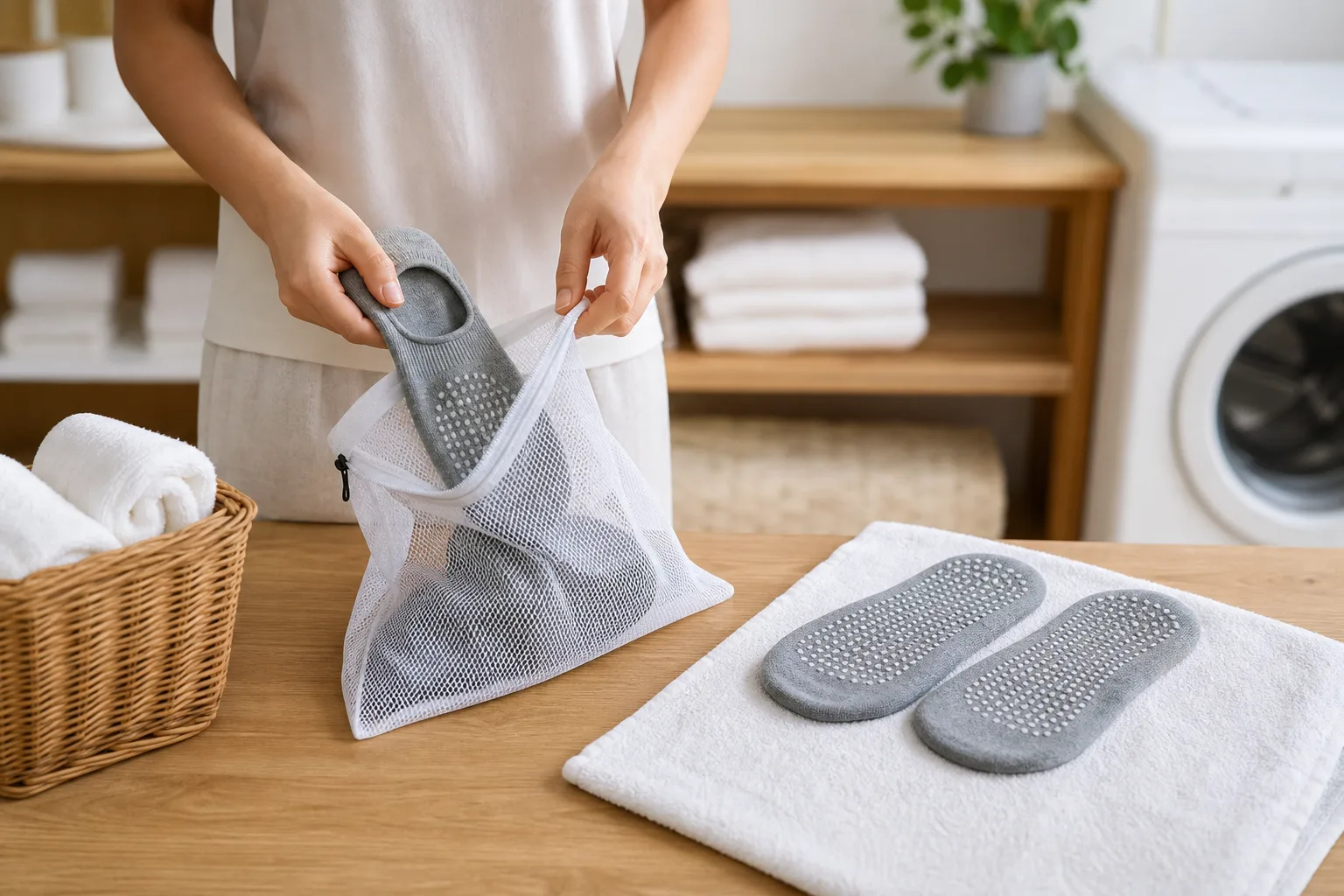
A low-wear care sequence
- close the mesh bag so small socks do not disappear into seals or filters;
- use the temperature and cycle on the label;
- keep hook-and-loop fasteners and rough hardware in another load;
- omit bleach and softener when prohibited;
- reshape toe pockets and heel while damp; and
- dry fully before stacking pairs together.
Washing inside out may protect the printed sole from drum abrasion, but it can also trap lint against the inner surface; follow the maker’s instruction if one is provided. Never iron the grip print.
Store pairs flat or loosely folded. Avoid stretching one cuff around both socks because that keeps the elastic under tension. Keep them away from direct heat and from sharp hook closures on other gear.
When grip socks are worn out
Age is a poor replacement rule because use, mat texture, laundering and rotation differ. Retire a pair from its intended use when:
- grip dots are polished smooth across major contact zones;
- silicone cracks, peels, transfers or goes missing;
- the knit rotates despite correct sizing;
- the heel slips down repeatedly;
- toe openings or seams fray;
- straps detach or arch elastic stops recovering; or
- persistent odor or staining remains after label-compliant cleaning.
One worn dot does not automatically condemn a pair. Look at the overall contact map and whether the construction still stays aligned. Replace pairs together if their wear has become noticeably asymmetric.
Compare value without stale prices
Prices, packs and promotions change. Use the live delivered price and normalize it:
Delivered cost per pair = (item price + delivery − immediate discount) ÷ number of wearable pairs
Then add the costs a headline price hides: return postage, required membership, replacement frequency and whether every pair in a multipack is the same usable size and format. A five-pair bundle is not better value when several pairs rotate or remain unworn.
Compare like with like. A graded five-toe pair with separate pockets, arch knitting and full-sole printing has different manufacturing details from a one-size conventional sock. Those features justify comparison, not an automatic premium. Buy the simplest construction that fits and meets the actual studio or home-use requirement.
Red flags
- “Non-slip” with no sole photograph.
- A dense forefoot pattern but an almost bare heel.
- One-size claims with no foot-length or shoe-size range.
- The same chart reused across adult and children’s listings.
- Five-toe images that do not show all pockets clearly.
- “Organic” without identifying which fiber carries the claim.
- “Breathable” with no fiber blend or knit detail.
- A high-instep warning hidden outside the size chart.
- Care instructions that conflict between the listing and label.
- Lifestyle images presented as proof of grip performance.
- Static comparison prices with no date, pack count or delivery basis.
A practical selection sequence
- Check whether the studio permits, requires or discourages socks.
- Choose conventional full-toe, five-toe, half-toe or open-vamp coverage.
- Measure both feet and use the current brand chart.
- Account for forefoot width, toe proportions, heel depth and instep volume.
- Inspect heel-to-forefoot grip coverage and bonding.
- Check the complete fiber blend, seams, bands and straps.
- Verify the combination on the actual clean, dry mat without assuming a guarantee.
- Follow the sewn-in care label and inspect after each wash.
- Compare current delivered cost per wearable pair.
The best yoga socks are not the pair with the most dots or the strongest “non-slip” wording. They are the format that fits without twisting, keeps its grip map under the foot, works with the intended mat and remains easy to inspect and care for.
Frequently asked questions
What type of yoga socks should I choose?
Choose by the kind of coverage you want. Conventional full-toe socks enclose all toes together, five-toe socks separate them, half-toe models leave the toe ends open, and open-vamp styles expose much of the top of the foot. Then verify size, heel fit and heel-to-forefoot grip coverage.
Are yoga socks and Pilates grip socks the same?
The products can overlap, but the buying context differs. Yoga socks are evaluated here for use on a yoga mat, including toe coverage and how the grip pattern meets the mat. Our Pilates guide covers reformer and studio policies. A marketing label alone does not prove suitability for either surface.
Should yoga socks fit tightly?
They should fit securely without bunching, rotating or creating uncomfortable pressure. Use the maker’s current foot-length chart rather than relying only on a usual shoe size. High insteps, wide forefeet and long toes can change the fit even when foot length matches.
How should I wash yoga grip socks?
Follow the sewn-in label. Common instructions are a cool or gentle wash, no bleach or fabric softener, and air drying. Heat and softener can affect elastic and silicone grip. Put small pairs in a mesh bag and inspect the grip after washing.
When should yoga socks be replaced?
Replace or retire a pair when the grip print is smooth, cracked or missing across important contact areas; the sock rotates under the foot; the heel slips; seams open; or elastic no longer recovers. Judge the condition of the whole pair, not its age alone.