

How this page has changed
July 26, 2026
Sources, internal links and safety or product context reviewed.
In this guide
- 01Yoga gloves at a glance
- 02Quick decision
- 03Three glove architectures
- 04Read the grip surface
- 05Fit is an interface, not a label
- 06Padding versus direct feedback
- 07Materials and allergy disclosure
- 08Surface compatibility and an unloaded check
- 09Inspection and retirement
- 10Cleaning, drying and storage
- 11Yoga gloves versus other grip products
- 12Claims to treat cautiously
- 13Buying checklist
- 14How this guide was researched
Yoga gloves are fingerless gloves or compact palm coverings with a textured contact surface. Their narrow job is to add traction between a hand and a mat or floor. They do not fix alignment, clean a contaminated surface or diagnose why a hand or wrist feels uncomfortable.
The category is less uniform than the name suggests. Current products range from stretchy knit gloves with small grip dots to minimal rubber palm pads and structured gloves with raised padding. Those architectures change coverage, heat, feedback, sizing and care. Compare the complete glove rather than shopping from the words “non-slip” or “wrist support.”
This is a source-checked buying and maintenance guide, not hands-on testing, pose instruction or medical advice.
Yoga gloves at a glance
| Current product | Architecture | Published material | Sizing | Published care |
|---|---|---|---|---|
| Gaiam Grippy Yoga Gloves | Full knit, fingerless; targeted palm and finger traction | 95% polyester, 3% rubber, 2% spandex | One size fits most | Machine wash; air dry |
| YogaPaws Gloves | Minimal palm pad with mesh and finger loops | Natural rubber, mesh, microfiber liner and Lycra/spandex listed | Sizes 1–4 by knuckle width | Hand wash inside-out; cold delicate machine cycle only if necessary; air dry |
| ProsourceFit Grippy Yoga Gloves | Full cotton-blend fingerless glove with grip dots | 92% cotton, 6% nylon, 2% elastin; PVC rubber dots | One size fits all | Machine wash |
| WAGs / Wrist Assured Gloves | Structured fingerless glove with raised palm wedge | Materials and features vary by model; retailer lists latex-free and vegan | Multiple sizes | Follow model label |
These are published specifications, not our measurements. ProsourceFit’s product page was unavailable for purchase when checked, so it is included as a documented construction example rather than a buying recommendation. The YogaPaws page uses both “natural rubber” and “latex-free” language. Because those statements can be difficult to reconcile, allergy-sensitive shoppers should request product-specific clarification before contact.
Quick decision
| Purchase question | Compare | Main trade-off |
|---|---|---|
| How much hand coverage? | Full knit glove versus palm-only pad | Coverage can improve containment but retain more heat |
| What contacts the surface? | Dots, printed pattern or continuous rubber | Pattern affects contact area, flex and wear visibility |
| Does the glove move on the hand? | Knuckle measurement, palm width, wrist opening and stretch | External grip is irrelevant if the liner slides internally |
| Thin or padded? | Published thickness and pad position | Padding changes height and feedback; it is not automatically support |
| Which surfaces? | Maker’s documented compatibility and your exact mat or floor | Grip is a system property, not a glove-only guarantee |
| How is it maintained? | Wash method, detergent limits and drying | Residue and heat can change fabric or grip compounds |
Start with the interface you are trying to manage. If perspiration is the issue, a washable textile glove may contain moisture. If portability is primary, a minimal palm pad occupies less space. If the glove itself rotates, bunches or traps too much heat, stronger external grip will not solve the internal fit problem.
Three glove architectures
Retail listings put visibly different products under one keyword. Separate them into three practical groups before comparing claims.
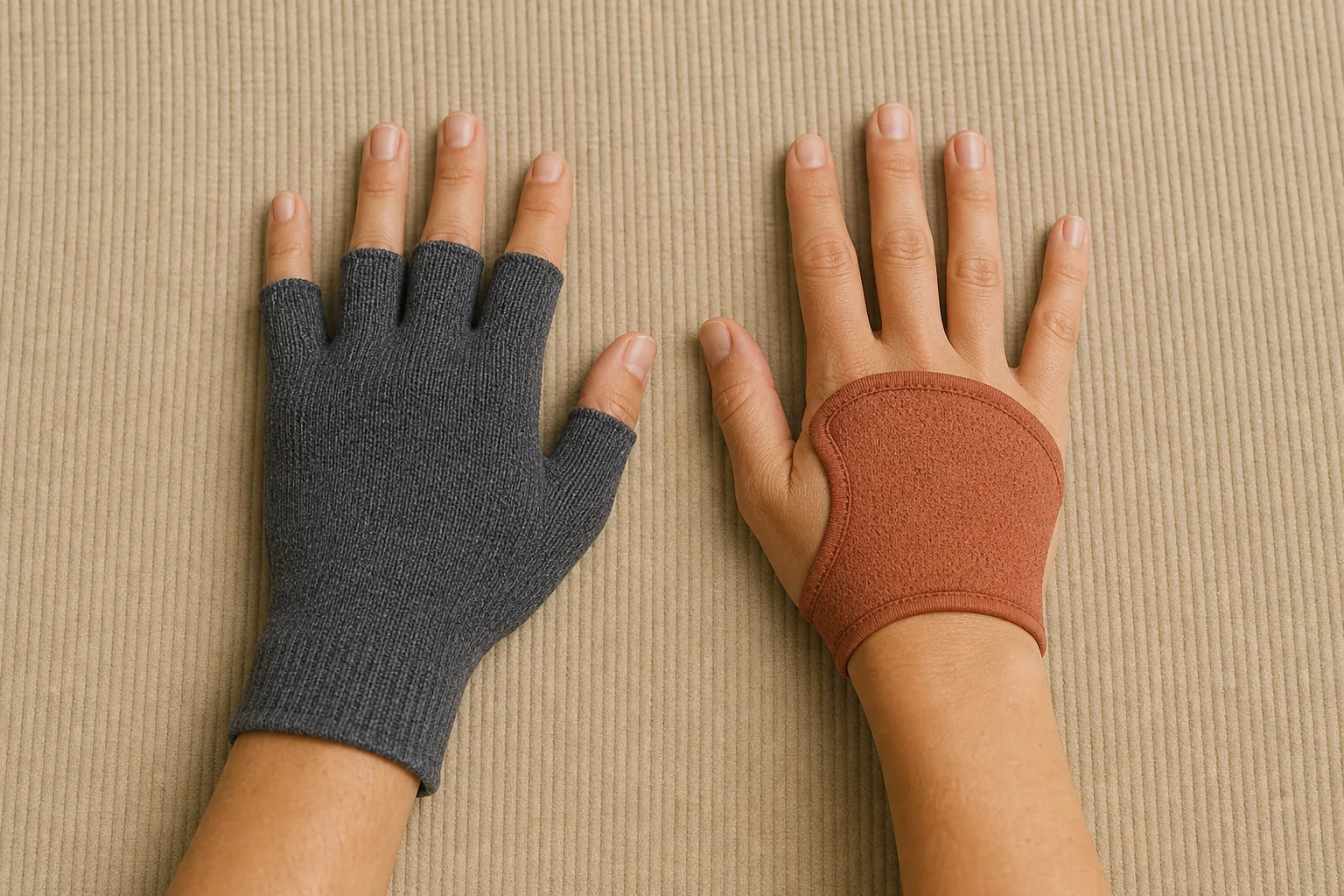
Full knit fingerless gloves
This familiar format resembles a lightweight studio glove. Fabric covers the palm, back and lower portions of the fingers, while fingertips remain open. Gaiam uses a mostly polyester construction; ProsourceFit publishes a mostly cotton blend. Both put discrete traction elements on the hand-facing surface.
The format offers broad fabric contact and can be easy to wash. It also creates a complete fabric layer between skin and surface. If the knit stretches across the palm, the glove may shift even while its dots remain fixed to the mat. Look for a shaped thumb opening, flat seams and enough elasticity to stay close without constriction.
Minimal palm pads
YogaPaws uses a smaller palm-focused architecture with finger loops, a rubber contact layer, mesh and a microfiber liner. This reduces back-of-hand coverage and exposes more skin. The trade-off is that a few attachment points must keep the pad centered.
Check where every loop and edge sits. A palm pad that is too long can ride toward the fingers; one that is too short can pull against the web spaces. Product photos should show both sides and the fastening path, not only the grip surface.
Structured or padded gloves
WAGs represents a third category: a glove with a visibly raised palm element. That construction changes the hand-to-surface geometry, not merely friction. Treat thickness, firmness and location as specifications that require their own evaluation.
Manufacturers may attach therapeutic language to structured gloves. This guide does not adopt those claims. A raised insert may change pressure distribution, but that does not establish that it prevents injury or treats a condition. If a clinician or qualified teacher has specified a device, confirm the exact model and configuration instead of substituting a generic grip glove.
Read the grip surface
“Non-slip” is not a measurable material specification. Useful product pages identify the traction material, its pattern and where it appears. Gaiam lists rubber within the glove composition; ProsourceFit specifies PVC rubber dots; YogaPaws identifies a natural-rubber layer.
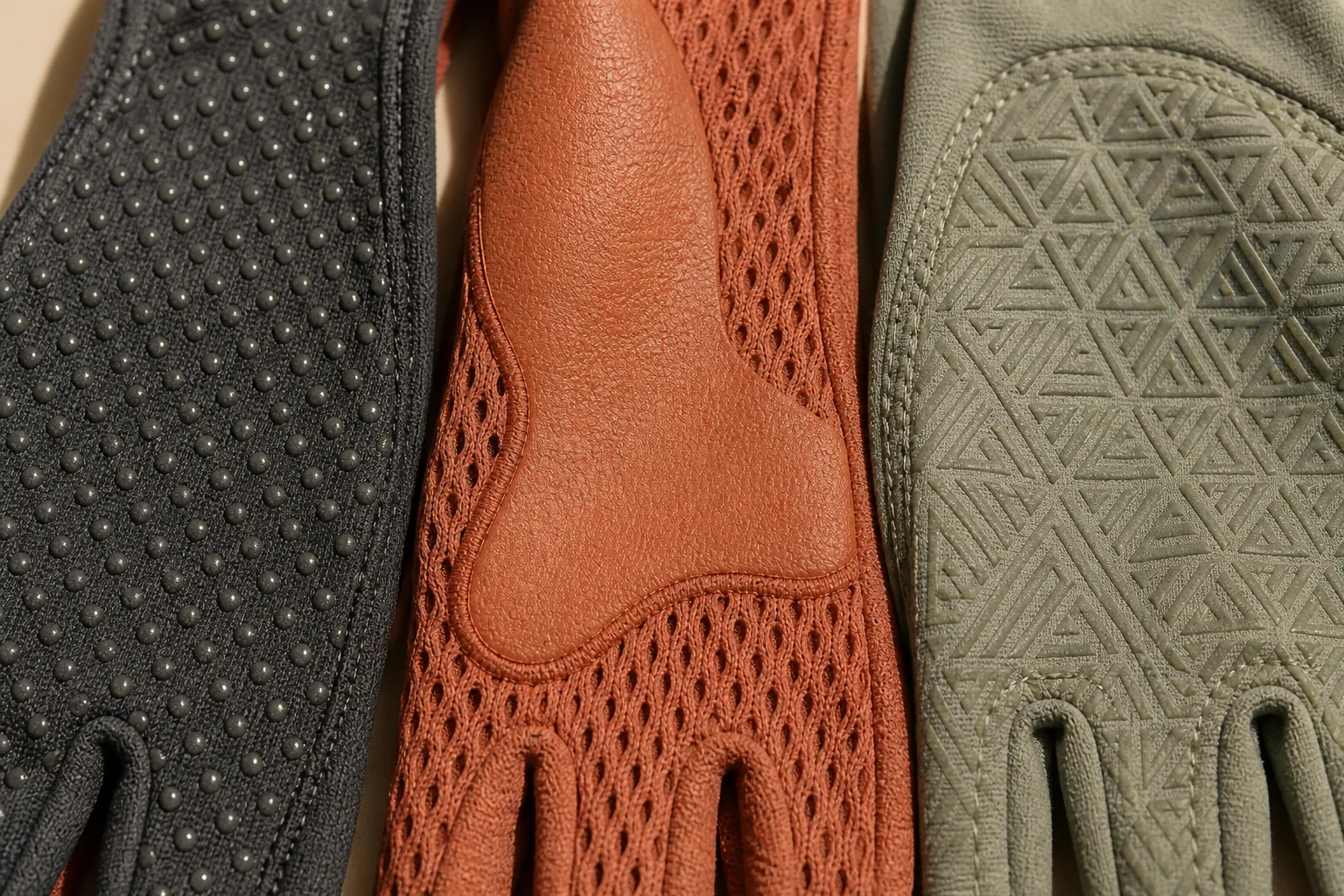
Dotted grip
Small dots preserve fabric flex and ventilation between contact points. They also create many edges, which can help a user see polishing, peeling or missing material. Dot height and spacing matter: sparse dots leave more textile exposed, while large raised dots can feel pronounced.
Inspect high-contact zones near the heel of the hand and finger bases. A photograph showing dots everywhere does not prove that all dots contact a surface once the hand bends.
Continuous rubber
A continuous layer provides a larger nominal contact area and can block moisture from reaching the mat. It may also feel warmer and flex differently from knit fabric. Look for bonded edges, creasing and whether the layer wraps beyond the intended palm area.
Rubber is not one universal substance. Natural-rubber and synthetic compounds have different disclosures, and neither label alone predicts grip, durability or allergy suitability.
Printed or geometric grip
A connected print can balance textile flexibility with more surface coverage than isolated dots. Compare how far it extends toward the thumb and fingers and whether the printed layer crosses seams. Thin printed lines may show abrasion earlier than a thicker pad.
Traction depends on the full system: grip compound, mat or floor chemistry, dust, oils, moisture, normal force and direction of movement. A glove that feels secure on one polyurethane mat may behave differently on natural rubber, PVC, cork or finished wood. Avoid absolute claims based on material name alone.
Fit is an interface, not a label
A glove creates two friction boundaries. The outside must engage the support surface, but the inside must also remain stable against the hand. An oversized glove can stick externally while the palm slides inside it. An undersized glove can pull between fingers, distort the grip pattern or restrict motion.
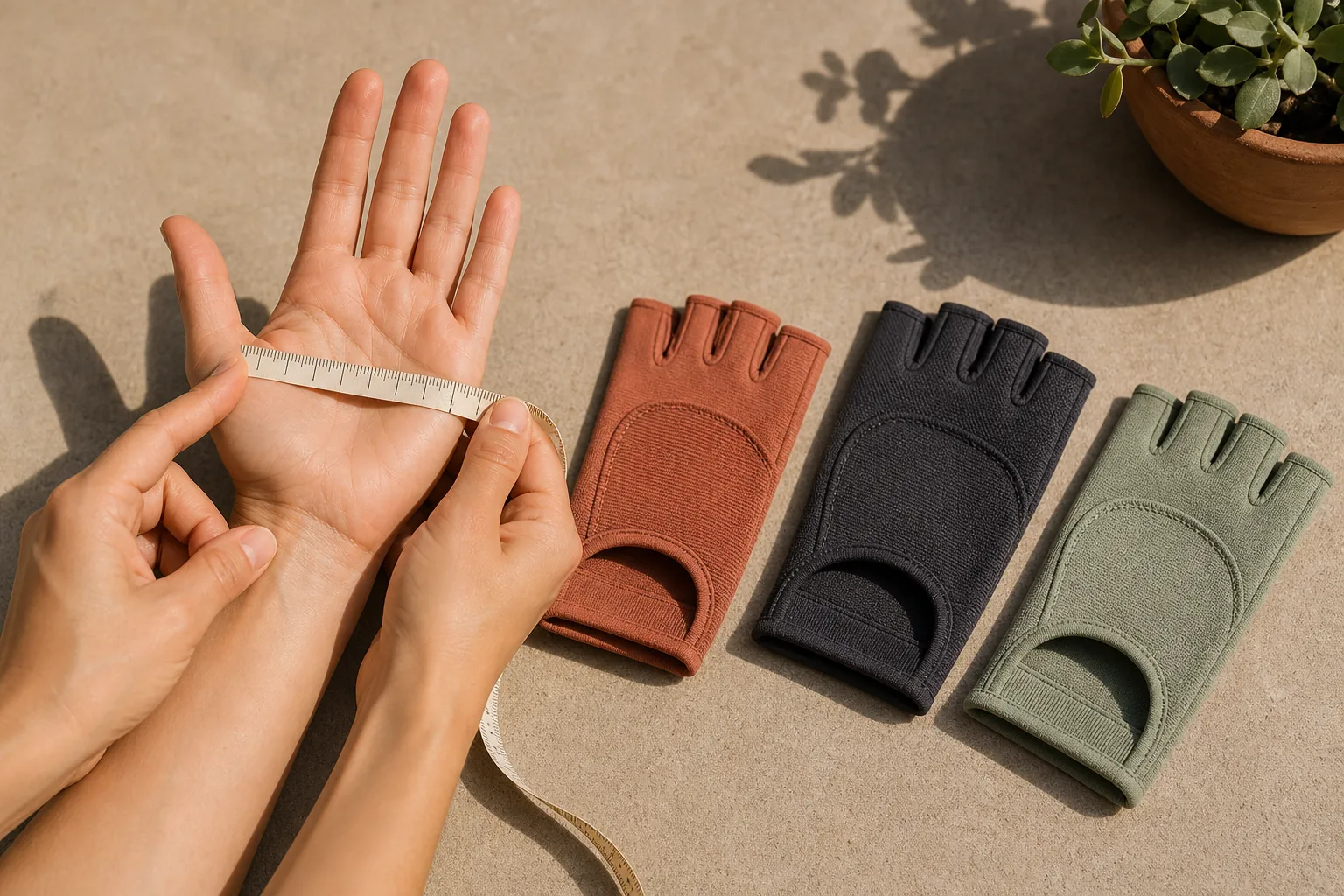
YogaPaws publishes sizes 1–4 based on width across the knuckles. That is more informative than a one-size statement, but only if the shopper follows the diagram’s location and units. Gaiam says one size fits most; ProsourceFit says one size fits all and publishes an approximate glove footprint of 5.9 by 4.5 inches. Those phrases are not evidence that every hand shape will fit.
Before keeping a glove, check it unloaded:
- Each finger opening sits flat without a tight rolled edge.
- The thumb seam follows the hand rather than pulling across the palm.
- The grip field stays centered when the fingers spread naturally.
- No fold forms at the heel of the hand.
- The wrist opening stays in place without leaving persistent pressure marks.
- A paired set feels equivalent left to right.
Then close and reopen the hand several times. Watch the glove rather than judging only comfort. A grip pad that migrates, a seam that rotates or fabric that tents above the palm indicates a fit mismatch.
Padding versus direct feedback
YogaPaws lists an Elite version with 5 mm padding and a SkinThin version with a 2 mm unpadded profile. Those figures demonstrate how much variation can exist within one brand. WAGs adds a more prominent raised element. A conventional knit grip glove may have no separately specified pad at all.
More thickness is not automatically more comfortable, safer or more supportive. Padding can reduce direct sensation and change contact height. A localized pad can create an edge transition. A thin glove preserves more surface feedback but offers little separation from hard texture.
Choose from a documented need, not a symptom-based promise:
- prefer thin construction when direct feedback and compact packing matter;
- compare padding when a class or qualified professional has specified it;
- reject listings that omit pad thickness or placement while making strong support claims;
- do not stack improvised inserts inside a glove, because they can migrate and alter fit.
Persistent pain, numbness, tingling, swelling, weakness or reduced function is not a shopping problem. Stop the aggravating activity and seek appropriate clinical assessment.
Materials and allergy disclosure
Material tables deserve careful reading because “rubber,” “silicone,” “PVC,” “latex-free” and “natural rubber” are not synonyms.
Gaiam publishes a fiber blend with 3% rubber. ProsourceFit identifies PVC rubber dots and places a California Proposition 65 warning on its page mentioning acrylonitrile. That warning should be read in its exact manufacturer and regulatory context; it is neither a blanket safety verdict nor something to omit when material disclosure matters.
YogaPaws describes natural rubber while the same page also uses latex-free language. Natural rubber latex can be relevant to allergy-sensitive users, so do not infer suitability from conflicting copy. Ask the manufacturer for the exact current material declaration for the specific color and model.
Also check:
- whether the grip compound is named or merely called “non-slip”;
- whether a liner contacts the whole palm;
- whether dyes or antimicrobial finishes are disclosed;
- whether material information applies to every variant;
- whether the sewn label matches the current web listing.
If you have a known contact allergy, use advice from your qualified clinician and product-specific documentation. This guide cannot establish individual compatibility.
Surface compatibility and an unloaded check
Gloves do not make every floor an appropriate yoga surface. Finished wood, tile and laminate vary by coating and contamination. Studios may also prohibit direct floor contact or require mats for hygiene.
For an equipment-only check, place a clean glove flat on the intended clean, dry surface with no hand inside. Press lightly and move it a short distance in several directions. Look for unexpected skating, rolling grip elements, transferred color or residue. This does not simulate a loaded practice and is not permission to perform a pose; it only identifies obvious incompatibility before use.
If the mat itself is persistently slick, inspect and clean it according to its manufacturer. A suitable non-slip yoga mat or a correctly matched yoga mat towel may address the surface more directly. Gloves can still be useful for portability or hand moisture, but they should not conceal a degraded mat.
Inspection and retirement
Check both gloves in bright light when new, after washing and before relying on them. Compare left and right because wear is often uneven.
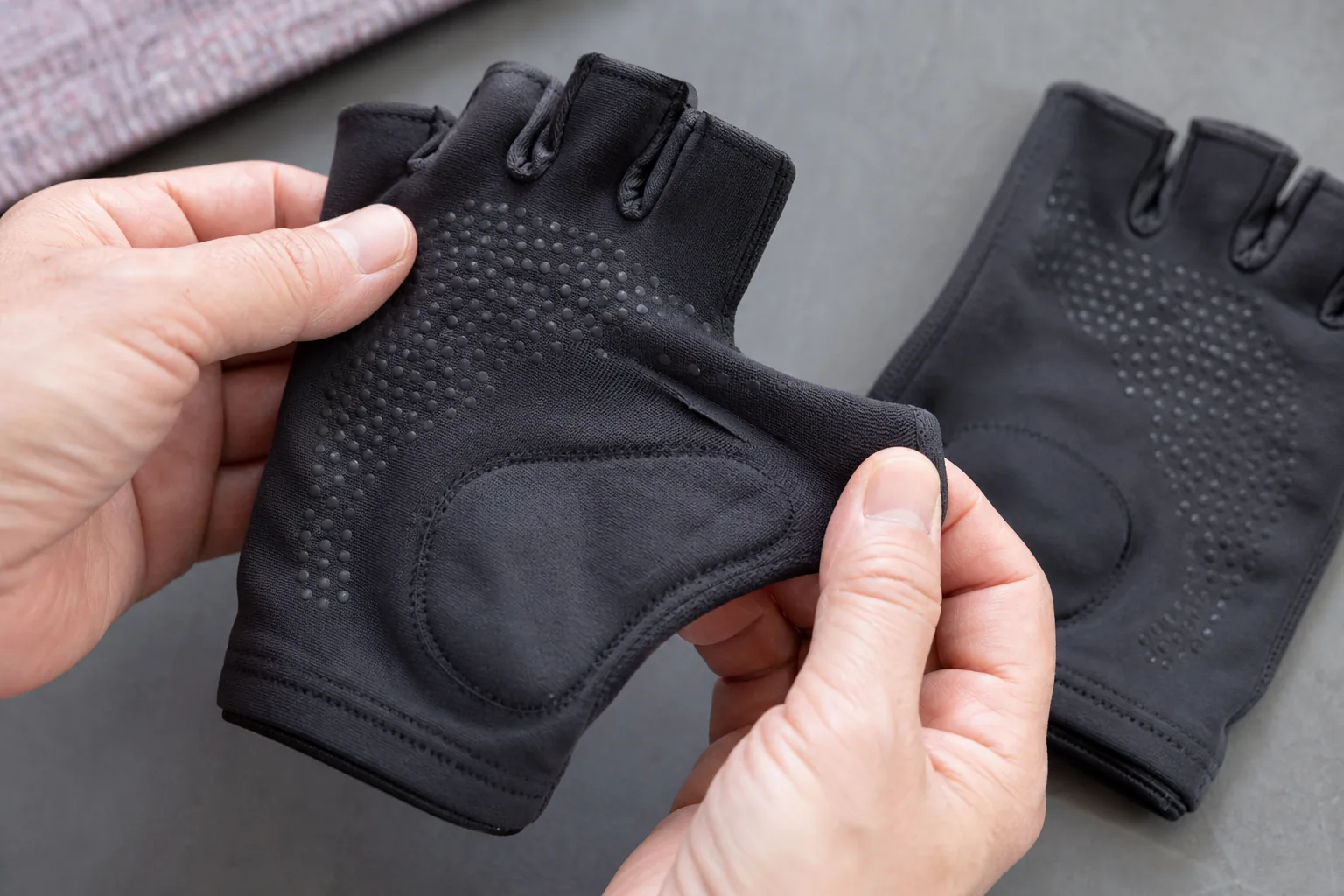
Look for:
- missing, polished, cracked or tacky grip elements;
- a continuous rubber layer lifting at an edge;
- holes or thinning fabric beneath the palm;
- loose seams at finger webs and thumb openings;
- permanently stretched elastic or a distorted wrist opening;
- detergent, oil, lint or other residue on the grip surface;
- odor or dampness that remains after the approved wash and dry cycle.
Retire a glove when the grip layer detaches, the glove no longer stays centered, a structural seam opens or cleaning cannot restore a clean, dry contact surface. Do not glue loose grip material and assume the original friction and flexibility have returned.
Cleaning, drying and storage
Follow the exact label because similar-looking gloves use different fibers and bonded compounds. Gaiam says its polyester-rich gloves can be machine washed and air dried. ProsourceFit also permits machine washing. YogaPaws prefers hand washing inside-out with cold water and gentle soap; it allows a cold delicate machine cycle only when necessary and specifies air drying.
A conservative routine is:
- Remove surface debris from the grip side.
- Fasten any hook-and-loop closure so it cannot snag fabric.
- Wash by the maker’s approved method with the permitted detergent.
- Rinse thoroughly if hand washing.
- Reshape the glove without stretching finger openings.
- Air-dry fully, separated from its mate, before storage.
Avoid fabric softener, bleach, solvent, essential oil and high dryer heat unless the manufacturer explicitly permits them. Softener and oil can leave residue; heat can alter elastic fibers or bonded grip compounds.
Store the pair clean and completely dry, with grip surfaces not pressed together. Do not leave gloves compressed under blocks or in a sealed damp mat bag. A small breathable pouch keeps the pair together while allowing residual moisture to escape.
Yoga gloves versus other grip products
| Product | Contact area | Useful distinction |
|---|---|---|
| Yoga gloves | Hands | Portable hand-specific interface; fit can introduce internal movement |
| Mat towel | Most or all of mat | Manages a broad moisture layer but can wrinkle or shift |
| High-grip mat | Whole practice surface | Changes the base surface without adding handwear |
| Pilates grip socks | Feet | Footwear category with different sizing, hygiene and movement demands |
Do not treat hand and foot products as interchangeable. Our Pilates grip socks guide owns foot-grip buying intent; this page owns handwear selection and care. A towel and gloves can also create multiple layers, each with its own movement boundary. More “grip” products do not necessarily produce a more stable system.
Claims to treat cautiously
Be skeptical of promises that gloves will correct poses, prevent injury, eliminate wrist pressure or treat carpal tunnel syndrome. Grip equipment can change friction or contact geometry. It cannot identify the cause of symptoms or guarantee a movement outcome.
Also avoid unsupported hygiene claims. A washable glove may create a personal contact layer, but that does not make a shared mat or floor sanitary. Wash the glove and clean the support surface according to their separate instructions.
The clearest product page publishes dimensions, materials, sizing method, care and return terms. Strong therapeutic copy with weak physical specifications reverses the information a buyer actually needs.
Buying checklist
Before ordering, verify:
- Architecture: full knit glove, minimal palm pad or structured padded design.
- Coverage: exact palm, finger, thumb and wrist areas covered.
- Grip material: rubber, PVC, silicone or another named compound.
- Pattern: dots, continuous layer or printed geometry.
- Sizing: a measurement chart, not only a one-size claim.
- Fit: return or exchange terms if the palm surface rotates or folds.
- Padding: measured thickness and location when present.
- Materials: complete skin-contact and grip-layer disclosure.
- Allergies: written clarification when rubber or latex language conflicts.
- Surface: documented compatibility without an every-surface guarantee.
- Care: wash temperature, detergent limits and drying method.
- Inspection: visible seams and a replaceable product at the end of service life.
- Claims: no reliance on injury-prevention or treatment promises.
For the simplest starting point, choose a correctly sized, unpadded fingerless glove with a clearly identified grip compound and explicit wash instructions. Move to a minimal pad for lower coverage or a structured glove only when that architecture solves a defined requirement.
How this guide was researched
We compared current manufacturer and authorized-retailer specifications from Gaiam, YogaPaws, ProsourceFit, WAGs and Balanced Body. We preserved omissions and inconsistent disclosures instead of turning them into invented certainty. No glove was hands-on tested, and no manufacturer performance or medical statement was converted into our own finding.
The page owns yoga-glove selection, fit, material disclosure, care and retirement. It excludes pose instruction, therapeutic protocols and individualized medical recommendations. That boundary keeps this equipment query distinct from mat, towel, foot-grip and wrist-health content.
Frequently asked questions
What are yoga gloves?
Yoga gloves are fingerless hand coverings or palm pads with a high-friction contact surface. Knit versions usually cover the palm and back of the hand, while minimal pads leave more of the hand exposed. They add two interfaces: hand to glove and glove to mat or floor.
Do yoga gloves work without a mat?
Some manufacturers market their gloves for mat-free use, but compatibility depends on the exact grip compound, floor finish, cleanliness and direction of force. A product claim is not proof for every surface. Test only in a low-consequence, unloaded setup and follow venue rules.
How should yoga gloves fit?
They should be snug enough that the palm surface does not fold or rotate, without constricting the fingers or wrist. Use the maker’s measurement method rather than assuming one-size labeling will fit every hand.
Are padded yoga gloves better than unpadded gloves?
Not universally. Padding changes contact height and pressure distribution, while a thin glove preserves more direct surface feedback. Compare padding thickness, placement and intended use. A padded glove is not automatically a medical device or treatment.
Can yoga gloves treat wrist pain or carpal tunnel syndrome?
No general-purpose yoga glove should be assumed to diagnose or treat pain or carpal tunnel syndrome. Persistent, sharp, worsening or unexplained symptoms, numbness, swelling or weakness need assessment from a qualified clinician.