
This guide contains affiliate links — recommendations aren’t based on commission. Read our full disclosure.
How this page has changed
July 25, 2026
Sources, internal links and safety or product context reviewed.
In this guide
- 01First: does your studio actually require them?
- 02What the evidence actually says about safety
- 03The two things that actually matter
- 04What the extra money does and does not buy
- 05Why your socks stop gripping — and how long they should last
- 06The picks
- 07Full toe, toeless or five-toe: an honest non-answer
- 08Who should skip grip socks
- 09Related reading
Two things decide whether a grip sock does its job. The grip has to run the full length of the sole, toes to heel. And the sock has to fit snugly. Almost everything above that is price.
That is an unusual thing to read on a page like this, so here is why I am confident: the same physical sock is routinely sold as both a Pilates sock and a hospital non-slip sock. Of 52 unique products returned for this search, 20 carry the word "hospital" in their own title. The category is not hiding it.
Quick answer. Check your studio's policy first — the chains genuinely disagree, and some ask you to go barefoot. If you do need them, a multipack does the traction job; spend more only for graded sizing, which is the one difference that changes how the sock performs. Buy at least three pairs, because they wear out.
By Marvin Smit · Long-time practitioner, not a certified instructor.
I have not worn these socks. This page is built from the brands' own specifications, named studio owners and instructors, two peer-reviewed sources, and the care instructions the manufacturers publish — which contradict each other in ways worth knowing about.
Looking for socks specifically for a yoga mat? Our yoga socks guide compares full-toe, five-toe, toeless and open-vamp construction, mat-facing grip coverage, sizing and care. This page retains ownership of Pilates reformer use, studio rules and product picks.
First: does your studio actually require them?
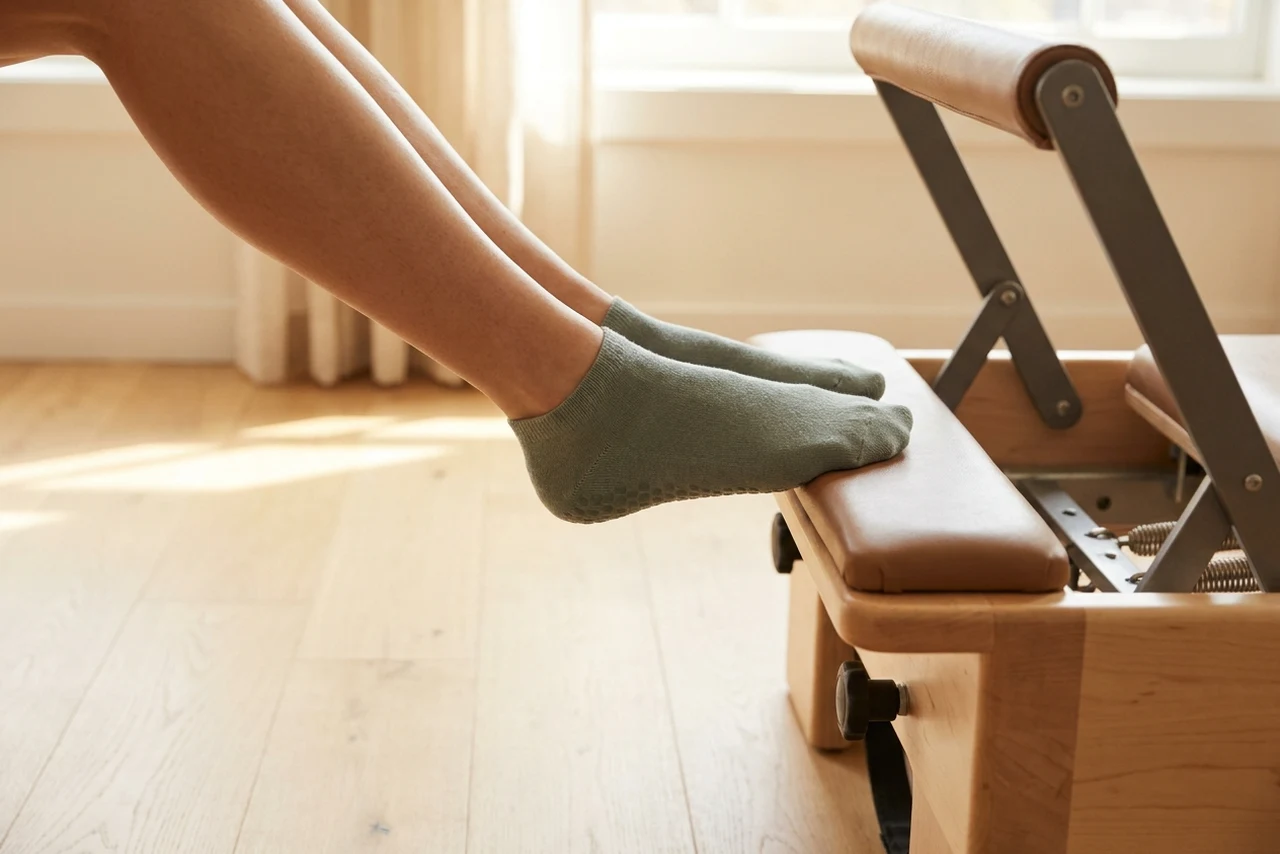
The page currently ranking above everything else on this search states that most studios require grippy socks. I checked six studios' own live pages, and it splits almost evenly.
They require them:
- Club Pilates: "For health and safety reasons, all Club Pilates classes require everyone to wear grip socks."
- Pure Barre: "For health and safety reasons, all Pure Barre classes require everyone to wear sticky socks."
- Lagree West: grip socks are mandatory, and staff will require a purchase before class if you arrive without them.
- The Megaformer Studio: "Grip socks are mandatory for all classes — no exceptions." Bare feet and ordinary socks are both banned.
They do not:
- [solidcore], a national chain, states plainly: "Our workout is done barefoot and grip socks are optional."
- An independent reformer studio goes further and recommends against them, on the grounds that bare feet allow natural foot articulation and better engagement with the equipment.
- A second independent tells beginners to start barefoot so they can feel the foot bar.
The pattern is not random. National franchises and Lagree-format chains mandate; a national barefoot chain, independents and classical studios do not. So the honest answer to "do I need these" is: look at your own studio's page, not at a buying guide.
One thing I will not tell you, because I checked and it is not true: the widely repeated claim that Club Pilates accepts any brand of non-skid sock. Its help article is 110 words long and says nothing whatsoever about brands.
What the evidence actually says about safety
The marketing frames grip socks as a safety product. The evidence for that is thinner than you would expect, and being straight about it costs nothing.
In the one setting where slip resistance has been measured properly — a laboratory study on hospital flooring — non-slip socks performed worse than bare feet, with barefoot producing the highest slip angles for every participant. A 2021 rapid review reached a similarly cautious place: no strong or conclusive evidence that non-slip socks prevent falls, plus an infection-control risk that needs managing.
And here is the limitation nobody else prints: every one of those studies tested hospital vinyl. There is no primary evidence at all on a reformer carriage, a footbar, or a Megaformer under spring load. Whatever grip socks do in a Pilates studio, nobody has measured it.
That is not an argument for bare feet either. A board-certified foot and ankle surgeon reports a predictable spike in second and third metatarsal stress fractures, plantar fasciitis and Achilles tendinopathy in the four to eight weeks after people switch suddenly to barefoot training. Neither option is risk-free, and neither is well studied.
The realistic case for grip socks is comfort, hygiene and studio policy. That is enough of a case. It just is not the case the packaging makes.
The two things that actually matter
Both come from named studio staff rather than from brands.
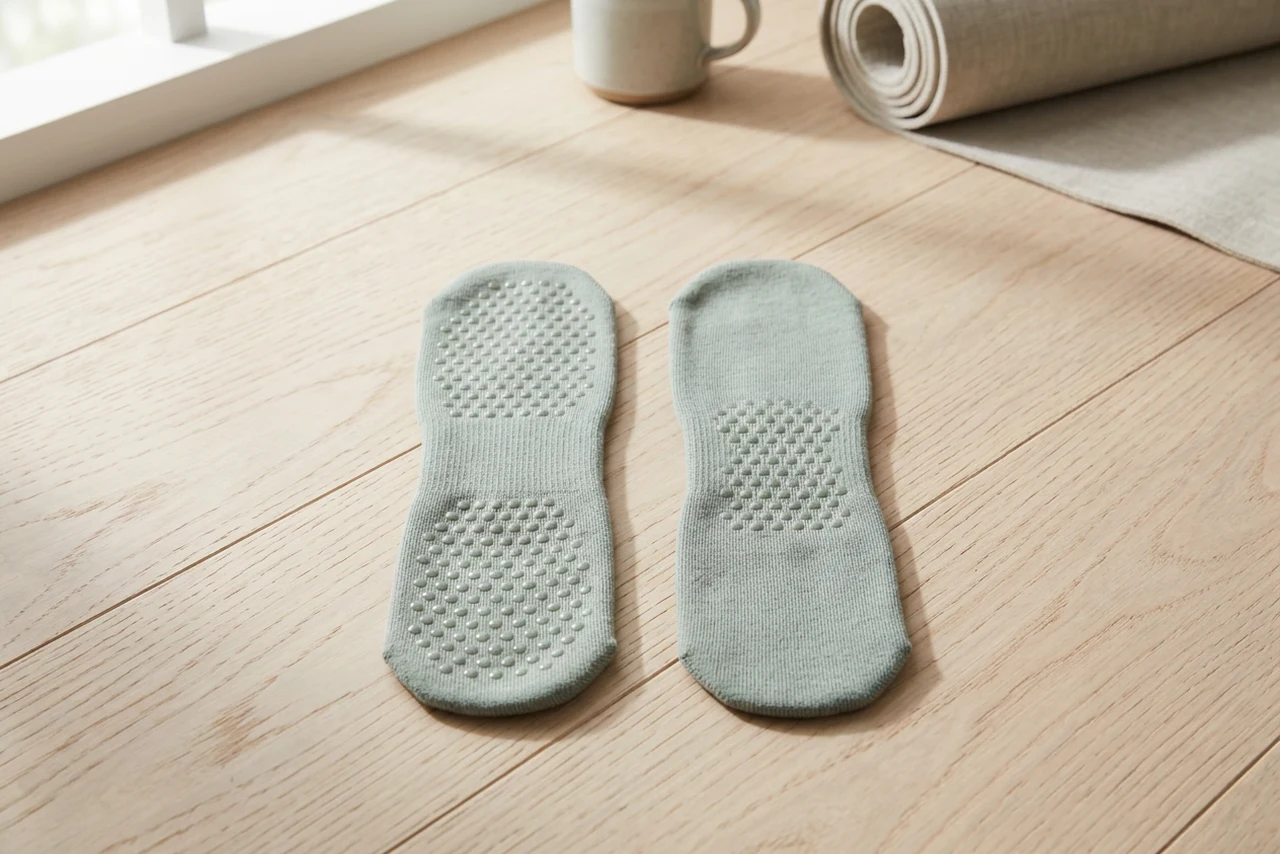
One: the grip must run toes to heel. A studio owner quoted by NBC puts it directly — some socks put grips only under the middle of the foot, and the good ones are covered from the toes to the heel. This is the single spec that separates a working sock from a decorative one, and it is visible in any product photo.
Two: the fit must be snug. The same expert: "We want them to be gripping your feet, so we don't want them to be loose." The mechanism matters — a loose sock lets the grip pattern rotate away from where your foot is actually pressing. If you are between sizes, size down.
That second point is the honest argument for spending more. The boutique pairs come in graded sizes; most multipacks are one-size. That is a real functional difference, and it is not the one the brands lead with.
A third criterion, from a Pilates VP of operations: the sock should not be too thick, so you can still feel the bottom of your foot and grip the machine through it.
What the extra money does and does not buy
Does not: immunity from wearing out. Owners name two of the most-recommended premium brands as losing stickiness after a handful of washes. Price is not durability here.
Does: graded sizing, as above. And in exactly one documented case, a different grip material — TAVI's Kai Crew is spec'd on the brand's own site with a high-density rubber sole in a triangle pattern, SGS-tested and phthalate-free, where the budget multipacks use printed silicone dots.
I want to be careful with that, because it is the one place a material claim is defensible. TAVI's Savvy page describes only a "non-slip grip sole" and does not name the material, so I am not going to tell you it is rubber. Only the Kai Crew is documented.
A Mayo Clinic Pilates and yoga instructor deflates the rest of it: the number of options does not matter, comfort does.
Why your socks stop gripping — and how long they should last
This is the question people search after buying, and no shop will ever answer it.
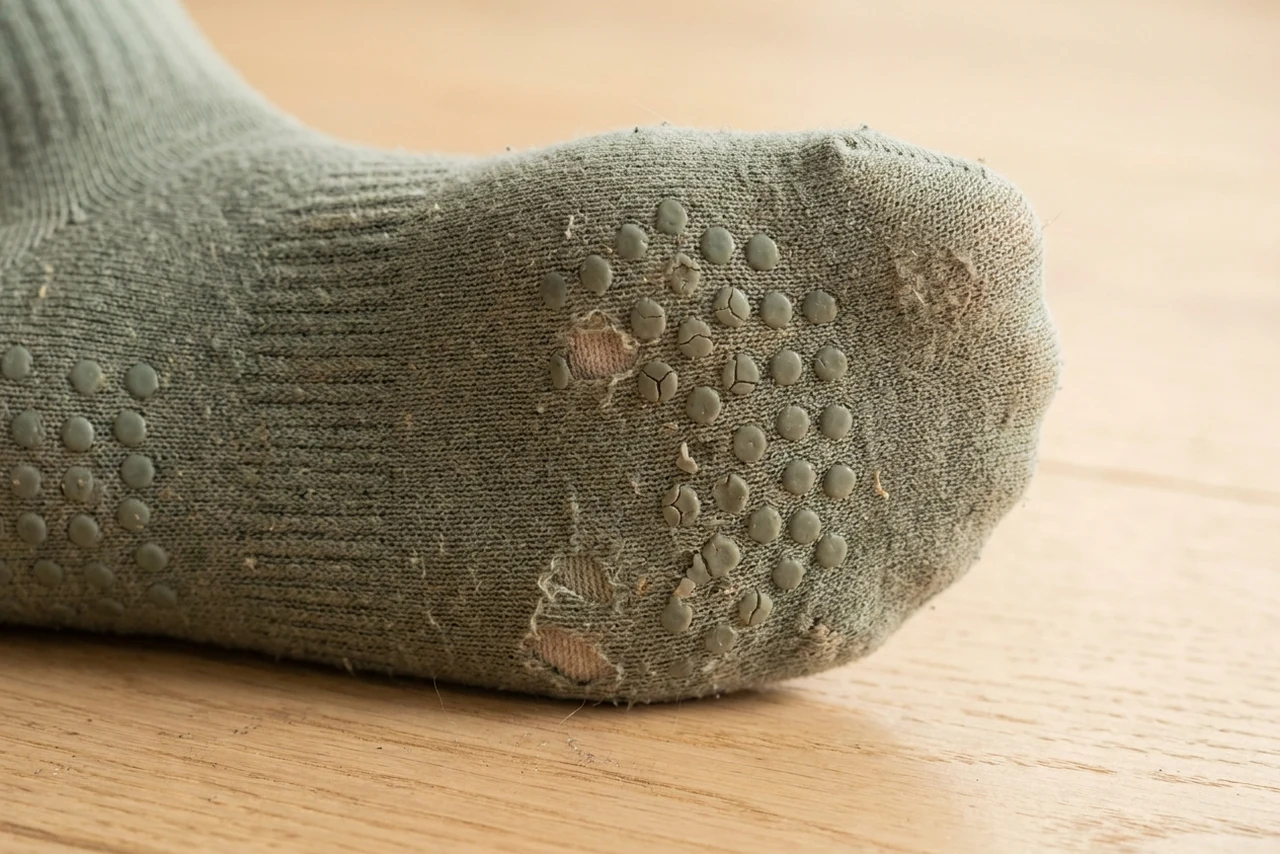
The grip is not woven in. It is silicone or rubber printed onto the knit, which is why heat, bleach, fabric softener and ironing all destroy it, and why every care instruction tells you to wash inside out.
How long they last. Two studio sources independently say six to twelve months with regular use and proper care. Owner reports run much wider than that: one describes the grip going by five washes and the socks feeling unsafe by eight, despite cold water and never using a dryer; another had the grips peel off around twenty-five washes; another reports a pair surviving years of ordinary washing including machine drying. Publish that spread rather than a single number, because the spread is the truth.
The care rules, and where brands disagree. Everyone agrees on inside out, cold, no softener, no bleach. The dryer is contested:
| Brand | Dryer |
|---|---|
| ToeSox | Low heat permitted |
| Griplies | No — says high heat makes the grip brittle |
| TAVI | Air dry |
| Tucketts | Hand wash and dry flat, or gentle machine and low heat |
| Lucky Honey | Contradicts itself: product page says tumble dry low, its own FAQ says lay flat |
One caveat that keeps this honest: ToeSox and TAVI are sister brands — ToeSox's own site lists TAVI under "Meet Our Sister Brands". Their shared permissiveness about low heat is one company's position, not independent agreement.
My reading: air dry. It costs nothing, it sidesteps the disagreement, and every source that bans the dryer bans it for the same reason.
Rotate pairs. One brand points out that rotating between pairs extends the life of all of them, which is a second argument for the multipack that has nothing to do with price.
The picks
Six socks covering genuinely different cases. No scores, because I have not worn them; the reasoning is the recommendation.
The sensible default — SkiBeaut 4-Pack
Four pairs, ankle height, cushioned, and the widest stated fit range in the shortlist at 5 to 12 — which matters because it is a multipack that is not strictly one-size. Pack size confirmed in the brand's own comparison table rather than just the title.
This is the pick that follows from everything above: enough pairs to rotate, enough grip coverage to work, and no premium for things that do not change performance.
Check price on AmazonIf sizing matters to you — TAVI Savvy
Low-rise, below the ankle, with a protective heel tab and a supportive arch band, in GOTS certified organic cotton. The one SERP-famous boutique brand that is actually sold on Amazon.
Two honest notes. It is sold as a single pair — the listing states no quantity anywhere, so do not expect a multipack. And the sizing is inconsistent between sources: the Amazon comparison table says XS to LG while TAVI's own product page offers only S and M. Check the brand's page for your size before ordering.
Check price on AmazonThe one with a documented rubber grip — TAVI Kai Crew
Crew height, and the only sock in this list whose grip material is actually specified: a high-density rubber sole in a triangle pattern, SGS-tested, phthalate- and PAH-free. If you have worn through silicone dots before, this is the one with a different answer.
Crew height also suits a cold studio, which the low-rise options do not.
Check price on AmazonFull-toe, two pairs — Ozaiic
No-show height, full-toe coverage, two pairs. A straightforward middle option if you want more than a single pair without committing to four.
Check price on AmazonToeless, if that is your preference — Tucketts Allegro
Two pairs, 70% recycled cotton, made in Colombia, with a left- and right-specific knit so the socks are not interchangeable. A patented open-toe design rather than a five-toe.
Tucketts tells you who it is wrong for, and I will just repeat it: its own comparison table marks the Allegro as having no arch support and no full-foot coverage, at low-ankle length. Wrong sock for a cold studio or for anyone who wants their toes covered.
Check price on AmazonFive-toe — Ozaiic
Ankle height, two pairs, with criss-cross elastic straps over the top of the foot that hold the sock in place. If your objection to grip socks is that your toes feel bound together, this is the format that answers it.
Check price on AmazonNamed, but not linked
Three of the brands holding page one for this search — Pointe Studio, Lucky Honey and Reformer Loops — are not sold on Amazon at all. Dedicated searches return zero branded listings. They are what a lot of studio staff wear, and if you want the boutique route they are worth looking up directly. I have no commercial relationship with any of them and no way to earn from them, which is exactly why they are named here rather than quietly omitted.
Full toe, toeless or five-toe: an honest non-answer
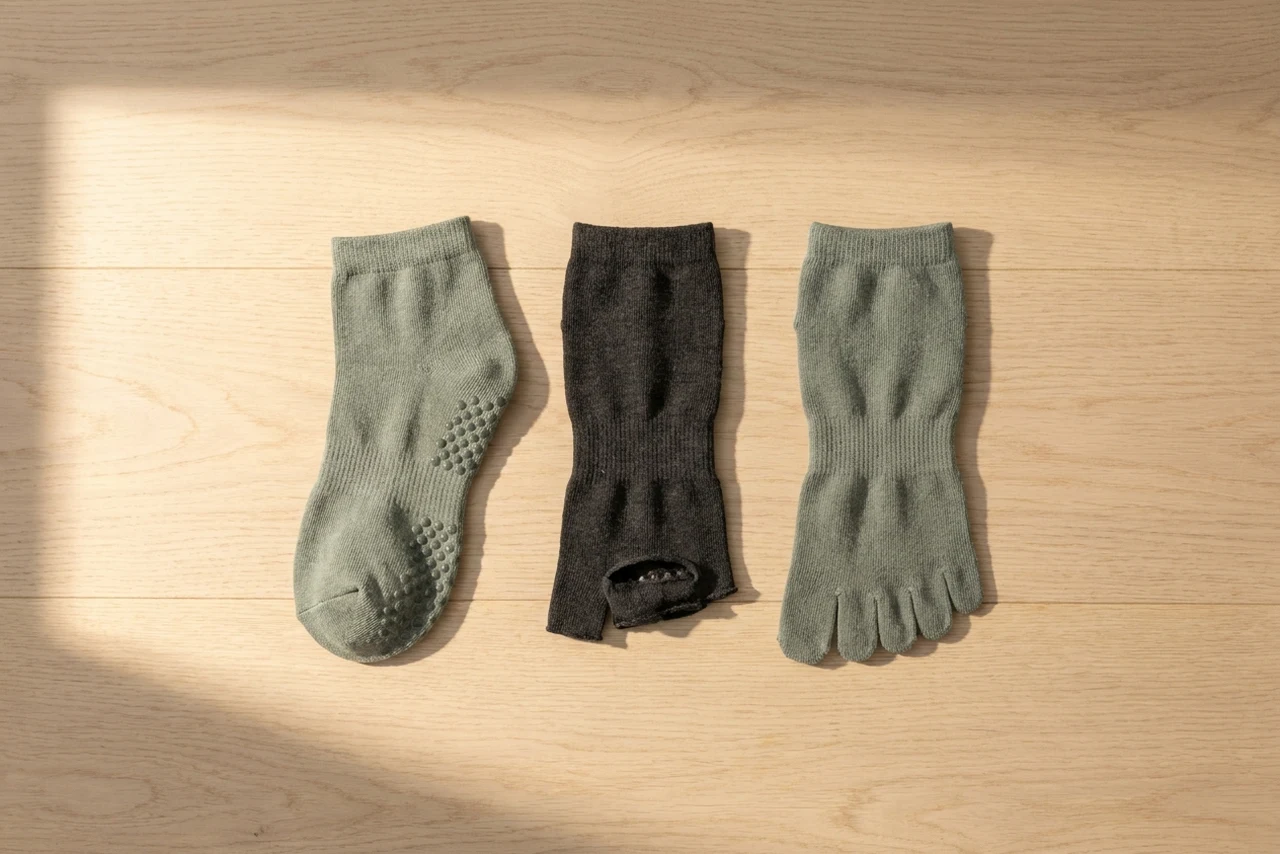
The sources genuinely disagree and none of them has evidence.
Studio owners quoted by NBC recommend against toeless socks, as less hygienic and self-defeating. A competing roundup awards toeless and five-toe styles two of its picks. Experienced reformer users argue that toeless is precisely what allows you to grip the footbar, and that you cannot really grip through a full sock.
The peer-reviewed base is close to empty: a 2023 scoping review of toe-separated socks found only four of twenty-three screened studies qualified, and reported clear gaps in primary research.
So: comfort preference, not performance. Buy the shape you will actually wear.
Who should skip grip socks
- Mat-only and home practitioners. A Mayo Clinic Pilates and yoga instructor recommends grip socks for the reformer and tells students to go without for mat Pilates and yoga, because balancing barefoot strengthens the ankle. If you practise at home on a Pilates mat, you probably do not need these.
- Anyone at a barefoot-friendly studio. See the policy section — some prefer you without them.
- Hot yoga practitioners. A retailer that sells grip socks concedes they go heavy and soggy within twenty minutes, creating a sliding effect inside the sock. Silicone can also slide on a genuinely wet surface. The answer there is a mat towel, not socks.
- Anyone who wants arch support or covered toes and is looking at the toeless option. Its own maker says it has neither.
- Anyone who will not hand wash and is tempted by a certain three-pack: at least one popular multipack states "Hand Wash Only" in its own care field. For socks you wear weekly, that is a genuine dealbreaker.
Related reading
- Best Pilates mat — the other half of the home Pilates setup, and where the thickness question actually matters.
- Best yoga mat towel — the right answer for heated practice, where socks are the wrong one.
- Best yoga knee pads — the same small-studio-accessory decision, with the same free-first answer.
- Best yoga mat for hot yoga — if sweat is the problem you are really trying to solve.
Frequently asked questions
Do I really need grip socks for Pilates?
It depends entirely on your studio, and the chains do not agree. Club Pilates, Pure Barre, Lagree West and The Megaformer Studio all require them in writing. [solidcore], a national chain, states its workout is done barefoot and grip socks are optional, and some independent studios recommend bare feet outright. Check your studio's own page before buying anything.
Why do Pilates socks lose their grip?
Because the grip is not part of the sock — it is silicone or rubber printed onto the knit. Heat, bleach, fabric softener and ironing all attack it. Two studio sources put realistic life at six to twelve months with proper care, though owners report anywhere from a handful of washes to several years. Wash inside out, cold, no softener, and air dry.
What are the negatives of grip socks?
Three worth knowing. The safety evidence is thinner than the marketing suggests — in the one setting where slip resistance has been properly tested, bare feet outperformed non-slip socks. They wear out and become a repeat purchase. And in a heated room they soak through and start sliding inside themselves.
Are cheap grip socks as good as expensive ones?
For the traction job a studio actually asks for, largely yes. The same physical sock is often sold as both a Pilates sock and a hospital non-slip sock. Where the money does buy something real: graded sizing, so the sock fits snugly and the grip stays under your foot rather than rotating off it.
Full toe, toeless or five-toe?
This is genuinely disputed and nobody has good evidence. Studio owners quoted by NBC recommend against toeless socks on hygiene grounds; experienced reformer users argue toeless is exactly what lets you grip the footbar. A 2023 scoping review of toe-separated socks found only four of twenty-three studies qualified. Treat it as comfort preference, not performance.
What size grip socks should I buy?
Snug. A loose sock lets the grip pattern rotate away from where your foot is actually pressing, which is the whole point of it. If you are between sizes, size down. This is also the clearest argument for a size-graded pair over a one-size multipack.