

How this page has changed
July 26, 2026
Sources, internal links and safety or product context reviewed.
In this guide
- 01Best yoga wheels at a glance
- 02How a yoga wheel is built
- 03The four constructions worth comparing
- 04Diameter and width are different decisions
- 05How to interpret a weight limit
- 06Compare surfaces in real light
- 07Inspection before every use
- 08Cleaning and storage
- 09Yoga wheel versus other props
- 10Buying checklist
- 11Bottom line
The best yoga wheel is not the one with the loudest flexibility promise. It is a wheel whose load-bearing core, padding, surface, dimensions and care instructions are clearly documented. For most buyers, a full-size wheel about 12 to 12.6 inches in diameter and 5 inches wide is the sensible comparison point. Choose between cork, foam and wood-core constructions only after checking the stated load limit and inspecting how the layers are bonded.
Our strongest all-round construction on paper is the Yoga Design Lab Cork Yoga Wheel: its maker publishes the complete layer stack, dimensions, weight and care method. UpCircleSeven is the specification-led option for buyers prioritizing thick padding and a high stated load rating. Yoloha is the distinctive wood-core choice. Dharma Basic is the lightweight original-format reference.
These selections are based on current published specifications, not hands-on testing. A manufacturer load rating is not an independent safety certification. This guide does not teach poses, prescribe spinal movement or promise pain relief. Learn use and progression from a suitably qualified teacher who can see you in person.
Best yoga wheels at a glance
| Construction | Published size | Published weight | Stated capacity | Best reason to shortlist |
|---|---|---|---|---|
| Yoga Design Lab Cork | 12.6 × 5 in | 3.1 lb | Not clearly published on source checked | Complete cork/TPE/ABS layer disclosure |
| UpCircleSeven 12-inch | 12 × 5 in | 3.4 lb on detail page | 550+ lb | 8 mm padding and detailed ABS specification |
| Yoloha 12-inch | 12 × 5 in | 2.5 lb | 300 lb | Heavy-duty wood core and rounded inner edges |
| Dharma Basic | 12⅜ in diameter | 2.7 lb | 275 lb | Lightweight, made-in-USA original-format option |
Specifications can change by color, generation and market. UpCircleSeven’s individual product listing says 3 lb while its detail page says 3.4 lb, a useful reminder to verify the exact selected SKU before ordering. The table reports claims, not laboratory results.
How a yoga wheel is built
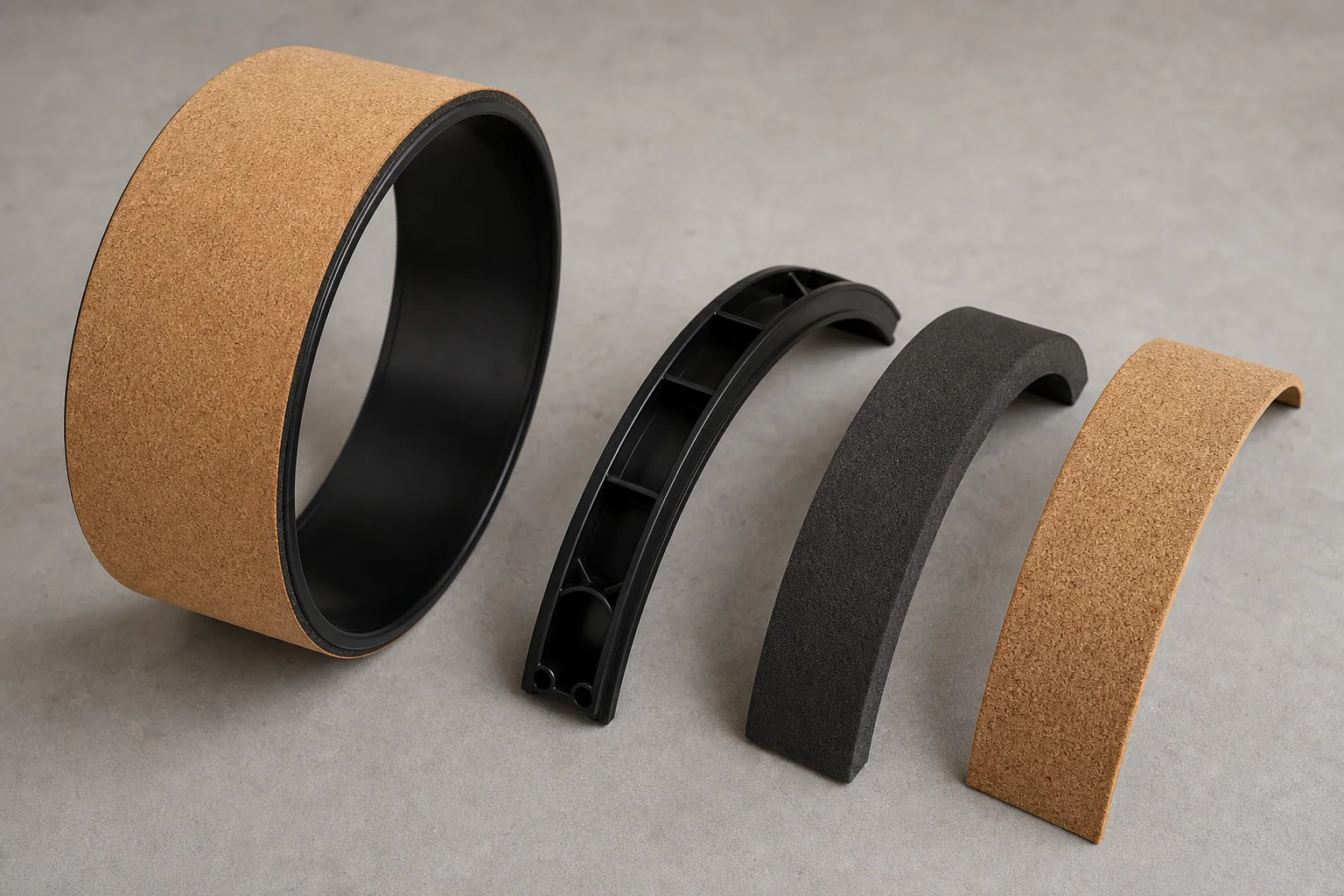
Most wheels look simple because the important engineering is hidden. The core carries load and maintains the circle. The padding changes how concentrated pressure feels and bridges small surface irregularities. The outer surface provides texture and receives sweat, skin oils and cleaning moisture. Adhesive and edge finishing hold that system together.
Yoga Design Lab publishes all three layers: a recyclable ABS ring, recyclable TPE foam and a 100% cork exterior. UpCircleSeven publishes an injection-molded high-grade ABS frame with 8 mm closed-cell padding. Yoloha uses a heavy-duty wood core, cork exterior and latex-free foam padding. Those disclosures make comparison possible; a listing that says only “premium wheel” does not.
Core: ABS versus laminated wood
ABS is common because it can be molded consistently into a light, rigid ring. That does not make every ABS wheel equal. Wall thickness, rib design, polymer formulation, molding defects and quality control remain invisible in most listings. Prefer an identifiable maker that publishes a limit, dimensions and warranty over a generic marketplace duplicate.
A laminated wood core offers a different construction and appearance. Layers should appear even, with no gaps, splinters or lifted edges. Wood is not automatically stronger or more sustainable: species, adhesive, sourcing and manufacturing matter. Yoloha’s published 300-pound capacity is more useful buying information than the word “wood” alone.
Padding: thickness is only one variable
UpCircleSeven specifies 8 mm padding, the clearest thickness figure among these examples. More millimeters can soften the contact surface, but density and resilience determine whether foam compresses immediately or recovers. Very soft padding can also feel less precise at the edge.
Look for padding that is uniformly bonded around the circumference. Press lightly with a thumb at several points before first use. The response should feel consistent; bubbles, hard voids or sections that slide relative to the core are warning signs. Do not attempt a load-bearing use to “test” suspect bonding.
Surface: cork versus foam or TPE
Cork has a dry, fine-grained texture and hides minor cosmetic marks well. It can chip at an exposed edge or lift if its adhesive bond fails. Foam and TPE surfaces can provide a continuous, slightly yielding skin and are generally straightforward to wipe, but they may nick, dent or become slick if a cleaner leaves residue.
“Cork” sometimes describes only a thin veneer over foam and plastic. “Eco-friendly” likewise proves little without material percentages, sourcing or end-of-life information. Yoga Design Lab’s explicit layer declaration is stronger evidence than an environmental adjective, although it still does not establish a full lifecycle assessment.
The four constructions worth comparing
1. Yoga Design Lab Cork Yoga Wheel — best documented layer stack
The Yoga Design Lab wheel measures 12.6 inches (32 cm) in diameter and 5 inches (13 cm) wide, and weighs 3.1 pounds (1.4 kg). Its official listing identifies renewable cork outside, recyclable TPE foam beneath it and a recyclable ABS inner ring.
That specificity is why it leads this guide. A buyer can identify what contacts the body, what provides cushioning and what carries load. The 12.6-inch diameter is slightly larger than the common 12-inch format, while the 5-inch width remains familiar.
The main limitation is equally important: the source we checked did not clearly publish a load capacity. Ask the maker for the current rated limit before buying if body weight or intended loading makes that specification important. Do not infer capacity from ABS alone.
Care is well documented: wipe with a damp cloth, allow it to air-dry fully and store in a cool, dry place away from direct sunlight. That is a conservative routine suitable for bonded cork; soaking would expose seams and adhesive to unnecessary moisture.
2. UpCircleSeven 12-inch Yoga Wheel — best published padding and capacity specification
UpCircleSeven publishes a 12 × 5-inch format, 8 mm padding, an injection-molded high-grade ABS frame and a stated 550+ pound maximum. Its product detail page lists 3.4 pounds, while an individual 12-inch listing says 3 pounds. Treat the discrepancy as a reason to confirm the SKU, not to average the figures.
This is the most complete option here for shoppers comparing padding thickness and stated capacity. However, 550+ pounds is the manufacturer’s claim. It does not tell you the test fixture, loading direction, duration, safety factor or effect of age and damage. A high number never authorizes use outside the manual.
The closed-cell surface should absorb less moisture than an open-cell foam, but “sweat resistant” does not mean maintenance-free. Wipe after use according to the maker’s current directions and inspect the full bonded seam. Avoid reproducing the brand’s therapeutic or injury-prevention language; a wheel is equipment, not treatment.
3. Yoloha 12-inch Yoga Wheel — best wood-core construction
The Yoloha listing describes a 12 × 5-inch wheel weighing 2.5 pounds, with a 300-pound stated capacity. It combines a natural cork surface, latex-free foam padding and a heavy-duty wood core, with rounded interior edges and US manufacture.
It is the clear alternative for someone who prefers a laminated wood structure over molded plastic. The lower product weight is also notable on paper. Neither feature establishes better performance by itself. Confirm the current warranty and inspect laminate edges carefully, especially after transport or exposure to humidity.
The published care direction is simple: clean the cork surface and air-dry. Use the cleaner and method the manufacturer currently recommends; household solvents, oils and prolonged soaking may affect cork, adhesive or finish. Anyone with material sensitivities should request a complete composition statement rather than relying solely on “latex-free foam.”
4. Dharma Yoga Wheel Basic — best original-format reference
Dharma’s current Basic is 12⅜ inches in diameter, weighs 2.7 pounds and has a stated 275-pound limit. The product page says it is made in the USA and uses 100% recyclable materials. The published diameter sits between typical 12-inch wheels and Yoga Design Lab’s 12.6-inch model.
This is a reasonable shortlist choice when low product weight and the original brand matter. Its 275-pound published limit is lower than the Yoloha and UpCircleSeven claims, so check the limit against the total load contemplated by the maker’s instructions. Never assume a dynamic or off-center load is equivalent to a person’s scale weight.
The listing uses broad benefit language, including flexibility, posture and injury claims. We do not use those claims to rank it. The useful decision evidence is its size, mass, stated limit, provenance and maker support.
Diameter and width are different decisions
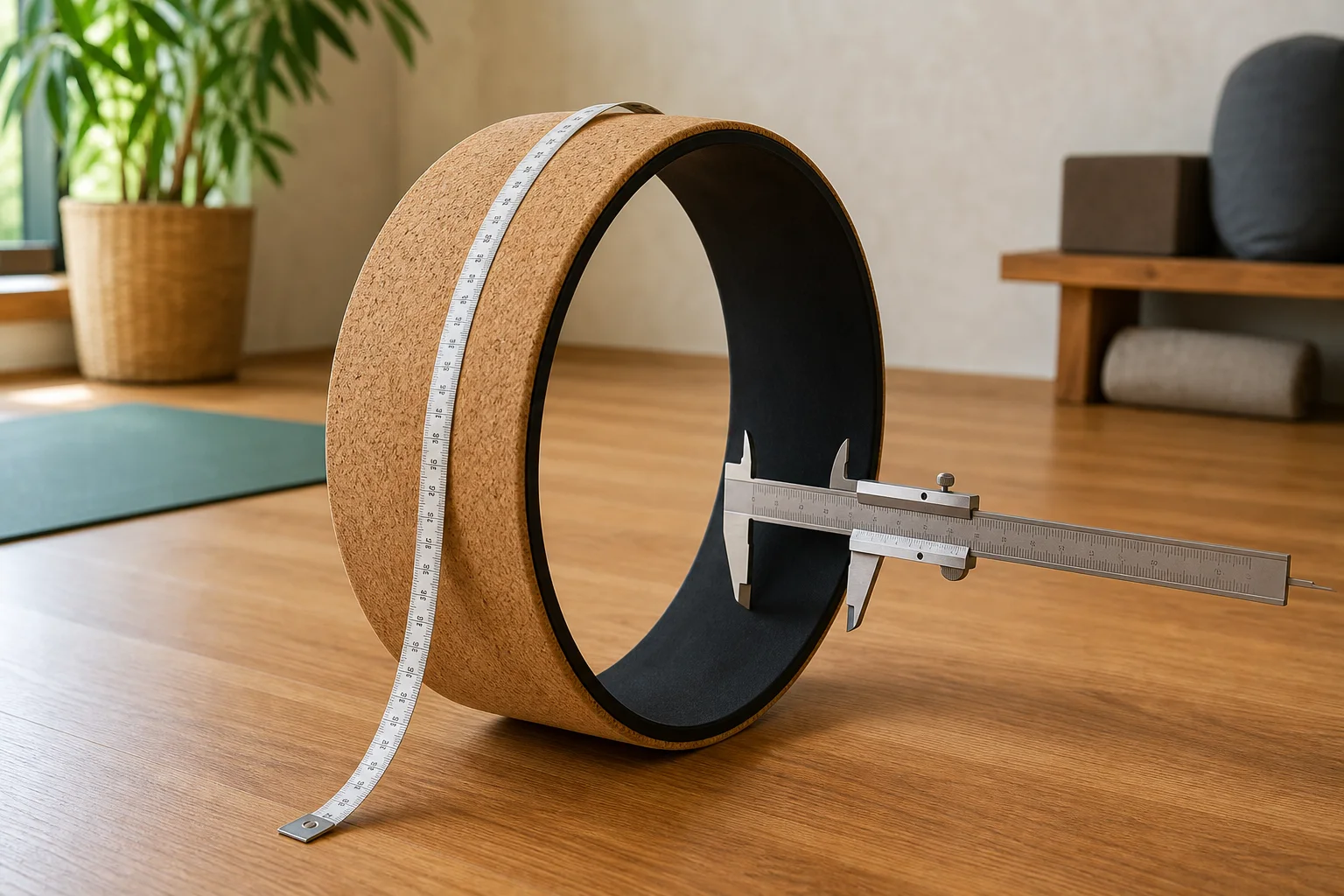
Diameter describes the wheel’s outside height. Width describes the distance from one side edge to the other. The four full-size examples here cluster between 12 and 12.6 inches in diameter and around 5 inches wide, but that pattern is not a universal prescription.
A smaller diameter creates a tighter curve. It should not be treated as merely a travel version of the same tool. A wider wheel offers a broader platform but may interfere with a particular instruction or body position. Your height alone does not determine the right geometry; intended technique and qualified guidance do.
Measure a product on arrival if the dimensions matter. Check outside edge to outside edge through the center for diameter, then side to side for width. A soft tape wrapped around the circumference does not directly report diameter unless calculated, and padding can make a caliper reading slightly compressible.
How to interpret a weight limit
A published limit is a screening requirement, not a promise that every kind of use below that number is safe. Manufacturers may test static downward force under controlled conditions. Real use can introduce movement, off-center force, impact, wear, heat and surface instability.
Ask five questions when a rating drives the purchase:
- Does the limit apply to this exact size and SKU?
- Is it a maximum user weight or maximum applied load?
- Was it independently tested, and to what standard?
- Does the warranty exclude impact, outdoor use or certain movements?
- What inspection or retirement guidance does the maker publish?
If the listing cannot answer the first two, do not treat a large printed number as reliable differentiation. Leave a comfortable margin and follow the maker’s use restrictions. Replace the wheel after a significant impact or visible structural change unless the manufacturer confirms otherwise.
Compare surfaces in real light
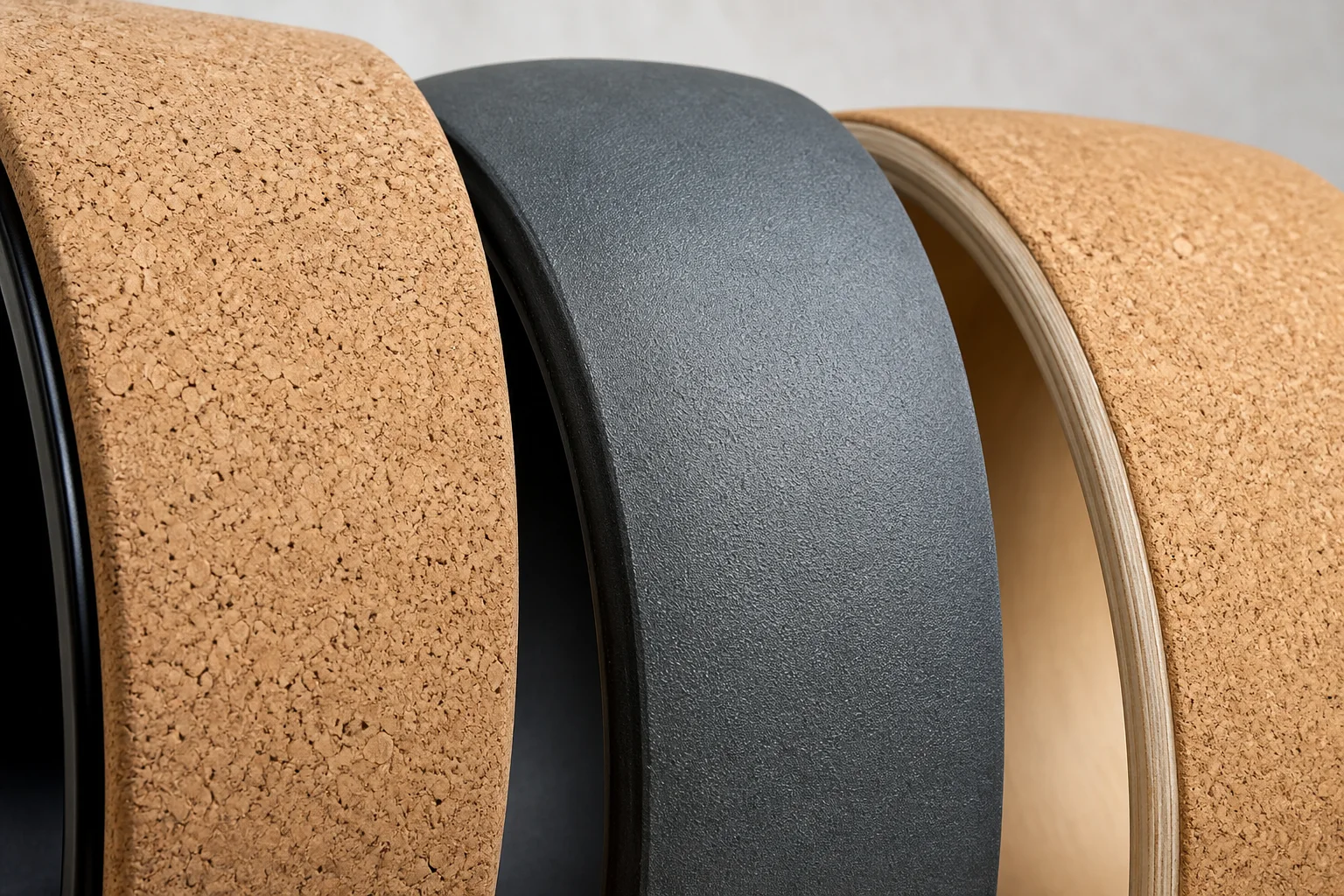
Product thumbnails flatten the details most likely to fail. Zoom into the longitudinal seam, both side edges and transitions between materials. A neat seam should lie flat without exposed adhesive. Padding should reach the edge consistently and the rigid core should have no sharp flash from molding or unfinished wood.
For shared studio equipment, a non-absorbent, maker-approved wipe-clean surface may take priority. At home, cork’s tactile finish and appearance may matter more. Neither surface is hygienic without cleaning, and neither should be saturated. Fragrance, essential oils and aggressive disinfectants can leave residue or degrade a bonded layer.
Color deserves little weight unless transfer or fading is visible. A dark core makes fine stress whitening easier to see on some plastics; a natural wood core can make gaps or moisture marks easier to spot. Cosmetic variation in cork is normal, but spreading cracks or moving edges are not.
Inspection before every use
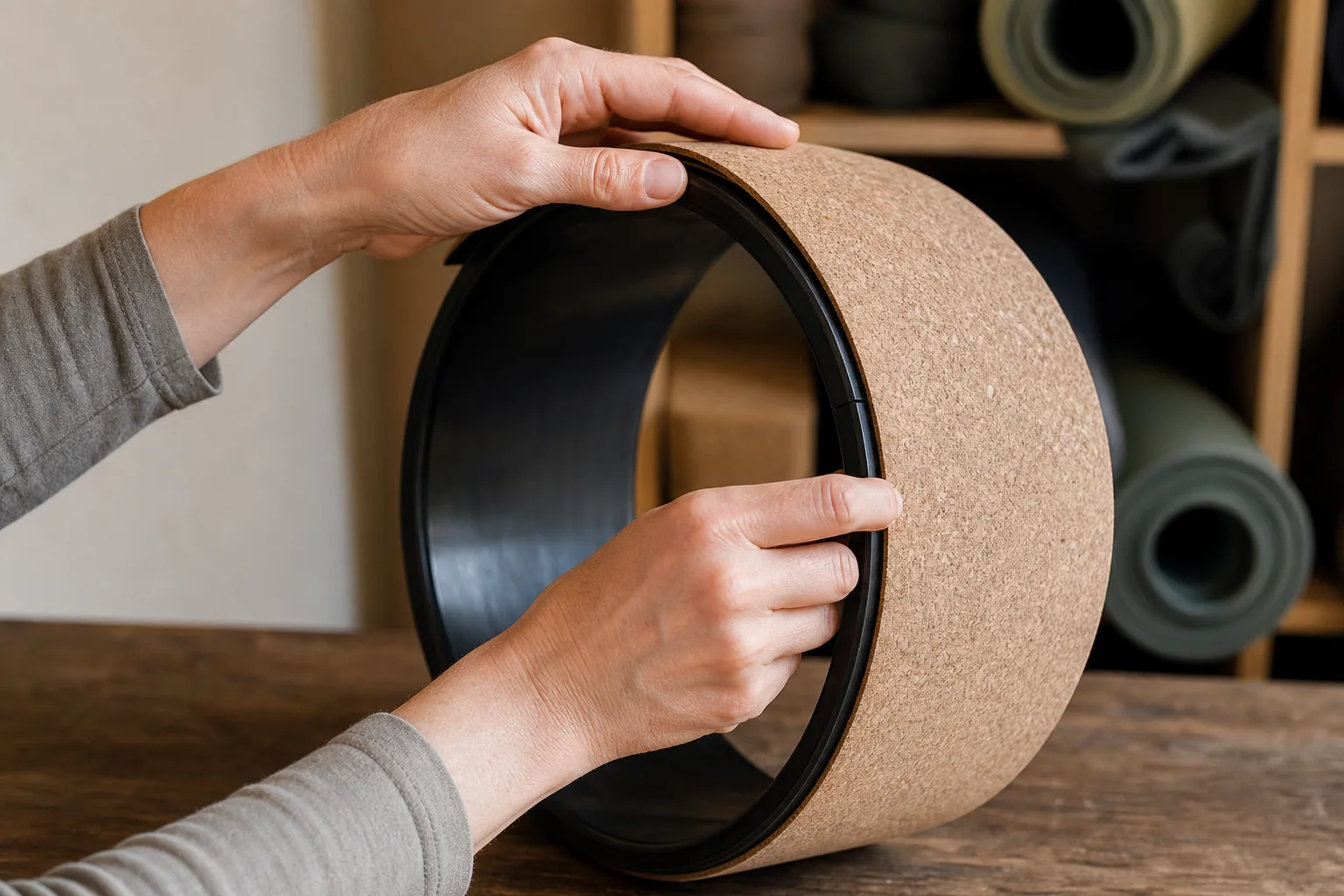
Set the wheel on a flat, dry floor in good light. Rotate it slowly and inspect the outer surface, both edge bonds and the inner ring. A new wheel should be round, stable and free from cracks, sharp edges, loose material and unexplained sounds.
Stop using it when you find:
- a crack, stress-whitened line or split in a plastic core;
- a gap, splinter or delaminating ply in a wood core;
- padding that shifts, bubbles or separates from the core;
- a cork or foam seam that continues to lift;
- permanent distortion, wobble or unusual flex;
- contamination that cannot be removed with the approved care method.
Do not glue a structural or bonded fault and return the wheel to load-bearing use. Adhesive compatibility and hidden core damage cannot be judged from the outside. Photograph the issue, record the SKU and contact the maker or retailer.
Cleaning and storage
Follow the exact maker’s instructions because surface and adhesive systems differ. The safest shared pattern among the documented cork examples is a lightly damp wipe followed by complete air-drying. Keep water away from exposed laminate edges and never store a damp wheel in a closed bag.
Store the wheel in a cool, dry location away from direct sunlight, heaters and temperature extremes. Stand it where it cannot roll into a walkway or fall from a shelf. Do not stack heavy objects on it; a wheel can be strong in its intended loading direction yet distort under prolonged sideways pressure.
Before using a studio-provided wheel, inspect it yourself. Shared ownership makes impact history and cleaning chemistry harder to know. A clean-looking surface does not prove an intact core.
Yoga wheel versus other props
A wheel is not a substitute for every prop. Choose by function:
| Prop | Shape and behavior | Better choice when… |
|---|---|---|
| Yoga wheel | Rigid circular support that can roll | A qualified sequence specifically calls for this geometry |
| Yoga bolster | Broad, cushioned and generally stable | Stable, compliant support is the priority |
| Yoga block | Small, firm, flat-sided support | Predictable height and non-rolling contact matter |
| Yoga blanket | Foldable, adjustable textile support | Fine height adjustment or padding is needed |
| Foam roller | Usually narrower and designed for rolling pressure | A movement professional recommends self-myofascial rolling rather than yoga-wheel work |
| Yoga sandbag | Compact weighted prop | Qualified instruction calls for stationary external weight |
The circular silhouette does not make a yoga wheel equivalent to a foam roller. Their diameters, widths, densities and intended methods differ. Likewise, a wheel cannot provide the broad, forgiving support of a yoga bolster or the stable faces of yoga blocks.
Buying checklist
Before checkout, capture the exact product page and confirm:
- outside diameter and width;
- wheel weight and stated maximum load;
- rigid core material and construction;
- padding material and published thickness;
- outer surface material;
- seam and edge finishing visible in close photographs;
- cleaning and drying method;
- storage restrictions;
- warranty, returns and replacement support;
- selected SKU, because sizes and materials can change by variant.
On arrival, compare the label and dimensions with the order. Photograph any shipping damage before use. Return a product that arrives distorted, cracked, delaminated or materially different from its specification.
For beginners, equipment choice is secondary to instruction quality. Start with our yoga for beginners guide, then ask a qualified teacher whether a rolling prop belongs in your practice at all.
Bottom line
The Yoga Design Lab Cork Yoga Wheel offers the clearest complete material stack. UpCircleSeven publishes the strongest padding and capacity detail, though its weight figures need SKU confirmation. Yoloha supplies a documented wood-core alternative, and Dharma Basic is a lightweight original-format reference.
Whichever you choose, buy the specification rather than the promise: known geometry, disclosed layers, a relevant stated limit, clear care and responsive maker support. Inspect the wheel before use and retire it when the structure or bonded surface becomes uncertain.
Frequently asked questions
What is the best yoga wheel for most people?
A documented 12- to 12.6-inch wheel around 5 inches wide, with a rigid core, intact bonded padding, a grippy surface and a stated load limit comfortably above the intended user load is the most versatile starting specification. The best exact model depends on surface preference, weight, care and the instruction you follow.
Is cork or foam better on a yoga wheel?
Neither is universally better. Cork provides a dry, textured surface and a natural appearance; closed-cell foam or TPE is usually easier to wipe and may offer thicker cushioning. Bond quality and edge finishing matter as much as the surface material.
What size yoga wheel should I buy?
Many full-size wheels are about 12 to 12.6 inches in outside diameter and 5 inches wide. Smaller wheels create a tighter curve and are not simply a compact substitute. Follow the dimensions specified by your qualified instructor rather than choosing by height alone.
How much weight can a yoga wheel hold?
Published limits vary. Current examples in this guide state 275, 300 and 550 pounds. These are manufacturer claims, not directly comparable independent certifications; verify the current listing and keep within the maker’s instructions.
How do I know when to replace a yoga wheel?
Stop using a wheel if the core is cracked, distorted or unusually flexible, or if padding is lifting, seams are opening or the surface no longer stays secure. Contact the manufacturer when the condition is uncertain.