

How this page has changed
July 26, 2026
Sources, internal links and safety or product context reviewed.
In this guide
- 01Current headstand benches compared
- 02Quick decision
- 03Understand the product architecture
- 04Footprint, height and opening
- 05Cushion construction and upholstery
- 06Load ratings need precise language
- 07Feet and floor contact
- 08Assembly is part of the rating
- 09Pre-use inspection and retirement
- 10Cleaning and storage
- 11Headstand bench versus other yoga props
- 12Claims to treat cautiously
- 13Buying checklist
- 14How this guide was researched
A yoga headstand bench is a raised frame with a padded U-shaped top. Retailers also call it a headstand stool, inversion chair or inversion trainer. Those names describe a product category, not proof that inversion is appropriate or safe for a particular person.
Current models differ substantially in footprint, frame construction, opening geometry, cushion material, feet, hardware and published load values. That physical specification is the useful basis for comparison. Promises about circulation, digestion, sleep, pain relief or injury prevention are not.
This is a source-checked product selection, assembly and inspection guide. It contains no instructions for entering, holding or leaving an inversion.
Current headstand benches compared
| Current product | Published dimensions | Product weight | Frame and cushion | Published load language |
|---|---|---|---|---|
| FeetUp Trainer | 64 × 40 × 40 cm | About 5 kg | Wood frame; vegan-leather cushion or fabric on specified variants | Page lists 900 kg “maximum capacity” and separately discusses lab testing |
| Yoga-Mad Headstand Bench | 61 W × 39 L × 39 H cm | 6.3 kg | Maple-veneered marine ply; foam with PU-leather lining | 300 kg maximum user weight |
| SISYAMA Inversion Bench | 28 × 19.5 in footprint; full height not clearly published on page | Not published | Metal-style frame; thicker PU-leather cushion claimed | No clear user limit found on page checked |
| Costway wood bench | 24 × 15 × 15.5 in | 11 lb | Beechwood/birch wood; PU pad | 440 lb weight capacity |
| MeFree Headstand Bench | 69.5 L × 44.5 W × 35.5 H cm | 9.8 kg | Pinewood; sponge and rexine | Not published on page checked |
| Yogikuti Headstand Bench | 65 L × 42 W × 37 H cm | 5.2 kg | Wood; padded non-slip top | Not published on page checked |
These are manufacturer or retailer values, not our measurements or performance findings. Dimension order is reproduced where the source labels it. An unlabeled sequence such as “64 × 40 × 40 cm” does not prove which value is width, depth or height.
The FeetUp figure also needs context. Its page uses a very high capacity value and discusses a load at which the frame was laboratory tested. A laboratory threshold is not automatically the permitted user weight, and it does not describe off-axis or dynamic forces. Ask for the current manual’s explicit maximum user weight if the product page does not state one unambiguously.
Quick decision
| Purchase question | Compare | Why it matters |
|---|---|---|
| Will it fit the room? | Labeled overall footprint plus clear working space | A compact product still needs unobstructed space around it |
| Does the frame have a broad base? | Front-to-back and side-to-side contact dimensions | Height alone says nothing about tipping geometry |
| What enters the opening? | Usable inner width, depth and edge radius | Overall cushion size does not reveal opening fit |
| How is the top supported? | One-piece panel, side frames, braces and fasteners | The load path should be visible and inspectable |
| What touches the floor? | Number, area and replaceability of feet | “Non-slip” does not mean every floor finish |
| Is the limit meaningful? | Maximum user weight and test standard | Static capacity marketing can obscure real use limits |
| Can it be maintained? | Upholstery, removable parts and approved cleaner | Sweat and cleaner can affect seams, coatings and traction |
Do not buy until you have the exact current manual for the exact model. Similar benches can use different bolt lengths, brace orientation and limits. A marketplace listing or photograph is not an assembly instruction.
Understand the product architecture
Most headstand benches share four visible systems: a raised frame, a U-shaped padded surface, an open center and floor-contact feet. The details are not standardized.
Panel-frame construction
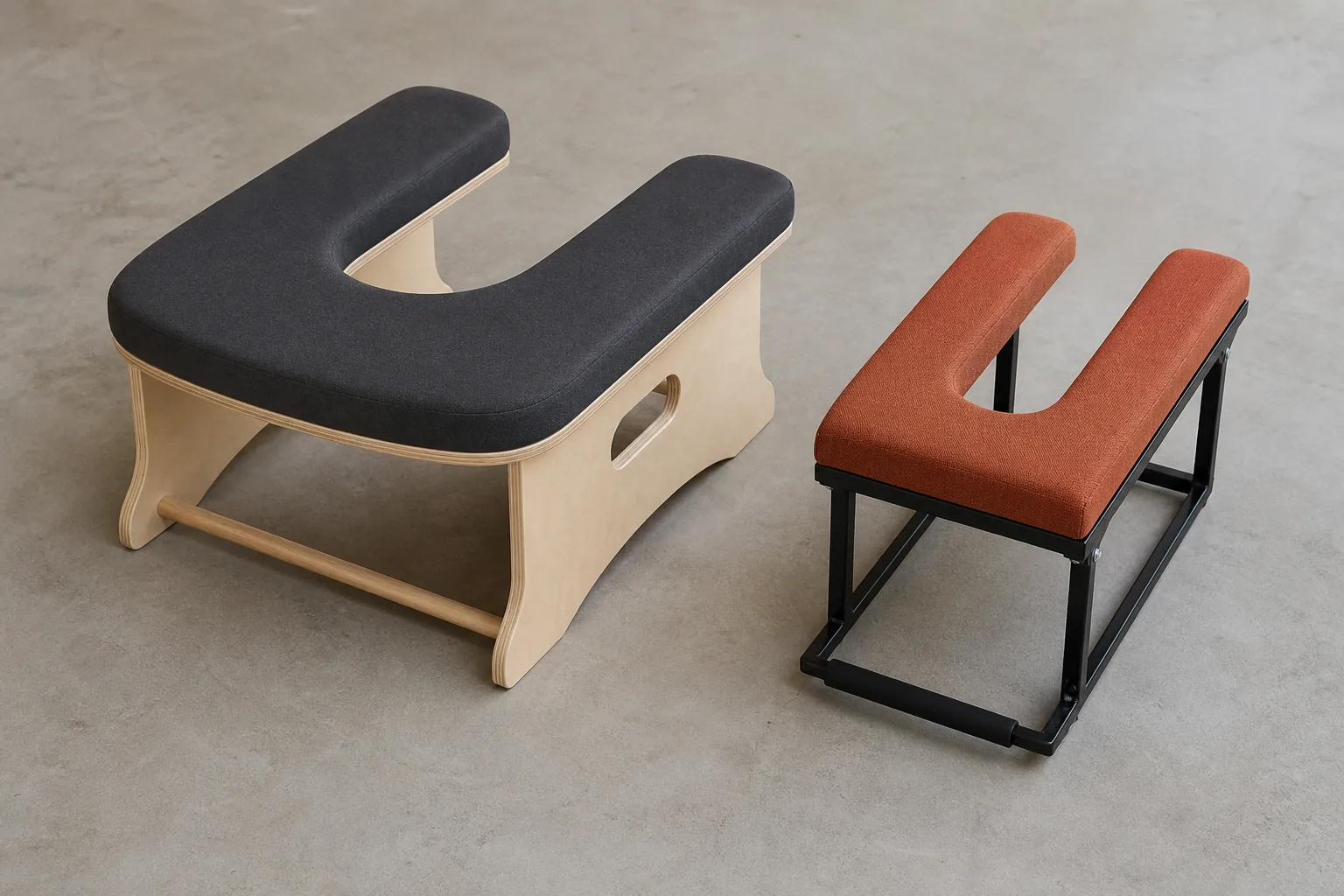
FeetUp, Yoga-Mad, Costway, MeFree and Yogikuti all document wood or wood-based frames. Some use broad plywood side panels; others use separate legs and rails. Plywood can create large continuous bearing surfaces and smooth curves, while solid-wood or rail construction exposes more individual joints.
The species name alone does not determine strength. “Birch,” “beechwood,” “pinewood” and “maple-veneered marine ply” describe different products, and veneer does not mean the entire panel is solid maple. Look for panel thickness, ply edges, brace layout, fastener specification and a model-specific rating.
Metal-frame construction
SISYAMA emphasizes a wider, longer design and uses a nontraditional frame appearance. Costway also lists an iron version in its range. Metal can reduce panel bulk, but tubing diameter, wall thickness, weld quality and joint design matter more than the word “steel” or “iron.”
A folding or demountable frame introduces hinges, locking points or repeated fastener cycles. Verify whether the model is designed for frequent disassembly; “portable” marketing does not prove that every connection tolerates repeated assembly indefinitely.
Crossbars and handles
Horizontal rails can brace the frame and may also be marketed as handholds. Those functions should not be conflated. A structural brace is not automatically rated for pulling in every direction. Only treat a rail as a handle when the manual identifies it as one.
Look for symmetrical braces, hardware on both sides and enough hand clearance from pinch points. Reject a frame with a bowed rail, split wood around a bolt or a fastener that cannot seat fully.
Footprint, height and opening
The documented products cluster loosely around 61–70 cm in their longest dimension, 39–45 cm in width and 35–40 cm in height. That is a category range, not a universal fit standard.
Overall footprint
Yoga-Mad publishes 61 cm width by 39 cm length by 39 cm height. Yogikuti lists 65 × 42 × 37 cm, while MeFree is larger at 69.5 × 44.5 × 35.5 cm. SISYAMA highlights a 28 × 19.5-inch base, approximately 71 × 49.5 cm, but its page does not clearly label a complete height in the specification quoted.
A larger footprint can widen the support polygon, but it also requires more clear floor area. Stability cannot be inferred from footprint alone: center of mass, frame stiffness, foot material and force direction also matter.
Measure the storage route as well as the final position. Doorways, stairs and closet depth can make a rigid 70 cm frame inconvenient. If a bench must be disassembled for storage, include hardware inspection and torque checking in the maintenance burden.
Product height
Published heights span roughly 35.5–40 cm in the examples with labeled dimensions. A difference of several centimeters changes the geometry and cannot be dismissed as styling. Never add blocks, cushions or improvised feet to alter height. That changes both load path and floor contact.
Usable opening
Overall pad dimensions are not the same as the inner opening. Costway publishes a pad size of 19 × 16.5 × 3 inches for one 24 × 15 × 15.5-inch bench, yet that external pad measurement still does not define the U-shaped opening.
Ask for opening width at its narrowest point, opening depth, edge radius and pad thickness. A photograph can hide taper or perspective. If the manufacturer offers an insert cushion, confirm whether published dimensions and limits apply with the insert installed, removed or both.
Cushion construction and upholstery
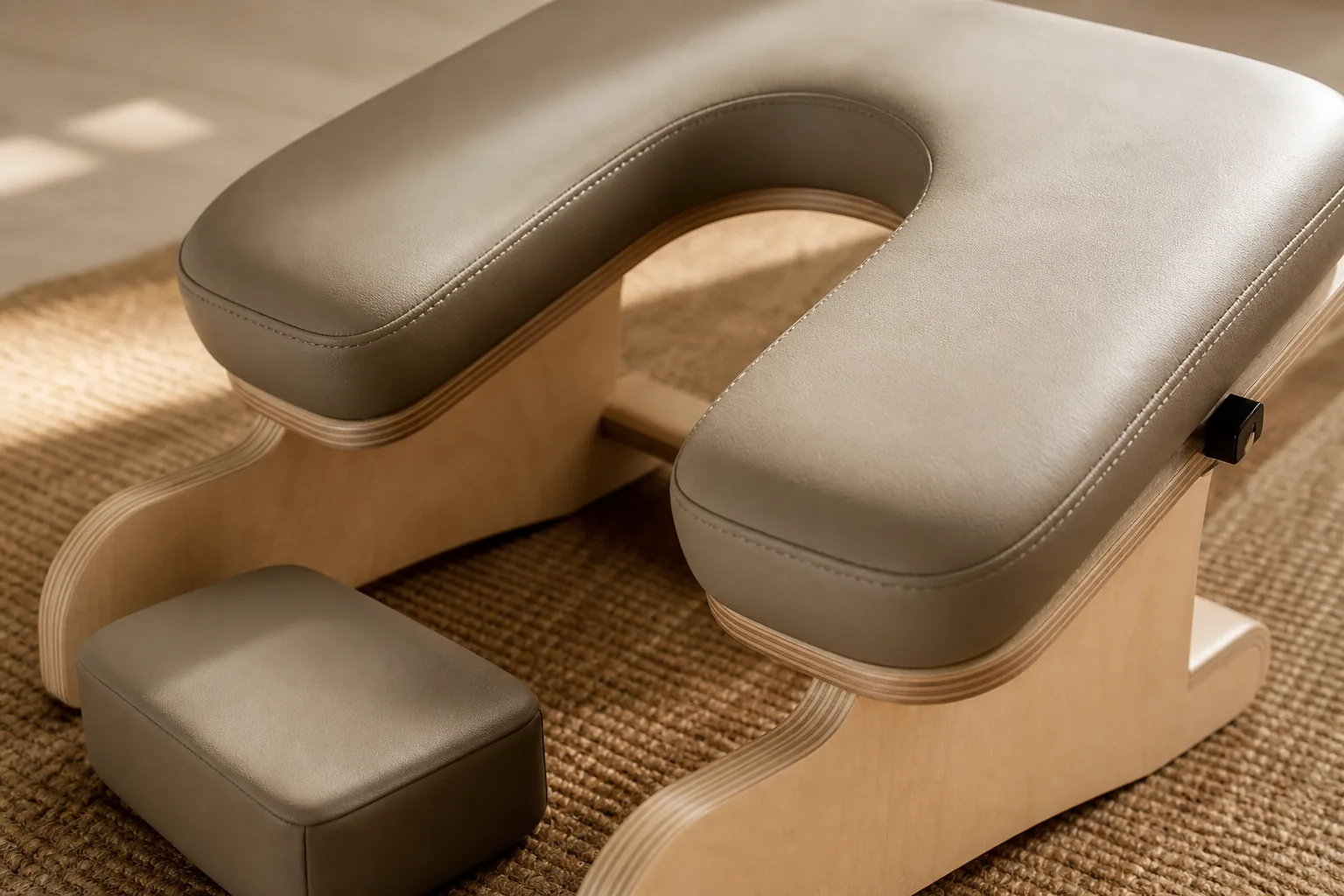
The cushion is a load-transfer component, not decoration. Current pages mention foam, sponge, PU leather, vegan leather, fabric and rexine. Those terms do not reveal density, compression set, seam strength or cleanability.
Thickness and firmness
Costway publishes a 3-inch pad thickness for one wood model. SISYAMA describes its cushion as thicker but does not supply a comparable measurement on the page checked. Thickness without foam density or compression data is incomplete: a thick soft pad and a thinner firm pad can deform differently.
Do not infer comfort or safety from thickness. Check for a level top, symmetrical compression and a smooth inner edge. A pad that bottoms out, permanently dents or shifts relative to the frame should be assessed under the maker’s warranty or replacement policy.
Cover material
PU upholstery is usually intended to be wipeable, and Yoga-Mad explicitly says its PU-leather top is easy to wipe clean. FeetUp offers vegan leather and fabric on certain variants. Fabric changes absorption and care; do not apply PU cleaning instructions to a textile cover.
“Vegan leather” describes the absence of animal leather, not the exact polymer or environmental profile. “Rexine” is also a broad coated-fabric term. For allergy, sustainability or chemical questions, request a complete product-level material declaration.
Seams and attachment
The highest-consequence defects are often at transitions: the inner U-shaped seam, front tips, attachment bolts and underside edge. Examine stitching for skipped sections, loose thread, puckering and abrasion. The pad should not rotate, lift or expose a hard frame edge.
If a cushion is removable, use only the maker’s specified fasteners or click system. Do not improvise hook-and-loop tape, adhesive or a replacement pad of unknown thickness.
Load ratings need precise language
Published numbers vary dramatically: Yoga-Mad states a 300 kg maximum user weight; Costway states 440 lb for documented wood models; FeetUp publishes a 900 kg maximum capacity and discusses laboratory testing before structural degradation.
These numbers cannot be ranked in one simple table without knowing:
- whether the value is a maximum user weight or a static test load;
- the test direction and loading area;
- whether a safety factor is already included;
- whether the product was fully assembled to a specified torque;
- whether dynamic and lateral loads were evaluated;
- which variant and production revision the number covers;
- which standard or independent laboratory performed the test.
A bench does not become safer merely because its marketing number is larger. Use the lowest explicit maximum user weight in the current manual and product labeling. If sources conflict, stop and ask the manufacturer in writing. Never reinterpret a breaking threshold as an allowed body weight.
Also remember that capacity does not prove suitability. Inversion can be contraindicated for some cardiovascular, eye, neurological, musculoskeletal and other health conditions. A product limit cannot provide medical clearance.
Feet and floor contact
Every foot must contact one level, clean, dry surface. Yoga-Mad and Yogikuti explicitly mention grip or non-slip feet. FeetUp describes patented rubber feet. Those statements identify design intent, not guaranteed traction on polished wood, tile, rubber, carpet or a yoga mat.
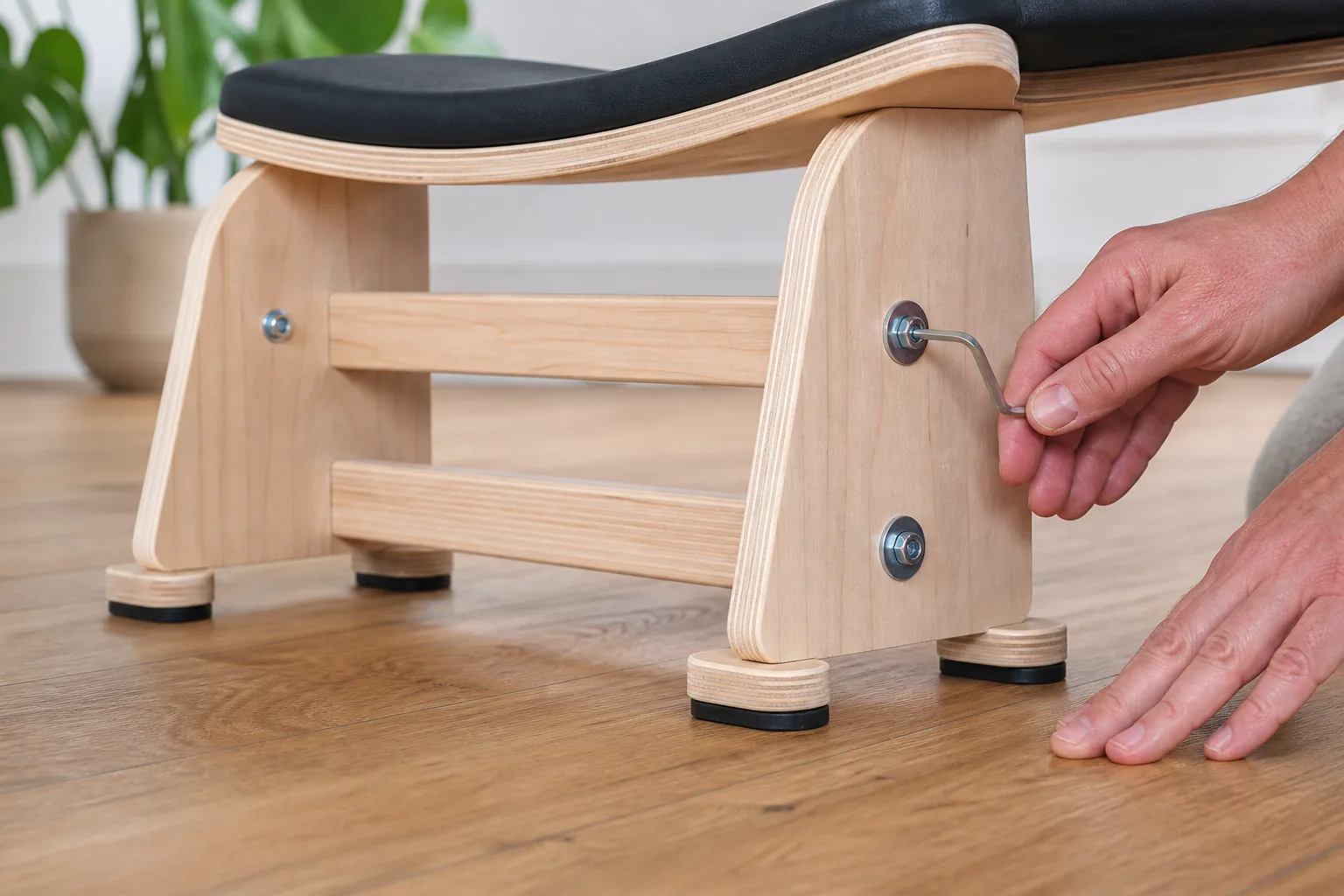
Before considering any instructed use, inspect the empty product:
- Place it on the intended bare floor and press each upper corner lightly.
- Check whether any foot lifts or the frame rocks diagonally.
- Confirm every rubber foot is present, seated and free from oil or dust.
- Look for transferred dye, residue or marks on a hidden floor area.
- Verify the manual permits a mat if you intend to put one underneath.
This is an unloaded furniture check, not an inversion instruction. A soft mat can compress unevenly; a rug can bunch; mixed surfaces can create different heights. Do not add improvised anti-slip material unless the manufacturer approves it.
Replace a worn foot only with the exact specified part. A hardware-store pad of different thickness can create rocking even if it looks similar.
Assembly is part of the rating
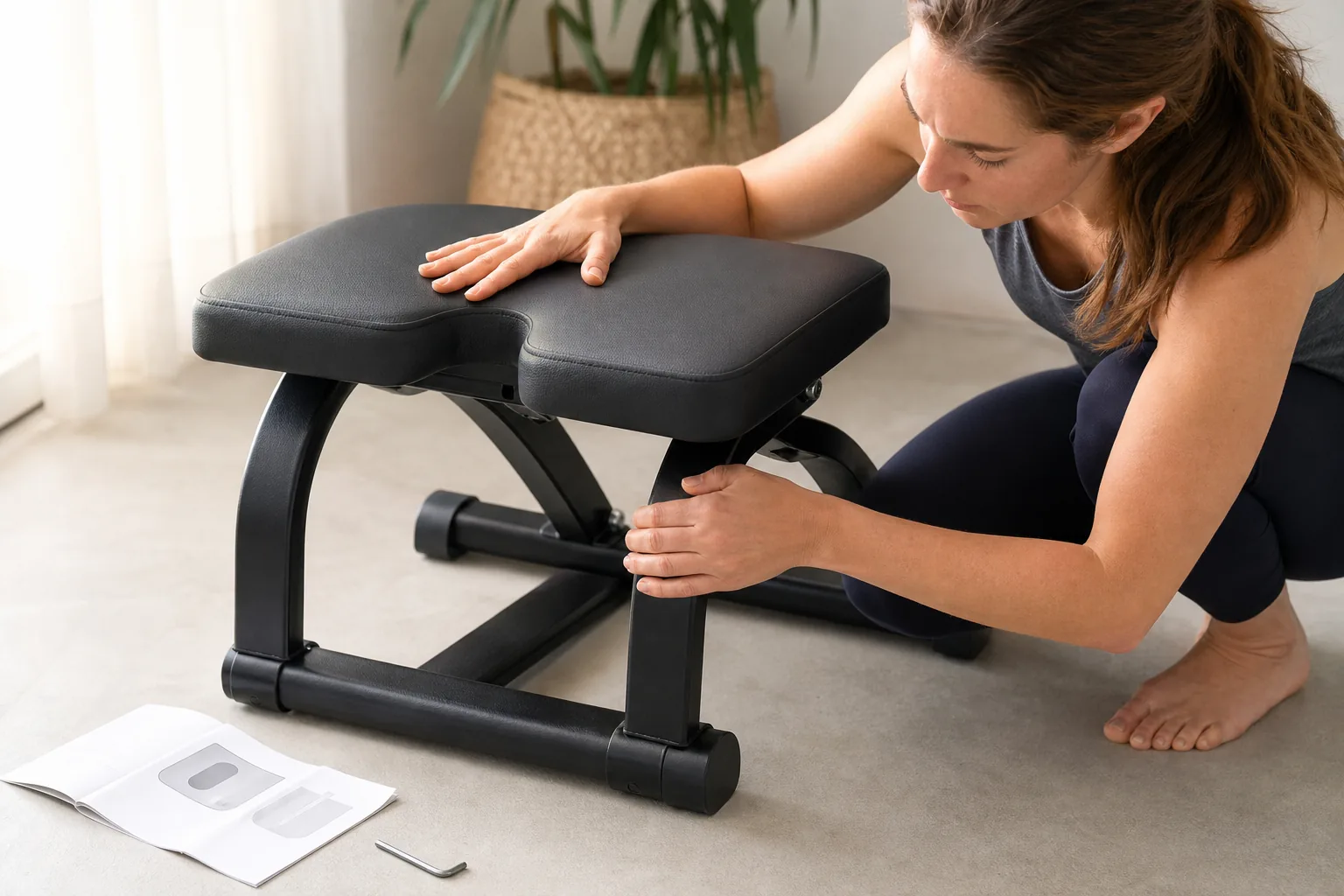
Published capacity assumes a correctly assembled, undamaged product. Missing washers, reversed braces, cross-threaded bolts and uneven tightening can change the frame before anyone uses it.
Use the current manual, inventory every part and identify left/right or front/back pieces before tightening. Start fasteners by hand to avoid cross-threading. Follow the documented tightening sequence and torque if provided. If no torque is given, do not assume “as tight as possible”; overtightening can crush plywood, strip an insert or distort tubing.
After assembly, confirm:
- paired side frames are parallel;
- the padded top is centered and cannot rotate;
- braces sit flush with no forced gap;
- washers and locking hardware match the parts list;
- bolt ends do not protrude into contact areas;
- all four feet share the floor;
- no crack, creak, loose insert or shifting joint appears during an unloaded check.
Do not use power tools unless the manual allows them. Keep spare hardware separate and labeled; an unexplained leftover structural bolt is a reason to stop, not a bonus part.
Pre-use inspection and retirement
A headstand bench should be inspected after assembly, after moving it, at the maker’s maintenance interval and whenever it has been dropped, stored damp or used by multiple people.
Look for:
- cracks across wood grain, veneer separation or crushed bolt holes;
- bent tubing, cracked coating, rust or an altered weld line;
- a brace that has loosened or moved from its seated position;
- a fastener that repeatedly backs out;
- a cushion that rotates, lifts, bottoms out or remains permanently compressed;
- split upholstery, exposed foam or an opened inner seam;
- missing, hardened, torn or uneven feet;
- rocking on a verified level surface;
- an unreadable model label or missing manual.
Stop using the product after a fall, impact or overload until the manufacturer or a qualified service provider confirms what inspection is required. Retire it when a structural crack, deformation, persistent rocking, failed joint or unavailable safety-critical replacement part cannot be resolved under the maker’s procedure.
Do not glue cracked plywood, weld a frame, add screws or replace foam as a DIY repair and assume the original rating remains valid.
Cleaning and storage
Yoga-Mad says its PU upholstery is wipe-clean. MeFree says to allow the bench to air-dry completely in a well-ventilated area. Those instructions support a conservative routine, but the exact label takes priority.
Remove loose dust first. Apply only a maker-approved cleaner to a cloth rather than flooding seams or bolt holes. Wipe the upholstery, exposed frame and non-slip feet separately. Remove cleaner residue and dry the bench fully before storage.
Avoid bleach, solvent, alcohol, essential oil, abrasive powder and steam unless explicitly approved for the exact surface. A product can be cosmetically wipeable while its adhesive, coating or rubber feet are sensitive to a cleaner.
Store the bench upright in a dry, temperature-stable location where it cannot fall. Do not stack heavy props on the cushion, hang weight from rails or leave the frame in direct sun. If it is disassembled, bag and label the complete original hardware set and protect upholstered parts from sharp edges.
Headstand bench versus other yoga props
| Product | Primary physical feature | Not interchangeable because |
|---|---|---|
| Headstand bench | Raised frame with U-shaped padded opening | Carries load through a furniture-like structure and requires assembly/inspection |
| Yoga chair | Open-backed or standard metal chair architecture | Different geometry, rating and intended manual |
| Yoga wheel | Circular rigid or padded ring | Rolls and has no stable four-foot frame |
| Yoga blocks | Small rectangular supports | Not designed to recreate a bench frame or opening |
| Meditation bench | Low seat for kneeling | Seat and leg geometry are not an inversion frame |
Never construct a headstand bench from yoga blocks, a yoga wheel, cushions or household furniture. Similar height does not create equivalent stability or load paths. A meditation bench is also a separate seated-equipment category despite the shared word “bench.”
Claims to treat cautiously
Current product pages make broad statements about neck or back pressure, circulation, digestion, sleep, fatigue, balance, spinal decompression and injury prevention. This guide does not validate those claims.
An inversion device changes where and how the body contacts equipment, but it does not remove gravity, fall risk or all load from the neck and spine. “Beginner friendly,” “safe,” “therapeutic” and “for all ages” need more evidence than a product description.
Seek medical advice before inversion when you have a relevant diagnosed condition, symptoms, recent surgery, pregnancy or medication-related concern. Stop and obtain assessment for pain, dizziness, faintness, visual changes, headache, numbness, weakness or unusual pressure. Qualified in-person instruction is necessary because a web buying guide cannot assess the user, room or assembled product.
Buying checklist
Before ordering, verify:
- Model identity: exact variant, revision and current manual.
- Dimensions: labeled length, width and height—not an ambiguous number string.
- Opening: usable inner width, depth, taper and edge radius.
- Footprint: enough room for the frame and the clear area required by the manual.
- Frame: documented material, braces, joints and finish.
- Cushion: thickness, cover material, attachment and replacement availability.
- Feet: quantity, material, floor compatibility and spare-part access.
- Rating: explicit maximum user weight, not only a static or breaking load.
- Testing: standard, direction and variant when a test claim drives the purchase.
- Assembly: complete hardware, tools, sequence and torque information.
- Care: approved cleaner, drying and storage method.
- Warranty: coverage for frame, upholstery, hardware and shipping damage.
- Instruction: qualified teaching and the manufacturer’s model-specific manual.
- Claims: no reliance on treatment, guaranteed safety or injury-prevention promises.
The best-documented option is not necessarily the one with the highest load number. Prefer a clearly labeled footprint and opening, a traceable maximum user weight, visible bracing, replaceable feet, complete assembly instructions and accessible replacement parts.
How this guide was researched
We compared current specifications from FeetUp, Yoga-Mad, SISYAMA, Costway, MeFree and Yogikuti. We retained missing measurements and ambiguous load language instead of filling gaps with assumptions. No bench was hands-on tested, and manufacturer medical or performance claims were not converted into editorial findings.
This page owns yoga-headstand-bench product selection, assembly, inspection and care. It deliberately excludes inversion technique, pose sequences, therapeutic protocols and individualized suitability. That boundary keeps a high-intent equipment query useful without publishing unreviewed high-risk instruction.
Frequently asked questions
What is a yoga headstand bench?
A yoga headstand bench is a raised frame with a padded U-shaped top and an opening for the head. It is also sold as a headstand stool or inversion trainer. Designs differ in footprint, height, opening, frame material, padding and assembly.
How big is a yoga headstand bench?
Current documented examples are commonly about 61–70 cm long, 39–45 cm wide and 35–40 cm high, but dimension order varies by maker. Compare a labeled drawing and the usable opening rather than relying on one unlabeled three-number specification.
Is a higher weight capacity always better?
No. A static laboratory breaking load, maximum capacity and maximum user weight are not automatically equivalent. A large number does not describe lateral stability, dynamic movement, assembly quality or individual suitability. Follow the exact current manual and never exceed its stated user limit.
Can a headstand bench treat neck or back pain?
Do not treat a headstand bench as a medical device unless it is specifically regulated and prescribed as one. Inversion can be unsuitable for some people. Pain, neurological symptoms and relevant health conditions require guidance from an appropriately qualified clinician.
Can beginners use a yoga headstand bench without instruction?
A beginner label is marketing, not an individual safety assessment. Inversion has meaningful fall and health risks. Obtain qualified in-person instruction and medical clearance when relevant, and use only the manufacturer’s current manual for the exact model.