

How this page has changed
July 27, 2026
Sources, internal links and safety or product context reviewed.
In this guide
- 01Meditation table formats at a glance
- 02Fixed low tables
- 03Folding and collapsible tables
- 04Narrow and stackable formats
- 05Measure the real envelope
- 06Height has no universal answer
- 07Top area and edge detail
- 08Materials, joinery and hardware
- 09Load rating and intended use
- 10Finish and routine care
- 11Delivery and assembly inspection
- 12Storage and portability
- 13Compare value without relying on price
- 14Red flags
- 15A practical selection sequence
A meditation table is a low piece of furniture sold for holding books, personal objects or room accessories. The search term does not describe one standard product. Current listings include fixed four-leg tables, collapsible lattice tables, folding-leg trays, long narrow tables and small stackable platforms. Some sellers use meditation altar table for decorated furniture, while others sell an unadorned utility table under the same broad query.
Buy from the specification sheet, not the mood photograph. Record the assembled width, depth and height; usable top area; leg spread; folded dimensions; total weight; stated load rating; material; finish; hardware; and assembly requirements. A low table is not a meditation bench, and a table must never be treated as seating unless its maker explicitly permits and rates that use.
This page owns the single-table product decision. Our meditation-room accessories guide covers the entire room system, while the meditation bench guide and meditation chair guide cover seating. This is not religious, ritual or meditation instruction.
“Meditation sand table” and a designer dining table named Meditation are separate intents and are excluded here.
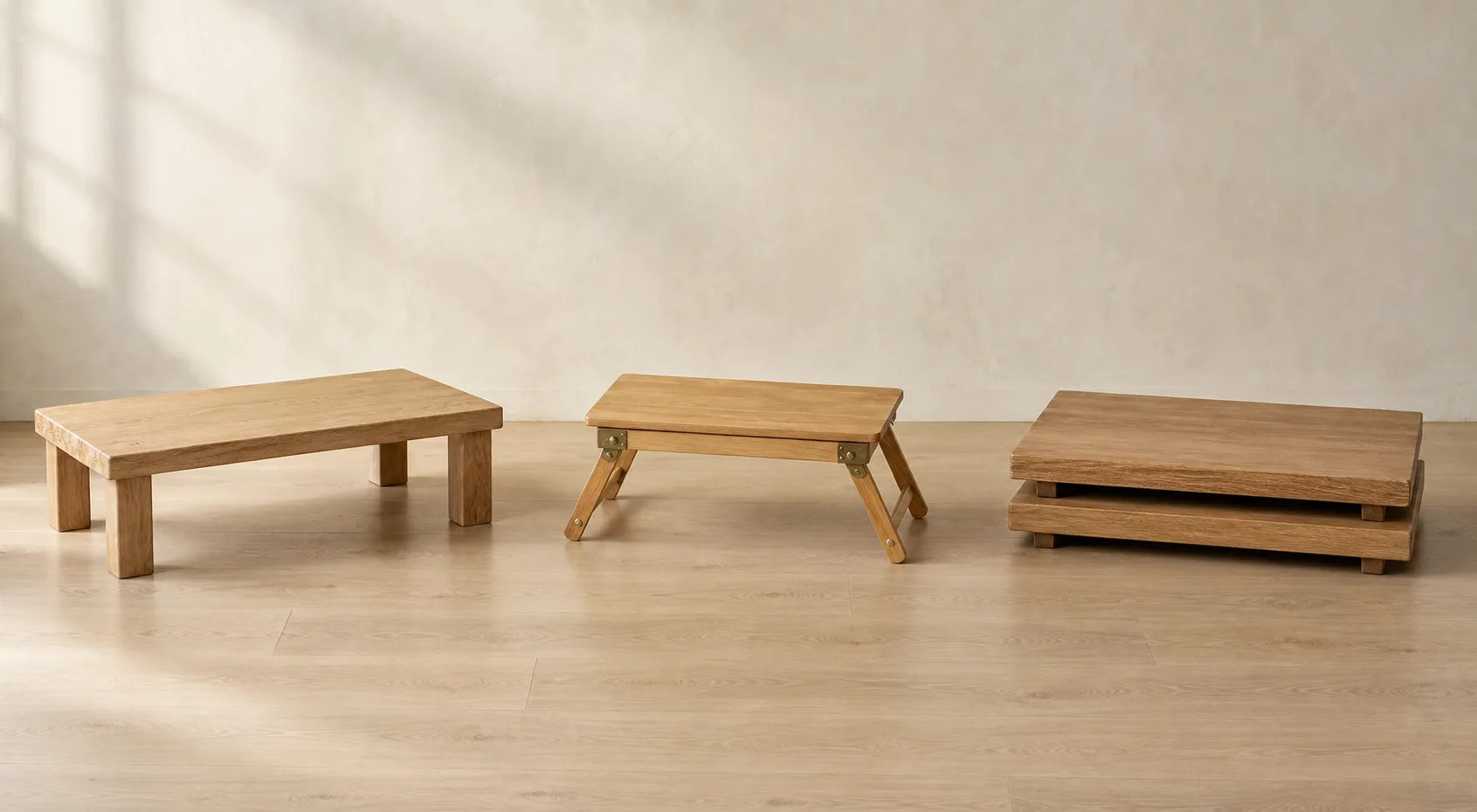
Meditation table formats at a glance
| Format | Construction cue | Main advantage | Main check |
|---|---|---|---|
| Fixed low table | Four fixed legs, apron or braced frame | Few moving parts | Full floor footprint and joinery |
| Folding-leg table | Hinged legs with braces or stops | Flatter storage envelope | Locking method and finger-clearance |
| Collapsible lattice table | Interlocking or expanding base | Compact transport | Fully opened geometry and top attachment |
| Narrow book table | Long, shallow top | Fits close to a wall | Tip resistance and usable depth |
| Stackable platforms | Two or more independent low units | Flexible area and storage | Stable stacking method and separate ratings |
| Small altar table | Fixed or folding decorated furniture | Purpose-specific appearance | Provenance, dimensions and care—not assumptions from decoration |
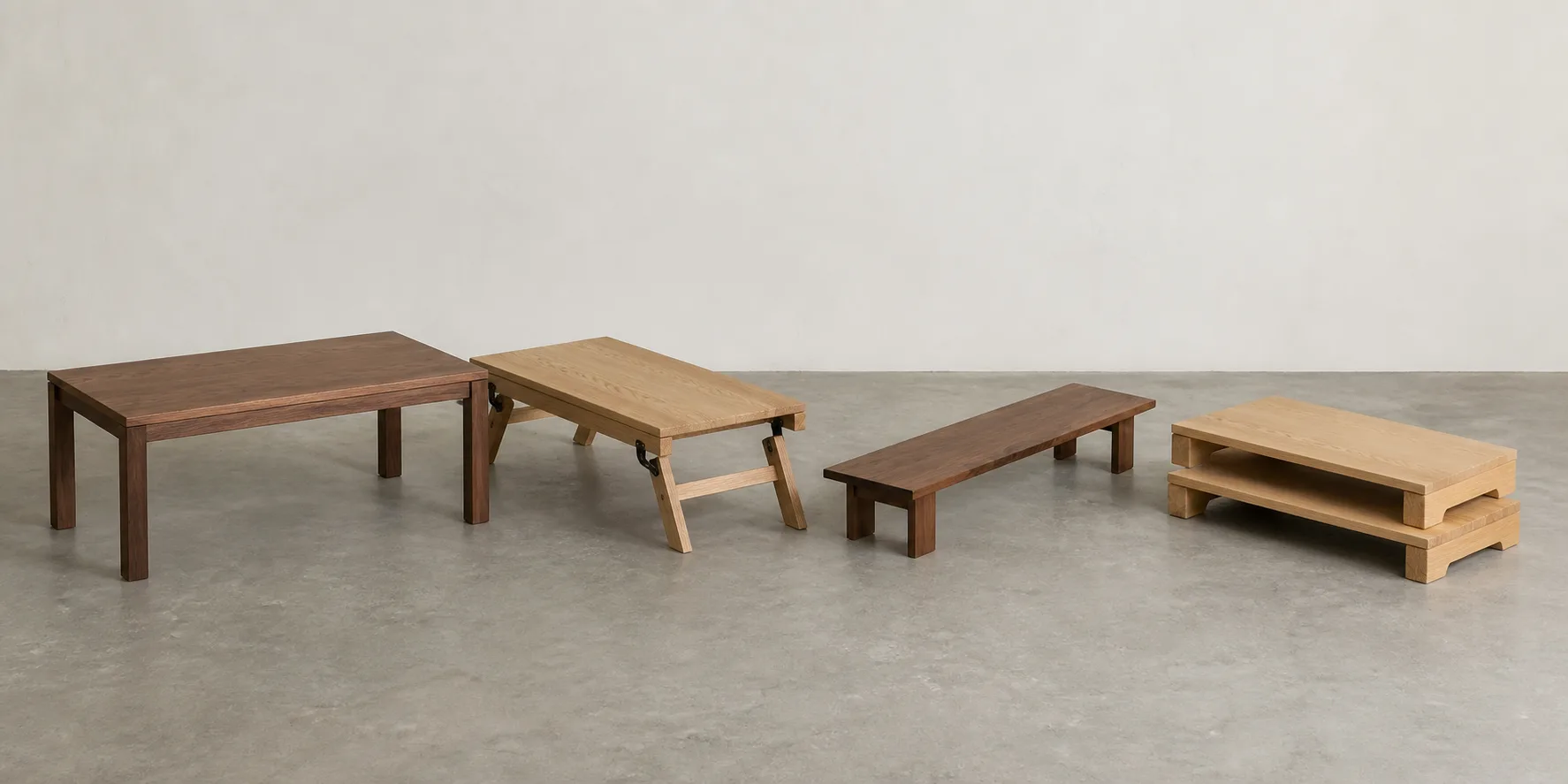
Fixed low tables
A fixed frame is the easiest format to inspect. Look underneath: legs may join directly to the top, connect through an apron, or be reinforced with stretchers. The useful question is not whether the construction sounds traditional or premium, but whether the connections are visible, repeatable and suitable for the published load.
Fixed legs consume their full assembled footprint during storage. That may be acceptable in a permanent room but awkward in a multipurpose living area. Measure the outermost foot positions, not only the top. Splayed legs can make the floor footprint wider than the tabletop; recessed legs can reduce usable knee or object clearance beneath it.
Folding and collapsible tables
Folding products trade permanent rigidity for storage efficiency. Current examples demonstrate several systems: individual hinged legs, a folding frame and a collapsible lattice base. Those systems should not be treated as interchangeable.
For hinged legs, find out what stops each leg in the open position. A visible hinge alone does not prove that a brace locks. Ask whether the hardware is captive, whether setup is tool-free and whether the table can be carried safely while folded. For a lattice base, verify how the top locates on the opened frame and whether parts can separate during transport.
Published folded dimensions are more useful than the word “portable.” Norbulingka, for example, publishes a roughly 14 × 9.5 × 9.5-inch assembled mini table and a folded height of about 3 inches. Vipp publishes a 3.5-kilogram folding mini table and explicitly says it is not a stool. Those disclosures answer real storage and misuse questions; a lifestyle photo does not.
Narrow and stackable formats
A long narrow table can provide width without taking much room depth. Daikukai lists its chestnut LHASA table at 62 × 16 × 20 centimeters (about 24.4 × 6.3 × 7.9 inches). That shallow top may suit a restricted floor plan, but it also leaves little front-to-back margin. Measure the objects you expect the furniture to hold rather than assuming “book table” guarantees adequate depth.
Stackable units provide several configurations, but the product must explain whether stacking is intended. Carpentray publishes separate dimensions for a large and small platform. Do not invent a combined load rating, and do not stack unrelated tables merely because their tops appear to fit. Check for locating lips, feet recesses or maker instructions that prevent sliding.
Measure the real envelope
Record dimensions in a small worksheet before shopping:
| Measurement | What to record | Why it matters |
|---|---|---|
| Top width | Clear usable edge-to-edge width | Determines object spacing |
| Top depth | Clear front-to-back depth | Prevents overhang |
| Assembled height | Floor to highest point | Controls the room sightline |
| Leg spread | Outermost feet in both directions | Defines the true floor zone |
| Under-table clearance | Height and width inside the frame | Affects cleaning and storage |
| Folded envelope | Length × width × thickness | Determines closet or shelf fit |
| Product weight | Complete carried weight | Tests the portability claim |
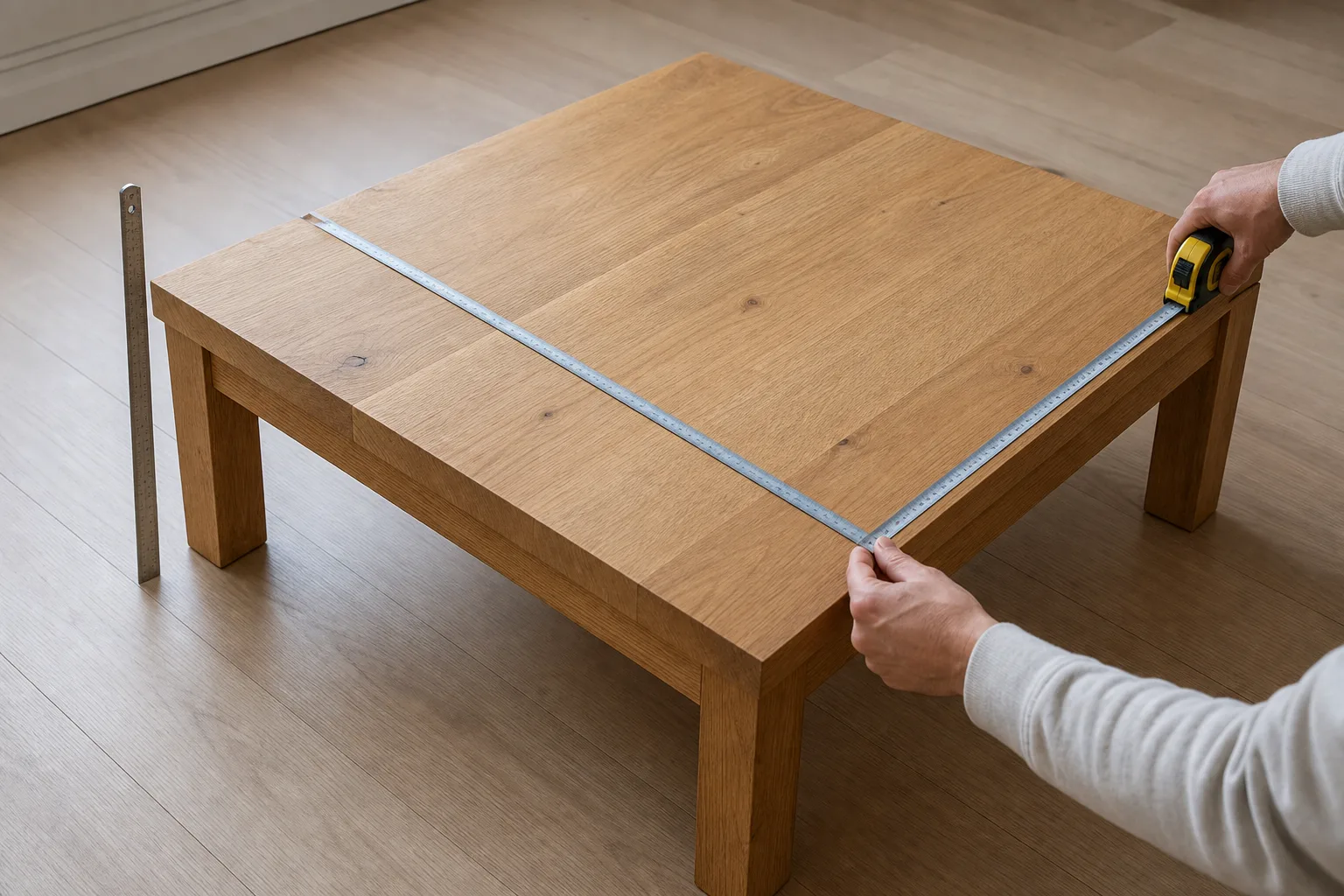
Allow clearance around every hinged or expanding part. A folded product may fit a shelf yet require more open floor to deploy. Include baseboards, radiator projection, doors and the route from storage to use. If a table will stand near a wall, measure its rear feet and top overhang rather than pushing it into the wall by eye.
Height has no universal answer
Current results range from very low platforms to products near side-table height. Tibet Arts & Healing lists a folding example at 24.5 × 13.5 × 12.5 inches. Tibet Shop Milano lists another at 68 centimeters wide, 29 centimeters high and 29 centimeters deep. A Wayfair listing reaches about 20.5 inches high. These are different room relationships despite sharing altar or meditation language.
Choose height from the intended room position and object, not an invented spiritual rule. Mock up the top with a rigid cardboard box of known dimensions. View it from the locations that matter, confirm it does not obstruct a route, and check that the top can be reached without moving other furniture. The mock-up tests geometry only; it does not establish safe loading.
Top area and edge detail
Usable area can be smaller than the advertised width and depth. Raised rails, carved edges, handles and rounded corners reduce the flat rectangle. Ask whether dimensions describe the top or the widest decorative projection. A strongly beveled edge can leave less support near the perimeter.
Check flatness by placing a straightedge or small level across several directions while the table stands on a verified level surface. A level shows orientation, not structural strength. If the product rocks, first rule out an uneven floor; then inspect foot lengths, hinges and loose connections. Do not shim a newly delivered product until you understand whether the cause is the floor, assembly or a defect.
Materials, joinery and hardware
“Wooden” is incomplete. Listings in the current result set mention European chestnut, teak and pine, while others use aluminium and steel components. Ask whether the top and frame are solid wood, veneer, plywood, composite board or metal. Each can be serviceable when honestly specified; the disclosure determines likely weight, edge durability, repair options and care.
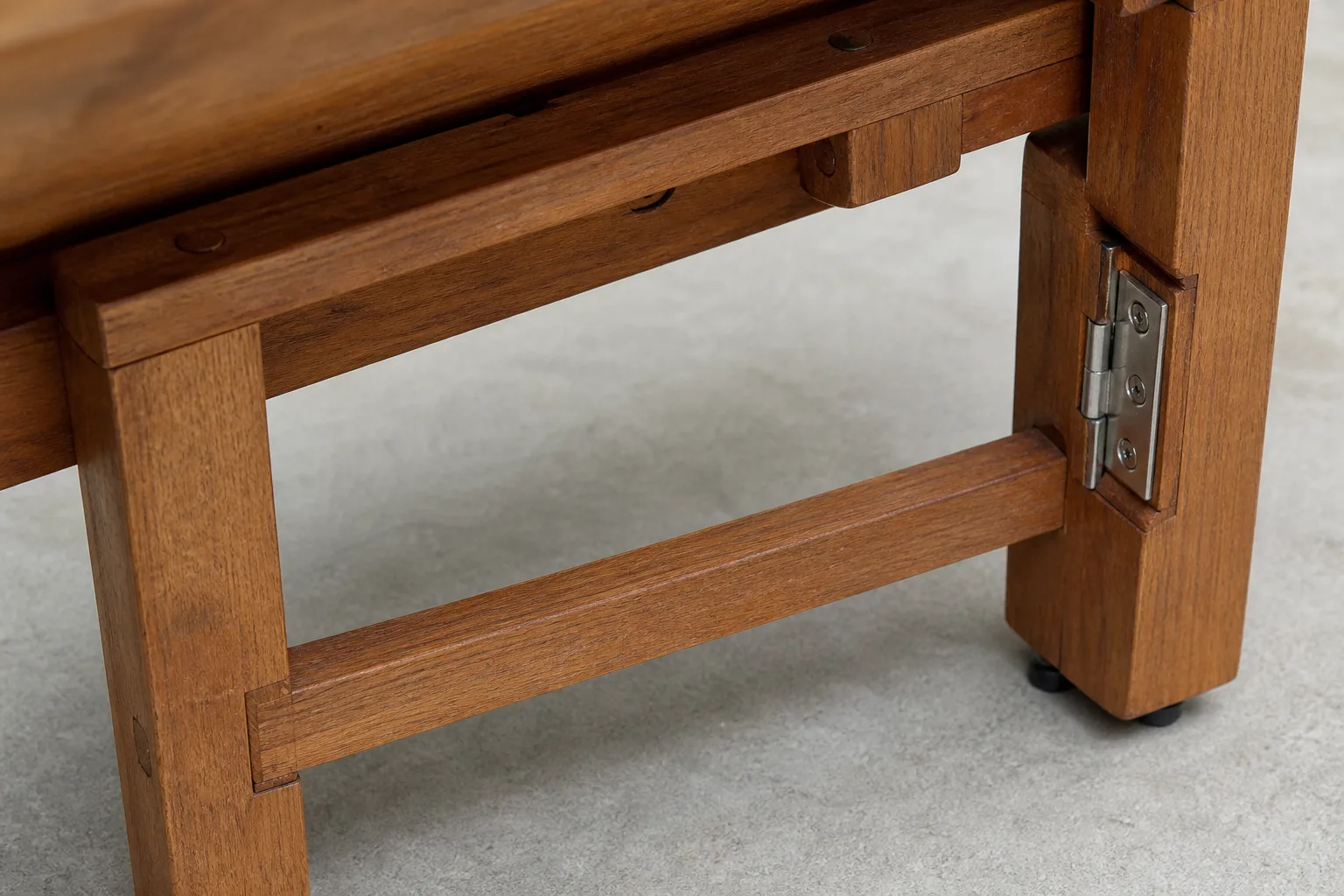
Photographs should show the underside, not only the finished top. For a fixed frame, look for continuous joints, an apron or bracing and clean contact at every connection. For folding furniture, look for correctly seated fasteners, hinge plates supported by adequate material and a positive open position. Tiny screws close to a board edge deserve closer inspection.
Do not assume handmade means structurally superior, or machine-made means inferior. Handmade listings may offer useful provenance and visible craft detail, but stability still depends on the actual frame and quality control. Likewise, decorative painting or carving does not establish a particular lineage, tradition or authenticity. When cultural provenance matters, rely on the maker’s documented origin, materials and production account—not generated imagery or marketplace adjectives.
Load rating and intended use
A load rating should state the maximum load, whether it is evenly distributed and whether testing applies to the assembled configuration. Vipp publishes a maximum load of 20 kilograms (44 pounds) for its mini table while explicitly warning that it is not a stool. That separation is important: a static object load is not equivalent to a person sitting, leaning or stepping on the top.
If a listing has no rating, ask the manufacturer rather than creating one from wood thickness. Keep the object mass below the published limit and follow any distribution restrictions. Never use the table as a step, seat or child’s climbing surface. Do not place body weight on it while opening or closing folding legs.
Finish and routine care
Find the exact finish: oil, wax, lacquer, paint, powder coat or another treatment. “Natural finish” can still require specific cleaning and may change color with light and use. Follow the maker’s instructions for moisture, cleaners and refinishing. Test no homemade cleaner on a visible area.
Use a dry or manufacturer-approved slightly damp cloth when permitted, then dry the surface. Keep liquid from hinge recesses and end grain unless the instructions allow it. Abrasive pads can change sheen; silicone polishes can complicate later refinishing. If the table has decorated surfaces, request care instructions specific to the pigments and protective layer.
Open flames, incense and hot vessels are outside this guide. A product being marketed as an altar table does not prove that its finish is heat-resistant or that its dimensions satisfy fire-clearance guidance. Treat fire safety, ventilation and the object’s own instructions as separate decisions.
Delivery and assembly inspection
Open the package on a clean surface and keep all inserts until inspection is complete. Match parts to the maker’s list. Photograph transit damage before assembly. Check:
- the top for splits, lifted veneer, deep dents and finish damage;
- each leg and brace for cracks, twist or mismatched length;
- hinges for bent leaves, loose pins and missing fasteners;
- threaded inserts for alignment and secure seating;
- feet for equal contact and intact anti-slip material;
- folding clearances for pinching or hardware interference;
- the assembled table for rocking on a known level floor.
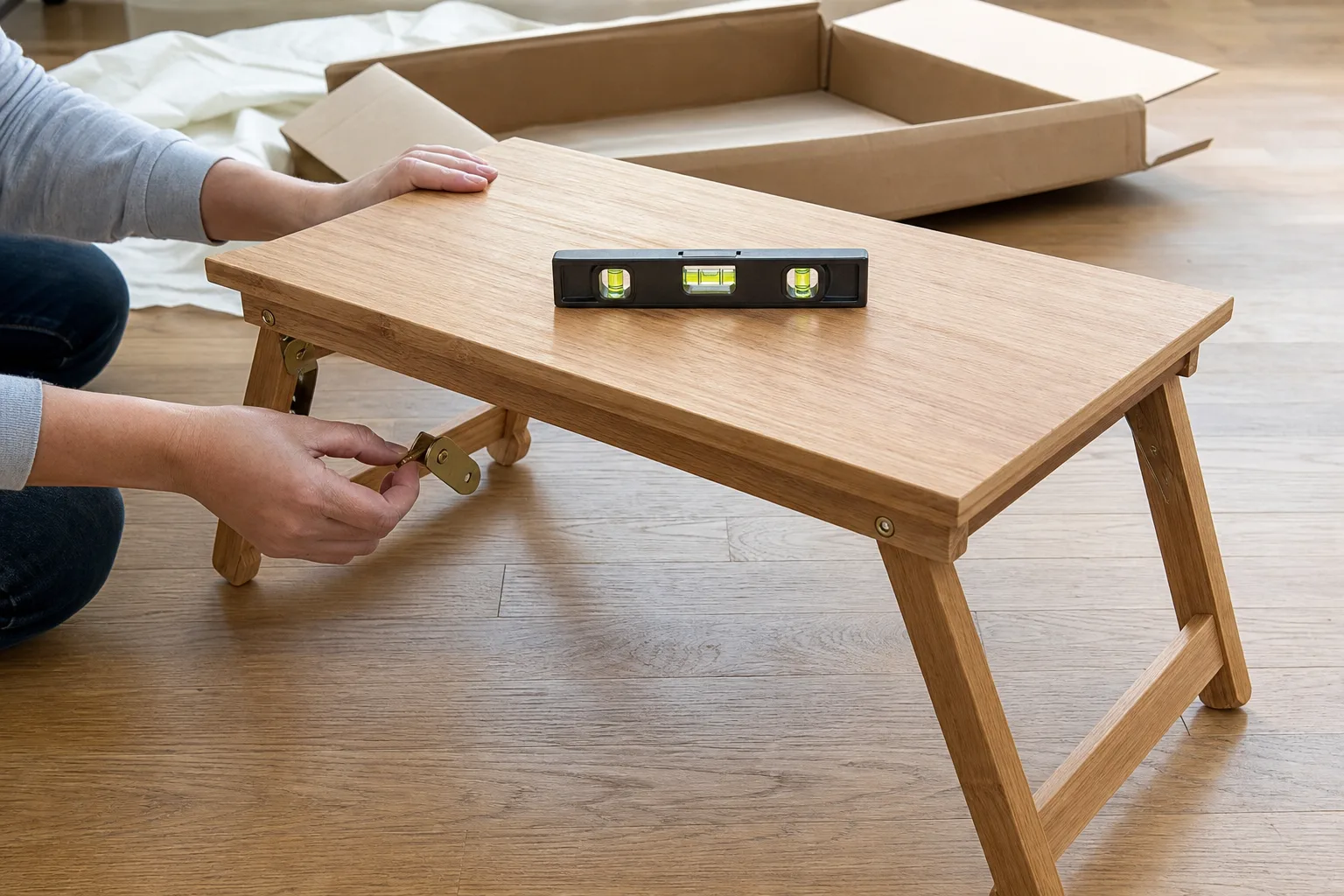
Use only the supplied fasteners and specified tools. Do not substitute longer screws: they can pierce the top or weaken a narrow rail. Tighten in the sequence given, and stop if parts must be forced into alignment. Folding hardware should move through its intended range without scraping wood, but it should not feel loose at the open stop.
After assembly, apply only the maker-approved test procedure. A bubble level and gentle corner-to-corner hand check can reveal orientation or rocking, but neither proves load capacity. If the table remains unstable on a level surface, document it and contact the seller rather than modifying a new product.
Storage and portability
Portable should mean more than “small.” Compare the product’s mass, folded thickness, loose parts, carrying method and setup sequence. A flat folding table may store behind a door but still be uncomfortable to carry because the legs swing or the edges lack a grip. A lattice table may pack compactly but introduce detachable components.
Store the table clean and dry in the orientation the manufacturer permits. Prevent folded legs from opening during transport with the provided latch or case, not an improvised strap that presses on a hinge. Do not pile weight on a folded top unless stacking is approved. Protect finished faces from metal hardware on neighboring objects.
Our yoga equipment storage guide covers whole-collection zoning and measured capacity. For this product, record the folded envelope and decide its exact storage bay before purchase.
Compare value without relying on price
Online prices change by region, shipping and seller, so compare durable attributes instead of a static price table. A useful value record includes:
- complete assembled and folded dimensions;
- disclosed materials and finish;
- product weight and published load rating;
- underside and hinge photography;
- replacement hardware or repair policy;
- assembly and care documentation;
- shipping protection, returns and warranty;
- maker provenance for any claimed craft tradition.
A less expensive table with complete measurements and replaceable hardware may be easier to own than an ornate listing with no underside view. Conversely, a simple fixed table may outlast a folding model when compact storage is unnecessary. Value is the fit between disclosed construction and your actual room constraints.
Red flags
Pause when a listing:
- shows only styled front views and hides the underside;
- omits one or more assembled dimensions;
- calls the product portable without folded dimensions or weight;
- describes a table as a stool elsewhere in the same listing;
- gives no load rating but shows people leaning or sitting on it;
- claims solid wood while the edge image suggests an undisclosed core;
- mixes centimeters and inches inconsistently;
- promises cultural authenticity without naming origin or maker;
- shows candles or hot objects but provides no finish or heat guidance;
- uses the same specifications for visibly different sizes.
Save the listing and specification sheet at purchase time. Marketplace copy can change, and the saved version helps resolve missing parts, incorrect dimensions or warranty questions.
A practical selection sequence
- Name the format. Fixed, hinged, lattice, narrow or stackable.
- Define the top task. List the objects and measure their combined footprint and mass.
- Mock up the envelope. Test width, depth, height and leg spread in the room.
- Verify storage. Record the folded dimensions, weight and loose parts.
- Inspect construction evidence. Require underside, joint, hinge and foot details.
- Confirm limits. Get the load rating and intended-use statement in writing.
- Check care and provenance. Separate material facts from decorative marketing.
- Inspect on arrival. Keep the table unloaded until assembly and stability checks pass.
The best meditation table is not the most ornate or the one photographed in the calmest room. It is the one whose real envelope fits your space, whose construction can be inspected, whose limits are published and whose storage and care you can manage without improvisation.
Frequently asked questions
What is a meditation table?
Current product results use meditation table for several low furniture formats: fixed low tables, folding tables, narrow book tables, stackable platforms and small altar tables. The name does not define one standard size or construction, so compare the actual dimensions, leg design, load rating and intended use.
Is a meditation table the same as a meditation bench?
No. A meditation bench or stool is seating and should publish a suitable load rating and seating dimensions. A meditation table supports objects. Never sit or stand on a low table unless the manufacturer explicitly identifies and rates it for that use.
How high should a meditation table be?
There is no universal correct height. Measure the intended location and the seated or standing sightline relevant to your room, then compare that requirement with the product height. Current examples range from very low platforms to furniture around 20 inches high, so the product name alone is not enough.
Are folding meditation tables stable?
A folding design can be stable when its hinges, braces or lattice base lock fully and all feet contact a level floor. Check the maker instructions and load rating, inspect the hardware after delivery, and keep the top unloaded while opening or closing the mechanism.
Can I place candles or incense on a meditation table?
Do not infer fire or heat suitability from the term meditation table. Wood finishes, textiles and nearby walls may be combustible or heat-sensitive. Follow the object and furniture manufacturers’ instructions and separate any open-flame decision from this furniture guide.