

How this page has changed
August 22, 2026
Sources, internal links and safety or product context reviewed.
In this guide
Quick answer. Yoga Nidra is a guided awareness practice usually done while lying down. For sleep, choose a 10- to 30-minute recording, support your body so you can remain still without strain, and follow the voice without trying to concentrate perfectly. Falling asleep is allowed, but it is not proof that the practice “worked.” Current research is promising but too limited to treat Yoga Nidra as a proven insomnia therapy.
Yoga Nidra is often translated as “yogic sleep,” but you are not performing a pose or trying to imitate deep sleep. A teacher guides your attention through the body, breath, sensations, or imagery while your body rests. You may remain aware, drift in and out, or fall asleep.
That makes it different from our bedtime yoga routine, which uses gentle physical poses before bed. Yoga Nidra has almost no movement once you are settled. It is closer to a structured guided relaxation or meditation.
Does Yoga Nidra actually help sleep?
There is an encouraging signal, but the evidence is not strong enough for a guarantee. A 2026 systematic review of six randomized trials found reported improvements in several sleep outcomes across small, varied groups. The authors also noted moderate-to-high risk of bias, inconsistent protocols, and poor reporting of adverse events.
A separate 2026 systematic review and meta-analysis judged the certainty of evidence very low. Its pooled randomized results for common sleep-quality and insomnia scales were not statistically significant, with small samples and substantial uncertainty.
The useful conclusion is modest: Yoga Nidra may be a worthwhile relaxation option, especially if you enjoy guided attention, but it is not a replacement for evidence-based insomnia care. The NCCIH identifies multicomponent cognitive behavioral therapy for insomnia (CBT-I) as the most strongly recommended treatment for chronic insomnia.
Yoga Nidra versus meditation, NSDR, and Savasana
| Practice | Typical format | Main distinction |
|---|---|---|
| Yoga Nidra | Guided, reclined, 10–45 minutes | Follows a structured sequence of attention |
| Mindfulness meditation | Seated, walking, or reclined | Often returns attention to present experience |
| NSDR | Broad modern label for guided deep rest | May borrow from Yoga Nidra without its full structure |
| Savasana | Final resting pose after yoga | A body position; guidance may be brief or absent |
| Bedtime yoga | Gentle movement sequence | Uses poses before the final rest |
A recording does not need every traditional element to be useful, but it should describe itself honestly. A ten-minute body scan is not automatically a complete Yoga Nidra practice, and “equivalent to four hours of sleep” is not a credible promise.
Set up before pressing play
Choose your position first; adjusting repeatedly during the recording makes settling harder.
Option 1: supported back-lying
Lie on a mat, carpet, or firm bed. Use a low folded blanket under the head if the chin points upward, and place a rolled blanket or pillow under the knees if straight legs pull on the lower back. Cover yourself before you feel cold. Let the arms rest where the shoulders are comfortable.
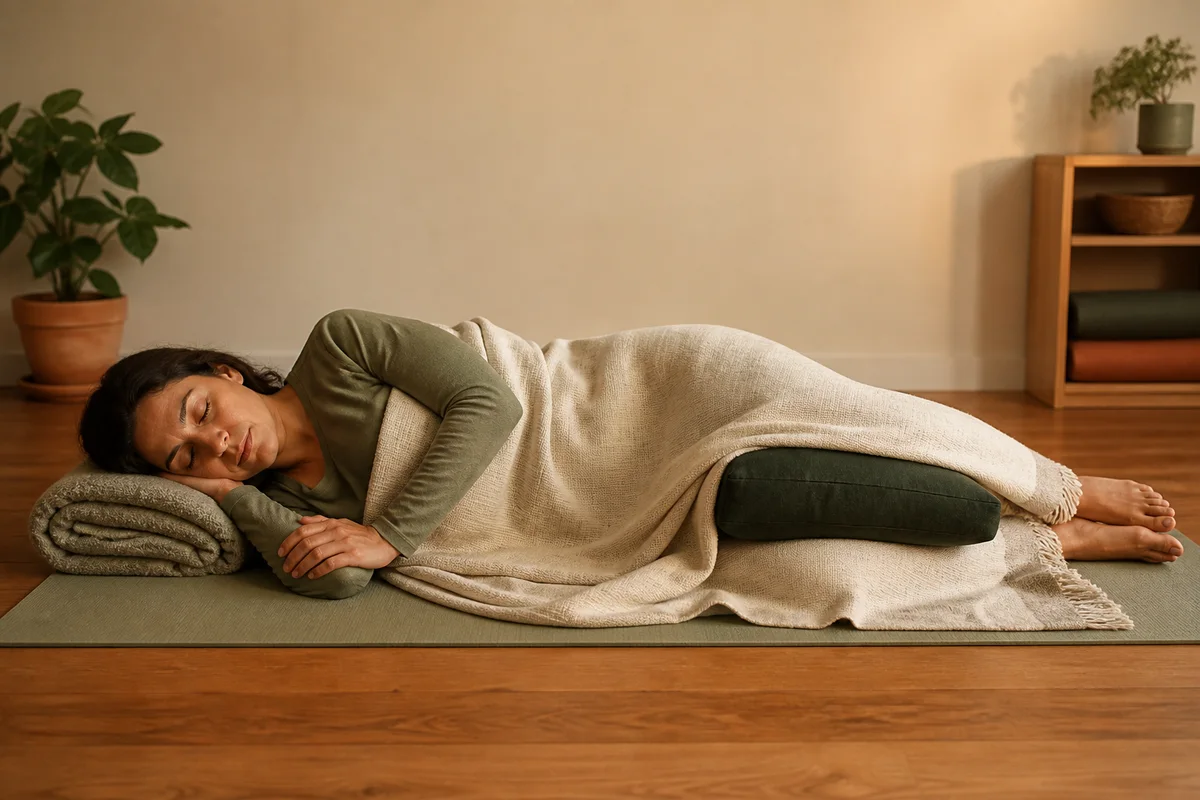
Option 2: side-lying
Side-lying is a valid choice for pregnancy, reflux, back discomfort, breathing comfort, or simply preference. Support the head so the neck does not bend toward the floor and place a pillow between the knees.
Option 3: reclined or seated
Use a supportive chair when getting to the floor is difficult or lying down makes you too sleepy. Support both feet and let the backrest carry your weight. Keep the head neutral rather than holding it rigidly upright.
An eye covering is optional. If you already use one, check its care and heating restrictions in our yoga eye pillow guide. Remove it before sleeping and skip it if darkness increases anxiety or disorientation.
A 15-minute Yoga Nidra practice map
If you want complete wording rather than a practice outline, use our free 15-minute Yoga Nidra script. It includes pause cues, an eyes-open chair option, and a print-to-PDF version.
Beginners will usually find it easier to follow a recording. This map helps you recognize a sensible sequence and practice without believing there is one mandatory script.
| Time | Stage | What to do |
|---|---|---|
| 0:00–2:00 | Arrive | Feel the surface supporting you; make any final adjustment |
| 2:00–3:00 | Intention | Decide to rest without forcing sleep or a special state |
| 3:00–8:00 | Body rotation | Briefly notice hands, arms, face, torso, and legs in order |
| 8:00–10:00 | Breath awareness | Observe natural breathing or count a few exhalations |
| 10:00–13:00 | Broad awareness | Notice heaviness, warmth, sound, or the body as a whole |
| 13:00–15:00 | Finish | Return gradually, or let a bedtime recording end quietly |
1. Arrive without optimizing forever
Check temperature, volume, and physical support. Set the phone to Do Not Disturb and place it where you do not need to look at the screen. Once comfortable, let small imperfections remain.
2. Use an intention without making a demand
“I will rest for fifteen minutes” is workable. “I must fall asleep now” adds pressure. Clock-watching and worry about sleep can themselves make sleep more difficult, as the NHLBI explains.
3. Rotate attention
Follow the named body region for a moment, then move on. You do not need to feel tingling, warmth, or complete relaxation. If a body area is painful or emotionally charged, skip it and return to a neutral anchor such as contact with the floor or sounds in the room.
4. Notice ordinary breathing
Yoga Nidra does not require forceful breathwork. Let breathing remain natural. If breath attention causes air hunger or anxiety, listen to external sounds instead.
5. Finish for your actual goal
A daytime practice should usually guide you back: deepen breathing, move fingers and toes, roll to one side, and sit up slowly. A sleep-specific recording may fade out so you can remain in bed. Preview the last minute before choosing—it is frustrating when a loud closing bell wakes you.
How to choose a good Yoga Nidra recording
Look beyond the title and thumbnail. Check:
- Length: start with 10–20 minutes; longer is not automatically deeper.
- Ending: choose a wake-up sequence for daytime rest and a quiet ending for bedtime.
- Voice and pace: understandable at low volume, with enough silence to follow.
- Claims: skip recordings promising trauma release, guaranteed deep sleep, hormone changes, or hours of sleep replacement.
- Instructions: the teacher should normalize movement, position changes, open eyes, and stopping.
- Background sound: music is optional; sudden volume changes are not useful near sleep.
Do not drive, bathe, or use machinery while following a sleep recording. Download it beforehand if notifications or buffering are likely to interrupt you.
What are the disadvantages of Yoga Nidra?
Most people experience it as low risk, but low risk is not no risk. Long stillness and inward focus can sometimes increase anxiety, intrusive thoughts, dissociation, grief, or a sense of losing control. The NCCIH notes that meditation research often underreports unwanted effects.
If you become distressed:
- open your eyes and name several objects in the room;
- move the hands and feet or sit up;
- switch attention to ordinary external sounds;
- stop the recording rather than trying to complete it;
- seek qualified support when reactions are intense or recurring.
You are also allowed to scratch, swallow, reposition, or bend the knees. Stillness is a tool, not a test.
Can you do Yoga Nidra by yourself?
Yes. “By yourself” does not have to mean unguided. A well-made recording provides structure while you remain responsible for your setup and stop choices. Practice earlier in the evening for the first few sessions so you can learn how the voice, silence, and inward attention affect you.
If a timer helps a daytime session end reliably, our meditation timer guide explains interval, offline, and physical options. At bedtime, adding another alert is usually unnecessary when the recording already ends at a known time.
The bottom line
Yoga Nidra can be a calm bridge between an active evening and sleep, but it is not a sleep medication in audio form. Choose a comfortable position, follow a short and honest recording, and allow awareness, drifting, or sleep without grading the outcome.
Keep the broader sleep basics in view. The NHLBI recommends a consistent schedule and a cool, quiet, dark sleep environment, alongside appropriate treatment when insomnia persists. Yoga Nidra can support that plan; it should not carry the whole burden.
Frequently asked questions
Does yoga nidra help you fall asleep?
Yoga Nidra may help some people relax and report better sleep, but current research is small and uncertain. It does not reliably make everyone fall asleep or replace treatment for chronic insomnia. Use it as an optional wind-down practice rather than a guaranteed sleep switch.
What are the disadvantages of yoga nidra?
Long stillness or inward attention can feel uncomfortable, increase anxiety, or bring up intrusive thoughts for some people. Recordings may also become frustrating when they promise sleep. Keep your eyes open, sit up, shorten the session, or stop if you feel worse.
Is it good to do yoga nidra before sleep?
It can fit well before sleep when the recording is quiet, the setup is comfortable, and you do not turn completion into another task. If you want to stay awake for the full practice, use it earlier in the evening; if sleep is the goal, choose a recording that ends without a wake-up sequence.
Can I do yoga nidra by myself?
Yes. Beginners usually follow a clear recording rather than memorize a script. Choose a trusted teacher, preview the length and ending, keep the volume low, and practice somewhere physically safe. Stop or switch to an eyes-open grounding activity if inward focus becomes distressing.