

How this page has changed
August 24, 2026
Sources, internal links and safety or product context reviewed.
In this guide
- 01Before you read the script
- 02Free 15-minute Yoga Nidra script
- 03How to make it 10, 20, or 30 minutes
- 04Is there a free Yoga Nidra script PDF?
- 05What happens if you practice every day?
- 06What did Andrew Huberman say about Yoga Nidra?
- 07Who should not practice Yoga Nidra?
- 08A responsible teacher’s final check
Quick answer. This is a free, original 15-minute Yoga Nidra script for personal practice or leading a general relaxation session. Read the words slowly, treat every bracketed direction as a pause rather than spoken text, and give listeners permission to move, keep their eyes open, or stop. To keep a copy, use Print → Save as PDF in your browser—no signup is required.
Yoga Nidra is usually guided while the body rests. A typical sequence moves through settling, an intention, a rotation of awareness, breath, contrasting sensations or imagery, and a gradual return. The order varies between schools, so a script is a map rather than a performance standard.
If you are new to the practice, read our beginner guide to Yoga Nidra for sleep first. It explains how Yoga Nidra differs from a body scan, Savasana, and the movement-led poses in a bedtime yoga routine.
Before you read the script
The words matter less than pace, permission, and a physically safe setup.
- Text in [square brackets] is a direction to the reader. Do not say it aloud.
- An ellipsis—…—marks a short pause. Longer pauses are named in brackets.
- Read conversationally. Test one complete run before teaching or recording it; the silence determines the true duration.
- Invite a position rather than prescribing one. Lying on the back, side-lying, or sitting in a supportive chair can all work.
- Never use the practice while driving, bathing, supervising a child near water, or operating machinery.
For lying on the back, a folded blanket under the head and a bolster or firm pillow under the knees can reduce effort. During pregnancy, reflux, congestion, or back discomfort, side-lying with support between the knees may feel better. A chair is useful when lying down feels vulnerable or makes sleep too likely.
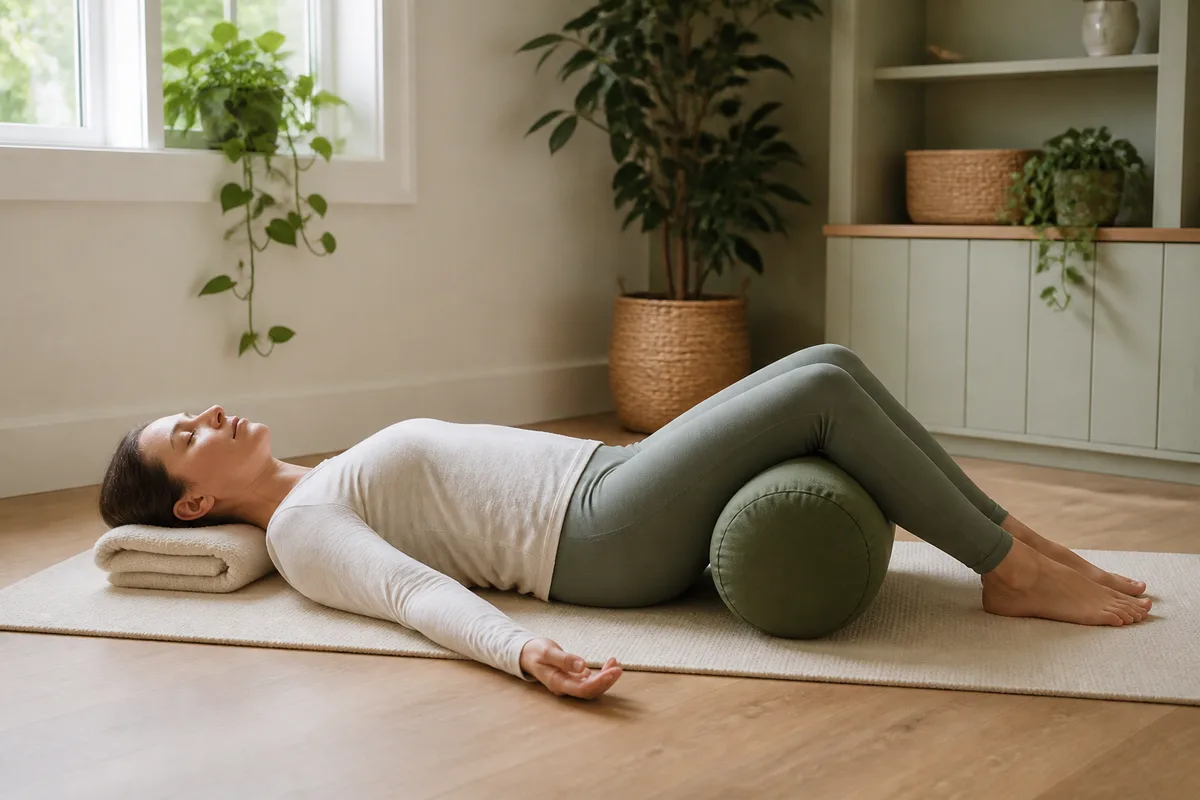
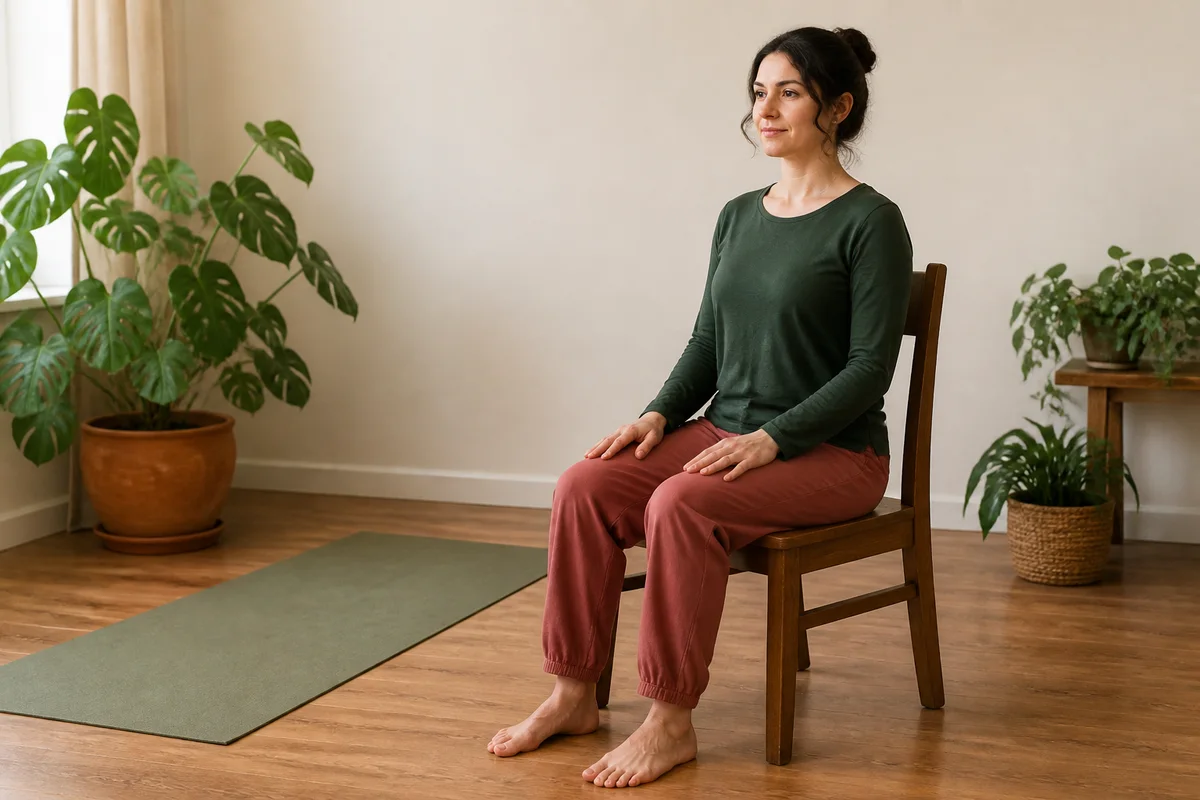
Free 15-minute Yoga Nidra script
Read the opening and closing with a little more continuity. Leave more silence during the body rotation, breath, and visualization. If you lose your place, simply name the next neutral anchor—contact, sound, or breath—and continue.
0:00–1:30 — Arrive
Settle into a position you can change whenever you need to. … Let your hands rest somewhere easy. … Your eyes can close, soften, or remain open with a steady gaze. …
Notice where your body meets the floor, bed, or chair. … Notice the temperature of the air on your skin. … Notice the most distant sound you can hear, and then a sound closer to you. …
There is nothing you have to achieve in the next few minutes. If an instruction does not suit you, let it pass. You can return to the feeling of your feet, the support beneath you, or the room around you. …
1:30–2:30 — Choose a simple intention
Bring to mind a short, realistic intention for this practice. It might be, “I will rest for these few minutes,” or, “I can meet this moment with steadiness.” …
Choose words that do not demand a particular result. Repeat the intention silently once or twice. … Then let the words rest. …
2:30–7:00 — Rotate awareness through the body
Move your attention lightly from place to place. You do not need to move, create a sensation, or relax on command. If any area feels uncomfortable to notice, skip it and return to a neutral point of contact. …
Notice the right hand. … The thumb … first finger … second … third … fourth finger. … The palm … back of the hand … wrist … forearm … elbow … upper arm … shoulder. …
Notice the left hand. … Thumb … first finger … second … third … fourth finger. … Palm … back of the hand … wrist … forearm … elbow … upper arm … shoulder. …
Bring awareness to the right foot. … The toes … sole … top of the foot … ankle … lower leg … knee … thigh … hip. …
Bring awareness to the left foot. … Toes … sole … top of the foot … ankle … lower leg … knee … thigh … hip. …
Notice the back of the body where it is supported. … The back of the pelvis … lower back … middle back … shoulder blades … back of the head. …
Notice the front of the body. … Lower abdomen … upper abdomen … chest … throat. …
Notice the jaw without asking it to change. … The mouth … cheeks … eyes … forehead … and the whole face. …
Now sense the body as a whole, supported in this position. … [Pause for 20–30 seconds.]
7:00–9:00 — Follow ordinary breathing
Notice that breathing is already happening. There is no need to make it deeper or slower. …
You might feel movement at the nostrils, chest, abdomen, or somewhere else. Choose the clearest comfortable place. … Follow one breath arriving … and one breath leaving. …
If breath attention feels tight or uncomfortable, listen to sounds in the room instead. … Stay with breath or sound for several easy cycles. … [Pause for 30–45 seconds.]
9:00–11:00 — Explore gentle contrasts
Notice the feeling of heaviness where your body meets its support. … Only the contact that is actually present. …
Then notice any sense of lightness: perhaps air around the hands, space around the face, or no clear sensation at all. …
Notice a place that feels a little warm. … Then a place that feels a little cool. … You do not need to intensify either one. …
Let both sides of each contrast go. Return to the simple fact of being supported. …
11:00–13:00 — Use neutral imagery, or skip it
If imagery feels comfortable, picture a familiar, steady place in daylight. It may be a quiet room, a path you know, or open sky. … Keep the image simple. There is nothing to solve and nowhere you need to go. …
If you prefer not to visualize, notice three ordinary sounds. … Then feel one clear point of contact beneath you. …
Let image and sound fade into the background. Sense the whole body here in the room. … [Pause for 30 seconds.]
13:00–15:00 — Return
Recall the intention you chose at the beginning. Repeat it silently once, without checking whether you succeeded. …
Notice the room around you. … The air … the sounds … the surface beneath you. … Let the next breath be a little fuller only if that feels comfortable. …
Begin small movements in the fingers and toes. … Turn the head gently, or keep it still. … Bend the knees if you are lying down. … Take the time you need to roll to one side or sit more upright. …
Let the eyes take in light and shape. Name one object you can see. … The practice is complete.
How to make it 10, 20, or 30 minutes
Do not squeeze a 15-minute script into ten minutes by speaking faster. Keep the same calm voice and alter the amount of silence or detail.
| Target length | What to change | What to keep |
|---|---|---|
| 10 minutes | Shorten the rotation to hands, arms, feet, legs, back, front, and face; use one contrast; omit imagery | Arrival, permission to opt out, ordinary breath, and a clear return |
| 20 minutes | Add 15–30 seconds of silence after each major body region and another minute with breath or sounds | The same simple wording and complete ending |
| 30 minutes | Slow the rotation, name smaller regions, and add several quiet intervals rather than extra claims or elaborate imagery | Choice, external anchors, and enough time to reorient |
When recording, play the file from beginning to end and time it. Editing software can make silence look long while it feels brief to a listener. For a daytime session, a quiet meditation timer can provide a reliable endpoint without interrupting the middle of the script.
Is there a free Yoga Nidra script PDF?
This page is the free version. Use your browser’s print command—Ctrl+P on Windows or Command+P on macOS—and select Save as PDF. That preserves the headings and timing notes without requiring an email address. Check the saved pages before teaching so a body-rotation paragraph is not split in an awkward place.
You may use the script for your own practice or read it in a class. If you publish or sell a recording, write your own version rather than presenting this text as your original work.
What happens if you practice every day?
There is no required daily dose. A short daily session may become familiar and easier to follow, but frequency does not guarantee deeper rest, better sleep, or a particular health result. Keep a simple note of how you feel before and after—not just whether you completed it.
The NCCIH describes meditation as generally low risk but notes that safety evidence is limited and unwanted experiences can occur. If daily practice repeatedly increases anxiety, intrusive thoughts, emotional numbness, or sleep disruption, reduce the length or stop. Persistent or intense symptoms deserve help from a qualified healthcare professional.
What did Andrew Huberman say about Yoga Nidra?
Andrew Huberman uses non-sleep deep rest (NSDR) as a broad term for guided practices that promote deep rest while a person remains awake. His official NSDR overview includes Yoga Nidra and certain meditation practices within that umbrella.
That does not make the terms interchangeable. Yoga Nidra is a specific tradition with recognizable elements; an NSDR recording may use only breath, a body scan, or another relaxation method. Choose by the actual instructions and safety language, not by a fashionable label.
Who should not practice Yoga Nidra?
There is no universal list of people who must avoid it. There are, however, situations where you should not begin: while driving, in water, during a task that needs attention, or anywhere falling asleep would be unsafe.
Inward attention and long stillness can occasionally bring up anxiety, intrusive thoughts, dissociation, or fear of losing control. The NCCIH relaxation guidance advises caution because relaxation practices can sometimes make symptoms worse. Keep the eyes open, use the chair variation, orient to visible objects, or stop. If reactions are intense or recurring—especially alongside trauma symptoms or a serious mental-health condition—ask a qualified clinician or trauma-informed teacher whether and how to continue.
A responsible teacher’s final check
Before reading this script to someone else:
- ask about physical comfort without requesting private medical details;
- state clearly that movement, open eyes, and stopping are allowed;
- do not touch or adjust a resting person without explicit consent;
- avoid promises about sleep, trauma, hormones, pain, or recovery;
- keep enough time for a gradual return and conversation afterward.
A good script is not one that makes every listener perfectly still. It is one that gives them clear structure while leaving control with the person in the practice.
Frequently asked questions
Is there a free PDF script for Yoga Nidra?
Yes. This original 15-minute script is free to read and print. Use your browser print command and choose Save as PDF for a clean personal copy. Directions in brackets are for the reader and do not need to be spoken aloud.
What happens if you do Yoga Nidra every day?
Some people find a daily practice calming, while others prefer occasional sessions. There is no required dose and more is not automatically better. Shorten, change, or stop the practice if inward attention increases anxiety, intrusive thoughts, numbness, or distress.
What did Andrew Huberman say about Yoga Nidra?
Andrew Huberman uses non-sleep deep rest, or NSDR, as an umbrella term for practices that guide deep rest while awake, including Yoga Nidra and some forms of meditation. Yoga Nidra is the more specific tradition and not every NSDR recording follows its full sequence.
Who should not practice Yoga Nidra?
Do not practice while driving, bathing, or operating machinery. There is no universal exclusion list, but people who become distressed, dissociated, or overwhelmed during inward-focused practices should stop and consider support from a qualified clinician or trauma-informed teacher before trying again.