

This guide contains affiliate links — recommendations aren’t based on commission. Read our full disclosure.
How this page has changed
August 20, 2026
Sources, internal links and safety or product context reviewed.
In this guide
- 01The short answer
- 02The specs, side by side
- 03Both say "lifetime guarantee". Only one covers wear.
- 04Weight is the difference you feel first
- 05Length matters more than most people expect
- 06Grip: neither of these is a sweat mat
- 07How long each one lasts
- 08Materials: both PVC, different claims
- 09Where each one wins
- 10Who should buy neither
- 11Which should you buy?
- 12If neither PRO nor Gaiam fits
Gaiam versus Manduka is a money question wearing a gear question's clothes. Both brands sell a 6mm PVC mat. Both promise a lifetime guarantee. One costs several times the other.
The gap is not cushion. It is weight, length, how long the surface holds up, and what those two guarantees actually cover when you read them.
A note on what this is. I have not practised on either mat. Our Gaiam Premium review and our Manduka PRO review are both research-and-specs reviews. Every figure below comes from Gaiam's own pages, Manduka's own pages, or OutdoorGearLab's testing, and I say which each time.
The short answer
Buy the Gaiam Premium 6mm if you are new, on a budget, or not yet sure yoga will stick. It is cushioned, light, and cheap enough that quitting costs you almost nothing.
Buy the Manduka PRO if you practise most days and the mat stays in one room. It is denser, longer, wider, and built to be the last mat you buy for a while.
If you are earlier than that decision, how to choose a yoga mat starts further back.
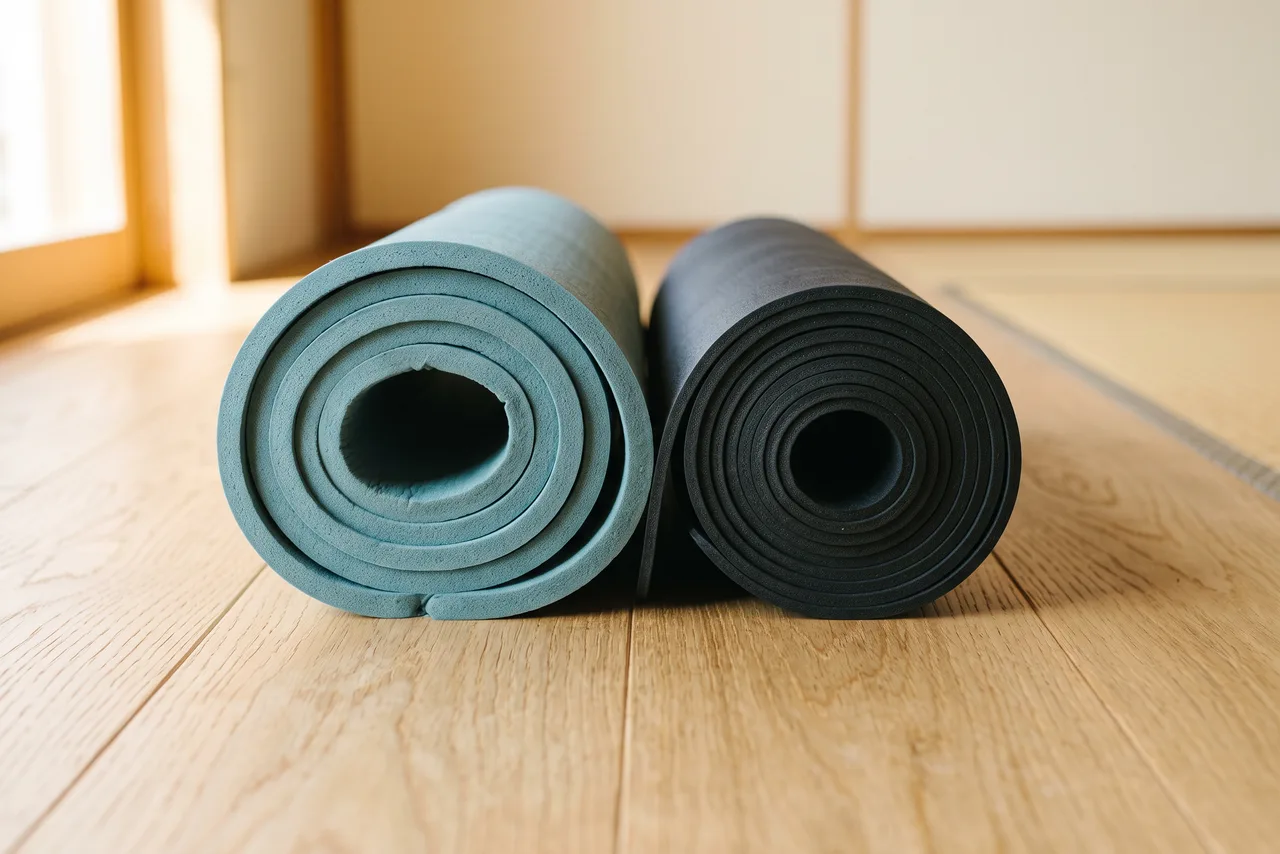
The specs, side by side
| Gaiam Premium 6mm | Manduka PRO | |
|---|---|---|
| Thickness | 6mm | 6mm |
| Length | 68 in | 71 in |
| Width | 24 in | 26 in |
| Weight | 3.3 lb (measured by OutdoorGearLab) | 7.5 lb (Manduka) |
| Material | PVC, latex-free, 6P free | Closed-cell PVC |
| Guarantee | Lifetime — defects only | Lifetime — surface wear |
| Price tier | $ | $$$ |
Sources: the Gaiam figures come from Gaiam's own product page, the Manduka figures from Manduka's PRO series comparison, and the Gaiam weight from OutdoorGearLab's testing, because Gaiam does not publish one.
One note on that weight. Gaiam does not publish one at all, so the 3.3 lb above is OutdoorGearLab's own measurement — it weighed the mat at 1.5 kg. Manduka publishes its 7.5 lb itself. Either way the point holds: the PRO is more than twice the mat to carry.
Both say "lifetime guarantee". Only one covers wear.
This is the part almost every comparison skips, and it is the one that decides value.
Gaiam's guarantee covers manufacturing defects only. Its own page says the guarantee "covers manufacturing defects only (including any defect in materials or workmanship)" and that "normal wear and tear is not covered under this Lifetime Guarantee". It applies to the original purchaser, to US residents only, and the sole remedy is a replacement mat.
Manduka's guarantee covers the opposite thing. Its page covers "wear to the top surface of the yoga mat from regular use that impacts its performance" — the wear a mat actually gets. Cosmetic marks that do not affect performance are excluded.
So when a Gaiam mat goes slick and compressed after a couple of years, that is normal wear, and the guarantee does not apply. When a PRO's surface wears to the point it stops performing, that is exactly what Manduka says it will replace.
Read the Manduka exclusions before you buy, though, because they are strict:
- Damage from excessive water, including submerging the mat
- Damage from a washing machine or a vacuum cleaner
- Cleaning with anything other than Manduka Mat Wash or water
- Creases from improper storage
- Mats used by a studio as in-studio equipment
Proof of purchase is required, and the replacement is limited to once per purchase. If you have been cleaning your mat in the bath, our guide on how to clean a yoga mat covers what to do instead.
Weight is the difference you feel first
3.3 lb against 7.5 lb is not a spec-sheet detail. It is more than double.
The Gaiam is the mat you sling under one arm without thinking. The PRO is the mat you plan a trip around. OutdoorGearLab lists "hefty" as a con of the PRO and calls the Gaiam light enough to be a beginner's carry mat.
That weight buys something, though. A dense heavy mat lies flat, does not bunch, and stays put when you step back into a lunge. Our PRO review scores its stability 5, the highest mark we give any mat. Our Gaiam review scores stability 3, and notes the soft 6mm cushion feels a little vague in standing balances.
Two mats, same stated thickness, opposite feel. Density is doing that, not millimetres.
Length matters more than most people expect
The Gaiam Premium is 68 inches long. The PRO is 71.
Three inches sounds like nothing until you lie down. At 68 inches, anyone around 5'10" or taller will find hands or feet drifting onto the floor in savasana and long poses. The 71-to-72-inch range is the standard almost everything else uses, so here the Gaiam is the short one, not the PRO the long one.
The PRO is also 26 inches wide against the Gaiam's 24. That is real room in a wide-legged forward fold, and it is why the PRO reads as a bigger mat in a room even though both are 6mm.
Grip: neither of these is a sweat mat
If you sweat, this whole comparison is the wrong one.
OutdoorGearLab lists "poor wet grip" as a con of the Gaiam and "more slick when wet" as a con of the PRO. Our own scores agree and put numbers on it: we score the PRO's wet grip 3, and the Gaiam's 2. Neither is good.
They fail differently, which is worth knowing:
- The Gaiam's foam surface gets slippery as moisture builds, in OutdoorGearLab's words. There is no break-in that fixes it.
- The PRO starts slick on purpose. Manduka says plainly that the PRO's "grip improves over time as you practice". You have to use it for weeks before it grips well dry, and it is still the weaker choice in a heated room.
Both are closed-cell. Manduka describes that as non-porous, so "sweat, dirt, and bacteria stay on the surface of the mat instead of soaking in". Good for hygiene, bad for wet grip. Same trade in both mats.
For heated practice, look at a rubber or PU mat instead — the alternatives at the end of this post are the two we have checked links for.
How long each one lasts
This is where the price gap earns or loses its keep.
Manduka states that "the lifetime of the mat is approximately 10 years of regular use when loved and cared for". That is the company's own estimate, not independent testing. OutdoorGearLab's tester reports an owner still using a PRO after 20 years, which is a single anecdote rather than a lab result, but it points the same way.
For the Gaiam, OutdoorGearLab is direct: it "compresses over time", is "less durable", and the material "can show signs of compression, scuffs, and wear with regular use". Our own review scores its durability 3 and frames the honest limit as a performance ceiling rather than a failure — the mat does not fall apart, it just goes soft and slick before a premium mat would.
So the sums depend entirely on how often you practise. A once-a-week practice may never reach the Gaiam's ceiling. Five sessions a week will.
Materials: both PVC, different claims
Neither of these is a natural mat. Both are PVC.
Gaiam's page lists the Premium as PVC and latex-free, and Gaiam markets its mats as 6P free, meaning free of DEHP, DBP, BBP, DINP, DIDP and DNOP — the six phthalates most often flagged in cheap mats.
Manduka's claim goes further on manufacturing. It says that "while made from PVC, PRO mats are manufactured in Germany to be toxin-free, phthalate-free, and emissions-free". Emissions-free refers to how the mat is made, not to what it is made of.
Both claims are the manufacturers' own. If PVC itself is the thing you are trying to avoid, neither mat solves it, and you want the rubber options below.
Where each one wins
Gaiam Premium wins on
- Price — this is the whole point, and it is a big gap
- Weight, at 3.3 lb measured against 7.5 lb published
- Cushion straight out of the wrap, with no break-in needed
- Low regret if yoga turns out not to be your thing
Manduka PRO wins on
- Lasting — Manduka claims about ten years, and covers surface wear in writing
- Stability, where our review scores the PRO 5 against the Gaiam 3
- Size — 71 by 26 inches against 68 by 24
- A guarantee that covers the wear you will actually cause
Who should buy neither
Three cases where this comparison sends you somewhere else entirely:
- You sweat heavily or practise hot. Both mats have weak wet grip. A rubber or PU surface is the fix, not a bigger budget.
- You want natural materials. Both are PVC, however clean the manufacturing claim. Rubber is the alternative.
- You are tall and on a budget. The Gaiam's 68 inches will annoy you every session, and the PRO's price may be out of range. A standard 71-inch budget mat beats both for you.
Which should you buy?
If money is the deciding factor, or you are still building the habit, take the Gaiam. It is enough mat to learn on, and OutdoorGearLab's Best Buy award for a first mat is a fair summary of it.
If you already practise most days, take the PRO. You are paying for density, size and a guarantee that covers wear, and those only pay off across years.
Both mats sell in many colours and a few sizes. The links above go to one listing each, and the specs in this post describe the standard size. Change the colour on the product page if you want a different one.
If neither PRO nor Gaiam fits
These three solve the problems the two mats above do not. Each has a checked link and a full review on this site.

If your hands sweat
Built around a grip surface rather than a dense slab, which is what a heated room needs.
- The line Manduka points sweaty practices toward instead of the PRO
- PU top over a rubber base, so latex sensitivity matters here
- Our full GRP Adapt review covers how the generations differ
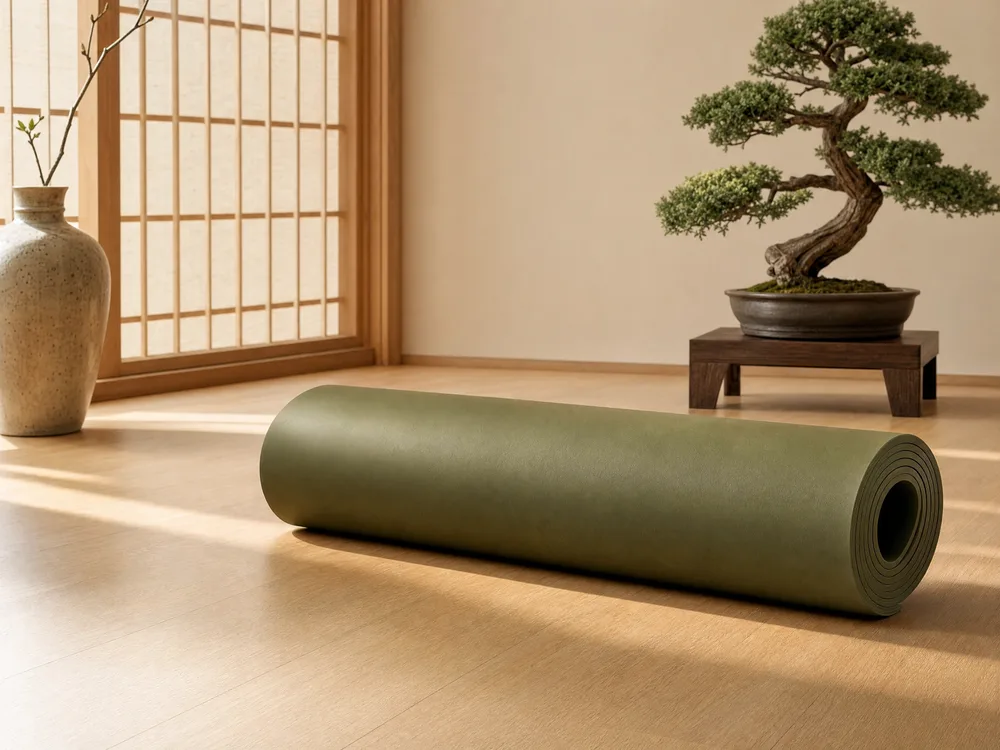
If you want rubber, not PVC
Natural tree rubber with grip that works from the first session, no break-in.
- Manduka says it grips straight out of the box, unlike the PRO
- Manduka calls it 99% latex-free, which is not the same as latex-free
- Closed-cell like the PRO, so it still wipes clean
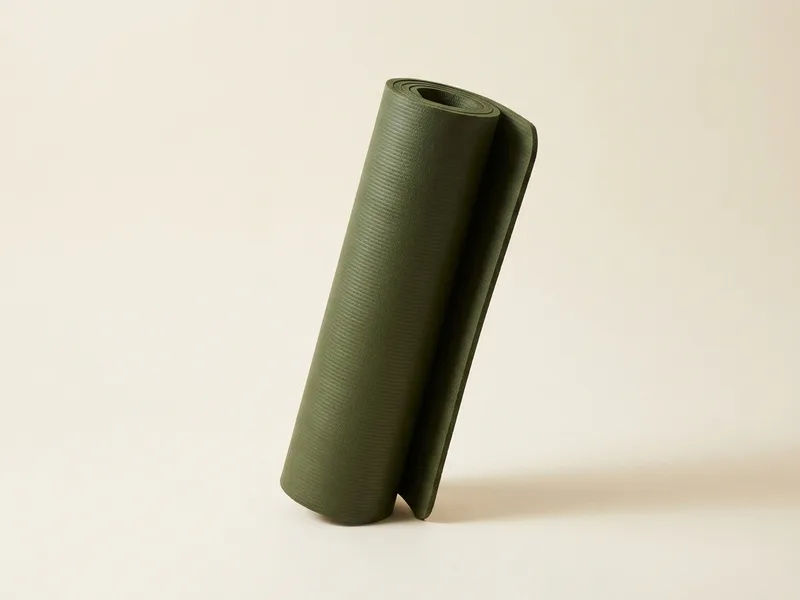
The grippy natural option
Open-cell natural rubber that grips immediately and wears faster in exchange.
- Jade sells two Harmony mats — our link goes to the original, made in the USA
- Natural rubber, so not an option if you react to latex
- Our Manduka versus Jade comparison covers the trade in full
Affiliate links — we may earn a commission. Prices and stock change too often to print here.
Still cross-shopping brands? Manduka versus Lululemon and our best yoga mat for beginners guide are the two people read next.
Frequently asked questions
Which yoga mat is better, the Manduka or the Gaiam?
They are built for different buyers, and the honest split is by practice, not by quality. OutdoorGearLab gives the Manduka PRO its Editors' Choice award as the best mat for a daily practice, and gives the Gaiam Premium 6mm its Best Buy award as the best first yoga mat. If you practise most days and the mat stays in one room, the PRO is the one that lasts. If you are still finding out whether yoga sticks, the Gaiam does the job for a fraction of the money.
Are Gaiam yoga mats good quality?
Good for the price, with two known limits. OutdoorGearLab praises the Premium 6mm for thick padding and calls it affordable, then lists poor wet grip and notes it compresses over time and is less durable than premium mats. Gaiam's own page confirms the material is PVC, latex-free and 6P free, meaning free of the six phthalates most often flagged in cheap mats. That is a real step up from no-name foam, and still a budget mat.
Why is Manduka so expensive?
Manduka's argument is lifespan and manufacturing, not cushion. Its guarantee page puts the life of a PRO mat at approximately ten years of regular use, and the PRO series carries a lifetime guarantee. Manduka also states that while the PRO is made from PVC, the mats are manufactured in Germany to be toxin-free, phthalate-free and emissions-free. Whether that is worth it depends on one question: will you still be using this mat in five years?
Does the Gaiam lifetime guarantee cover a worn-out mat?
No. Gaiam's guarantee page states it covers manufacturing defects only, including defects in materials or workmanship, and that normal wear and tear is not covered. It applies to the original purchaser, US residents only, and the only remedy is a replacement mat. Manduka's guarantee is the opposite shape: it covers wear to the top surface from regular use that impacts performance, which is the wear a mat actually gets.
Which yoga mat brand is best for beginners?
OutdoorGearLab names the Gaiam Premium 6mm the best first yoga mat, and that matches what the mat is: cushioned, light and cheap enough that quitting costs you little. The catch is size. Gaiam lists it at 68 inches long against the Manduka PRO's 71, so taller practitioners will run off the end in long poses. Our beginner mat guide works through the trade-offs properly.