

How this page has changed
August 14, 2026
Sources, internal links and safety or product context reviewed.
In this guide
- 01Does yoga actually improve balance?
- 02Set up the room before testing yourself
- 03Optional gear that can make setup more predictable
- 04The three-level balance progression
- 05Five yoga poses for balance
- 06A 15-minute yoga-for-balance routine
- 07What yoga is best for balance?
- 08Is there one best balance exercise for seniors?
- 09How to tell whether the practice is progressing
Quick answer. Yoga can train balance, but beginners do not need to wobble unsupported to make the practice count. Start beside a wall, keep your gaze steady, move from two feet to a toe-supported stance, and progress only when you can breathe normally and exit with control. This 15-minute sequence practices weight shifting, leg strength, and single-leg balance without treating a fall as part of learning.
Balance is not one trick. Standing still, stepping around an obstacle, turning your head while walking, and recovering from a small loss of position are different tasks. A photo of Tree Pose shows only one of them.
That is why this guide builds from a broad base to a narrower one. You will first feel weight move across two feet, then keep one set of toes down, then optionally lift a foot. The wall stays available throughout. Using it is intelligent practice, not a failed version of the pose.
If your balance has changed suddenly, you have repeated unexplained falls, new weakness or numbness, fainting, severe dizziness, chest pain, or a recent injury, skip this routine and seek appropriate medical advice. Yoga cannot diagnose the cause.
Does yoga actually improve balance?
There is a reasonable evidence signal, but it needs careful wording. The National Center for Complementary and Integrative Health reports that 11 of 15 studies in a 2014 review found improvement in at least one balance outcome, with newer studies also suggesting benefits for community-dwelling older adults. That does not mean every yoga class works equally well or that yoga prevents every fall.
Yoga can challenge several ingredients at once: leg strength, foot pressure, attention, body position, and controlled transitions. Harvard Health distinguishes static balance—staying in one place—from dynamic balance, which involves anticipating and responding as you move. A complete practice should not be only long one-leg holds.
For older adults, the CDC recommends balance activities alongside aerobic and muscle-strengthening activity. Yoga can be one multicomponent option, not the entire plan.
Set up the room before testing yourself
Practice on a clear, level, non-slippery floor. Remove loose rugs, bottles, blocks, pets, and furniture from your stepping space. Use a wall, countertop, or genuinely sturdy chair; avoid wheeled office chairs and lightweight folding furniture.
Wear glasses or hearing aids you normally use for movement. Practice in good light. If bare feet reduce traction or sensation for you, use secure footwear recommended for your situation rather than following a blanket “yoga must be barefoot” rule.
Stand close enough to support that you can touch it without leaning or lunging. A fingertip contact is useful because it leaves most of the work to you while providing orientation and an immediate safety option.
Optional gear that can make setup more predictable
You do not need to buy equipment for this routine: a clear floor, a wall, and a sturdy non-rolling chair are the important pieces. If you already know you want dedicated yoga gear, these two options solve specific setup problems without pretending to improve balance by themselves.
Best for a planted home-practice base: Manduka PRO 6mm
The Manduka PRO is a dense, closed-cell PVC mat with a floor-facing dot pattern. Manduka lists the standard mat at 71 × 26 inches, 6 mm thick, and 7.5 pounds. That weight is inconvenient for carrying but useful when your priority is a mat that stays planted during slow standing work.
Pros: dense rather than pillowy; substantial weight; closed-cell surface is straightforward to wipe down.
Skip it if: you need a lightweight travel mat, avoid PVC, or want strong wet grip immediately. Manduka says the surface has a break-in period and recommends a towel for sweaty practice.
Check price on AmazonBest for raising the floor under your hands: Manduka Cork Block
A block does not belong under your standing foot for this routine. Its useful job is raising the floor under one or both hands in a supported hinge, shortening the reach so you can keep your weight over your feet. Manduka specifies a standard 4 × 6 × 9-inch solid cork block weighing 2.2 pounds.
Pros: firm surface; three usable heights; heavier and less compressible than a typical foam block.
Skip it if: a firm edge is uncomfortable, carrying weight matters, or two stable hardcover books already give you the height you need.
Check price on AmazonThese are affiliate links, which means we may earn a commission without changing your price. See our affiliate disclosure. A wall or sturdy chair remains the safer primary support; no mat or block substitutes for appropriate assessment when balance problems are significant or new.
The three-level balance progression
Use this progression inside every standing pose:
| Level | Foot position | Hand support | Move on when… |
|---|---|---|---|
| 1. Wide base | Both feet down, hip-width apart | Full hand or fingertips | You can shift weight without gripping your toes |
| 2. Kickstand | One heel lifts; toes stay down | Fingertips on wall | You can hold 3–5 breaths and step out smoothly |
| 3. Single leg | One foot lifts low | Support remains within reach | You stay steady without holding your breath |
Closing your eyes, standing on cushions, or removing support are not required upgrades. Those changes remove sensory information or make the surface less predictable; they can increase challenge faster than your control improves.
Five yoga poses for balance
1. Mountain Pose with slow weight shifts
Stand beside a wall with feet hip-width apart and knees relaxed. Let the whole foot contact the floor. Move your weight slightly right without lifting the left foot, return to center, then move left. Repeat six times.
The goal is not the largest shift. Notice when pressure moves from heel to forefoot and inside to outside edge. Keep the head over the rib cage instead of sending it ahead of the hips.
Make it easier: hold the wall with one hand and make the shift almost invisible.
Progress it: let the unweighted heel rise while the toes remain down.
2. Supported Chair Pose
Face a wall or sturdy chair back with both hands supported. Bend the knees slightly and send the hips back as though beginning to sit. Keep heels grounded and stop well before the knees or back feel strained. Hold for three breaths, stand, and repeat twice.
This trains the leg strength used to control the center of mass without demanding one-leg balance. The clinically reviewed Hinge Health balance guide likewise begins with accessible strength-and-stability movements rather than treating advanced poses as the entry point.
Make it easier: reduce the bend or practice standing up from a firm chair.
Progress it: briefly lighten one heel while keeping both sets of toes down.
3. Low Tree Pose at the wall
Stand with your right side near the wall and place right fingertips on it. Shift weight into the right foot. Turn the left knee slightly outward and place the left heel at the right ankle with left toes on the floor. Keep hips facing mostly forward and gaze at one steady point.
Stay for three to five breaths, release, and change sides. Only if the kickstand version is controlled should you place the foot at the inner calf. Do not press directly into the knee joint.
Harvard Health’s Tree Pose instructions similarly suggest the ankle or calf as an easier position and recommend a fixed visual focus.
4. Warrior II with a shorter stance
Step the feet apart, turn the right toes outward, and bend the right knee slightly while keeping the left leg comfortably straight. Face the long edge of the mat, extend arms only if that feels steady, and keep a wall or chair within reach. Hold for three breaths, straighten the knee, and switch sides.
Warrior II uses a broad base but changes foot direction and weight distribution. Our detailed Warrior II guide covers stance length and alignment options.
Make it easier: shorten the stance and keep both hands on the hips.
Progress it: turn the head slowly to look over the front hand, then return the gaze forward. Skip the head turn if it makes you dizzy.
5. Supported Warrior III hinge
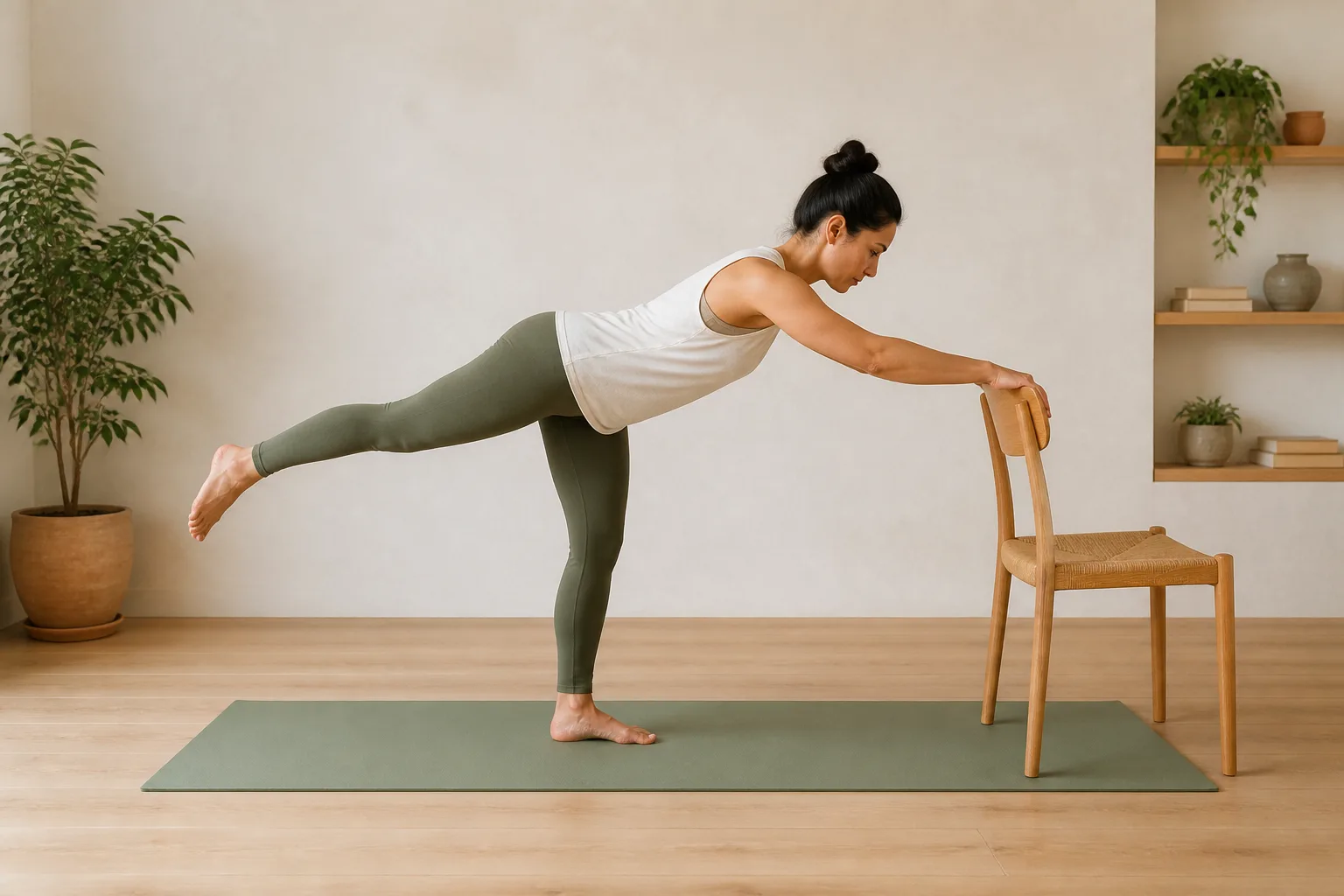
Face a sturdy chair back or wall and rest both hands lightly on support. Step the left foot back, hinge forward from the hips, and shift weight into the right foot. Lift the left leg only a few inches at first. Keep the standing knee soft and the pelvis roughly level.
The pose is successful when you can lower the foot quietly. Height is irrelevant. If the standing hamstring or back feels strained, keep the rear toes on the floor in a kickstand.
A 15-minute yoga-for-balance routine
| Time | Practice | Focus |
|---|---|---|
| 0:00–2:00 | Mountain weight shifts | Feel pressure move across both feet |
| 2:00–4:00 | Supported Chair, 3 rounds | Leg strength and controlled lowering |
| 4:00–7:00 | Low Tree Pose, both sides | Kickstand before single-leg balance |
| 7:00–10:00 | Short-stance Warrior II | Broad-base stability and gaze |
| 10:00–13:00 | Supported Warrior III, both sides | Hip hinge and quiet foot placement |
| 13:00–15:00 | Mountain Pose, then seated rest | Return to a stable base and reassess |
Rest whenever quality drops. Two controlled repetitions are more useful than ten rushed ones. Practice the routine two or three times a week only if it fits your current activity level and recovery; there is no need to repeat it daily to “catch up.”
If getting down to the floor or standing unsupported is not appropriate, our chair yoga for beginners guide provides a more supported format. New practitioners can also review yoga for beginners before combining balance work with a longer class.
If your main goal is becoming more comfortable across everyday standing and sitting positions, the yoga for posture routine combines mobility with back-body strength without promising a single perfect alignment.
What yoga is best for balance?
A slow beginner Hatha-style class is often practical because it gives time to organize the feet and use props, but labels are inconsistent. “Gentle,” “foundations,” “balance,” or “chair yoga” may be better clues than the word Hatha alone.
Ask the teacher three concrete questions:
- Is wall or chair support available throughout?
- Does the class include getting down to and up from the floor?
- Are inversions, eyes-closed balances, or quick transitions expected?
The right class is one where you can modify without being hurried or embarrassed. A qualified teacher should welcome support, not frame wobbling near a fall as courage.
Is there one best balance exercise for seniors?
No. The answer depends on why balance is limited and which daily task matters. Someone who feels unsteady rising from a chair may need leg strength and sit-to-stand practice. Someone who struggles when turning may need a different progression. A person with dizziness or medication-related symptoms needs assessment, not a harder Tree Pose.
The CDC’s fall-prevention guidance emphasizes a broader approach that can include strength and balance exercise, medication review, vision care, and home safety. Yoga can contribute to movement practice, but it should not be marketed as a complete fall-prevention program by itself.
How to tell whether the practice is progressing
Do not judge only by hold time. Better signs include:
- using less pressure through the supporting hand;
- placing a lifted foot down more quietly;
- turning the head without losing the stance;
- moving into and out of the pose without rushing;
- breathing normally instead of bracing;
- choosing the easier variation before form deteriorates.
Balance changes from day to day with sleep, fatigue, stress, illness, and environment. Treat each session as information. Keep the wall close, progress one variable at a time, and stop while you still have control.
Frequently asked questions
What yoga is best for balance?
A slow beginner Hatha-style practice is a practical starting point because it gives you time to set your feet, use support, and repeat simple standing shapes. The teacher, progression, and use of a wall matter more than the style label.
Can yoga improve my balance?
Research summarized by NCCIH suggests yoga can improve at least some balance outcomes, including in community-dwelling older adults. Results vary, and yoga is not a guarantee against falls or a substitute for assessment when balance changes suddenly.
What is the single best balance exercise for seniors?
There is no single best exercise for every older adult. The safest choice depends on strength, vision, medications, dizziness, fall history, and mobility. A supported weight shift or chair-based class may be more appropriate than a one-leg pose.
Which exercise is best for improving balance?
No one exercise covers every part of balance. Useful programs commonly combine leg strength, static balance, dynamic stepping, and regular practice. Yoga can contribute, but walking, tai chi, strength work, or clinician-designed exercises may also fit.