

How this page has changed
August 30, 2026
Sources, internal links and safety or product context reviewed.
August 12, 2026
First published.
In this guide
Quick answer. The best yoga poses for two beginners are not stunts. Start with back-to-back breathing, seated side bends and twists, a shallow supported chair, and a low Tree Pose variation. Keep each hold short, let both people control their own range, and use one rule throughout: either partner can say “stop” and both release immediately.
Two-person yoga can be as simple as using another person as a steady point of contact. You do not need to lift, carry, invert, or pull each other into a deeper stretch. In fact, those photogenic shapes are poor starting points because a small mistake can affect two bodies at once.
Practicing with one more friend? Our yoga poses for three people keeps all three bodies grounded and uses the same consent-first approach.
This 15-minute routine is for two generally healthy adults who can get down to and up from the floor comfortably. It works for friends, couples, siblings, or any two willing practice partners. If either person has a recent injury, significant balance problem, pregnancy-related restrictions, or a condition affected by exercise, ask an appropriate health professional and a qualified yoga teacher about modifications first.
Before you begin: four partner rules
- Consent is pose-specific. Agreeing to practice together does not mean agreeing to every touch or shape. Explain the next pose before making contact.
- Use a clear stop signal. “Stop” means both people release pressure immediately. Do not wait for the end of a breath.
- The less mobile person sets the range. Never pull a partner farther because you can move farther.
- No surprise weight-sharing. Keep both feet or both sitting bones grounded unless the instructions explicitly say otherwise.
The National Center for Complementary and Integrative Health describes yoga as generally safe for healthy people when practiced appropriately, but notes that sprains and strains can occur and advises beginners to avoid extreme practices. Partner work adds communication and another moving body, so conservative choices make sense.
What you need
Use two non-slip mats on a level floor with at least an arm’s length of clear space around them. Remove bottles, blocks, furniture corners, pets, and loose rugs from the practice area. Wear clothing that lets you move without catching on your partner.
Partners do not need matching height or flexibility. When heights differ, sit on folded blankets for seated work and use a wall rather than your partner for standing balance. Similar body size is not permission to lift each other.
Eight easy yoga poses for two people
Move slowly between poses and pause whenever you need to reorganize. The times below are suggestions, not targets.
1. Back-to-back breathing — 90 seconds
Sit cross-legged or with legs extended. Touch backs lightly from the pelvis to the shoulder blades without leaning your full weight backward. Rest hands on your own thighs and take five to eight comfortable breaths.
Notice your partner’s movement without trying to force the same rhythm. If crossed legs are uncomfortable, both people can sit on chairs placed back to back.
2. Back-to-back side bend — 45 seconds each side
Stay seated. Both partners place the right hand on the floor or a block beside the right hip. Reach the left arm up and slightly right while keeping both sitting bones grounded. Return upright together, then switch sides.
Keep the contact gentle. If one person moves farther, the other does not have to follow.
3. Seated partner twist — 30 seconds each side
Sit back to back with a tall but relaxed spine. Turn right and place your right hand on your own thigh or the floor. The left hand can rest on your own opposite knee. Your partner turns left at the same time.
This is deliberately not a pulling pose. Do not grab each other’s knees or use your partner’s arm as a lever. Exhale, return to center, and switch.
4. Partner tabletop — 6 slow rounds
Face each other on hands and knees with enough space that fingertips can touch when both reach forward. Keep one hand grounded and extend the opposite hand toward your partner. Touch palms lightly, return, and alternate.
For less wrist load, stand facing each other and press one palm together at shoulder height. For more stability, keep both knees wide and toes relaxed.
5. Shallow supported chair — 3 breaths
Stand facing each other, feet about hip-width apart, and hold each other’s forearms rather than gripping hands. Step back until the arms are comfortably extended. Both partners bend the knees a little and send the hips back as if approaching a chair.
Keep the squat shallow enough that each person could stand without being pulled. Then straighten the legs together. If the timing feels uncertain, practice beside a wall independently.
6. Gentle counterbalance — 3 breaths
From standing, keep the forearm hold and take one small step back. Hinge very slightly from the hips while keeping the spine long. Both partners maintain their own weight through their feet; the arms provide feedback, not suspension.
Do not round down into a deep fold or pull. Partners with dizziness, uncontrolled blood-pressure concerns, or back symptoms should skip this and remain upright.
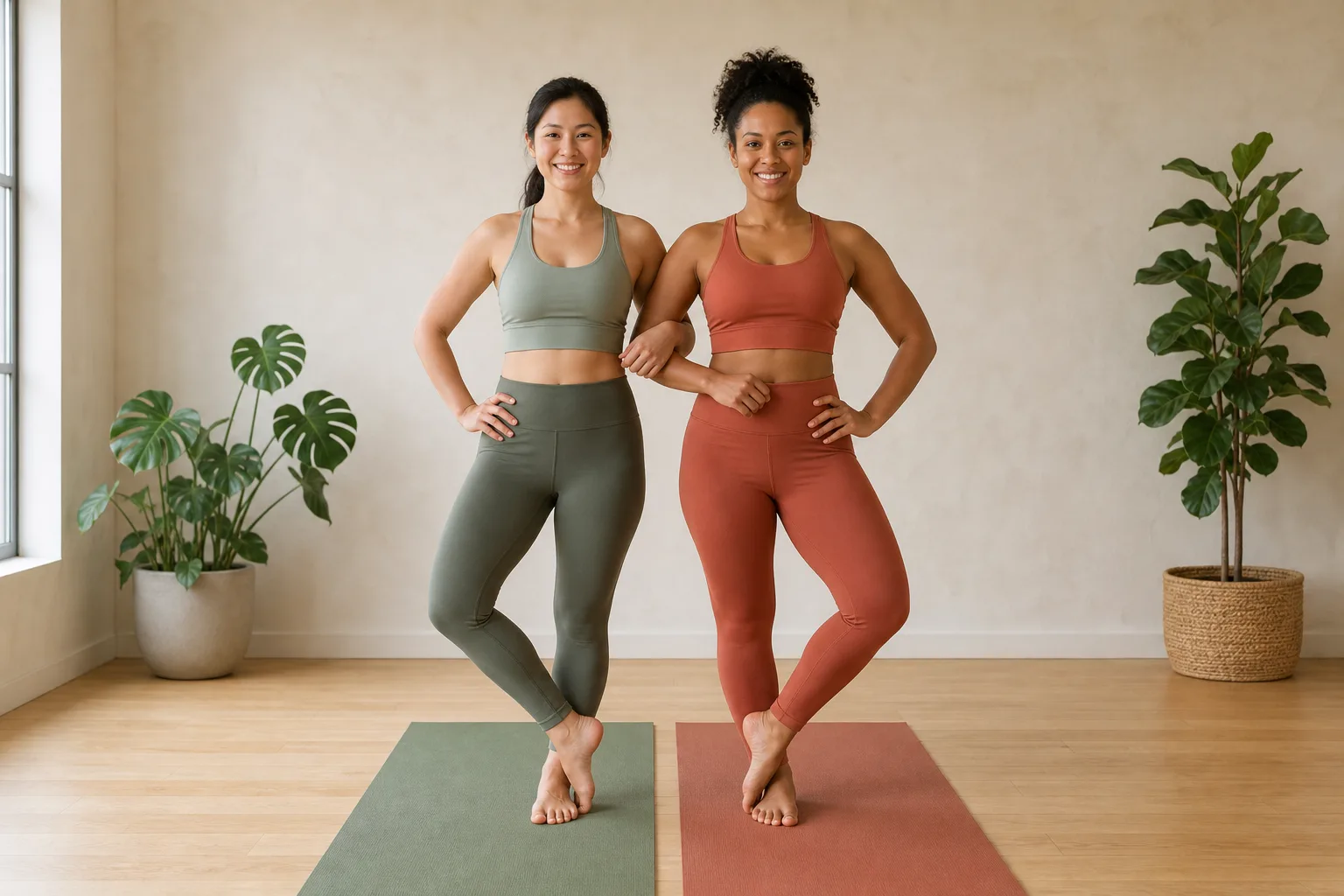
7. Low partner Tree Pose — 3 breaths each side
Stand side by side with inside shoulders close. Link inside forearms lightly or place inside hands on each other’s upper arms, after asking. Shift weight onto the inside leg. Turn the outside knee slightly outward and place the outside heel at the opposite ankle while keeping toes on the floor.
Keep the lifted foot below the knee. Harvard Health’s Tree Pose guidance likewise offers the ankle or calf as an easier position and recommends a fixed visual focus. A wall remains the more predictable support if either person feels unsteady.
8. Separate constructive rest — 2 minutes
Finish on separate mats. Lie on your backs with knees bent and feet flat, or place lower legs on chair seats. Let the arms rest by the sides and breathe normally. This is not synchronized breathing; each person rests independently.
Roll to one side before sitting up. Check in with a simple question: “Anything feel uncomfortable?” That answer should guide what you repeat next time.
A 15-minute partner yoga sequence
| Time | Pose | Main cue |
|---|---|---|
| 0:00–1:30 | Back-to-back breathing | Light contact; no leaning |
| 1:30–3:00 | Side bends | Both sitting bones stay grounded |
| 3:00–4:30 | Seated twists | No pulling |
| 4:30–6:30 | Partner tabletop | One hand stays grounded |
| 6:30–8:30 | Shallow supported chair | Each person can stand alone |
| 8:30–10:00 | Gentle counterbalance | Hinge only slightly |
| 10:00–12:30 | Low partner Tree Pose | Toes may stay down |
| 12:30–15:00 | Constructive rest | Separate mats; natural breath |
If this is your first yoga practice, learn the basic shapes independently through our yoga for beginners guide before adding partner contact. Child’s Pose is a useful individual rest option, while our morning yoga routine offers a simple solo sequence for days when schedules do not match.
Is two-person yoga good for couples?
It can be a pleasant shared practice, but partner yoga is not automatically romantic and it does not prove trust, compatibility, or communication skills. Friends and relatives can practice the same sequence. What matters is that both people want to participate and can decline touch without pressure.
Yoga Journal’s discussion of partnering exercises captures an often-missed point: people have very different comfort levels with touch and partnering, and some teachers avoid it because of injury or consent concerns. Treat opting out as a complete answer.
What about advanced poses for two people?
Search results often jump from seated twists to Double Downward Dog, flying balances, stacked planks, handstands, or acro-yoga. Those are not logical “next steps” simply because you completed this routine. They introduce load-bearing, falls, spotting, and technique demands that an article cannot supervise.
If you want to explore acro-yoga, find an in-person beginner class that teaches bases, flyers, spotters, safe exits, and appropriate matting. Do not learn a stacked inversion from a still image. Until then, make the basic sequence more interesting by slowing transitions, practicing both roles, or trying it with less hand contact—not by adding height.
The useful goal is cooperation, not a photo
A good two-person practice should leave both partners able to describe what happened and choose whether to repeat it. The best-looking pose is irrelevant if one person felt trapped, pulled, or unstable.
Start with the quiet shapes, keep the balance low, and finish while communication is still easy. That is enough partner yoga for one session.
Frequently asked questions
What poses are easiest for two-person yoga?
Back-to-back breathing, a back-to-back side bend, a seated twist, a supported chair pose, and a low partner Tree Pose are among the easiest places to start. They keep both people close to the floor or let each person control their own range.
What are seven easy yoga poses for beginners?
For two beginners, try back-to-back breathing, back-to-back side bend, seated partner twist, partner tabletop, supported chair, low partner Tree Pose, and constructive rest. This guide adds an optional gentle counterbalance as an eighth shape.
Is two-person yoga good for couples?
It can be an enjoyable shared activity for couples, friends, or family members, but the relationship label is not what makes it useful. Clear consent, similar expectations, and the ability to stop immediately matter more than being a couple.
What are advanced yoga poses for two people?
Acro-yoga balances, stacked inversions, and poses in which one person carries the other are advanced skills. They are outside this beginner guide and are best learned with a qualified instructor, appropriate spotting, and suitable mats.