

How this page has changed
August 30, 2026
Sources, internal links and safety or product context reviewed.
August 18, 2026
First published.
In this guide
Quick answer. The easiest yoga poses for three people keep all three bodies on the floor or standing on their own feet. Start with seated triangle breathing, small seated side bends, a tabletop palm-tap circle, synchronized Mountain Pose, and a low Tree Pose practiced independently. Skip lifts, stacked planks, deep counterbalances, and inversions unless you are learning with a qualified instructor and appropriate spotting.
Search results for three-person yoga are full of challenges. The pictures are dramatic because someone is usually carrying weight, balancing above the floor, or relying on two other people to prevent a fall. That is acrobatics, not a useful first group practice.
This routine takes the opposite approach. It gives three generally healthy adults a way to move together while everyone remains responsible for their own body weight. No one lifts, stands on, hangs from, or pushes another person deeper into a pose.
It is general educational guidance, not individualized instruction. If anyone is pregnant, recovering from surgery or injury, has significant balance concerns, or has a condition affected by exercise, ask an appropriate health professional and a qualified yoga teacher about suitable modifications first.
The three rules that matter most
- Consent applies to each pose and each touch. Explain the next setup before making contact. A yes to the routine is not a yes to every variation.
- “Stop” stops all three people. Release contact and return to a stable position immediately. Do not wait for a countdown or the end of a breath.
- Everyone supports their own weight. A fingertip or palm tap can provide orientation. It should not be the only thing preventing somebody from falling.
The National Center for Complementary and Integrative Health describes yoga as generally safe for healthy people when practiced appropriately, but notes that sprains and strains can occur. It advises beginners to avoid extreme practices and recommends qualified instruction. With three moving bodies, conservative choices and predictable exits become even more important.
Set up the room for three people
Use three non-slip mats on a level floor. Arrange them in a loose triangle for seated work, then parallel for standing poses. Leave at least an arm's length between each mat and move bottles, blocks, furniture corners, pets, and loose rugs out of the practice area.
Before starting, decide who will read the instructions. That person is not the leader of anyone else's body; they simply announce the next step and the exit. If heights or mobility differ, make the shape smaller for the whole group or let each person use a different variation.
You need no special equipment. A wall is more predictable than a friend for balance, and a folded blanket can make sitting more comfortable. If getting down to the floor is difficult, do the breathing, side bend, and Mountain Pose from three sturdy, non-rolling chairs instead.
Six easy yoga poses for three people
Move slowly and leave a pause between shapes. The suggested times are ceilings, not targets. End a pose sooner if anyone loses easy breathing, clear communication, or a controlled exit.
1. Seated triangle breathing — 90 seconds
Place the mats in a loose triangle and sit facing outward, with backs near one another but not carrying each other's weight. Sit cross-legged, extend the legs comfortably, or use a folded blanket. Rest hands on your own thighs.
Take five to eight unforced breaths. You may notice the timing of the other two people, but nobody needs to synchronize. The point is to arrive together without making breath-holding into a team exercise.
Chair variation: sit on three chairs arranged back to back. Keep all chair legs flat and leave a small gap so no chair can be pushed by someone leaning.
2. Outward seated side bend — 30 seconds each side
Stay in the triangle and face outward. Put the right hand on the floor or a block beside the right hip. Reach the left arm up, then slightly right. Keep both sitting bones grounded and the front of the chest open enough to breathe comfortably.
Return upright before changing sides. Each person chooses their own range. Matching angles is unnecessary, and nobody should pull a neighbor's hand to make the picture more symmetrical.
3. Tabletop palm-tap circle — 6 slow rounds
Turn inward and come onto hands and knees, far enough apart that fingertips can meet near the center. Check that wrists are under shoulders and knees are under hips. Keep three hands on the floor while each person reaches the other hand forward for a very light, brief palm tap.
Return the hand to the mat, reorganize, then repeat with the other hand. Move one round at a time rather than racing to match perfectly.
Wrist-friendly variation: stand in a wide triangle and touch one palm toward the center at shoulder height. Keep elbows soft and step closer instead of leaning.
4. Three-person Mountain Pose — 5 breaths
Move the mats into three parallel lines. Stand independently with feet at a comfortable width and arms alongside the body. Everyone looks forward rather than turning to check whether the group matches.
On an inhale, raise both arms only as high as the shoulders remain comfortable. On an exhale, lower them. Repeat three slow times, then stand for two ordinary breaths.
This is a coordination exercise, not a flexibility test. If one person needs a smaller shoulder range, that is the correct variation for them.
5. Independent low Tree Pose — 3 breaths each side
Before adding any contact, practice balance separately. Shift weight onto the left foot. Turn the right knee slightly outward and place the right heel at the left ankle while keeping the right toes on the floor. Keep both hands relaxed or use a wall.
Choose one stationary point to look at. The Harvard Health Tree Pose guidance similarly recommends a fixed visual focus and offers the ankle or calf as an easier foot position. Never press the lifted foot into the standing knee.
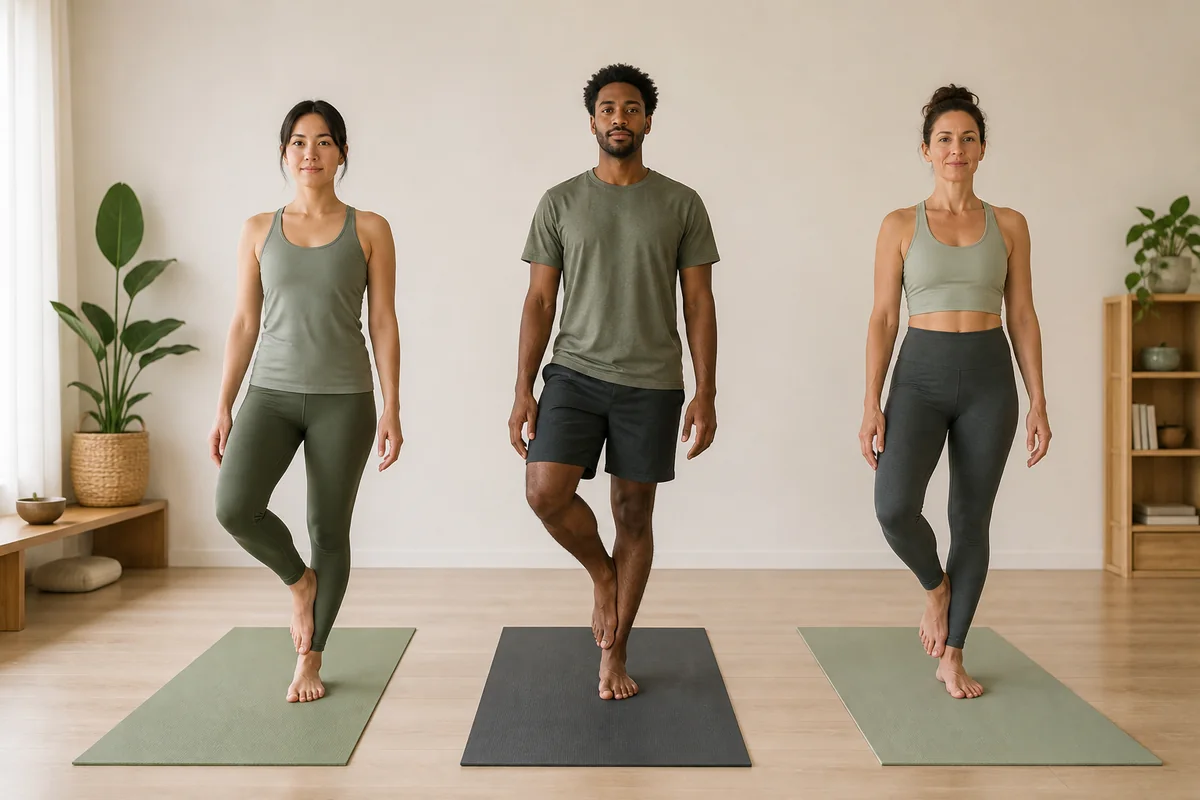
If everyone can enter and exit without hopping, you may stand side by side with space between mats. Do not link arms. Three independent balances performed together still count as group practice.
6. Separate constructive rest — 2 minutes
Lie on separate mats with knees bent and feet on the floor. Place arms where they are comfortable and leave enough space that nobody has to climb over another person to sit up.
Rest quietly for about two minutes. Then roll to one side, pause, and sit up independently. Finish by asking one useful question: did every setup feel easy to leave? If the answer is no, simplify that stage next time.
A practical 15-minute trio plan
| Stage | Time | What to prioritize |
|---|---|---|
| Boundaries and floor check | 2 minutes | Stop word, contact consent, clear exits |
| Seated breathing | 1.5 minutes | No leaning or forced synchronization |
| Seated side bends | 2 minutes | Individual range |
| Tabletop palm taps | 2 minutes | Three stable hands before each reach |
| Mountain Pose | 2 minutes | Slow shared timing |
| Independent low Tree | 3 minutes | Wall available, toes may stay down |
| Constructive rest | 2.5 minutes | Separate space and unhurried exit |
Do not add difficulty just because the first round feels easy. Repeat the same plan on another day and make transitions smoother. Reliability is a better sign of progress than producing a more dramatic photograph.
What about a three-person yoga challenge?
Make coordination the challenge. Try completing the routine while all three people can speak normally, every transition happens without rushing, and nobody needs to be caught. You can also let a different person read the sequence each time.
Avoid turning pain tolerance, longest hold, deepest stretch, or highest stack into the score. Those goals reward people for ignoring the stop signals the group needs most.
If your group wants acroyoga, partner lifts, or inversions, look for qualified in-person instruction with explicit progressions and spotting. A beginner article cannot assess whether three specific bodies are ready to base, fly, or spot one another.
Common problems and simple fixes
One person is much taller
Use independent shapes and reduce hand contact. For seated work, the shorter person can sit on a folded blanket, but nobody needs to create a perfectly level line.
One person is less flexible
That person chooses their own range. The other two do not pull, press, or hold them in place. In a side bend, three visibly different angles are a successful result.
The group keeps laughing or losing timing
That is not a problem unless it makes balance unsafe. Return to seated breathing or Mountain Pose, where a missed count has no consequence. Skip standing balance until everyone can focus again.
Someone feels wrist or knee discomfort
Leave hands-and-knees work out. Use the standing palm-tap variation, sit on chairs, or finish the session. Props can change pressure, but they do not diagnose why a joint hurts.
The room is too small for three mats
Do only the seated and standing stages with chairs or clear floor markers. Do not overlap mats or place one person close to furniture to preserve the sequence.
The bottom line
Simple three-person yoga is possible without making anyone a base or a flyer. Keep every body grounded, agree on contact before it happens, and treat a controlled exit as part of the pose. Seated breathing, side bends, palm taps, Mountain Pose, and independent low Tree give a trio enough material for a real shared practice.
If three people feels like too much coordination, start with our yoga poses for two routine. Newer practitioners can also review the complete beginner guide, use the wall-supported ideas in yoga for balance, or learn Child's Pose as an individual rest option.
Frequently asked questions
What are some simple 3-person yoga poses?
Start with seated triangle breathing, seated side bends, a tabletop palm-tap circle, three-person Mountain Pose, independent low Tree Pose, and separate constructive rest. These keep everyone grounded and let each person control their own range.
What are some 3-person yoga poses for balance?
A low Tree Pose practiced side by side is the safest starting point. Each person keeps the lifted-side toes on the floor and uses a wall if needed. Practice independently first; another person should not become the support that prevents a fall.
What is the hardest 3-person yoga pose?
There is no official hardest pose. Online challenges often feature stacked planks, flying shapes, and multi-person inversions, but difficulty depends on training, spotting, strength, and communication. Those acrobatic shapes are outside this beginner guide and should not be copied from a picture.
Can you give me a 3-person yoga pose challenge?
Yes: try completing the six grounded stages in this guide while keeping conversation possible, exits controlled, and every transition unhurried. The challenge is coordination and consent, not lifting someone or holding the deepest shape.