

How this page has changed
August 20, 2026
Sources, internal links and safety or product context reviewed.
In this guide
Quick answer. Yoga may support posture by giving you regular practice with mobility, strength, balance, and noticing how you hold yourself. It does not “fix” the body into one perfect shape. A useful routine moves the spine in several directions, trains the upper back and trunk, and leaves you feeling more capable—not pinned into a rigid chest-up position.
Posture is a position, not a character trait. Sitting rounded over a book, reaching for a shelf, and standing at a counter all require different shapes. The goal is not to hold one alignment all day. It is to have enough options, strength, and comfort to change position when the current one becomes tiring.
This guide offers six accessible movements and a 15-minute sequence. It is general movement education, not a diagnosis or treatment plan. If a posture change is sudden or comes with significant pain, spreading numbness, weakness, loss of coordination, dizziness, breathing difficulty, or symptoms after an injury, skip the routine and seek appropriate medical advice.
Can yoga actually improve posture?
The honest answer is possibly, depending on what you mean by posture and what the practice contains.
Yoga combines movement, held positions, balance, breathing, and attention. That can help you notice when you have been still for too long, learn different spinal and shoulder positions, and build the capacity to support them. But those are trainable ingredients—not proof that yoga can permanently “correct” every rounded shoulder, forward head, or pelvic position.
A 2024 systematic review and meta-analysis of controlled exercise studies found that stretching alone did not change measured spinal or lumbopelvic posture in healthy participants. Chronic strengthening showed an improvement signal, although the underlying studies and posture measures varied. A separate review of adult hyperkyphosis research concluded that stronger evidence is still needed, particularly for stretching by itself.
That makes a useful practical distinction: a posture routine should not be five versions of pulling the chest open. It should combine movement variety, strength, and control.
What this routine trains
| Ingredient | Why it is included | What it is not |
|---|---|---|
| Awareness | Notice foot pressure, breath, and unnecessary effort | Constant self-monitoring |
| Mobility | Practice flexion, extension, rotation, and hip movement | Forcing maximum range |
| Strength | Support the trunk, shoulder blades, and hips | Bracing every muscle all day |
| Endurance | Hold easy shapes briefly with normal breathing | Proving you can tolerate discomfort |
| Variation | Move between standing, kneeling, and prone positions | Replacing necessary medical care |
You do not need a posture brace, wheel, or special strap for this sequence. Use a clear floor and, if helpful, a folded blanket under the knees. A sturdy chair can make the lunge and standing poses more predictable.
Six beginner yoga poses for posture
1. Mountain Pose: establish a neutral starting point
Stand with feet about hip-width apart and knees relaxed. Let the arms hang. Feel three broad contact areas under each foot: heel, base of the big toe, and base of the little toe. Look forward without lifting the chin.
Do not squeeze the shoulder blades together or push the ribs forward. Take four ordinary breaths and notice where you are working harder than necessary.
Try this: gently shift forward, backward, left, and right, then return to the middle. Neutral is easier to understand after you have explored the edges.
2. Cat-Cow: move instead of holding one spinal shape
Come to hands and knees, placing hands under or slightly ahead of the shoulders. On an inhale, let the breastbone travel forward while the tailbone lifts only as far as comfortable. On an exhale, press the floor away and round gently.
Repeat six times. Think of distributing the motion instead of making one part of the lower back do everything.
Wrist variation: place hands on the seat of a sturdy chair and practice the same spinal movement while standing.
3. Supported Low Lunge: vary the hip position
From hands and knees, step the right foot forward. Keep hands on blocks, the chair seat, or the front thigh. Slide the left knee only as far back as you can remain steady and breathe. Keep the front foot planted and hold for three breaths before changing sides.
The aim is not a dramatic hip-flexor stretch. It is spending a little time with one hip extended after sitting often keeps both hips flexed.
Knee variation: pad the back knee or keep both hands on a chair and use a short standing split stance.
4. Low Cobra: strengthen without chasing height
Lie on your abdomen with hands beside the lower ribs. Keep the tops of the feet down. Lightly draw the breastbone forward and lift the head and upper chest a small distance, using the back rather than pushing hard through the hands. Lower slowly. Repeat four times.
Keep the gaze down and forward so the back of the neck stays long. A lift of two inches can be enough. Skip this shape if lying prone is unsuitable or it causes back pain.
5. Bird Dog: connect shoulders, trunk, and hips
Return to hands and knees. Slide the right toes backward while they stay on the floor. If the trunk remains steady, lift that leg a few inches. Then optionally reach the left arm forward. Hold for two breaths, lower quietly, and change sides.
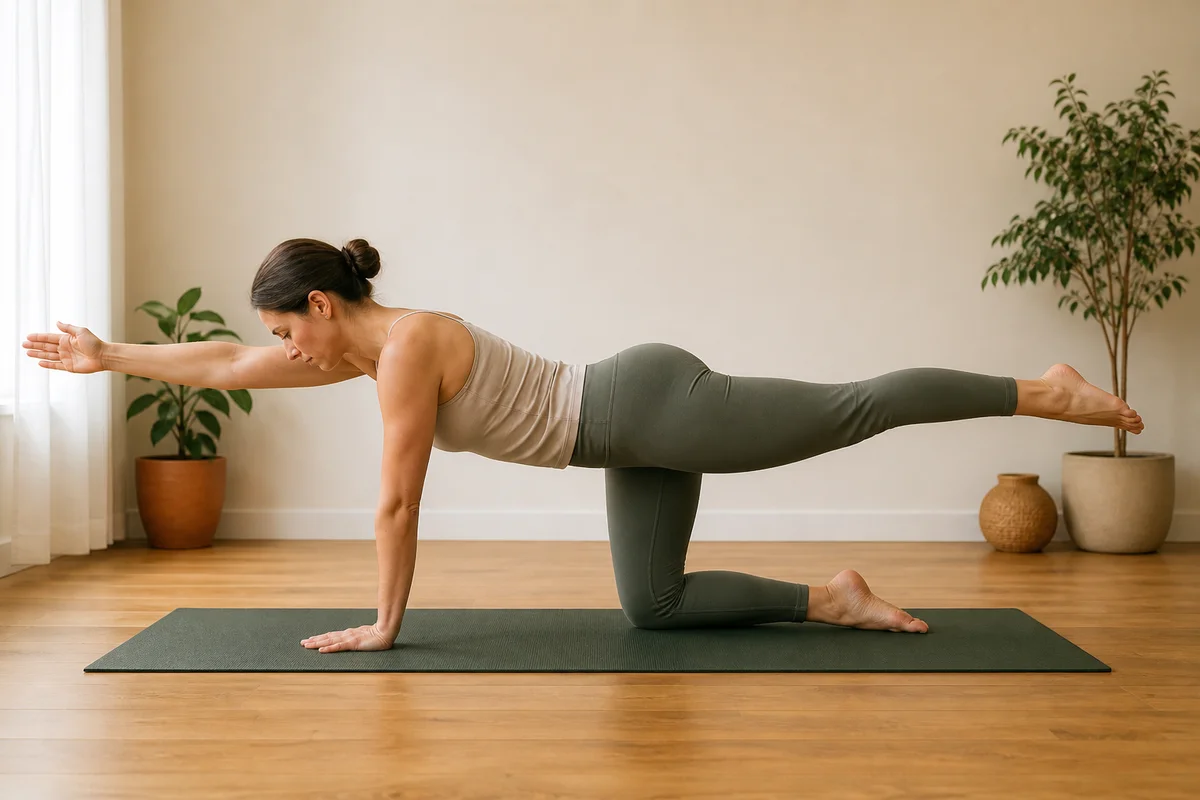
The full arm-and-leg reach is optional. A hand slide plus a toe slide trains the same coordination with four contact points close to the floor. If the supporting wrist is uncomfortable, keep both hands down and alternate only the legs.
6. Short-stance Warrior II: carry control into standing
Step the feet apart, turn the right toes outward, and bend the right knee slightly. Keep the stance short enough that both feet feel secure. Face the long side of the mat, rest hands on hips or extend the arms, and hold for three breaths. Change sides.
Use the broad base to practice organizing the feet, hips, rib cage, and gaze without demanding a single-leg balance. Our full Warrior II guide explains stance and knee options.
A 15-minute yoga-for-posture routine
| Time | Movement | Practical focus |
|---|---|---|
| 0:00–1:00 | Mountain Pose and weight shifts | Notice, do not force |
| 1:00–3:00 | Cat-Cow, 6 slow rounds | Move through a comfortable range |
| 3:00–6:00 | Supported Low Lunge | Three breaths per side, repeat once |
| 6:00–8:00 | Low Cobra, 4 repetitions | Small lift, slow return |
| 8:00–11:00 | Bird Dog variations | Two controlled rounds per side |
| 11:00–14:00 | Short-stance Warrior II | Three breaths per side, repeat once |
| 14:00–15:00 | Mountain Pose | Compare ease, breath, and effort |
Repeat the sequence two or three times a week if it fits your current activity level. On other days, a short walk or simply changing position regularly may be more useful than another formal routine. Posture capacity comes from what you do across the week, not one corrective session.
Beginners can review our how to start yoga guide before adding a longer practice. If steadiness is the limiting factor, use the wall-supported progressions in yoga for balance. Downward-Facing Dog is optional, not a posture requirement.
Which yoga is best for posture?
Choose the class by its teaching, not only its style name. A slow Hatha, Iyengar-inspired, gentle, or foundations class may provide time to feel each setup, but labels are inconsistent. Look for:
- both strengthening and mobility rather than stretching alone;
- clear smaller-range and chair-supported options;
- time to transition without rushing;
- cues that describe choices rather than one universal body shape;
- permission to stop when pain, dizziness, or numbness appears.
Avoid any teacher who diagnoses your spine from across the room, promises to correct posture in a few sessions, or treats discomfort as proof that a pose is working. The NCCIH considers yoga generally safe when practiced appropriately, but strains and sprains can occur and beginners should avoid extreme practices.
Can yoga correct rounded shoulders?
It can help you practice shoulder movement and upper-back strength, but “rounded shoulders” describes appearance rather than one diagnosis. Anatomy, work habits, training, fatigue, breathing, comfort, and the task all influence the shape you see.
Repeatedly yanking the shoulders back is not the answer. Try moving them through several directions: reach forward, lift, lower, and gently draw back. Then build strength with controlled Cobra and Bird Dog variations. The useful outcome is more comfortable options and better endurance—not holding the shoulder blades pinched together all day.
Get individual advice when the position is new, strongly one-sided, worsening, or linked with pain, tingling, numbness, weakness, loss of hand coordination, or symptoms after trauma.
Common posture-routine mistakes
- Treating posture as a photo. How you move into, out of, and between positions matters more than matching a side-view diagram.
- Stretching without strengthening. Chest opening may feel pleasant, but current evidence does not support stretching alone as a reliable posture-changing strategy.
- Forcing the ribs forward. A large backbend can masquerade as “standing tall.” Keep breathing easy and reduce the range.
- Ignoring the workstation or task. No yoga pose makes eight uninterrupted hours in one position ideal. Change the setup and take movement breaks.
- Practicing through symptoms. Sharp pain, neurological symptoms, dizziness, or progressive problems need context—not a harder routine.
The bottom line
Yoga for posture works best as practice, not correction. Move the spine in different directions, give the back body some strength work, vary the hips and shoulders, and return to standing without forcing a showroom-perfect shape.
After 15 minutes, ask three better questions: Can I breathe more easily? Can I access more than one comfortable position? Can I move between them with control? Those answers are more useful than whether you look perfectly straight.
Frequently asked questions
Can yoga fix your posture?
Yoga may help you practice strength, mobility, balance, and awareness, but it cannot guarantee one permanently corrected posture. Posture changes with the task, fatigue, comfort, anatomy, and habit. Persistent pain, weakness, numbness, or a visible change that concerns you deserves an individual assessment.
Can I correct years of bad posture?
You can often become more comfortable and capable in a wider range of positions, but “bad posture” is too broad to diagnose online. Build movement variety and strength gradually instead of forcing your body into one rigid shape. Ask a qualified clinician for help when symptoms persist or worsen.
Which yoga is best for posture?
A slow beginner or foundations class that includes both strengthening and mobility is more useful than a label alone. Look for controlled transitions, back-body strength, different spinal movements, and permission to use smaller ranges. Avoid classes that promise to correct every body with one alignment rule.
Can yoga correct rounded shoulders?
Yoga can train upper-back strength, shoulder movement, and awareness, but rounded shoulders are not automatically a problem and have many possible influences. Do not repeatedly pull the shoulders back or force the chest open. Seek assessment if the shape is new, painful, one-sided, or paired with weakness or numbness.