

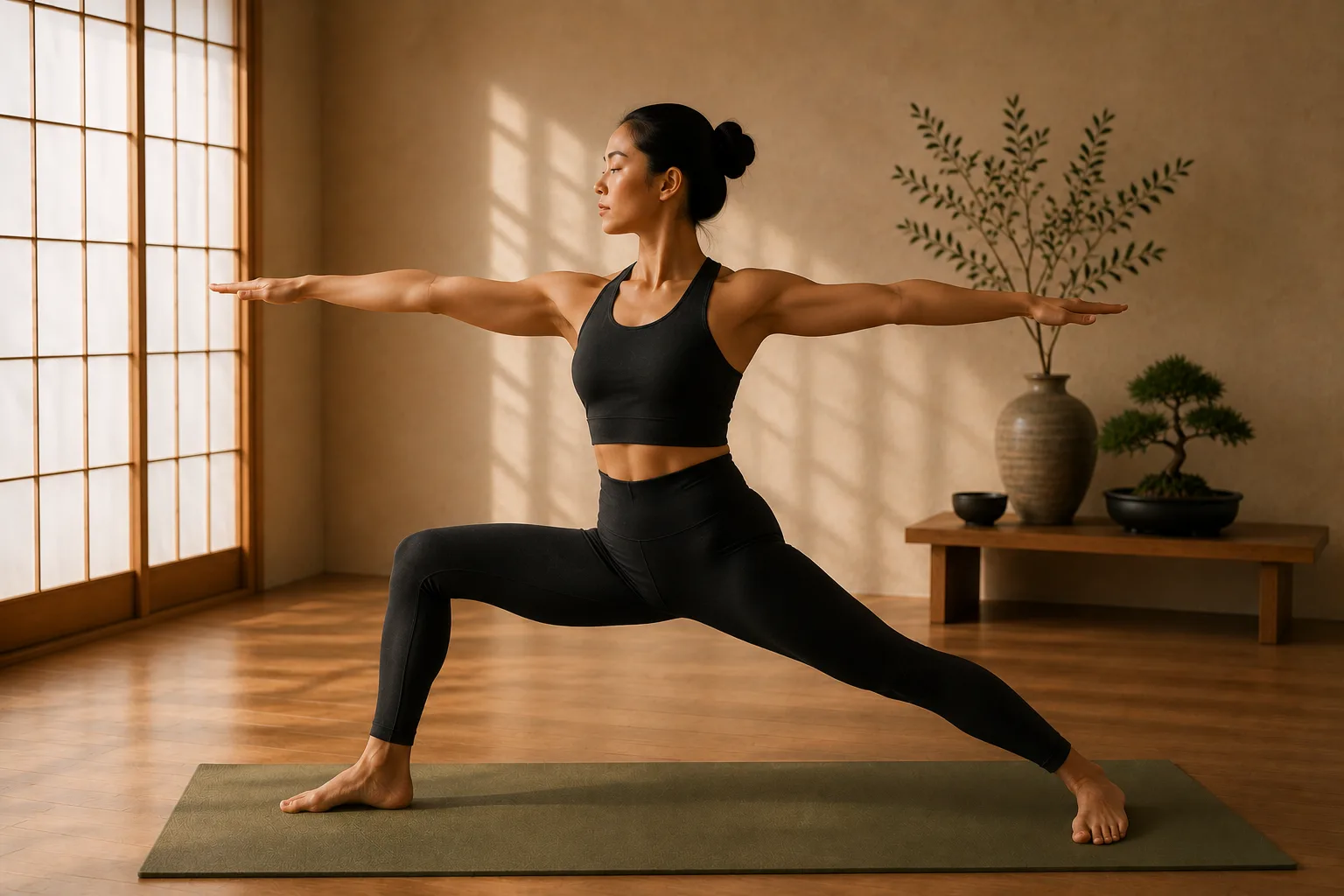
Pose information
At a glance
- Level
- Beginner
- Type
- Standing · strength
- Primary areas
- Legs, hips, shoulders and balance
- Helpful props
- Chair or wall for support
- Modify or avoid when
- Knee pain, balance risk or difficulty maintaining a comfortable stance
- Hold
- Several comfortable breaths on each side
Practise with options
Breath, exit and variations
- Breathing
- Let the breath stay steady while the stance remains comfortable.
- Leave safely
- Straighten the front leg, turn the feet forward and step in with control.
- Easier variation
- Shorten the stance and bend the front knee less.
- Chair variation
- Use a chair under the front thigh or hold the chair for balance.
- In a sequence
- Place it among standing poses and follow with a neutral stance or rest.
Educational guidance only. Yoga can require individual modifications; do not postpone professional care for a medical concern. Read the NCCIH yoga safety overview.
How this page has changed
June 14, 2026
Instructions, modifications and safety context reviewed.
Warrior II — Virabhadrasana II — is where standing yoga starts to feel strong. It builds steady legs, open hips and a calm, focused gaze, and it shows up in nearly every class. It is also a pose where small alignment habits matter, because the front knee carries real load. This is the steady guide: the cues that count, the mistakes that strain the knee, and how to make it work for you.
This is general guidance, not medical or personalised instruction — see a qualified teacher for hands-on help.
Warrior II at a glance
| Sanskrit | Virabhadrasana II |
| Level | Beginner-friendly · strengthening |
| Type | Standing pose · strength + hip opening |
| Targets | Legs, glutes, hips, shoulders, chest; builds stability and focus |
| Hold | 3–5 breaths per side |
| Props | A chair under the front thigh; a non-slip mat for a stable stance |
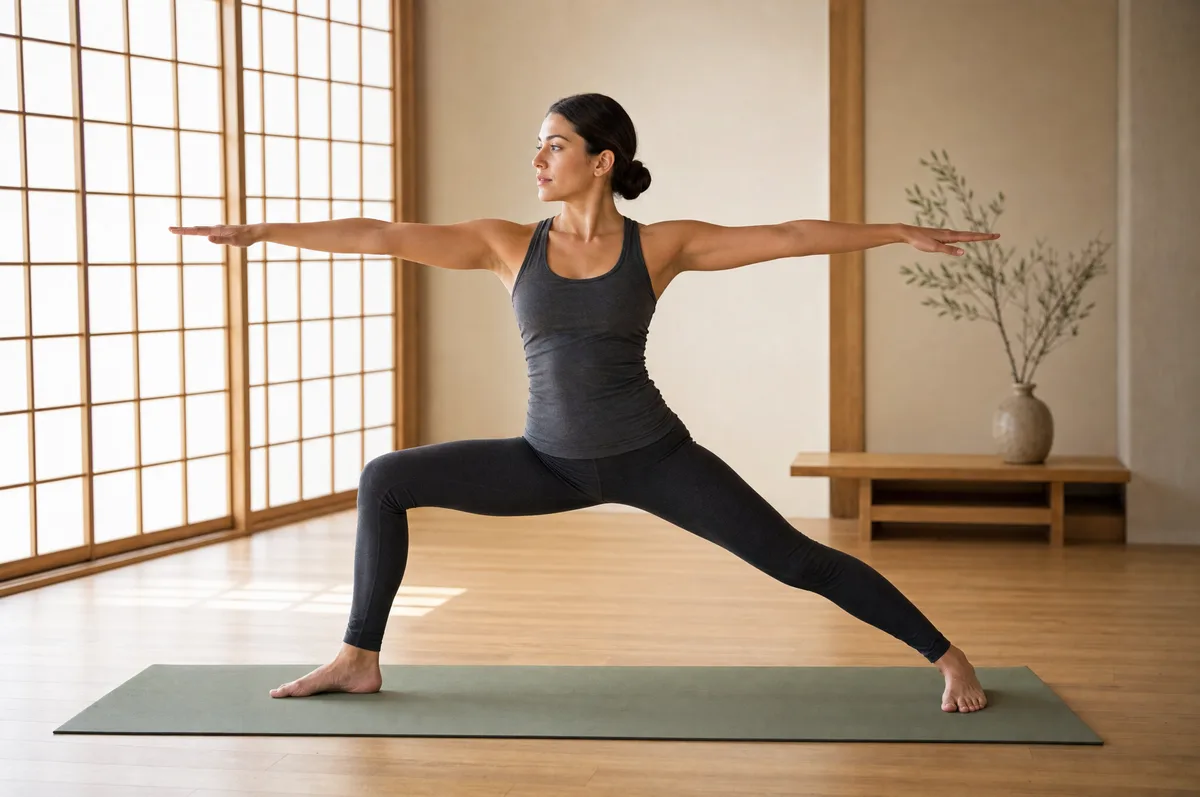
How to do Warrior II
- Set the feet wide (about three to four feet). Front foot points straight ahead; back foot angles in, front heel roughly in line with the back arch.
- Bend the front knee toward 90 degrees, stacked over the ankle and tracking toward the middle toes. Back leg stays straight and strong.
- Open the hips and chest to the long side of the mat, torso tall and upright over the hips — not leaning forward.
- Extend the arms parallel to the floor, front and back, shoulders soft. Back wrist over the back ankle.
- Gaze over the front hand and hold for three to five steady breaths, then switch sides.
Common mistakes
- The front knee caving inward. The most important one to fix — it strains the inner knee ligaments. Actively guide the knee toward the little-toe edge of the foot.
- The front knee sliding past the ankle. Loads the kneecap. Step your stance wider so the shin stays vertical.
- The "running warrior." Leaning the torso forward over the front leg and shifting the hips back. Keep the back wrist over the back ankle and stack the shoulders over the hips.
- Shoulders hiking up to the ears. Reach the arms long but let the shoulders settle down the back.
Modifications
- Shorten the stance if the front knee can't stack over the ankle, or if balance feels shaky.
- Bend the knee less — you do not need a full 90 degrees to get the benefits. Build depth over time.
- A chair under the front thigh lets you hold longer and learn the alignment without fatiguing the leg — useful for sensitive knees or building strength.
- Hands on the hips instead of extended, if the shoulders tire or you want to focus purely on the legs.
What it's good for
Warrior II builds real strength through the legs and glutes, opens the hips and chest, and trains the steadiness and focus that carry into harder balances. Held with calm breath, it is as much a concentration practice as a strength one — strong legs, soft gaze.
Keep practising
Warrior II is a cornerstone of standing sequences — it flows naturally with other standing poses and pairs well with a calm Child's Pose when you need a rest, or a Downward Facing Dog to transition. A mat with reliable grip keeps the front foot from sliding as you settle into the stance.
Frequently asked questions
Where should my front knee be in Warrior II?
Directly over the ankle, tracking toward your middle toes. Look down: you want to see your toes just in front of the knee, not hidden behind it. The knee should never drift inward — that is the alignment that protects the joint, and the single most important cue in the pose.
Why does my front knee hurt in Warrior II?
Almost always alignment. If the knee caves inward it strains the inner ligaments; if it slides past the ankle toward the toes it loads the kneecap. Press the knee gently toward your little-toe side so it stacks over the ankle, and shorten your stance so you can keep that alignment. Persistent knee pain is worth a professional's eye.
How wide should my stance be in Warrior II?
Wide enough that, with the front knee bent to about 90 degrees, the knee stacks over the ankle — usually around three to four feet, but it depends on your height. If the knee shoots past the ankle, step wider; if you can't bend much, step a little narrower. Comfort and alignment beat a textbook number.
How long should I hold Warrior II?
Three to five steady breaths per side is plenty for beginners. It is a strong standing pose, so the front thigh will talk to you — build up gradually. Quality of alignment matters far more than how long you hold.