

How this page has changed
August 8, 2026
Sources, internal links and safety or product context reviewed.
In this guide
Quick answer. Yoga for runners works best as a modest complement to running, not a cure-all. Before a run, keep movement brief and dynamic. Afterward, walk until your breathing settles, then use a gentle 12-minute sequence for calves, hips, hamstrings, and the back. The stretches should feel mild; yoga cannot guarantee faster recovery or prevent an injury.
Running repeats a relatively narrow movement thousands of times. Yoga gives you a controlled place to move differently: bend the knees, rotate the hips gently, load the arms, balance, and notice which ranges feel easy today. That can be useful without claiming that every runner is “tight” or needs a dramatic flexibility overhaul.
This guide separates three jobs that often get blurred together: a dynamic pre-run warm-up, a calm post-run routine, and a fuller yoga session on another day. The main sequence takes about 12 minutes and needs only a clear floor, a mat, and optional blocks.
If you have sharp or worsening pain, swelling, a recent injury, unexplained weakness or numbness, or pain that changes your gait, skip this routine and seek appropriate professional advice. Do not stretch through symptoms to “release” an injury.
At a glance
| Question | Practical answer |
|---|---|
| Before or after running? | Dynamic movement before; longer, mild holds after an easy walk |
| How long? | About 12 minutes for this post-run sequence |
| How often? | Start with 1–2 short sessions weekly |
| Best style? | Gentle hatha or mobility-focused work; intensity matters more than the label |
| Useful props | Two blocks and padding for the back knee |
| Main limit | Yoga is not proven protection against running injuries |
Is yoga actually good for runners?
It can be useful, but the honest benefits are narrower than many headlines suggest. Yoga offers a structured way to practice mobility, balance, controlled strength, and attention to movement. A runner might use it to explore ankle motion in Downward-Facing Dog, hip extension in a supported lunge, or single-leg control in a separate standing practice.
That does not establish that yoga prevents common running injuries. A systematic review and meta-analysis of prospective studies concluded that recommendations for injury prevention could not be made from biomechanical and musculoskeletal measurements alone. A broader review of exercise-based prevention programs also found that the evidence remains uncertain and that program adherence varies. In other words, becoming more flexible is not a universal insurance policy.
Use yoga because the movement feels helpful, builds a skill you value, or gives your training week a low-impact option. Keep sensible running progression, sleep, fueling, recovery, and any prescribed rehabilitation in their proper roles.
Yoga before or after running?
Before a run: keep it dynamic
A cold, quiet 60-second Pigeon Pose is a poor stand-in for a running warm-up. Before running, use movements that gradually raise temperature and rehearse the action ahead: easy walking, ankle circles, controlled leg swings, marching, and shallow alternating lunges. If you include familiar yoga shapes, flow through them rather than settling into your end range.
For example, move between a short Downward-Facing Dog and a bent-knee plank three or four times, then stand and walk. Keep the whole sequence around three to five minutes before continuing with your usual run-specific warm-up.
After a run: walk first, then settle
Do not stop at the door and drop straight into a deep fold while breathing hard. The NHS Couch to 5K plan pairs running sessions with a cool-down walk and optional stretches. A practical sequence is: walk easily for three to five minutes, drink if needed, then begin the floor routine once you can breathe and transition comfortably.
On a non-running day: train a broader skill
A separate 20- to 40-minute beginner class can include standing balance, upper-body loading, and controlled strength that would be unnecessary in a post-run cooldown. Choose a class described by pace and level, not a promise to “fix runners.” Our beginner yoga guide explains what to expect and how to scale a first class.
Set up a safe post-run space
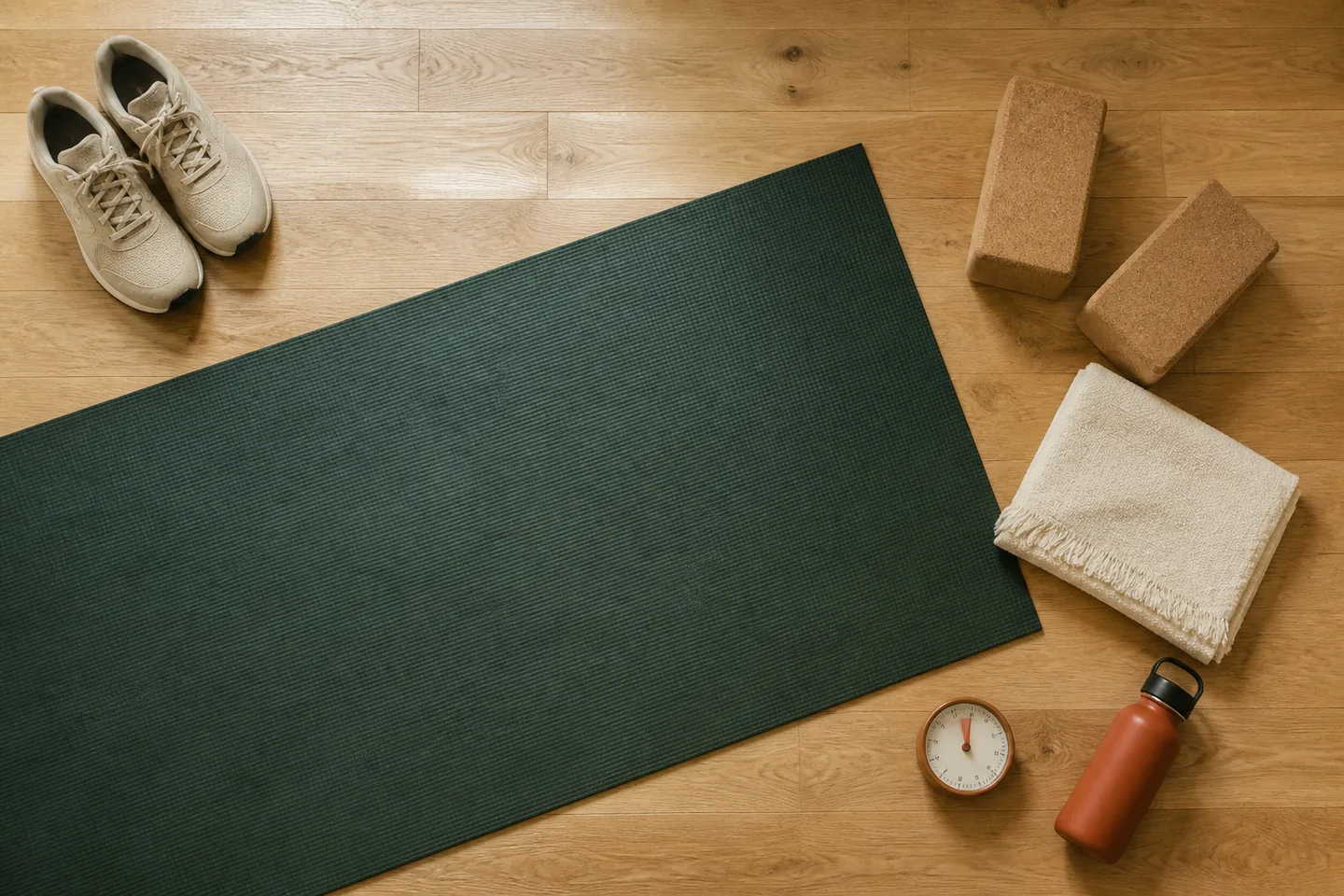
Move shoes, bottles, and loose gear beyond the mat edge. Place two stable blocks at the front and fold a towel or blanket for the back knee. Sweat can reduce traction, so dry your hands before weight-bearing poses and skip any surface that slides.
A 12-minute post-run yoga routine
Treat the times as ceilings, not achievements. Work on both sides and keep a mild, steady sensation rather than increasing range with every breath.
1. Cat-Cow — 1 minute
Come to hands and knees with wrists below or slightly ahead of the shoulders. Inhale into a small arch; exhale into a comfortable rounded back. Repeat about six slow cycles without dropping heavily into the lower back.
If the wrists are tired, place forearms on a stable chair seat and make the same small movement while standing.
2. Moving Downward-Facing Dog — 90 seconds
Lift the hips and keep both knees generously bent. Alternate extending one leg a little as the opposite knee bends. Your heels do not need to touch the floor, and the back does not need to become perfectly straight.
Use our Downward-Facing Dog guide for hand, shoulder, and hamstring variations. Skip it if loading the wrists or shoulders is uncomfortable; use a wall-supported calf stretch instead.
3. Supported low lunge — 1 minute per side
Step one foot forward from hands and knees, lower the back knee onto padding, and place both hands on blocks. Keep the front foot flat and shift forward only until the front of the back hip feels mildly lengthened. Avoid pushing the pelvis down or forcing the front knee farther forward.
For a runner with tender knees, stand in a short split stance and bend the front knee slightly while keeping both hands on a wall. The goal is a manageable hip position, not the floor shape.
4. Bent-knee half split — 1 minute per side
From the lunge, shift the hips back and straighten the front leg only partway. Keep a visible bend in the knee and hinge from the hips with hands on blocks. Stop before the hamstring sensation becomes sharp or the foot tingles.
This is not a test of toe-touching. A runner after hill repeats may choose a much smaller range than after an easy jog.
5. Reclining figure four — 1 minute per side
Lie on your back with both knees bent. Cross the right ankle over the left thigh, keeping the right foot gently flexed. Stay here or draw the left thigh toward you without lifting the head. Repeat on the other side.
Supported Pigeon Pose is an alternative, not an upgrade. Choose it only if the front knee is comfortable and you can support the hip without twisting or collapsing.
6. Child's Pose or constructive rest — 90 seconds
Finish in a comfortable Child's Pose, with the torso supported if useful. If kneeling does not suit your knees or ankles, lie on your back with knees bent and feet on the floor. Let breathing return to normal without forcing long exhales.
Adjust the routine to the run
The same sequence should not follow every workout unchanged:
- After an easy 30-minute run: use the full routine at mild intensity.
- After intervals or hill repeats: walk, refuel as appropriate, and keep the yoga shorter. Fatigue makes end-range positions harder to control.
- After a long run: prioritize getting warm, hydrated, and comfortable. A few minutes of supported floor movement may be enough.
- The day before a race: do only familiar movements. This is not the time to test deep Pigeon Pose or a new power-yoga class.
- With localized pain: stop treating the session as ordinary stiffness. Avoid provocative poses and get individualized advice when symptoms persist or affect running.
Common mistakes runners make in yoga
- Turning every pose into a flexibility contest. Running performance does not require the deepest possible hip or hamstring range.
- Holding the breath. Reduce the range until breathing is easy and ordinary.
- Confusing sensation with effectiveness. Stronger is not evidence that a stretch is more useful.
- Using Pigeon Pose for every hip complaint. Reclining figure four or a supported variation may be more controllable; neither diagnoses pain.
- Adding a hard yoga class to an already hard day. Power yoga can be training load, not recovery.
- Expecting stretching to replace strength work or rehabilitation. These are different tools with different purposes.
The National Center for Complementary and Integrative Health describes yoga as generally safe when practiced appropriately, while noting that sprains and strains can occur and that beginners should avoid extreme practices. For runners, the simplest rule is useful: finish each session feeling as though you could comfortably have done a little less.
Build it into a running week
Start with one 12-minute post-run session after an easy day. If that fits without extra soreness or fatigue, add a second short session or one beginner class on a non-running day. Keep at least one genuine low-load day if your training plan calls for it; yoga does not have to fill every gap.
Which yoga is best for runners? The version that has a clear job, fits the week's total load, and leaves you ready for the next run. A calm routine can support mobility and body awareness. It does not need a dramatic promise to earn its place.
Frequently asked questions
Which yoga is best for runners?
There is no universally best style. A short, gentle hatha or mobility-focused sequence works well after an easy run, while a separate beginner strength-and-mobility class can complement training on a non-running day. Avoid judging a class only by its label; pace and intensity matter more.
Is yoga good for runners?
Yoga can be a useful way to practice mobility, balance, body awareness, and controlled strength. It should not be sold as a guarantee against running injuries or a replacement for appropriate training, recovery, or clinical care.
How many days a week should a runner do yoga?
Start with one or two short sessions a week and assess how they fit your running load. Ten gentle minutes after an easy run is different from a demanding power-yoga class. Keep hard sessions away from races and key workouts until you know how your body responds.
What's better for runners, yoga or Pilates?
Neither is automatically better. Yoga often emphasizes varied postures, mobility, balance, and breathing; Pilates commonly emphasizes controlled trunk and hip work. Choose the format you can perform consistently and that addresses your actual goal without making you too fatigued for running.