

How this page has changed
July 27, 2026
Sources, internal links and safety or product context reviewed.
In this guide
- 01Foam blocks at a glance
- 02Start with the polymer disclosure
- 03Dimensions and usable geometry
- 04Weight reveals important differences
- 05Density, firmness and compression are different
- 06Closed-cell claims and moisture
- 07Edge design and surface texture
- 08Wear patterns and replacement
- 09Cleaning and disinfection
- 10Storage and transport
- 11Foam versus cork
- 12Delivery inspection
- 13Value without stale prices
- 14A practical buying sequence
A foam yoga block is a lightweight rectangular prop made from a foamed polymer, commonly EVA. The category includes inexpensive soft blocks, dense studio products, recycled-content models, travel minis, slim blocks and curved forms. Color and softness in a photograph do not reveal density, compression behavior or durability.
This guide owns the foam-material purchase and condition decision. Our yoga block size guide covers dimensions across materials, cork yoga block guide owns cork, and best yoga blocks guide compares the entire category. This page does not prescribe poses, alignment or injury modifications.
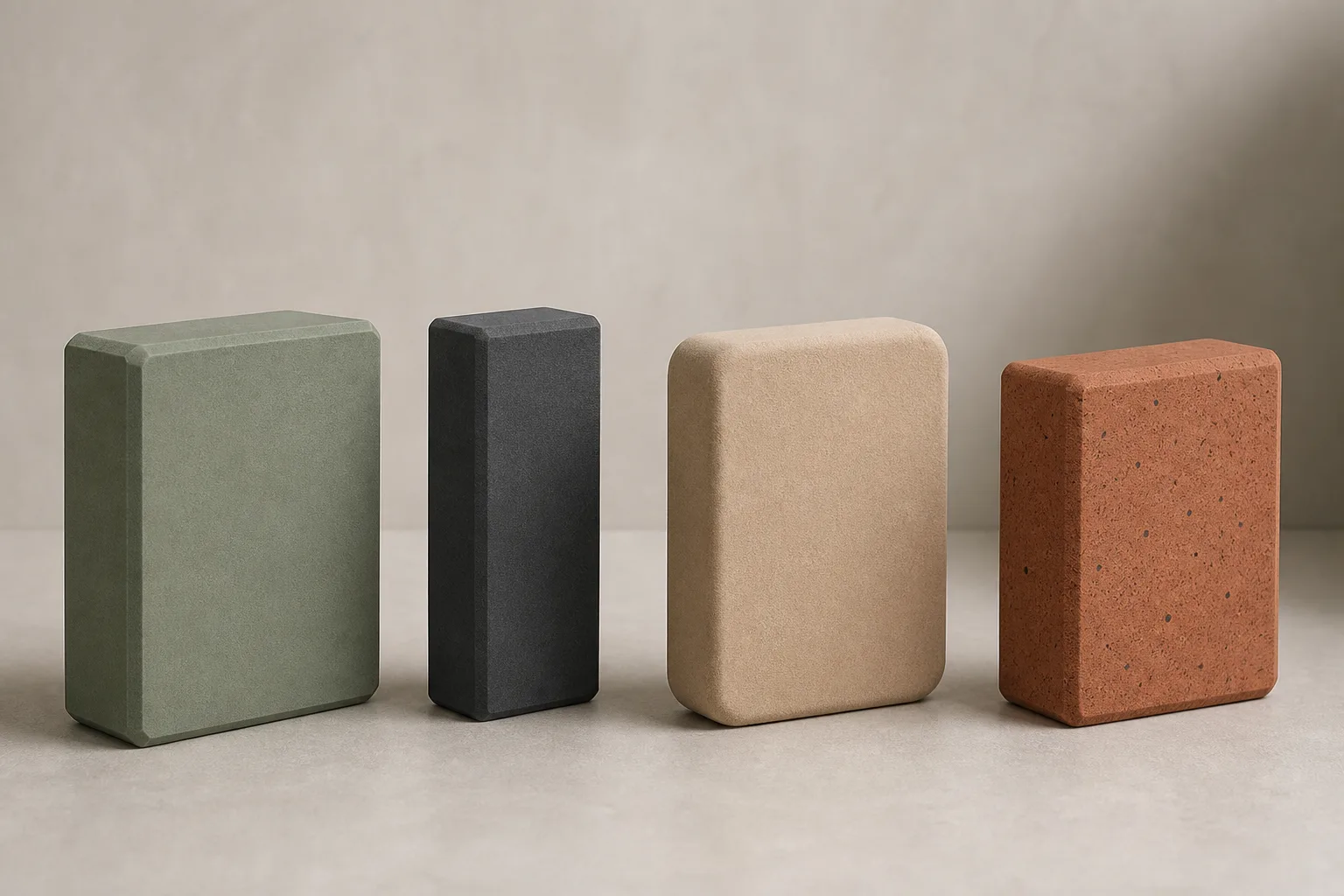
Foam blocks at a glance
| Variable | Verify | Avoid assuming |
|---|---|---|
| Polymer | EVA, another foam or a blend | Every foam block is EVA |
| Recycled content | Percentage, feedstock and calculation | Speckles prove recycled material |
| Dimensions | Length × width × thickness | “Standard” means one exact size |
| Weight | Individual block mass | Lightweight means low density |
| Density | Numerical value and method if claimed | “High density” is standardized |
| Firmness | Product-specific compression information | Density and firmness are identical |
| Cell structure | Closed-cell or otherwise, if disclosed | All foam resists moisture equally |
| Edge shape | Bevel, radius or curved face | Rounded always leaves the same flat area |
Start with the polymer disclosure
EVA means ethylene-vinyl acetate, a family of copolymers whose properties change with formulation and foaming. A listing that says only “premium foam” does not identify the material. Ask whether the product is EVA, another polymer or a blend, and whether it has a skin, coating or printed layer.
Manduka currently identifies its full-size block as high-density EVA foam. Its EU disclosure says the recycled model contains a guaranteed 50–75% blend of post-industrial and post-consumer recycled EVA, depending on the block. That is more useful than the word recycled alone because it names a range and feedstock types.
Do not infer recycled content from black speckles or marbling; color can be decorative. Equally, “eco foam” is not a polymer specification. Look for a percentage, basis of calculation, manufacturing location and any certification scope. Recycled content does not by itself establish durability, recyclability or total environmental impact.
Dimensions and usable geometry
A common full-size block is approximately 9 × 6 × 4 inches. Manduka and Hugger Mugger both list that format for current dense foam models. Manduka’s current collection also includes a mini around 10 × 11.5 × 15 centimeters, lean blocks around 22 × 7 × 11 centimeters and a curved unBLOK format.
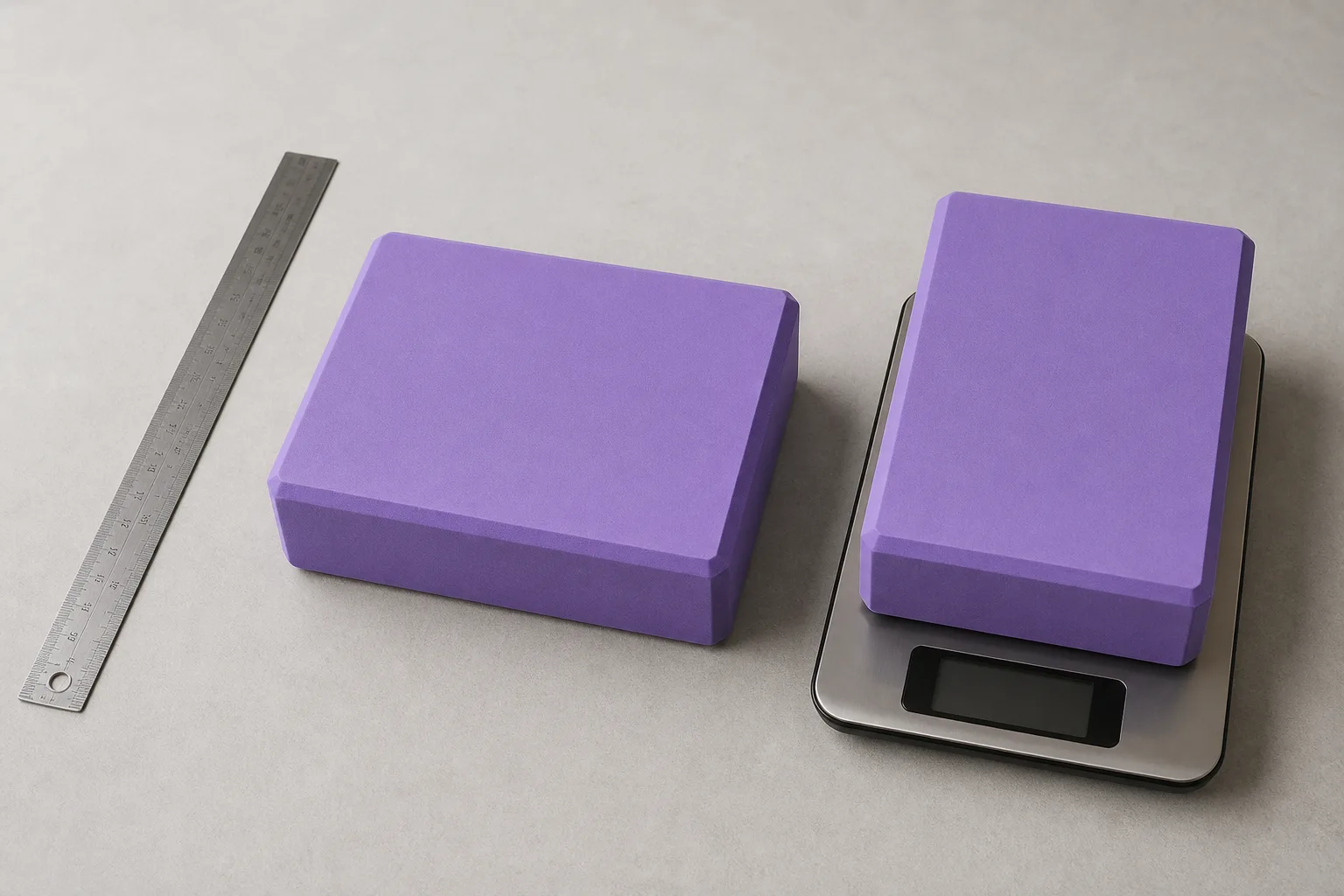
Record the longest edge, width and thickness. Then measure the largest fully flat rectangle on each face. A deep bevel or curved side reduces usable contact area even when the outer dimensions match a conventional block. Curved designs should be treated as their own product type, not a cosmetic variant.
Compare a pair face-to-face. Large mismatch can matter when the blocks are stored together or expected to provide equal height. Slight mold lines and color variation may be cosmetic; twisting, rocking or a face that will not lie flat is a functional problem.
Weight reveals important differences
Foam does not have one standard mass. Manduka lists 1 pound (0.45 kilogram) for its dense 9 × 6 × 4-inch recycled EVA block. Gaiam lists 4.6 ounces for a current basic foam block. Without matching dimensions, neither figure proves which is denser; it does show why “lightweight” is too vague for a purchase comparison.
Weigh one bare block, not a boxed pair. Divide mass by approximate external volume only if you need a rough bulk-density comparison, and disclose that beveled edges and rounded corners make it an estimate. Never turn a calculated density into an unsupported load rating.
For travel, multiply by quantity and include the rest of the kit. For storage, low weight makes overhead placement tempting, but falling equipment can still cause injury or damage. Keep blocks fully supported on a shelf and follow the storage system’s rating.
Density, firmness and compression are different
Density is mass per volume. Firmness describes resistance to indentation under a specified test. Compressive strength describes behavior under load. Sellers often use these terms loosely, and most consumer block pages publish no test method.
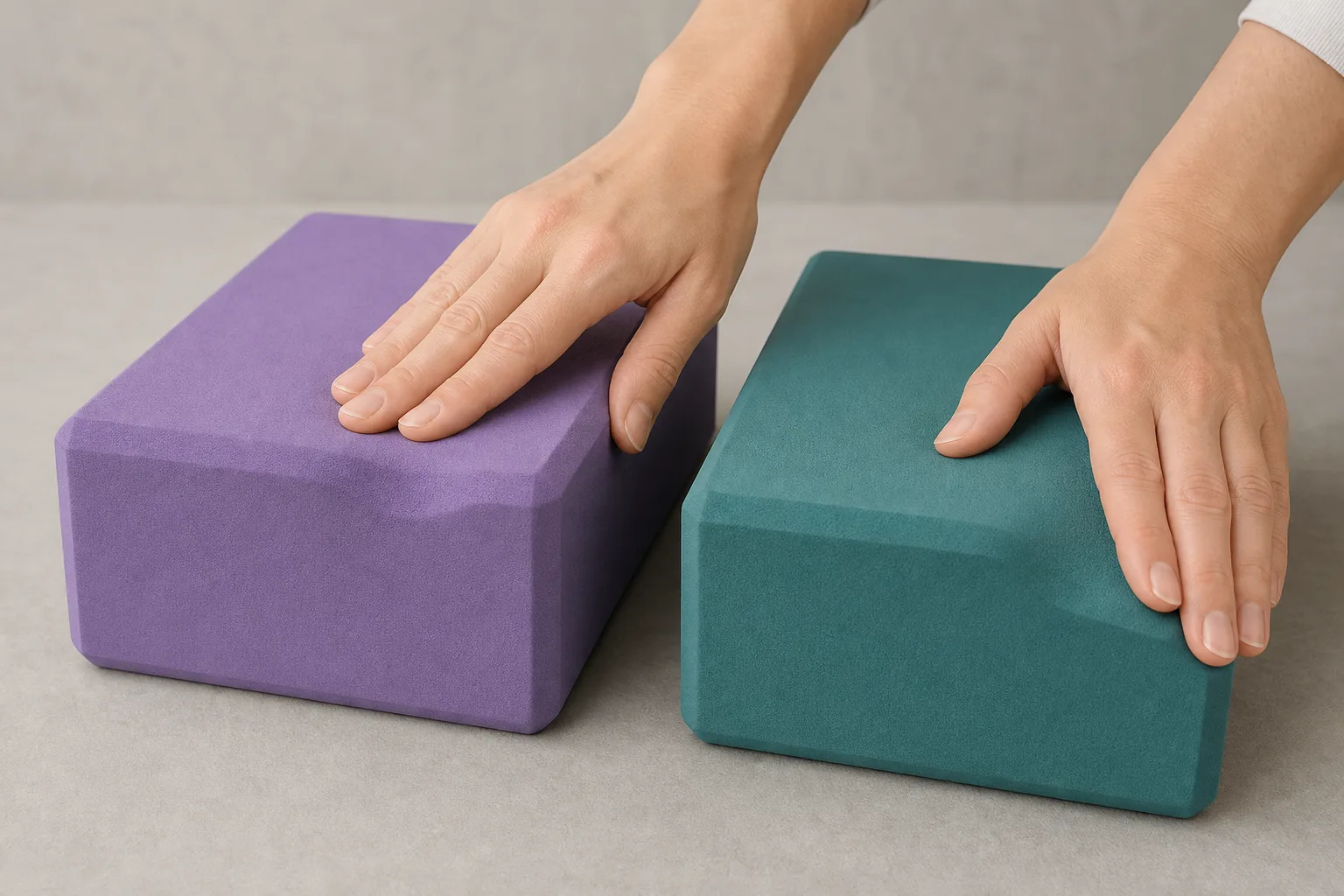
If numerical data is absent, compare within sensible limits: dimensions, mass, maker description, surface recovery and return policy. On a new block, apply only light hand pressure permitted during ordinary handling. Observe whether the surface rebounds promptly and whether a thumb leaves a lasting depression. Do not stand on, jump on or overload a returnable product as a home test.
Temperature affects many polymers. A block may feel different after sitting in a cold car or direct sun. Let it reach normal indoor conditions before comparing firmness or deciding that it is permanently distorted.
Closed-cell claims and moisture
Closed-cell foam contains cells that are largely enclosed rather than interconnected. Manduka describes its current EVA block as closed-cell and moisture resistant. That does not mean waterproof, sterile or safe to soak. Cuts, mold seams, coatings and surface wear can change how contamination behaves.
Ask whether the closed-cell claim applies to the core, surface skin or complete product. Follow the maker’s cleaning instructions and drying time. Shared-studio equipment needs a documented between-user protocol compatible with the product; a household care sentence may not satisfy a facility’s hygiene requirements.
Edge design and surface texture
Most rectangular foam blocks use beveled or rounded edges. A narrow bevel preserves more flat area; a generous radius softens the corner but reduces it. Some products have two strongly curved faces. Inspect all sides because listing thumbnails often show only the most conventional angle.
Surface texture may come from the foam mold, a skin or a coating. A smooth skin can be easy to wipe but may show scratches. A fine-cell matte surface can feel tactile yet collect visible dirt. Printed patterns introduce another layer whose ink durability and cleaner compatibility should be disclosed.
No photograph can prove wet or dry grip. Treat “non-slip” as a claim requiring a test method or specific manufacturer explanation. Condition, dust, cleaner residue and the contacting floor or mat all affect friction.
Wear patterns and replacement
Foam commonly shows dents, compressed corners, cuts, abrasion and eventually crumbling. The location and persistence matter more than cosmetic perfection. A shallow mark that rebounds is different from a crushed corner that changes the block’s height or a crack that spreads across a face.
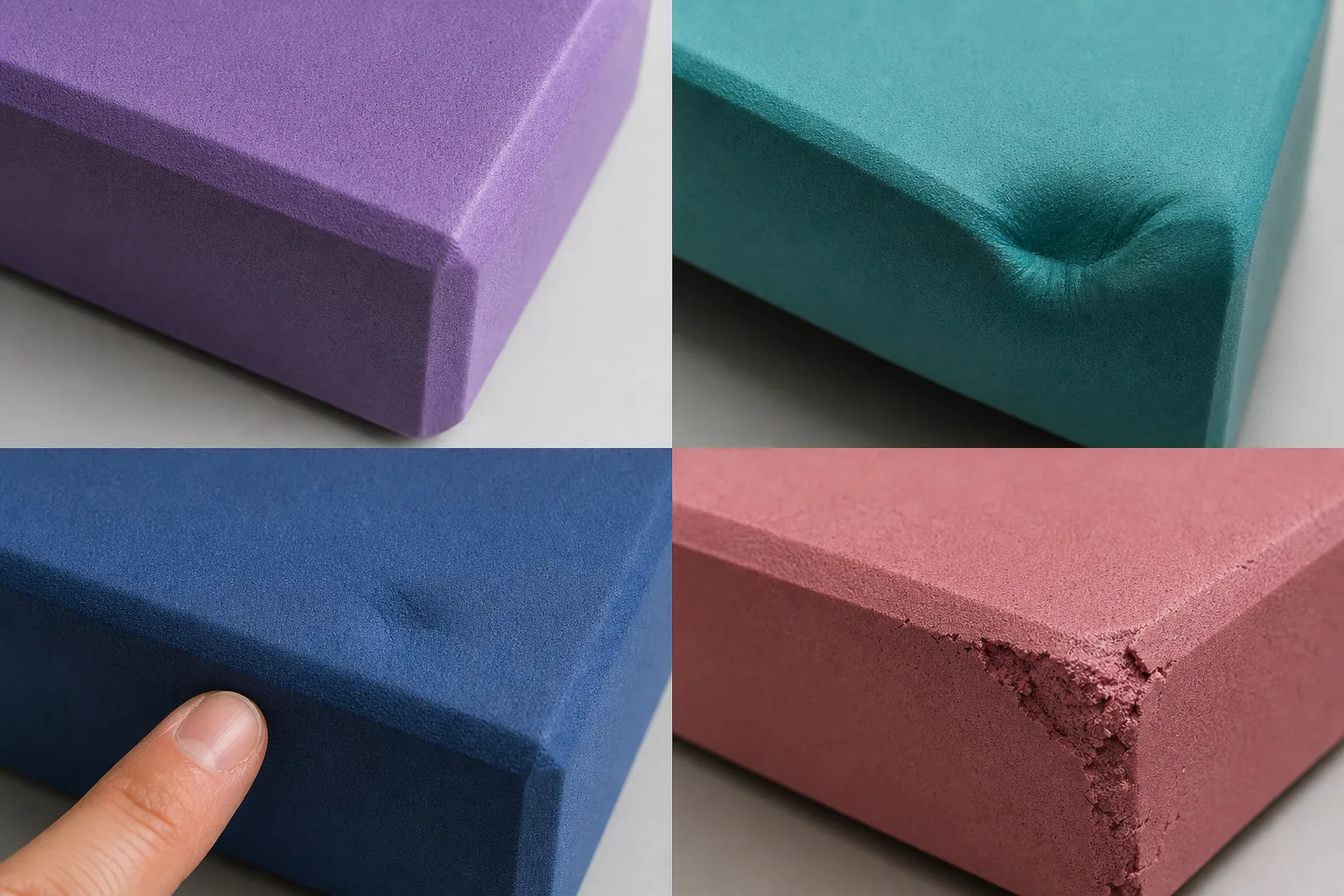
Inspect under bright neutral light:
- all six faces for flatness and twisting;
- corners for permanent crushing;
- bevels for cuts that open under light handling;
- surfaces for flaking, sticky residue or powder;
- seams or layered areas for separation;
- printed or coated areas for transfer;
- odor after the maker-approved airing period.
Retire the block when a face no longer lies flat, a corner remains materially shorter, tears propagate, foam crumbles, layers separate or contamination persists after approved cleaning. Do not fill a structural cut with adhesive unless the manufacturer provides a repair method.
Cleaning and disinfection
Manduka currently specifies wiping its closed-cell EVA block with a damp cloth and mild detergent, avoiding machine washing and full submersion, then storing it dry away from direct sunlight and excess humidity. That guidance belongs to that product and should not be generalized to every foam formulation.
Check before using alcohol, bleach, vinegar, essential oils, solvents, steam or UV equipment. A disinfectant can be effective on one compatible hard surface yet damage or fail to remain wet long enough on another product. Cleaning removes soil; disinfection is a separate process with its own concentration and contact time.
For ordinary personal care, remove visible soil according to the label, wipe away cleaner residue if instructed and air-dry every face. Never close a damp block in a bag. If a studio needs pathogen control, obtain compatibility and protocol details from the block and disinfectant manufacturers.
Storage and transport
Store foam blocks in a cool, dry place away from direct sun and heat. Manduka specifically warns against heavy objects on top because indentations can form. Keep blocks away from sharp buckles, pet claws, rough wall hooks and leaking bottles.

Standing blocks upright saves shelf width, provided the shelf is deep enough and the blocks cannot fall into a walkway. Stacking flat is simple but encourages users to place heavier props on top. A ventilated cubby with a defined pair position makes missing blocks and damp equipment easy to notice.
Use a bag compartment without sharp hardware. A tight strap can permanently crease softer foam. After transport, unpack rather than leaving the pair compressed beneath a rolled mat or water bottle.
Foam versus cork
| Buying factor | Foam tendency | Cork tendency |
|---|---|---|
| Individual mass | Usually lighter | Usually heavier |
| Surface give | More product-dependent compression | Generally firmer |
| Moisture care | Often wipeable closed-cell surface; verify | Porous; avoid soaking |
| Common damage | Dents, cuts, crushing, crumbling | Chips, granule loss, cracks |
| Material disclosure | Polymer and recycled fraction | Cork form, binder and source |
| Portability | Often favorable | Pair weight can be substantial |
These are product-selection distinctions, not instructions about who should use which prop. A person dealing with pain, injury, disability or a specific movement limitation should seek individualized guidance from an appropriately qualified professional.
Delivery inspection
Keep the packaging and specification screenshot until you have checked:
- exact quantity and color variant;
- length, width, thickness and individual mass;
- polymer and recycled-content disclosure;
- all faces for flatness and pair consistency;
- edges for tears, dents or molding voids;
- surface for stickiness, powder or color transfer;
- care instructions, returns and warranty.
Allow the product the manufacturer’s stated airing period when a normal new-material odor is disclosed. A severe or persistent unexpected odor, oily surface, visible contamination or inconsistent foam should be documented and reported. Do not mask an odor with fragrance before deciding whether to return the product.
Value without stale prices
Compare cost per block, not only the bundle headline. Add the evidence that remains useful after a sale ends: polymer, recycled percentage, dimensions, individual weight, geometric options, care limits, warranty and single-block replacement availability.
A cheap light block may be appropriate when its disclosure and firmness match the requirement; a heavier dense model may justify more cost when it retains shape longer. Neither conclusion follows from price alone. Avoid “professional grade” unless the seller explains the test or facility standard behind it.
A practical buying sequence
- Identify full-size, slim, mini or curved geometry.
- Verify the polymer, recycled fraction and surface construction.
- Record all dimensions and individual mass.
- Treat density, firmness and strength as separate claims.
- Inspect face flatness, edge design and pair tolerances.
- Confirm cleaning, drying, temperature and compression limits.
- Choose a dry storage bay before buying.
- Save the listing and inspect the delivered pair before use.
The best foam-block evidence is ordinary and measurable: named material, honest recycled-content range, exact size and mass, clear care rules and a useful return policy. Those details make a product easier to compare than color, lifestyle photography or an unexplained high-density label.
Frequently asked questions
What are foam yoga blocks made from?
Many current products use EVA foam, but “foam” is not a complete material disclosure. Confirm the polymer, recycled-content percentage, cell structure, surface coating and country of manufacture for the exact model.
What size is a foam yoga block?
A common full-size format is approximately 9 by 6 by 4 inches, but slim, mini and curved blocks are also sold. Measure all three edges and compare the usable flat faces because rounded or curved designs reduce flat area.
How much does a foam yoga block weigh?
Weight varies sharply with dimensions and density. Current examples range from roughly 4.6 ounces for a light basic block to 1 pound for a dense 9 by 6 by 4-inch recycled EVA block. Compare the exact model and make sure the listing reports one block rather than a pair.
What does high-density foam mean?
Without a numerical density or test method, high density is a relative marketing term. Firmness, density and compressive strength are different properties. Compare published mass and dimensions, plus a clear return policy, rather than assuming the phrase guarantees performance.
When should a foam yoga block be replaced?
Replace it when a face no longer lies flat, a corner remains crushed, cracks or tears spread, the surface crumbles, layers separate, or approved cleaning cannot remove contamination or persistent odor.