

How this page has changed
July 27, 2026
Sources, internal links and safety or product context reviewed.
In this guide
- 01Cork blocks at a glance
- 02Measure size rather than trusting “standard”
- 03Weight is a first-class specification
- 04What “cork” should disclose
- 05Grain, surface and edges
- 06Density is rarely stated consistently
- 07Cork versus foam and wood
- 08Care and drying
- 09Storage
- 10Delivery inspection
- 11Compare value without a static price
- 12Replacement signals
- 13A practical buying sequence
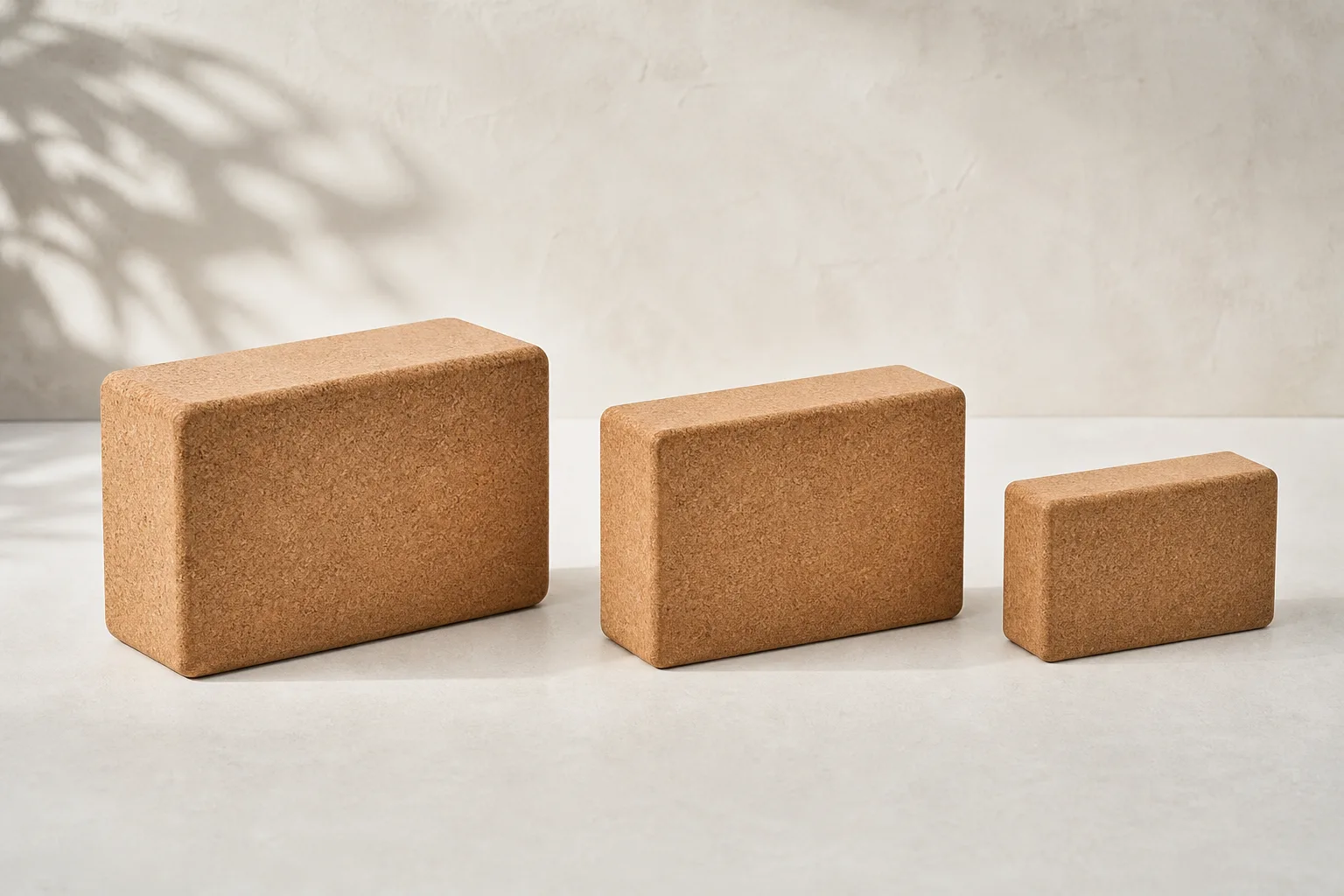
A cork yoga block is a rigid rectangular prop made from compressed cork granules or another disclosed cork construction. Compared with many foam blocks, current cork products are heavier, firmer and more textured. Those are category tendencies, not guarantees: two blocks labeled “cork” can differ in width, thickness, mass, grain size, binder, edge radius and finish.
This page owns the cork-material buying decision. Our yoga block size guide owns general sizing, wooden yoga block guide covers wood construction, and best yoga blocks guide compares the full category. No pose, alignment or therapeutic instruction is provided here.
Cork blocks at a glance
| Variable | What to verify | Why it changes the product |
|---|---|---|
| Length, width, thickness | Actual finished dimensions | Determines usable faces and grip span |
| Weight | Mass per block, not shipping weight | Affects carrying and how readily it shifts |
| Grain | Fine or coarse visible particles | Influences texture and edge behavior |
| Construction | Granulated cork, binder and finish | “Natural” alone is incomplete |
| Edge radius | Square, beveled or rounded | Changes usable flat area and edge contact |
| Face flatness | All six faces on a flat surface | Reveals rocking or distortion |
| Care | Approved cleaner, water exposure and drying | Porous material can change when soaked |
| Provenance | Cork origin and manufacturing country | Supports specific environmental claims |
Measure size rather than trusting “standard”
The familiar full-size block is often about 9 × 6 × 4 inches. Manduka publishes those dimensions for its current cork block. Hugger Mugger publishes 9 × 5.5 × 3.5 inches, a meaningfully slimmer product, while lean and mini blocks in current collections narrow one or more faces further.
That variation changes more than storage. Width defines the broad face, thickness defines the narrowest face, and rounded edges reduce the completely flat area. Product pages sometimes reorder dimensions, so map each number to a physical edge instead of assuming the first number is length.
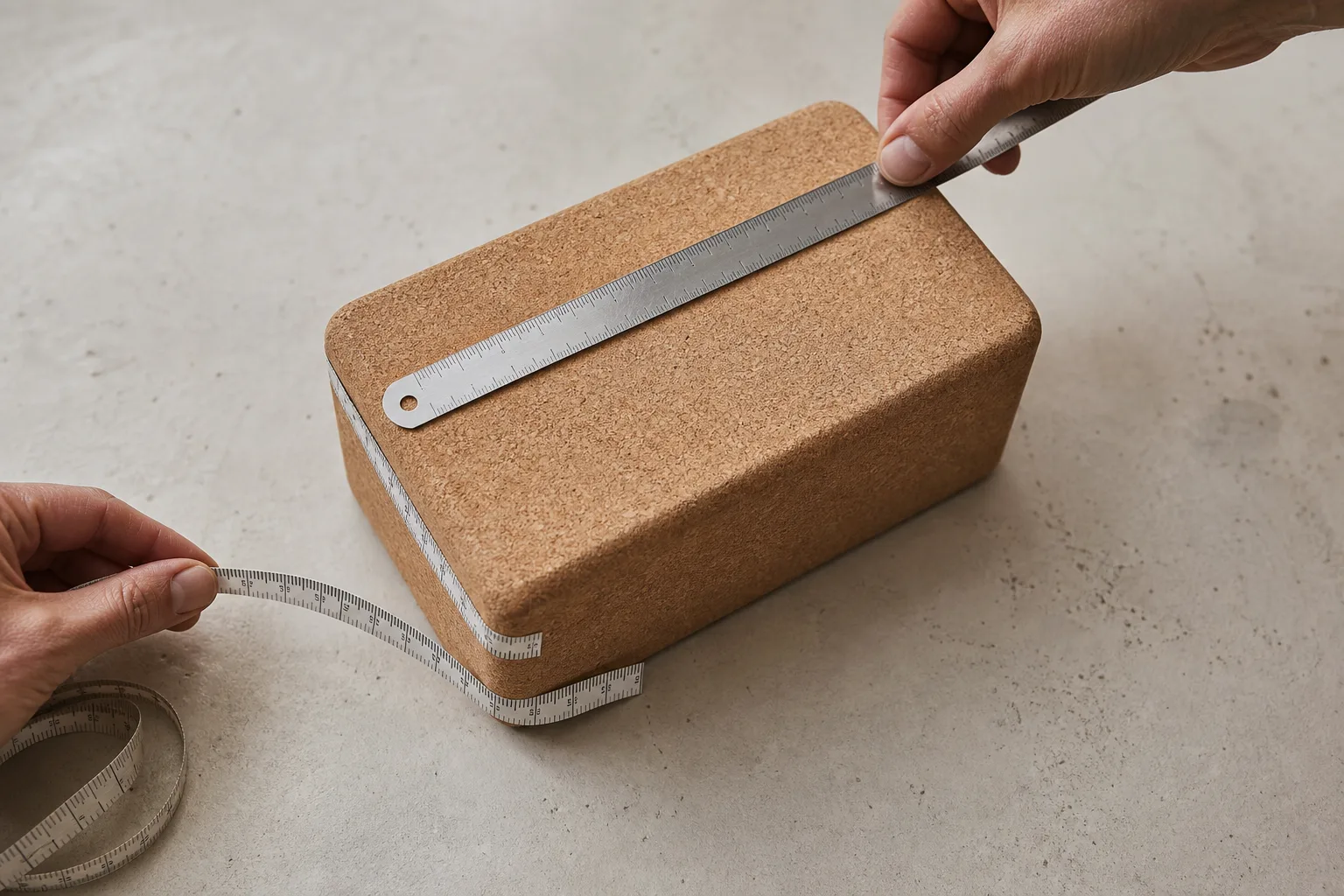
Measure a delivered block at several points with a rigid ruler. A flexible tape can follow a rounded edge and overstate a straight dimension. Compare a matched pair face-to-face: the edges should align closely, and neither block should rock when each face is placed on a verified flat surface.
Weight is a first-class specification
Cork blocks can differ substantially in mass. Manduka lists 2.2 pounds (1 kilogram) for a 9 × 6 × 4-inch block. Hugger Mugger lists 1.65 pounds for its smaller 9 × 5.5 × 3.5-inch model. JadeYoga UK lists 0.870 kilogram for a large cork block. These figures cannot be compared fairly without the dimensions.
Weigh the unwrapped product on a scale with enough capacity and resolution. Confirm whether a listing reports one block, a pair or shipping weight. A marketplace package titled “set of two” may display the pair’s mass in one field and a single block’s dimensions in another.
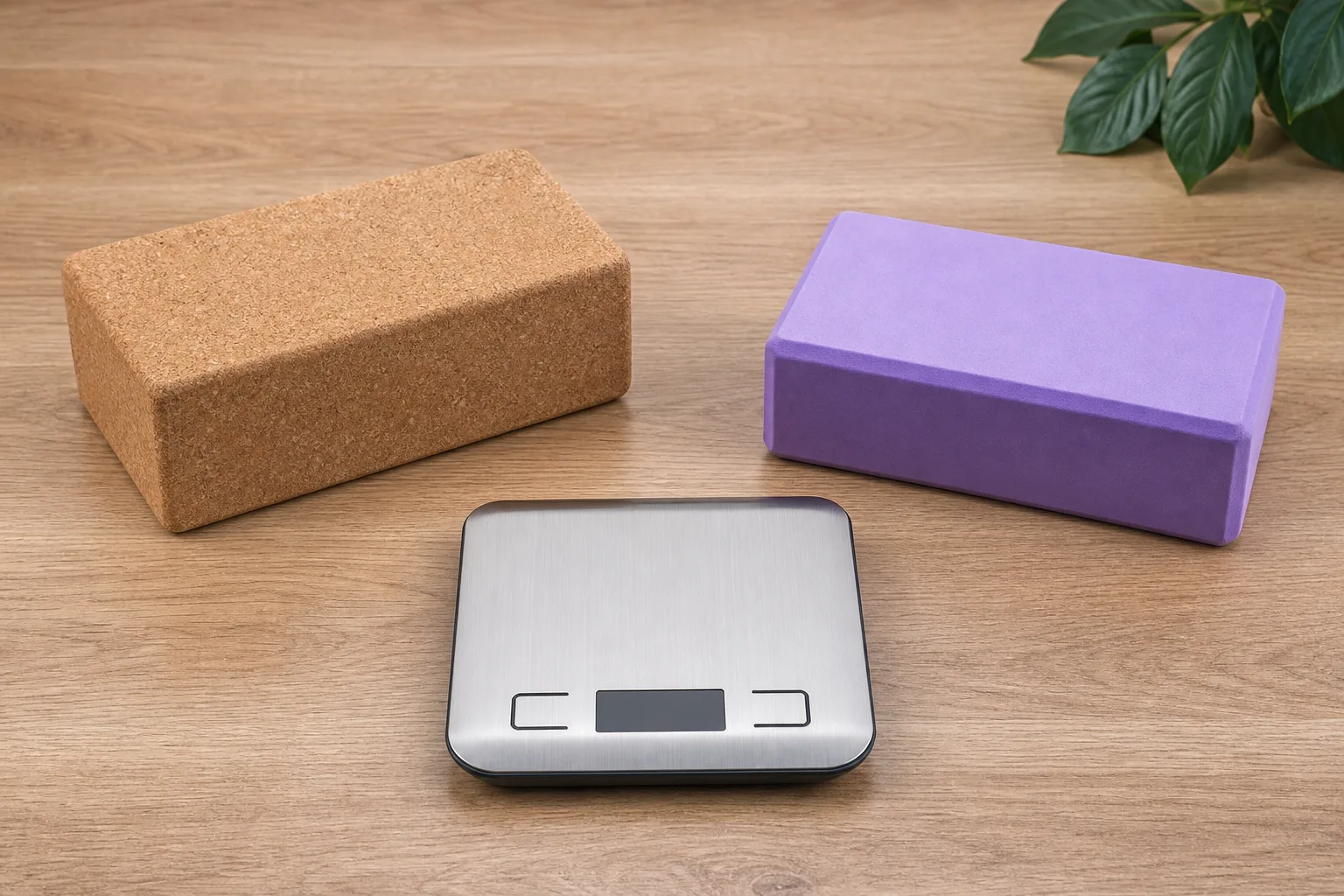
Mass affects a carry bag and shelf just as surely as a yoga mat does. Two 2.2-pound blocks add 4.4 pounds before the mat, strap, water and clothing. If portability matters, calculate the complete kit. If storage is permanent, check shelf capacity and keep blocks away from edges where a fall could damage the block or floor.
What “cork” should disclose
Cork bark is harvested from cork oak, but most block-shaped products are not single pieces carved from bark. They typically use cork granules consolidated into a mold. The granule size, binder and compression process affect the result. A claim of “100% cork” may describe the named solid fraction without explaining the binder needed to hold particles together.
Look for answers to four separate questions:
- What percentage and form of cork is used?
- Is recycled cork included, and how is that percentage calculated?
- What binder or coating is present?
- Where was the cork sourced and where was the block manufactured?
Renewable does not automatically mean a particular product has low total impact. Evidence should cover source, processing, binder, shipping, expected life and end-of-life route. Certifications should name the standard, certified entity and scope rather than showing an unexplained green badge.
Grain, surface and edges
Fine grain creates a visually uniform surface; coarse particles are more obvious. Neither appearance alone proves density or longevity. Pressed cork can have small pores and color variation without being defective. Inspect for loose granules, open seams, deep voids and corners that shed with light handling.
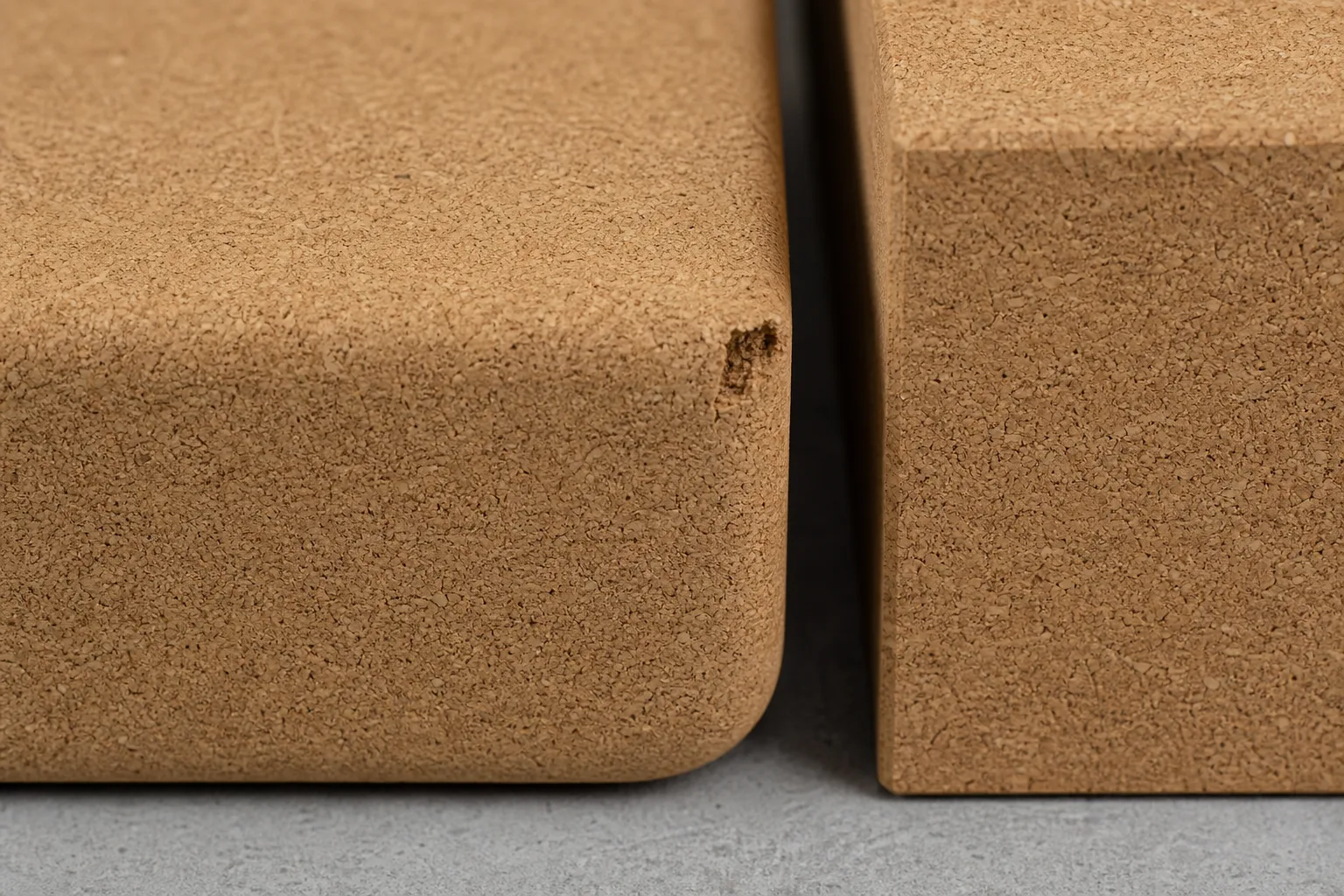
An edge bevel is a flat angled cut; a radius is smoothly rounded. Larger rounding may feel less abrupt at an edge, but it also reduces the size of the flat faces. Compare close-ups from several angles. Marketing photos shot head-on can hide edge geometry and a surface coating.
Run a clean, dry hand lightly over a new block above a sheet of plain paper. A few harmless particles from packaging are different from continuing shedding. Do not scratch, gouge or deliberately drop a returnable product as a “test.” Document material loss that occurs during normal unpacking.
Density is rarely stated consistently
Density means mass divided by volume. Many listings use “high density” without publishing a value or test method. You can calculate an approximate bulk density when accurate dimensions and weight are supplied, but rounding and beveled edges make it only an estimate. It should not be converted into a load rating.
Firmness, compressive strength and density are related but not interchangeable. A block can feel firm at the surface while its edge construction remains vulnerable to impact. No home press test proves safety under every load. Use maker instructions and replace a damaged block instead of inventing a maximum load.
Cork versus foam and wood
| Property | Cork tendency | Foam tendency | Wood tendency |
|---|---|---|---|
| Mass | Medium to high | Low | Medium to high |
| Surface give | Low | Low to moderate, product-dependent | Very low |
| Texture | Granular | Fine-cell or coated | Smooth grain or finish |
| Water behavior | Porous; avoid soaking | Often closed-cell; verify | Finish-dependent |
| Edge damage | Chips or granule loss | Dents, cuts or crumbling | Dents, splits or finish damage |
| Disclosure priority | Cork, binder, source | Polymer, recycled fraction, density | Species, construction, finish |
This table describes common construction, not suitability for a specific body or pose. Buyers who need individualized support should consult a qualified instructor or clinician who can assess their use. Product choice alone does not correct technique or treat pain.
Care and drying
Follow the exact maker instructions. Manduka currently recommends a damp cloth with mild soap and allows a specified diluted water-vinegar mixture for deeper cleaning; it warns against submerging because expansion or texture change may result. Hugger Mugger recommends a warm wet cloth or its gear wash and air-drying away from direct sunlight.
These instructions are product-specific. Do not assume vinegar, alcohol, essential oil, steam or disinfectant is compatible with every binder and finish. Never saturate a block to “clean inside.” Wipe the surface, remove residue as directed, and let every face air-dry before stacking or enclosing it.
Rotate the block during drying so moisture is not trapped beneath the broad face. Avoid radiators, hair dryers and prolonged direct sun. Heat can affect binder or surface finish even when the cork itself appears unchanged.
Storage
Store cork blocks clean, dry and flat or neatly stacked according to the maker. A shelf should fit the full length and width; an overhanging block can fall or chip. Avoid a sealed container while residual moisture or odor remains.
Do not stack heavy equipment on top unless the manufacturer permits it. Separate blocks from sharp metal buckles, damp towels and leaking bottles. Our yoga equipment storage guide explains how to zone an entire equipment collection; this page owns only cork-block conditions.

Delivery inspection
Before removing tags or discarding packaging:
- verify quantity, dimensions and individual weight;
- compare color and grain without expecting perfect natural uniformity;
- inspect every face for cracks, deep voids and loose areas;
- place all six faces on a known flat surface and check for rocking;
- compare paired blocks face-to-face for material size mismatch;
- photograph dents or edge loss before use;
- save the listing, material statement and care instructions.
A superficial rub mark may be cosmetic. A crack crossing an edge, a face that is not flat, continued shedding, separated layers or a strong persistent odor deserves seller review. Do not repair a new structural defect with glue: that changes the product and obscures the original issue.
Compare value without a static price
Prices and promotions change. Build a durable comparison from cost per block, verified dimensions, weight, material disclosure, grain quality, return policy, warranty and expected replacement path. Include shipping when a dense pair is expensive to deliver or return.
A lower-cost block with complete specifications may be easier to evaluate than a premium block described only with lifestyle claims. Conversely, clear sourcing, stable pair tolerances and replaceable single-block availability can justify a higher current price. Record the date and seller rather than publishing a price that will immediately age.
Replacement signals
Retire a cork block when it has a structural crack, unstable face, spreading corner failure, loose sections, significant distortion, unexplained persistent odor or contamination that approved cleaning cannot remove. Photograph and measure damage if it appears during a warranty period.
Minor surface color change or one small sealed chip is not automatically structural failure. Monitor it away from the main contact edge. If granules continue releasing or the defect grows, stop using the block and ask the manufacturer. Do not sand a coated product without explicit instructions; sanding can remove finish, change dimensions and expose binder.
A practical buying sequence
- Choose standard, slim, lean or mini dimensions from a measured need.
- Compare mass for the exact dimensions—not material name alone.
- Require cork form, binder, source and manufacturing disclosures.
- Inspect grain, all six faces, edge radius and pair tolerances.
- Confirm the approved cleaner, drying method and storage limits.
- Calculate pair weight and complete-kit portability.
- Save specifications and inspect the delivered product before use.
A strong cork-block listing is specific. It tells you how large and heavy the product is, what it is made from, how its edges are finished and how it should be cleaned. That evidence is worth more than an unsupported “eco,” “non-slip” or “professional” label.
Frequently asked questions
What size is a standard cork yoga block?
A common current format is approximately 9 by 6 by 4 inches, but slim examples are closer to 9 by 5.5 by 3.5 inches and lean or mini formats are narrower. Verify all three dimensions because standard is not a controlled specification.
How much does a cork yoga block weigh?
Current full-size examples vary. Manduka lists 2.2 pounds for its 9 by 6 by 4-inch block, while Hugger Mugger lists 1.65 pounds for a 9 by 5.5 by 3.5-inch model. Dimensions, grain and construction all affect mass, so check the exact product.
Are cork yoga blocks solid cork?
Many are molded from granulated cork with a binder rather than cut from one solid piece of bark. “Natural cork” does not reveal the binder, recycled content, source or manufacturing method. Look for a complete material and provenance disclosure.
How do you clean a cork yoga block?
Follow the maker’s instructions. Current brands commonly specify wiping with a damp cloth and mild cleaner, then air-drying fully away from direct sun. Do not soak or submerge a cork block unless the manufacturer explicitly allows it.
When should a cork yoga block be replaced?
Retire it when it has a structural crack, spreading edge loss, loose material, persistent odor after approved cleaning, major distortion or an unstable face. A small cosmetic chip is different from damage that changes the support surface.