

How this page has changed
July 26, 2026
Sources, internal links and safety or product context reviewed.
In this guide
- 01Best men's yoga pants at a glance
- 02Start with silhouette, not brand
- 031. Alo Co-Op Pant — best overall men's yoga pant
- 042. Quince Flowknit Performance Jogger — best value construction
- 053. Vuori Sunday Performance Jogger — best from studio to everyday wear
- 064. Ten Thousand Interval Pant — best for sweaty yoga and cross-training
- 075. lululemon Balancer Relaxed-Fit Pant — best roomy performance option
- 086. Manduka Men's CAS Jogger — best for warmth and natural fibers
- 09The fitting-room test: five movements, no yoga performance required
- 10Fabric: what specifications can and cannot tell you
- 11Do men need yoga-specific clothes?
- 12The verdict
- 13Frequently asked questions
The Alo Co-Op Pant is the strongest all-round men's yoga pant on paper: its current product page describes an ultra-light, sweat-wicking performance pant with a streamlined shape that can move from mat to everyday wear. The Quince Flowknit Performance Jogger is the more affordable construction match, while the lululemon Balancer Relaxed-Fit Pant is the starting point for people who dislike a narrow jogger silhouette.
Those recommendations are based on current manufacturer specifications, available fits, independent search-result patterns and recurring user concerns—not a claim that The Yoga Sensei wore every pair for months. Product pages and availability were checked July 26, 2026. There are no paid placements, affiliate links, invented durability scores or copied customer ratings on this page.
The right answer may also be something you already own. If a pair of training pants passes the movement, coverage and waistband checks below, a “yoga” label adds nothing essential.
Best men's yoga pants at a glance
| Pick | Best for | Published construction | Fit signal | Main limitation to check |
|---|---|---|---|---|
| Alo Co-Op Pant | Best all-rounder | Ultra-light performance fabric; sweat-wicking | Streamlined; regular and long listings | Premium tier; limited public fabric detail |
| Quince Flowknit Jogger | Best lower-cost technical jogger | 88% recycled polyester, 12% spandex | Tapered, cuffed | Only letter sizes S–XXL shown |
| Vuori Sunday Performance Jogger | Best studio-to-everyday option | Midweight recycled stretch knit | Athletic slim; 28-inch regular inseam | Shorter cut and thicker than a hot-yoga shell |
| Ten Thousand Interval Pant | Best for high-sweat cross-training | 63% nylon, 37% spandex; quick-drying shell | Tapered; regular and shorter choices | Technical features may be excessive for gentle yoga |
| lululemon Balancer Pant | Best relaxed performance fit | Yoga-category relaxed pant | XS–XXL; regular listing | Verify fabric and inseam on the selected color |
| Manduka CAS Jogger | Best warm natural-fiber option | 76% organic cotton, 24% hemp fleece | Relaxed; 27-inch inseam in M | Warm, short and less suited to heavy sweat |
The table compares declared construction, not laboratory performance. A “sweat-wicking” label is a manufacturer claim; it does not prove that two fabrics dry at the same speed.
Start with silhouette, not brand
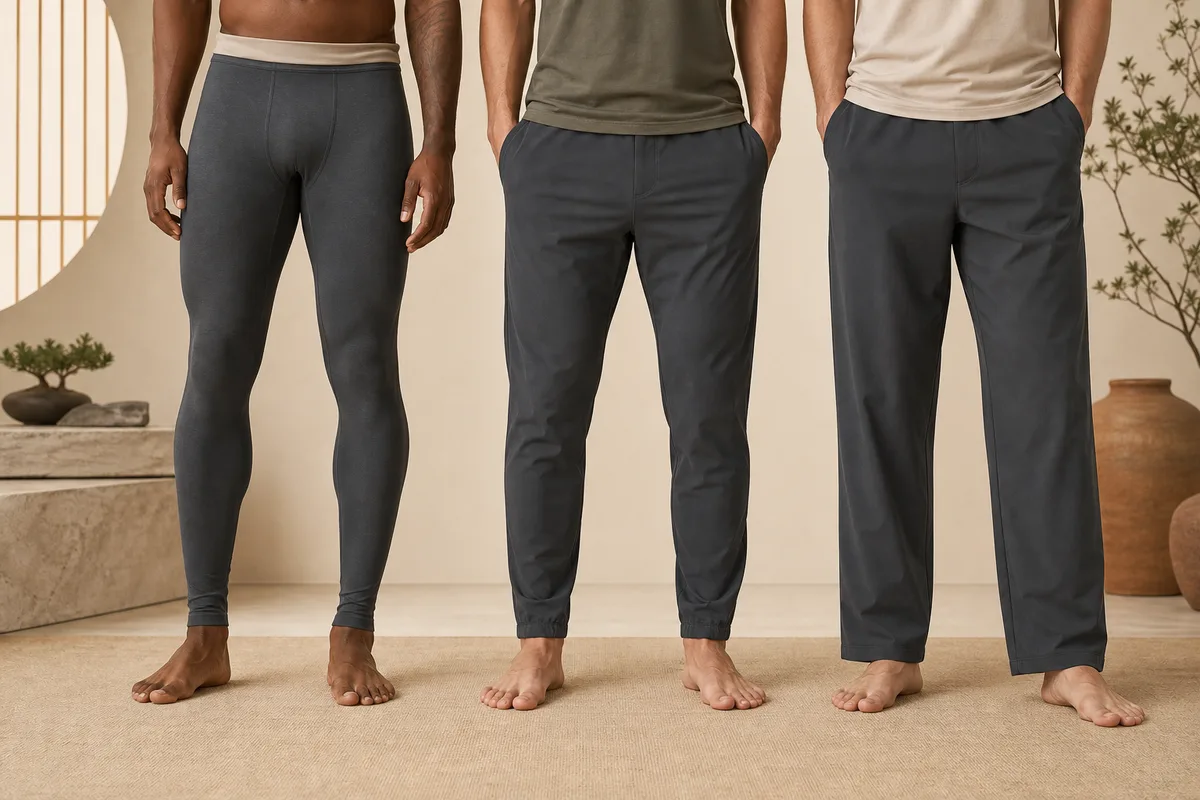
Men's yoga bottoms fall into three useful shapes. Tights remove loose fabric and make leg position easy to see, but offer the least visual coverage. Tapered joggers are the most versatile compromise: room through the hips, less fabric at the ankle and a secure waistband. Relaxed straight pants feel least like gymwear, but extra fabric can shift during inversions and wide hems can approach the feet.
There is no etiquette rule that men must choose one. Reddit discussions surfaced in the live search repeatedly include ordinary sweatpants, lined shorts, compression layers, tights and Thai fisherman-style pants. The practical question is whether the garment stays out of the way when your hips and legs change orientation.
1. Alo Co-Op Pant — best overall men's yoga pant
Alo currently describes the regular Co-Op Pant as breathable, sweat-wicking and ultra-light, made for high-performance training and all-day wear.
The collection also shows regular and long variants, which matters because a tapered pant only looks and moves as intended when the knee and ankle land correctly. Alo does not expose a detailed fiber breakdown in the product text captured for this review, so do not infer one from another Alo style.
Choose it if: you want a streamlined technical pant for regular or vigorous classes and expect to wear it away from the mat.
Skip it if: transparent material specs, a lower price tier or a roomy straight leg matters more than the polished silhouette.
Check current sizes and regional availability on the official Alo Co-Op Pant page.
2. Quince Flowknit Performance Jogger — best value construction
The Flowknit is the strongest budget-positioned alternative because Quince publishes the construction needed to assess it: 88% recycled polyester and 12% spandex, four-way stretch, quick-drying and moisture-wicking claims, cuffed ankles and a zip back pocket. The tapered format prevents the lower leg from falling toward the knee in legs-up positions.
It is not proven equivalent to a premium jogger. Quince makes its own comparisons, but fabric percentages and feature lists cannot establish identical hand feel, seam quality or lifespan. The value case is narrower: useful technical specifications at a lower listed tier than the premium options in this roundup.
Choose it if: you want a conventional stretch jogger and prefer spending less before learning which fit you enjoy.
Skip it if: you need numeric waist sizing, an explicitly published inseam or a truly lightweight woven shell.
See the current specification and size chart at Quince.
3. Vuori Sunday Performance Jogger — best from studio to everyday wear
Vuori's Sunday Performance Jogger uses a midweight knit made from 88% recycled polyester and 12% elastane. The official page identifies four-way stretch, moisture-wicking fabric, an elastic cuff, drawcord, zip pocket and athletic slim fit. Its regular version has a 28-inch inseam and is intended to finish at the ankle on someone who normally wears a 30-inch trouser inseam.
That short, tidy leg is useful on the mat and easy to wear casually. The midweight knit is the trade-off: it may be more comfortable for a normal-temperature studio or a slow class than for a humid hot-yoga room.
Choose it if: soft technical knit, a short ankle fit and everyday usefulness matter more than minimum weight.
Skip it if: you normally need a long inseam, dislike a close hip-and-thigh fit or practise primarily in heat.
Confirm the available length and size on the official Vuori page.
4. Ten Thousand Interval Pant — best for sweaty yoga and cross-training
The Interval Pant is built as a training shell rather than a yoga lifestyle jogger. Ten Thousand publishes a 63% nylon, 37% spandex fabric, four-way stretch, sweat-wicking and quick-drying claims, an internal drawcord, secure pocket system, gusset, tapered athletic fit and ankle zips.
Those details address real distractions in stronger practice: a waistband that shifts, a phone that swings and fabric that holds sweat. The ankle zips also make a close cuff easier to remove. For restorative or gentle sessions, the same engineering may feel needlessly technical and less soft than a knit or cotton-hemp fleece.
Choose it if: yoga is part of a mixed training week, you sweat heavily or secure pockets are non-negotiable.
Skip it if: softness, natural fibers or an understated lounge feel outrank moisture management.
Review current inseam options and specs at Ten Thousand.
5. lululemon Balancer Relaxed-Fit Pant — best roomy performance option
The Balancer is the deliberate alternative to slim joggers. Lululemon currently places it in the men's yoga-pants category and lists a relaxed fit in sizes XS through XXL. That makes it the first option to inspect when thigh room and a non-tapered feel are more important than the least possible fabric movement.
The public product result available for this review did not provide enough stable material and inseam detail to repeat here. Treat the recommendation as a fit-category pick, not an assertion that its fabric outperforms the others. Check the selected color because product variants and markdown pages can differ.
Choose it if: tapered pants feel restrictive or you want a distinctly relaxed yoga silhouette from a specialist activewear brand.
Skip it if: you want a cuffed ankle, a clearly documented fabric recipe before clicking or a budget option.
Start at lululemon's current Balancer Relaxed-Fit Pant page.
6. Manduka Men's CAS Jogger — best for warmth and natural fibers
Manduka's CAS Jogger is the outlier: a brushed fleece blend of 76% organic cotton and 24% hemp, rather than a synthetic performance fabric. Manduka publishes a relaxed low-rise fit, adjustable drawcord, three pockets and a 27-inch inseam in size M. Its zero-waste pattern process is designed to reduce cutting waste.
That construction makes sense for a cool room, gentle Hatha, restorative work or the trip to and from class. Cotton-rich fleece usually carries more warmth and absorbs more moisture than a light synthetic shell; the CAS is therefore not the default hot-yoga recommendation. The short inseam also needs checking on taller bodies.
Choose it if: warmth, soft natural fibers and a relaxed feel matter most.
Skip it if: you want minimum weight, fast drying, a long inseam or a high-output training pant.
Read the full material and care specification on Manduka's official CAS Jogger page.
The fitting-room test: five movements, no yoga performance required
You do not need an advanced pose to evaluate trousers. Keep underwear on, leave tags attached and follow the retailer's return conditions.
| Movement | What the pants should do | Failure signal |
|---|---|---|
| Deep bodyweight squat | Allow the hips and knees to bend without the waistband dropping | Pulling at the seat, knee restriction or exposed lower back |
| High forward step | Move through the crotch and front thigh without resistance | Seams bite or the waistband rolls |
| Wide stance | Preserve coverage and room through the inner leg | Fabric turns visibly strained or restrictive |
| Lie down and lift both legs | Keep hems and waistband controlled | Cuffs fall toward the knees or pockets empty |
| Sit cross-legged for two minutes | Remain comfortable without constant adjustment | Drawcord, zip or seam creates a pressure point |
This is a clothing-fit check, not yoga instruction. Stop if a movement is not comfortable for your body; the goal is to assess the garment, not to reach a particular depth.
Fabric: what specifications can and cannot tell you
Elastane or spandex usually adds stretch and recovery, but a higher percentage is not automatically better. Knit structure, fabric weight, pattern shape and seam placement all change how a pant moves. Likewise, “moisture-wicking” describes intended transport of moisture, not a standardized guarantee that the garment will feel dry in your class.
| Practice context | Useful construction | What to question |
|---|---|---|
| Hot or high-sweat class | Light synthetic fabric, controlled hem, minimal bulk | Heavy fleece, cotton-rich fabric, bulky pockets |
| Regular studio flow | Four-way stretch, stable waistband, tapered or close hem | Rigid knees, loose items in open pockets |
| Gentle or restorative | Soft hand feel, relaxed seat, no pressure points | Hard zips, tight compression, stiff drawcord hardware |
| Studio plus errands | Secure pockets, understated cut, easy-care fabric | Phone movement, decorative hardware, slow drying |
| Cool room or commute | Midweight knit or fleece, comfortable ankle coverage | Overheating once the class becomes active |
Manufacturer pages are most useful for fiber content, inseam and care. Comfort, opacity, noise, dry time and durability still require trying the actual size on your body.
Do men need yoga-specific clothes?
No. A secure pair of training shorts, joggers or tights can be entirely adequate. The yoga for beginners guide starts with comfortable clothes and a little floor space, not a specialist wardrobe. Spend first on removing a real distraction: slipping fabric, unwanted exposure, overheating or a waistband that shifts.
For tops, shorts, underlayers and complete class-by-class outfits, use the broader yoga clothes for men guide.
Your class type matters too. The Hatha vs Vinyasa guide explains why a slower class and a continuous flow create different clothing demands. In a hot room, a mat towel may improve the experience more than premium trousers.
The verdict
Start with the Alo Co-Op Pant if you want the most direct premium answer to “men's yoga pants”: light, streamlined and intended for training plus everyday wear. Choose the Quince Flowknit for a lower-cost technical jogger, the Vuori Sunday for soft studio-to-street use, or the Ten Thousand Interval for sweat and cross-training.
The relaxed alternatives serve a different preference. lululemon's Balancer avoids the standard slim-jogger look; Manduka's CAS Jogger favors warmth and natural fibers. None is universally best. The pair that stays quiet, covered and out of the way is doing its job.
Frequently asked questions
What pants should men wear for yoga?
Wear bottoms that let you squat and lunge without pulling at the knees, stay in place when your legs lift, and do not collect under your feet. A tapered stretch jogger is the easiest general-purpose choice. Tights give the least fabric movement, while relaxed straight pants suit slower practice if the hem remains controlled.
Do men need special yoga pants?
No. Many men practise in ordinary training joggers, tights or lined shorts. Yoga-specific marketing matters less than unrestricted movement, a secure waistband, appropriate coverage, manageable pockets and fabric that matches the room temperature.
Should men wear shorts or pants to yoga?
Shorts usually feel cooler in hot or vigorous classes; pants provide more coverage and warmth in regular, slow or restorative classes. If shorts ride up or expose more than you want during leg lifts, choose a lined short, wear compression shorts underneath or use tapered pants.
Are loose pants good for yoga?
Loose pants can work well for gentle and restorative practice, but wide hems may slide down the leg in inversions or catch under a foot. Look for a controlled ankle opening, light fabric and enough room through the seat and knees without excessive volume.
How should men's yoga pants fit?
The waistband should stay put without digging in, the rise should allow a deep squat, and the fabric should not pull across the knees or seat. Check the actual garment measurements and inseam rather than relying only on small, medium or large.
Frequently asked questions
What pants should men wear for yoga?
Wear bottoms that let you squat and lunge without pulling at the knees, stay in place when your legs lift, and do not collect under your feet. A tapered stretch jogger is the easiest general-purpose choice. Tights give the least fabric movement, while relaxed straight pants suit slower practice if the hem remains controlled.
Do men need special yoga pants?
No. Many men practise in ordinary training joggers, tights or lined shorts. Yoga-specific marketing matters less than unrestricted movement, a secure waistband, appropriate coverage, manageable pockets and fabric that matches the room temperature.
Should men wear shorts or pants to yoga?
Shorts usually feel cooler in hot or vigorous classes; pants provide more coverage and warmth in regular, slow or restorative classes. If shorts ride up or expose more than you want during leg lifts, choose a lined short, wear compression shorts underneath or use tapered pants.
Are loose pants good for yoga?
Loose pants can work well for gentle and restorative practice, but wide hems may slide down the leg in inversions or catch under a foot. Look for a controlled ankle opening, light fabric and enough room through the seat and knees without excessive volume.
How should men’s yoga pants fit?
The waistband should stay put without digging in, the rise should allow a deep squat, and the fabric should not pull across the knees or seat. Check the actual garment measurements and inseam rather than relying only on small, medium or large.