

How this page has changed
July 26, 2026
Sources, internal links and safety or product context reviewed.
In this guide
- 01Quick decision
- 02Cleaner, refresh, restore and disinfectant are not synonyms
- 03Match the spray to the mat construction
- 04Read the formula, not the front label
- 05Bottle and sprayer design matter
- 06Apply the product as directed
- 07Residue and grip check
- 08Shared mats and disinfecting claims
- 09Value and sustainability
- 10Buying checklist
- 11How this guide was researched
- 12Further reading
A yoga mat cleaner spray should solve one modest job: remove everyday sweat, skin oil and surface soil without damaging the mat or leaving it slippery. The bottle that smells most botanical or says “natural” most loudly is not necessarily the safest choice.
Choose by exact mat model, surface construction, permitted ingredients, fragrance, application method, drying instructions and evidence behind the claims. A refresh spray, deep cleaner, rubber restore product and registered disinfectant are different products. Treating them as interchangeable is where otherwise careful mat owners go wrong.
This is an independent selection guide, not a hands-on product ranking. Recipe intent remains in our separate complete yoga mat cleaning guide.
Quick decision
| If you own | Start with | Reject when |
|---|---|---|
| Closed-cell PVC mat | Maker-approved refresh spray or the maker’s documented mild-cleaning method | Label leaves the compatible material unclear |
| Natural-rubber mat | Formula explicitly approved for that model; often a distinct refresh or restore product | It contains a solvent, harsh chemical or unapproved oil mixture |
| Open-cell polyurethane/rubber mat | Exact model directions and a low-saturation application | Product promises universal compatibility or requires soaking |
| TPE mat | Model-approved gentle cleaner with full drying directions | Formula or fragrance is undisclosed |
| Cork-faced mat | Cork maker’s surface-care method | Generic spray treats cork like PVC |
| Shared studio mat | Cleaning protocol approved for the mat; separately assess whether regulated disinfection is required | “Antibacterial” language has no applicable label directions or evidence |
The mat maker’s current care label wins over a generic spray’s marketing. If the mat brand does not identify its surface material or care restrictions, ask before applying a new formula. A small hidden-area test can reveal discoloration or residue, but it cannot prove long-term chemical compatibility.
Cleaner, refresh, restore and disinfectant are not synonyms
Product pages place these terms close together, but they describe different outcomes.
Refresh spray is usually intended for frequent removal of light sweat, odour and surface soil. Manduka’s current Wash & Refresh, for example, is a water-based formula with either lavender or lemongrass essential oil and a bio-based, PEG-free fragrance solubilizer. Its directions describe spraying, wiping and drying; that does not turn it into a disinfectant.
Deep cleaner is for more accumulated soil and may require longer dwell, gentle agitation or a second damp-cloth pass. “Deep” does not grant permission to saturate an absorbent mat.
Restore or conditioner is material-specific care. Manduka distinguishes Restore from its daily Refresh product and limits Restore to its natural-rubber eKO line. A conditioner made for rubber is not a general cleaner for PVC, polyurethane or cork.
Disinfectant is a regulated claim in the United States. The EPA explains that registered disinfectants carry an EPA registration number and label directions, including the organisms, surfaces, dilution if applicable and contact time. A pleasant scent, essential oil or phrase such as “freshens naturally” does not establish disinfection.
Do not combine products to get all four effects. Mixing cleaners can create an incompatible formula, and layering a conditioner over cleaner residue can change grip.
Match the spray to the mat construction
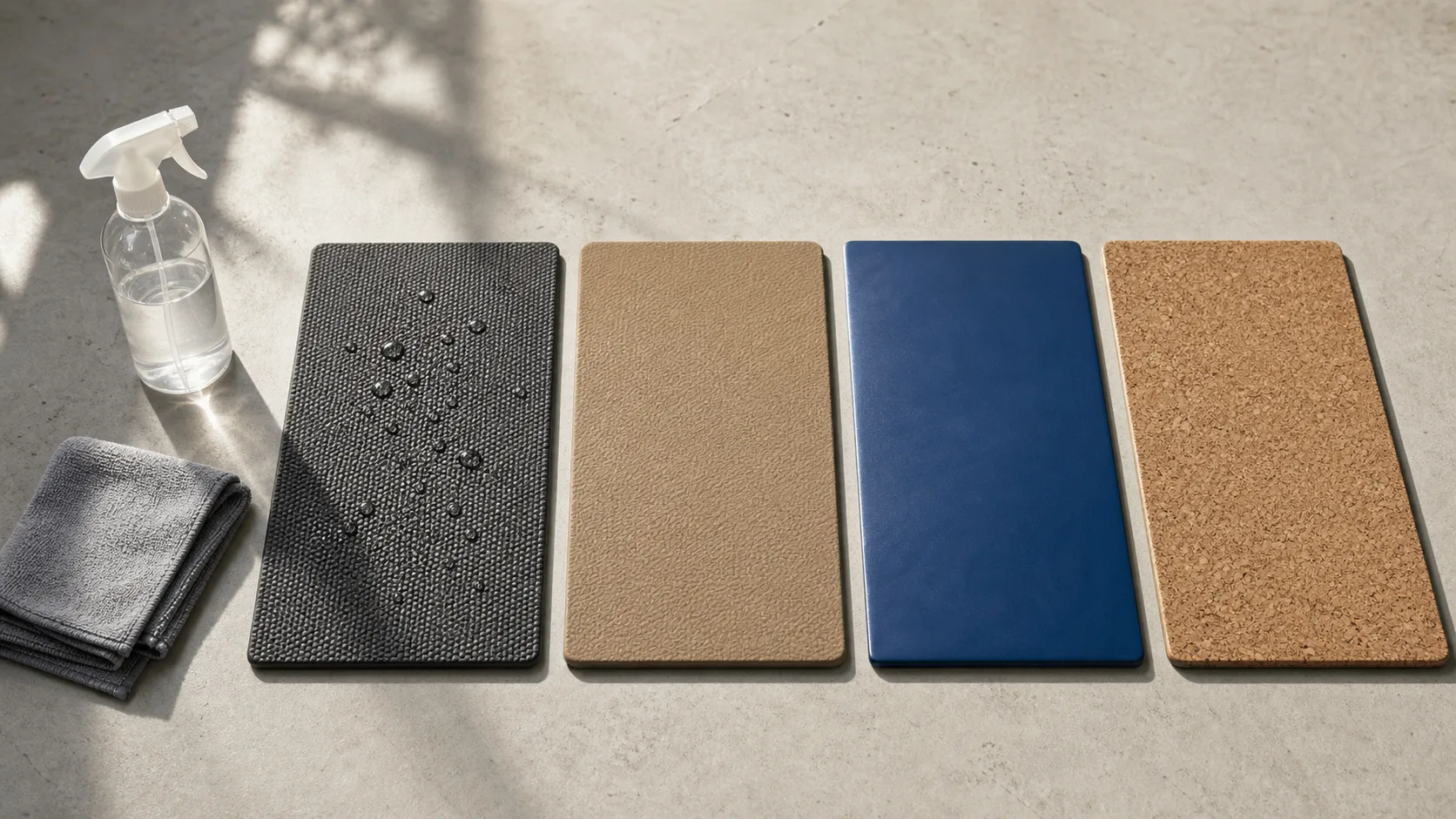
Closed-cell PVC
Closed-cell surfaces resist liquid penetration, so a controlled mist and wipe can remain at the surface. Manduka classifies its PRO range as closed-cell PVC and approves its Wash & Refresh across its own mat materials. Gaiam’s current PVC Here & Now mat instead gives two options: its Yoga Mat Wash or a damp cloth with cold water and mild detergent, followed by flat drying.
Those examples show why “PVC-safe” is still too broad. Surface texture, printed layers and maker-approved formulas differ. Check whether the cleaner needs a clean-water follow-up wipe and whether direct spraying is permitted.
Natural rubber
Natural rubber can react to harsh chemicals, solvents, excess water, oil and prolonged sunlight. Manduka’s eKO guidance says not to soak or submerge the mat, recommends Wash & Refresh for routine care and identifies a separate monthly Restore product. It also says not to use soap on that line.
That directly contradicts universal internet recipes. “Natural ingredients” do not automatically make a formula safe for natural rubber. A direct splash of essential oil is chemically and physically different from a finished product in which a solubilizer distributes a small amount through water.
Open-cell polyurethane practice surfaces
An open-cell top is designed to take up moisture during practice, which can improve wet grip but also makes saturation a concern. Many premium mats pair that top with a rubber base. Use the exact model’s instructions and the minimum liquid needed to lift soil.
Manduka’s GRP care information, for example, treats its open-cell construction differently from the PRO and eKO lines and warns against disinfectants. That is a product-specific restriction, not a claim about every polyurethane mat. It illustrates why one brand can require multiple care protocols.
TPE and other foams
TPE is a family of materials rather than one standardized recipe. Density, cell structure, surface film, pigments and laminated layers vary. Do not assume that every budget TPE mat can be rinsed or that a cleaner approved for PVC is interchangeable.
Look for an explicit material statement, application quantity and drying method. If all three are missing from both mat and cleaner documentation, plain controlled wiping under the mat maker’s guidance is a more defensible starting point than experimenting with fragrance or solvent.
Cork and fabric-faced mats
Cork is porous and commonly bonded to another material. Fabric-faced mats may include microfiber, adhesives and a rubber or polymer base. Both need construction-specific care, not the closed-cell assumption that liquid remains on top.
Check for colorfastness, adhesive restrictions and whether the maker permits direct misting. “Cork is naturally antimicrobial” is not a substitute for cleaning instructions and does not prove that a particular mat is disinfected.
Read the formula, not the front label
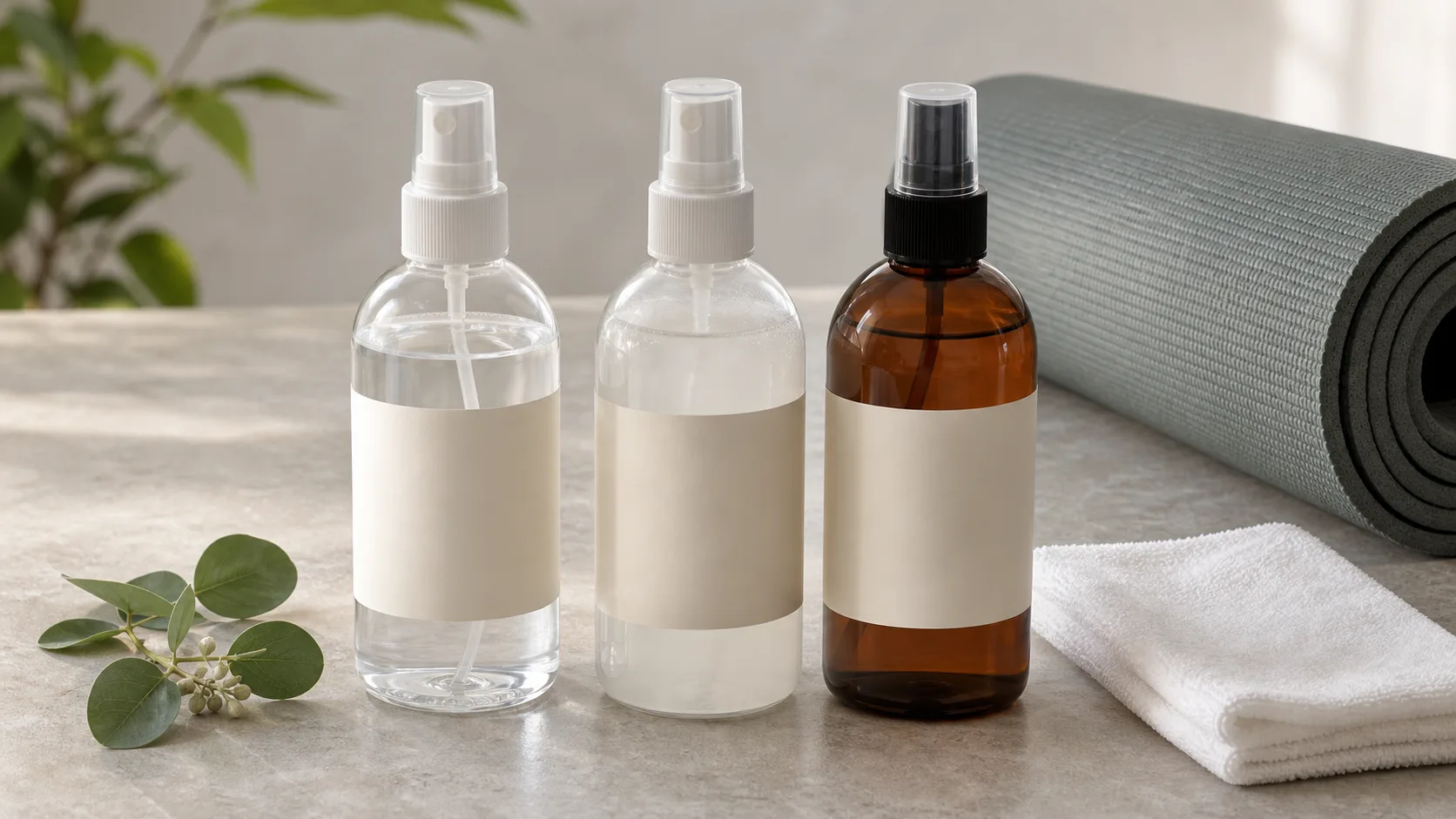
Water and cleaning system
Water may be the largest ingredient, but water alone does not explain performance. A finished spray may use a surfactant to loosen oils, a solubilizer to keep fragrance dispersed, a preservative to keep a water-based bottle stable, or alcohol for a defined purpose. Assess the complete formula and its intended surface.
Avoid reverse-engineering safety from one familiar ingredient. A mild ingredient at one concentration can behave differently at another concentration or in combination with oils, solvents and fragrance.
Fragrance and essential oils
Scent is optional, not evidence of cleanliness. A heavily fragranced bottle can be distracting in breath-focused practice, and fragrance-sensitive users may prefer a clearly labelled fragrance-free option. “Unscented” and “fragrance-free” can be different claims, so read the ingredient disclosure rather than relying on the bottle color.
Essential oils require the same scrutiny. Manduka explains that applying essential oil directly can make a mat slippery, while its Wash & Refresh uses a solubilizer to distribute the oil in its formulated product. Do not add extra drops to a finished cleaner; doing so changes the formula the compatibility statement covers.
Ingredients and claims to question
Pause when a product:
- says “safe for all mats” but does not name materials or models;
- hides its ingredients behind only “plant-based blend” or “proprietary fragrance”;
- says antibacterial, sanitizing or disinfecting without the applicable registration and full label directions;
- uses “chemical-free,” an impossible description of a physical product;
- implies essential oil guarantees germ control;
- promises “zero residue” without directions for dose, wiping and drying;
- calls packaging eco-friendly without identifying the material or end-of-life route;
- suggests that natural means hypoallergenic, pet-safe or universally rubber-safe.
This does not mean every simple formula is poor. It means the buyer needs enough information to connect the product to a real surface and a reproducible use method.
Bottle and sprayer design matter
A good formula can still be frustrating when the sprayer floods one patch and misses the next. Fine-mist pumps spread a small dose over a broad area. Trigger sprayers can move more liquid per pull and suit larger surfaces, but their output varies. Pump bottles may be intended for dispensing onto a cloth rather than spraying.
Compare:
- spray pattern: fine mist, narrow stream or uneven droplets;
- dose control: whether one pull releases a predictable amount;
- lock: useful in a gym bag, especially when the bottle is stored sideways;
- bottle material: compatible with the formula and protected from breakage;
- refill format: only valuable when the refill has clear dilution and container-cleaning directions;
- volume: enough for your practice frequency without sitting open for years;
- label durability: directions should remain readable around moisture.
Manduka currently offers 8 fl oz (237 ml) and 32 fl oz (946 ml) versions of Wash & Refresh. Larger volume is not automatically better value: estimate uses from the labelled dose, storage life and whether you clean one personal mat or a studio inventory.
Apply the product as directed
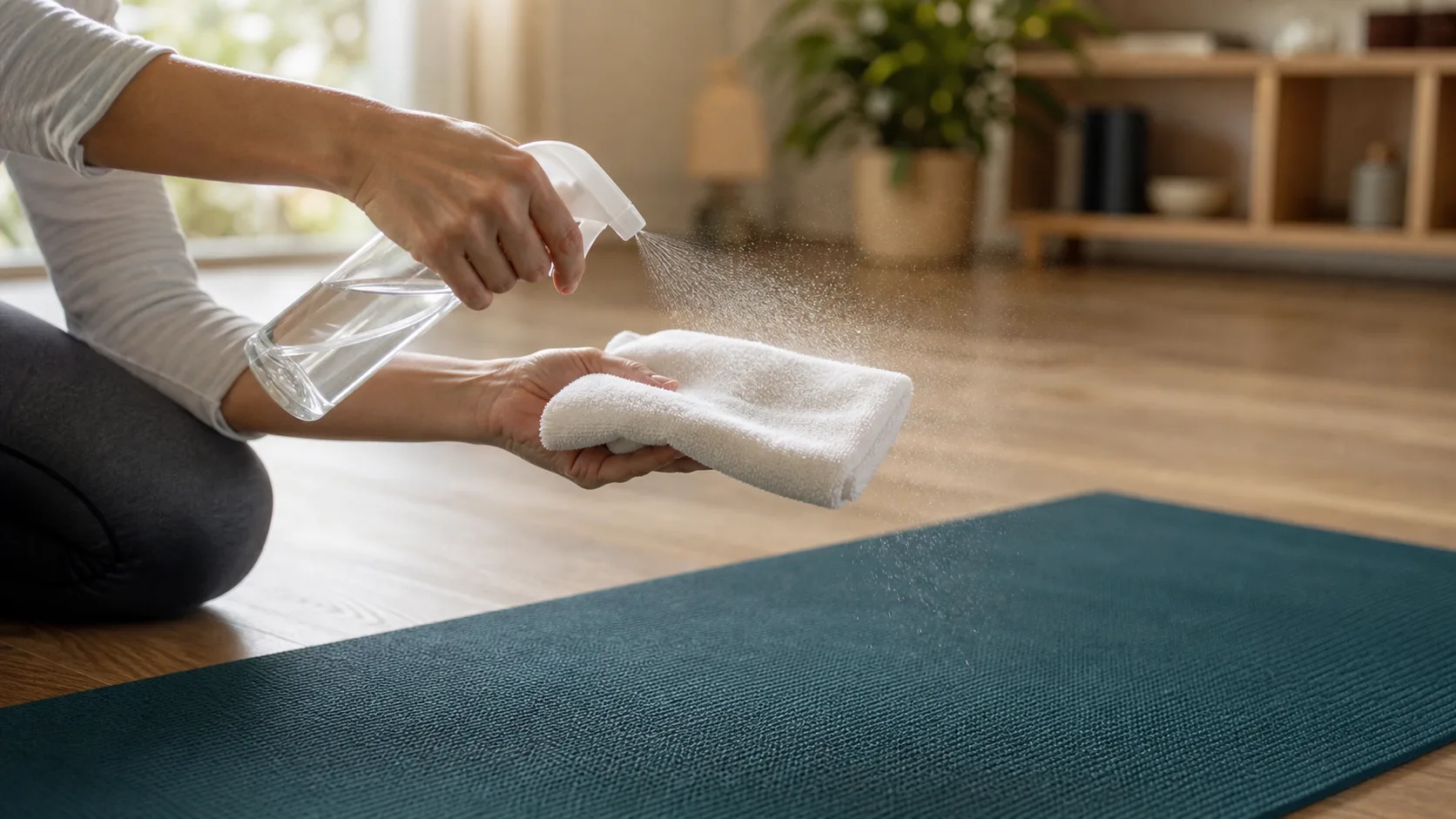
Before first use, identify the mat model and find its current instructions. Then read the entire cleaner label, including warnings and drying time. Ventilate the area if directed and keep the product away from children and pets according to its label.
A conservative sequence is:
- Remove loose grit so wiping does not grind it into the surface.
- Test an inconspicuous edge when the manufacturer recommends testing.
- Apply only the stated amount, either to the mat or cloth as directed.
- Wipe with the specified cloth and pressure; do not improvise abrasive scrubbing.
- Complete any required damp-cloth rinse pass.
- Let both surfaces dry fully in the permitted orientation and light conditions.
- Check for scent, discoloration, tackiness, shine or loss of grip before practice.
Manduka’s Wash & Refresh directions distinguish a routine spray-and-wipe from a more thorough refresh in which the surface is visibly wet, rests for one to two minutes, is gently scrubbed and dries before rolling or use. Those are directions for that product on the materials it approves—not a generic dwell time for every cleaner.
Do not spray a large wet patch merely to make the process feel thorough. More liquid can mean slower drying, deeper absorption and more residue without better cleaning.
Residue and grip check
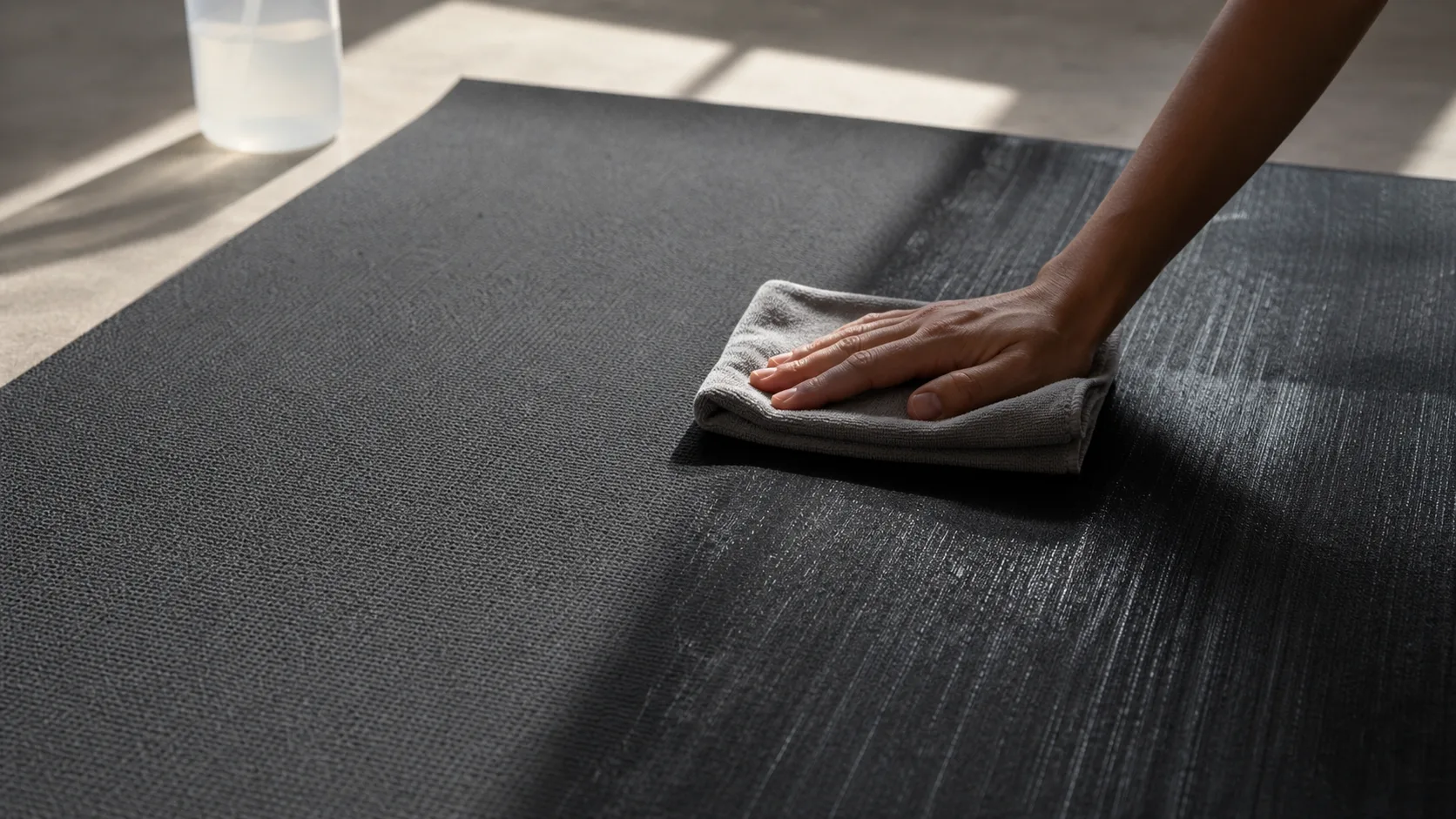
Never evaluate grip while the mat is still wet unless the mat is specifically designed and instructed for wet use. After the labelled drying period, place the mat on a stable floor and inspect it without beginning a demanding sequence.
Look across the surface in raking light. Compare an untreated area with the cleaned area for color shift, lifted print, edge curl, unusual shine or streaks. Touch lightly with clean, dry hands. If it feels oily, tacky, powdery or unusually slick, stop using the cleaner and consult the mat and cleaner makers before applying something else.
Do not “neutralize” residue with another household ingredient. Layering vinegar, soap, alcohol, essential oil and commercial cleaner makes the cause harder to identify and can worsen material damage. Follow only an approved clean-water removal step or the manufacturer’s recovery advice.
Shared mats and disinfecting claims
Cleaning removes soil; disinfection uses a product registered for claims against named microorganisms on named surfaces under precise conditions. A shared studio may need both, but the disinfectant must also be compatible with the mat.
For a US product, verify the EPA registration number against the EPA record and read the master label. Confirm that the relevant surface type is permitted and that the surface remains visibly wet for the full contact time. A spray wiped off immediately cannot satisfy a longer labelled contact time.
Then check the mat maker. If a mat prohibits disinfectant or cannot remain wet for the required time, do not assume the public-health goal overrides material chemistry or vice versa. The workable solution may be a different approved product, a washable barrier, assigned mats or retiring a surface that cannot support the required protocol.
This guide does not prescribe infection-control procedures. Studios, clinics and other regulated settings should build their protocol with the applicable public-health guidance, product label, mat manufacturer and local requirements.
Value and sustainability
Compare cost per compliant use rather than bottle price. You need the labelled dose or a defensible estimate of applications; “concentrated” has little meaning without a dilution ratio and finished volume.
Packaging claims also need detail. Manduka identifies HDPE packaging for its current spray and describes it as recyclable. Actual recyclability still depends on local acceptance, bottle preparation and whether the trigger must be separated. A refill can reduce packaging only when you reuse the original container safely and follow the correct dilution and labelling.
Avoid buying a large bottle for occasional use when the formula may age, separate or lose label legibility before it is finished. Keep the original label attached and do not transfer cleaner to a beverage bottle.
Buying checklist
Before checkout, answer all ten:
- What is the exact mat model and complete surface construction?
- Does the mat maker approve this product, formula type or cleaning method?
- Does the cleaner name compatible materials instead of saying only “all mats”?
- Are ingredients and fragrance status disclosed?
- Is it a cleaner, refresh, restore product or registered disinfectant?
- Are dose, wiping, contact and drying directions complete?
- Does the sprayer provide enough control for this surface?
- Are warnings, company details and batch information present?
- Can you buy a sensible volume for your actual cleaning frequency?
- Is there a clear path if the surface develops residue or discoloration?
Reject a product when compatibility depends on guesswork. A less glamorous cleaner with exact instructions is a better purchase than a beautifully scented bottle whose claims cannot be matched to your mat.
How this guide was researched
Product attributes are reported as manufacturer disclosures, not as our measurements. We did not rank cleaning performance because we have not run controlled soil-removal, surface-friction, residue, material-aging or microbiological tests.
The most important finding is the lack of a universal protocol. Manduka publishes different care logic for PRO, eKO and GRP constructions; Gaiam publishes a PVC mat method tied to its own wash or mild detergent; the EPA separates regulated disinfectant claims from ordinary cleaning language. Those differences are more useful than a list of affiliate bottles presented as interchangeable.
This URL owns commercial yoga-mat-cleaner selection, formula evaluation and compatibility. The existing how to clean a yoga mat guide owns cleaning routines and material-care workflow, preventing two pages from competing for the same reader job.
Further reading
- Learn the structural difference in open-cell vs closed-cell yoga mats.
- Use the model-specific routine for cleaning a Lululemon yoga mat.
- Compare material trade-offs in the natural-rubber yoga mat guide.
- Dry completely, then follow the yoga mat storage guide.
- Read our affiliate disclosure for how commercial recommendations are handled.
Have a cleaner label or compatibility instruction we should verify? Email hello@theyogasensei.com. Corrections are logged in the article review date.
Frequently asked questions
What is the best yoga mat cleaner spray?
There is no universal best spray. The right product is explicitly approved for the exact mat material, discloses its ingredients and directions, leaves no slick residue when used as directed, and makes only supportable cleaning or disinfecting claims.
Can I use a yoga mat cleaner spray on every mat?
No. Closed-cell PVC, natural rubber, open-cell polyurethane, TPE and cork can have different care restrictions. Follow the current instructions for the exact mat model; a spray described as safe for one brand or material is not automatically universal.
Does yoga mat spray disinfect a mat?
Not unless the product is legally marketed and labelled as a disinfectant for that surface and is used for the stated contact time. A refresh spray or cleaner can remove soil and odour without being a disinfectant.
Should I spray cleaner directly onto the mat or onto a cloth?
Follow the product and mat directions. Direct misting may be permitted on some closed-cell surfaces, while a controlled application to a cloth can reduce saturation on absorbent or sensitive surfaces. Never assume one method suits every mat.
Are essential oils safe in yoga mat cleaner?
Not universally. Concentrated or poorly dispersed oil can leave residue, affect grip or conflict with a mat maker’s care instructions. Fragrance can also be unwanted for sensitive users. Choose a compatible finished formula rather than adding oil to a bottle at random.