

In this guide
Walk into a big-box store or scroll Amazon for a first yoga mat and you will meet Gaiam almost immediately: cushioned, covered in a nice print, and cheap. For a beginner, that is a genuinely good combination — and the Gaiam Premium 6mm earns its place as one of the better budget mats you can buy. This review is about where that value is real, and the few places the low price quietly shows.
This is a research-and-specs review, not a paid lab test. I draw on Gaiam's published specs, hands-on testing from OutdoorGearLab and T3, and the themes that repeat across owner reviews — attributed where it matters, no invented scorecard or frozen price.
By Marvin Smit · Long-time practitioner, not a certified instructor.
The short verdict
Buy the Gaiam Premium 6mm if you are starting out, practise gentle-to-regular (not heated) classes, want real cushion under your joints, and like the idea of a stylish mat that does not cost much. For a first mat, it is hard to do better for the money. Skip it if you do hot yoga (it gets slippery), you are tall (it is shorter than standard at 68 inches), or you want a premium mat that performs at the top for a decade.
Check price on AmazonEverything below is the reasoning. If you are still deciding on thickness and material in general first, read how to choose a yoga mat and come back.
What you're actually buying
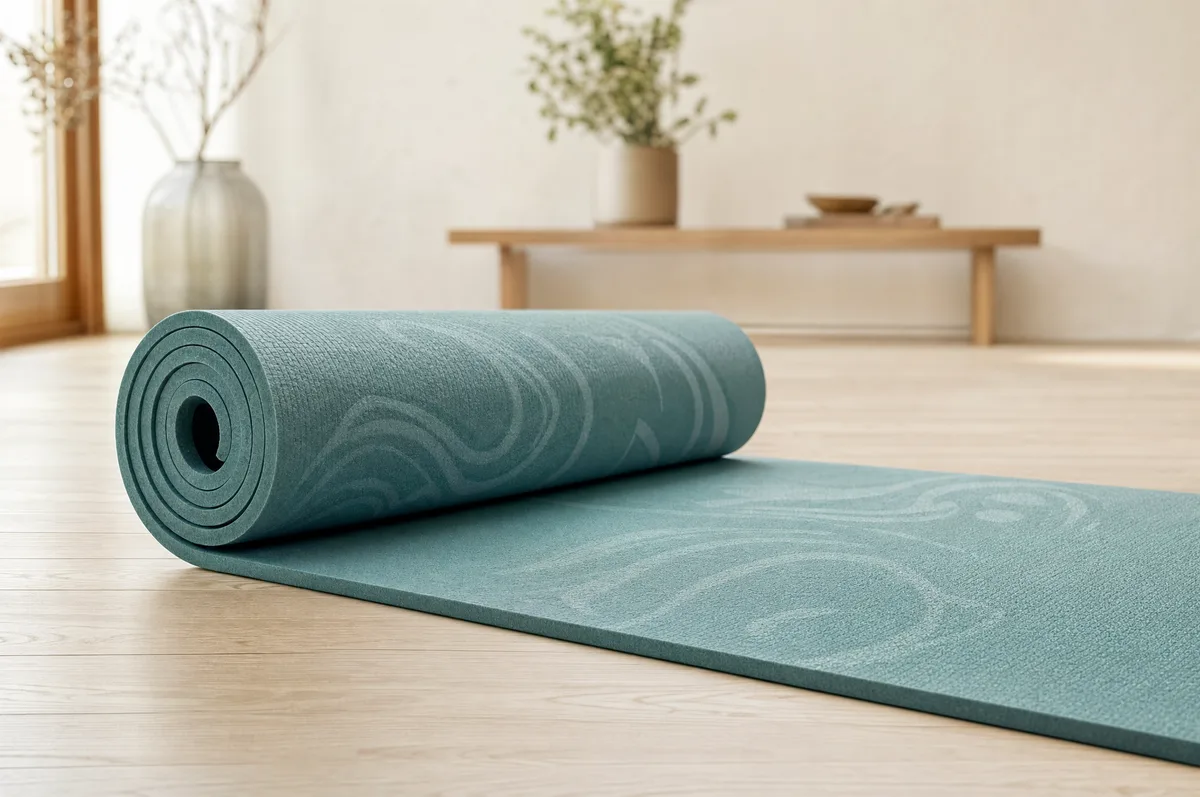
The mat most people mean by "the Gaiam yoga mat" is the Premium 6mm — the cushioned, printed PVC mat sold everywhere. Here are the specs that matter, from Gaiam's listings.
| Spec | Gaiam Premium 6mm |
|---|---|
| Thickness | 6mm |
| Dimensions | 68″ × 24″ (shorter than the 71–72″ standard) |
| Weight | ~4.5 lb |
| Material | PVC — latex-free and 6P-free (free of six common phthalates) |
| Surface | Textured "sticky" finish |
| Extras | Lifetime guarantee; wide range of prints |
The price usually lands around $25–30 depending on the design, which is the whole point — check the current figure on Gaiam's site or the retailer rather than trusting a number frozen into a review.
Why it works for beginners
The 6mm cushion is the real draw. It compresses just enough to take pressure off knees, wrists and elbows during longer holds, which is exactly what a newer practitioner — or anyone with sensitive joints — wants while the body adjusts. OutdoorGearLab and teacher-testers regularly flag it as one of the more comfortable budget options for that reason.
The other half is softer but real: the designs. A mat you find attractive is a mat you roll out, and for someone building a habit that matters more than spec sheets admit. Add a low price and a lifetime guarantee, and the risk of trying yoga on a Gaiam is about as low as it gets. If sore knees are your main concern, the cushion logic is unpacked further in the best yoga mat for bad knees guide.
The honest downsides
The low price shows in a few specific, predictable places.
- It gets slippery when you sweat. Grip is fine in a regular class, but the surface turns slick in heat or heavy sweat — noticeably more than mats built for it. This is not a hot-yoga mat; the best yoga mat for hot yoga guide covers what to use instead.
- It is short. At 68 inches, it is a few inches under the 71–72″ standard. Taller practitioners will find hands or feet running off the end in long poses.
- It smells at first. The printed PVC off-gases out of the wrap, sometimes strongly. Air it out for a few days before your first session; most owners say it fades, a few say it lingers.
- The cushion costs some stability. Six millimetres of soft PVC is forgiving but a little vague in standing balances. If balance is most of your practice, a firmer, thinner mat suits you better — see how thick a yoga mat should be.
- It is not a premium mat. Construction and long-term grip don't match a Manduka or Lululemon. That is the deal you are knowingly making for the price.
Cushion vs. stability
Illustrative
Material: 6P-free PVC, but check the label
Gaiam's Premium is PVC that is latex-free and 6P-free — free of the six phthalates most often flagged in cheap mats. That is a genuine step up from basic PVC and a fair reason to pick Gaiam over a no-name foam mat.
It is still PVC, though, and that comes with two honest notes.
Who should buy it — and who shouldn't
Buy it if you are new to yoga or practise casually, want cushion for your joints, like having a mat you find good-looking, and want to spend as little as sensibly possible. As a first mat, it is one of the easiest recommendations in the category.
Don't buy it if any of these are you:
- You do hot yoga or sweat heavily — it gets slippery.
- You are tall — 68 inches will feel short.
- You want a premium, decade-long mat — that is the Manduka or Lululemon tier, not this one.
- You react badly to mat off-gassing and can't air it out first.
How it compares
Think of the Gaiam Premium as the middle of the budget tier. Below it, an ultra-cheap foam mat like the Retrospec Solana gives more raw cushion for less money but a wobblier, less refined feel. Above it, the premium brands — the Manduka lineup and the Lululemon Reversible Mat — cost three to five times as much and earn it on grip, longevity and feel, not on looks. Gaiam's pitch is the sweet spot for starting out: enough mat to learn on, little enough money that it is an easy yes. When your practice outgrows it, the best yoga mats of 2026 shortlist is where to look next.
FAQ
Are Gaiam yoga mats good?
For beginners, casual practice and anyone on a budget, yes — the Gaiam Premium 6mm gives real cushion, attractive designs and a lifetime guarantee for around the price of a couple of class drop-ins. It is a weaker pick for hot yoga (it gets slippery when wet), for tall practitioners (it is 68 inches, shorter than standard), and for anyone wanting a premium, decade-long mat.
What is the Gaiam Premium yoga mat made of — is it toxic?
It is PVC that is latex-free and 6P-free, meaning free of the six phthalates most often flagged in cheap mats — a genuine step up from basic PVC. That said, like most PVC mats it still carries a California Proposition 65 warning. Prop 65 is a broad right-to-know labeling law, not proof of harm in normal use, but if you'd rather avoid it, a natural-rubber, cork or TPE mat sidesteps it.
Is the Gaiam yoga mat good for hot yoga?
No. The textured "sticky" surface grips fine in a regular class but turns slippery once you sweat, more so than many mats. For heated practice, you want a rubber or PU mat built for wet grip — or a towel on top at minimum.
Does the Gaiam yoga mat smell?
Often, yes, at first — the printed PVC mats release a strong odor out of the wrap. Gaiam says to unroll and air it out for two to three days, though some owners report it lingers longer. It fades, but plan to air it out before your first session.
How long does a Gaiam yoga mat last?
PVC is slow to degrade, and Gaiam backs the Premium with a lifetime guarantee; owners report three-plus years of regular use in good shape. It is more durable than cheap foam, though the surface grip and cushion soften before a premium mat would.
Is the Gaiam Premium good for beginners?
It is one of the best beginner picks. The 6mm cushion is forgiving on knees and wrists while you learn, the price is low, the designs make you want to roll it out, and the lifetime guarantee removes the risk. Just air out the smell first and skip it if your classes are heated.